Recognition: 2 theorem links
· Lean TheoremCharacterizing the Gamma-ray Emission from Low-Luminosity AGN
Pith reviewed 2026-05-10 19:37 UTC · model grok-4.3
The pith
Fermi LAT data show gamma-ray emission from low-luminosity AGN, with new individual detection and stacked subthreshold signal.
A machine-rendered reading of the paper's core claim, the machinery that carries it, and where it could break.
Core claim
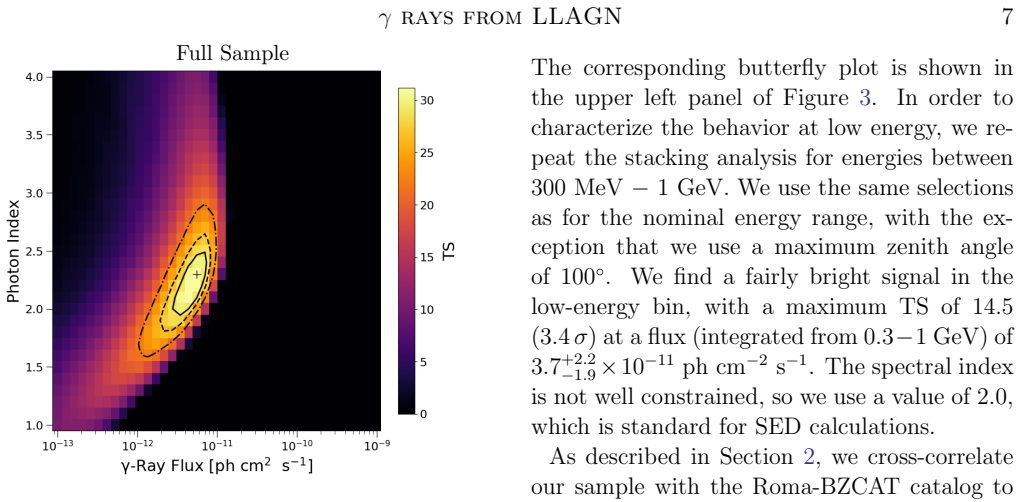
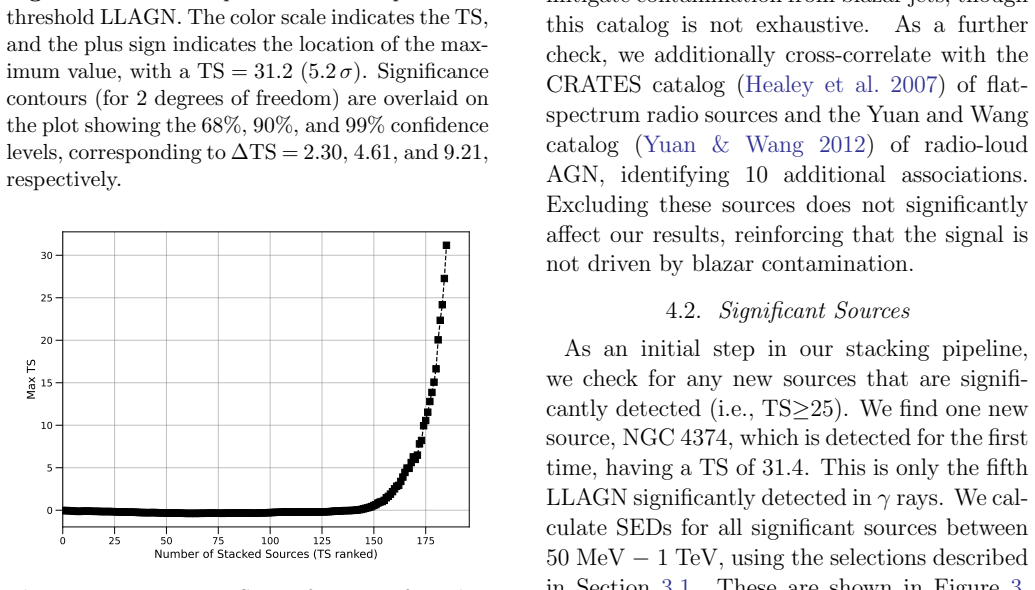
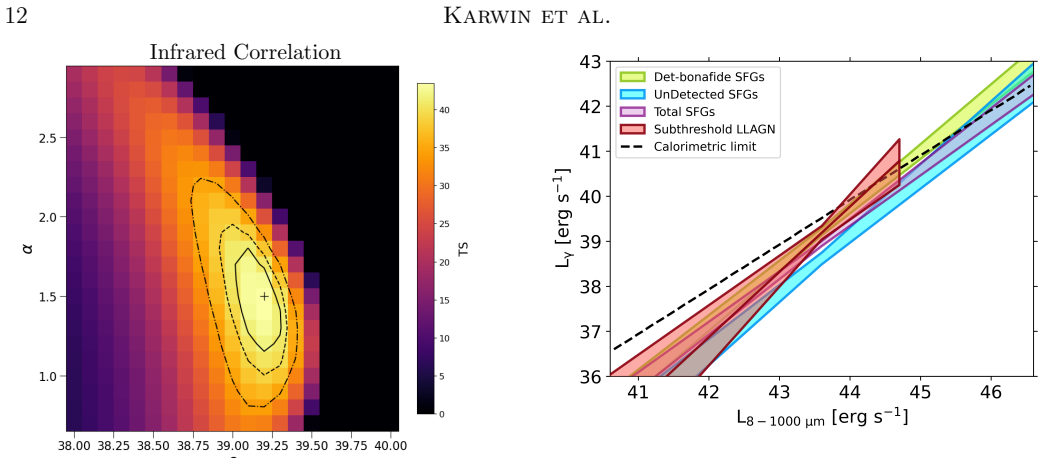
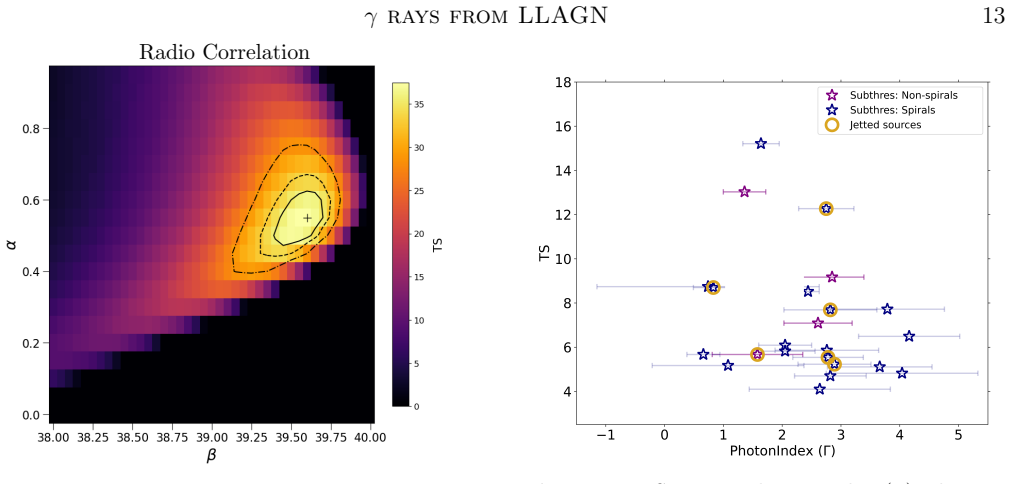
Our analysis results in a new detection of one LLAGN, as well as a detection of the subthreshold population using a stacking technique. We find that the signal from the subthreshold sample is consistent with being dominated by star-formation activity, although a contribution from compact jets or a mixed contribution from jetted and non-jetted systems is also feasible. On the other hand, the individually detected LLAGN are likely dominated by jet emission. We perform detailed spectral modeling for a subset of these sources and find that the gamma-ray signal can be explained by synchrotron self-Compton radiation, if the inner jet emission region is weakly magnetized with its total energy being
What carries the argument
Stacking technique for subthreshold Fermi-LAT sources combined with synchrotron self-Compton modeling of inner jet emission under conditions of weak magnetization and particle dominance.
If this is right
- Individually detected LLAGN produce gamma rays primarily through jet processes rather than accretion disks.
- The subthreshold LLAGN population contributes gamma rays consistent with star-formation activity in their host galaxies.
- Inner jets in LLAGN can be described as weakly magnetized, particle-dominated, and slowly moving to match the observed spectra.
- The released Python stacking library enables statistical studies of other faint source populations with LAT data.
Where Pith is reading between the lines
- LLAGN may contribute only modestly to the overall extragalactic gamma-ray background compared to brighter AGN.
- The stacking approach could be extended to search for hidden signals in other classes of faint high-energy sources.
- If jet emission proves common but often subthreshold, targeted deeper observations might resolve more individual LLAGN.
Load-bearing premise
The detected and stacked gamma-ray signals originate from the LLAGN targets rather than residual background, cosmic-ray interactions, or unrelated sources.
What would settle it
If higher-resolution multiwavelength follow-up shows that the gamma-ray positions or spectra do not match the modeled LLAGN locations and jet conditions.
Figures




read the original abstract
A majority of the active galactic nuclei (AGN) in the local Universe are classified as low-luminosity AGN (LLAGN), having bolometric luminosities $\lesssim 10^{42} \ \mathrm{erg \ s^{-1}}$. Although high-energy gamma-ray emission is predicted from both the jets and disks of LLAGN, to date only four have been detected by the Fermi Large Area Telescope (Fermi-LAT). In this work, we therefore conduct a comprehensive study of all the LLAGN from the Palomar spectroscopic survey of bright, northern galaxies, including both subthreshold and detected gamma-ray sources, using 14.4 years of LAT data. Our analysis results in a new detection of one LLAGN, as well as a detection of the subthreshold population using a stacking technique. We find that the signal from the subthreshold sample is consistent with being dominated by star-formation activity, although a contribution from compact jets or a mixed contribution from jetted and non-jetted systems is also feasible. On the other hand, the individually detected LLAGN are likely dominated by jet emission. We perform detailed spectral modeling for a subset of these sources and find that the gamma-ray signal can be explained by synchrotron self-Compton radiation, if the inner jet emission region is weakly magnetized with its total energy density being strongly particle dominated, and only slowly moving. With this work we also publicly release our Python-based stacking library for analyzing subthreshold source populations with the LAT, based on a proven technique used in numerous studies.
Editorial analysis
A structured set of objections, weighed in public.
Referee Report
Summary. The paper analyzes 14.4 years of Fermi-LAT data for LLAGN from the Palomar spectroscopic survey. It reports one new individual detection plus a stacked detection of the subthreshold population. The stacked signal is interpreted as consistent with star-formation activity in host galaxies (with possible jet contributions), while individually detected sources are attributed to jet emission. SSC spectral modeling for a subset implies weakly magnetized, particle-dominated, slowly moving inner jets. The work publicly releases a Python-based stacking library.
Significance. If the stacking correctly attributes the signal and the modeling is robust, the results would help distinguish jet versus star-formation origins of gamma rays in LLAGN and constrain jet parameters. The public release of the Python stacking library is a clear strength for reproducibility and future studies of subthreshold populations.
major comments (2)
- [Stacking analysis section] Stacking analysis section: the manuscript does not report control stacks on SFR-matched non-AGN galaxies, randomized-position null tests, or explicit per-host modeling of the expected star-formation gamma-ray contribution. These are required to demonstrate that the stacked signal originates from the LLAGN targets rather than residual background, diffuse emission, or host-galaxy cosmic-ray interactions, directly affecting the central claim about emission origins.
- [Methods and results sections] Methods and results sections: details on background subtraction, systematic uncertainties, and the precise stacking implementation (e.g., weighting, aperture, or likelihood treatment) are insufficient to allow verification of the new individual detection and the subthreshold population signal.
minor comments (2)
- [Abstract] Abstract: the phrase 'consistent with being dominated by star-formation activity' should be accompanied by a quantitative comparison to the expected SF flux rather than a qualitative statement.
- [Spectral modeling section] The spectral modeling paragraph would benefit from a table listing the best-fit parameters (magnetization, particle dominance, bulk motion) and their uncertainties for the modeled sources.
Simulated Author's Rebuttal
We thank the referee for their thorough review and constructive suggestions. Below we provide detailed responses to the major comments, indicating the revisions we will make to address them.
read point-by-point responses
-
Referee: [Stacking analysis section] Stacking analysis section: the manuscript does not report control stacks on SFR-matched non-AGN galaxies, randomized-position null tests, or explicit per-host modeling of the expected star-formation gamma-ray contribution. These are required to demonstrate that the stacked signal originates from the LLAGN targets rather than residual background, diffuse emission, or host-galaxy cosmic-ray interactions, directly affecting the central claim about emission origins.
Authors: We agree that these additional tests would strengthen the interpretation. In the revised version, we will include randomized-position null tests using the same stacking procedure to show that the signal is not an artifact of the analysis. For control stacks on SFR-matched non-AGN galaxies, we will select a sample from the Palomar survey or similar catalogs matched in SFR and distance, and perform the stack to compare. Regarding explicit per-host modeling, since individual sources are subthreshold, we instead use the average SFR of the sample and the established L_gamma-SFR relation to estimate the expected contribution, which matches the observed stacked flux within uncertainties. We will add this calculation explicitly. These additions will support rather than alter our conclusion that the signal is consistent with star-formation dominance. revision: yes
-
Referee: [Methods and results sections] Methods and results sections: details on background subtraction, systematic uncertainties, and the precise stacking implementation (e.g., weighting, aperture, or likelihood treatment) are insufficient to allow verification of the new individual detection and the subthreshold population signal.
Authors: We apologize for the insufficient detail in the current draft. The background subtraction follows the standard Fermi-LAT pipeline using the galactic diffuse emission model gll_iem_v07 and the isotropic template, with the ROI defined as 10 degrees around each source. Systematic uncertainties are assessed by repeating the analysis with alternative diffuse models and by varying the energy threshold. The stacking uses a joint likelihood approach where the flux of each source is tied in a weighted sum, with weights proportional to the expected signal-to-noise based on exposure time and source position. The aperture for the test statistic is 1 degree, and the likelihood is computed using the standard binned likelihood in the LAT analysis tools. These details are implemented in the publicly released Python library, which we will cite and describe more fully in a new methods subsection. We will also provide the exact parameters used for the new detection and the stack in the revised manuscript. revision: yes
Circularity Check
No significant circularity in observational data analysis
full rationale
The paper conducts standard Fermi-LAT data analysis for LLAGN sources, reporting one new individual detection and a stacking detection of the subthreshold population. Spectral modeling fits SSC emission to observed spectra under stated jet parameters (weak magnetization, particle dominance, slow motion). No equations, predictions, or uniqueness claims reduce by construction to fitted inputs, self-citations, or ansatzes; results are driven by external LAT observations and conventional astrophysical modeling. The released stacking library is a tool, not a load-bearing derivation. This is self-contained against external benchmarks.
Axiom & Free-Parameter Ledger
axioms (1)
- standard math Standard assumptions in Fermi-LAT source detection, background modeling, and stacking analysis hold for this dataset.
Lean theorems connected to this paper
-
IndisputableMonolith/Foundation/RealityFromDistinction.lean (and Cost/FunctionalEquation.lean)reality_from_one_distinction; washburn_uniqueness_aczel unclear?
unclearRelation between the paper passage and the cited Recognition theorem.
Our analysis results in a new detection of one LLAGN, as well as a detection of the subthreshold population using a stacking technique... The signal from the subthreshold sample is consistent with being dominated by star-formation activity... We perform detailed spectral modeling... synchrotron self-Compton radiation, if the inner jet emission region is weakly magnetized...
-
IndisputableMonolith/Foundation/Atomicity.lean; AlexanderDuality.leanatomic_tick; alexander_duality_circle_linking unclear?
unclearRelation between the paper passage and the cited Recognition theorem.
stacking technique... fermi-stacking library... 2D TS profiles... Lγ–LIR and Lγ–L15GHz correlations
What do these tags mean?
- matches
- The paper's claim is directly supported by a theorem in the formal canon.
- supports
- The theorem supports part of the paper's argument, but the paper may add assumptions or extra steps.
- extends
- The paper goes beyond the formal theorem; the theorem is a base layer rather than the whole result.
- uses
- The paper appears to rely on the theorem as machinery.
- contradicts
- The paper's claim conflicts with a theorem or certificate in the canon.
- unclear
- Pith found a possible connection, but the passage is too broad, indirect, or ambiguous to say the theorem truly supports the claim.
Reference graph
Works this paper leans on
-
[1]
, " * write output.state after.block = add.period write newline
ENTRY address archivePrefix author booktitle chapter doi edition editor eprint howpublished institution journal key month number organization pages publisher school series title misctitle type volume year version url label extra.label sort.label short.list INTEGERS output.state before.all mid.sentence after.sentence after.block FUNCTION init.state.consts ...
-
[2]
write newline
" write newline "" before.all 'output.state := FUNCTION format.url url empty "" new.block "" url * "" * if FUNCTION format.eprint eprint empty "" archivePrefix empty "" archivePrefix "arXiv" = new.block " " eprint * " " * new.block " " eprint * " " * if if if FUNCTION format.doi doi empty "" " " doi * " " * if FUNCTION format.pid doi empty eprint empty ur...
-
[3]
thebibliography [1] 20pt to REFERENCES 6pt =0pt -12pt 10pt plus 3pt =0pt =0pt =1pt plus 1pt =0pt =0pt -12pt =13pt plus 1pt =20pt =13pt plus 1pt \@M =10000 =-1.0em =0pt =0pt 0pt =0pt =1.0em @enumiv\@empty 10000 10000 `\.\@m \@noitemerr \@latex@warning Empty `thebibliography' environment \@ifnextchar \@reference \@latexerr Missing key on reference command E...
-
[4]
A., Ackermann , M., Ajello , M., et al
Abdo , A. A., Ackermann , M., Ajello , M., et al. 2009 a , ApJ, 707, 55, 10.1088/0004-637X/707/1/55
-
[5]
doi:10.1088/0004-637X/699/1/31 , eprint =
---. 2009 b , ApJ, 699, 31, 10.1088/0004-637X/699/1/31
-
[6]
2018, Science, 362, 1031, doi: 10.1126/science.aat8123
Abdollahi, S., et al. 2018, Sci, 362, 1031, 10.1126/science.aat8123
-
[7]
2020, ApJS, 247, 33, doi: 10.3847/1538-4365/ab6bcb
Abdollahi , S., Acero , F., Ackermann , M., et al. 2020, ApJS, 247, 33, 10.3847/1538-4365/ab6bcb
-
[8]
2022, ApJS, 260, 53, doi: 10.3847/1538-4365/ac6751
Abdollahi , S., Acero , F., Baldini , L., et al. 2022, , 260, 53, 10.3847/1538-4365/ac6751
-
[9]
2011, PhRvL, 107, 241302, 10.1103/PhysRevLett.107.241302
Ackermann , M., Ajello , M., Albert , A., et al. 2011, PhRvL, 107, 241302, 10.1103/PhysRevLett.107.241302
- [11]
-
[12]
Ajello , M., Mauro , M. D., Paliya , V. S., & Garrappa , S. 2020 c , ApJ, 894, 88, 10.3847/1538-4357/ab86a6
-
[13]
2021, ApJ, 921, 144, 10.3847/1538-4357/ac1bb2
Ajello , M., Baldini , L., Ballet , J., et al. 2021, ApJ, 921, 144, 10.3847/1538-4357/ac1bb2
-
[14]
Ram Pressure Stripping of Disc Galaxies: The Role of the Inclination Angle , shorttitle =
Allen , S. W., Dunn , R. J. H., Fabian , A. C., Taylor , G. B., & Reynolds , C. S. 2006, , 372, 21, 10.1111/j.1365-2966.2006.10778.x
-
[15]
Arnaud , K. A. 1996, in Astronomical Society of the Pacific Conference Series, Vol. 101, Astronomical Data Analysis Software and Systems V, ed. G. H. Jacoby & J. Barnes , 17
1996
-
[16]
Atwood , W., Albert , A., Baldini , L., et al. 2013, arXiv e-prints, arXiv:1303.3514, 10.48550/arXiv.1303.3514
-
[17]
Atwood , W. B., Abdo , A. A., Ackermann , M., et al. 2009, ApJ, 697, 1071, 10.1088/0004-637X/697/2/1071
-
[18]
Baldi , R. D. 2023, AAPR, 31, 3, 10.1007/s00159-023-00148-3
-
[19]
Baldi, R. D., et al. 2018, MNRAS, 476, 3478, 10.1093/mnras/sty342
-
[20]
Baldi , R. D., Williams , D. R. A., McHardy , I. M., et al. 2021, , 500, 4749, 10.1093/mnras/staa3519
-
[21]
2021, , 647, A67, 10.1051/0004-6361/202039612
Boccardi , B., Perucho , M., Casadio , C., et al. 2021, , 647, A67, 10.1051/0004-6361/202039612
-
[22]
Boizelle , B. D., Walsh , J. L., Barth , A. J., et al. 2021, , 908, 19, 10.3847/1538-4357/abd24d
-
[23]
2024, ApJL, 977, L16, 10.3847/2041-8213/ad93cf
Bronzini , E., Grandi , P., Torresi , E., & Buson , S. 2024, ApJL, 977, L16, 10.3847/2041-8213/ad93cf
-
[24]
Bruel , P., Burnett , T. H., Digel , S. W., et al. 2018, arXiv e-prints, arXiv:1810.11394, 10.48550/arXiv.1810.11394
-
[25]
2024, ApJL, 971, L45, 10.3847/2041-8213/ad5e6d
Cao , Z., Aharonian , F., Axikegu , et al. 2024, ApJL, 971, L45, 10.3847/2041-8213/ad5e6d
-
[26]
Celotti , A., & Ghisellini , G. 2008, MNRAS, 385, 283, 10.1111/j.1365-2966.2007.12758.x
-
[27]
Davis , S. W., & Laor , A. 2011, ApJ, 728, 98, 10.1088/0004-637X/728/2/98
-
[28]
de Menezes, R., Nemmen, R., Finke, J. D., Almeida, I., & Rani, B. 2020, MNRAS, 492, 4120, 10.1093/mnras/staa083
-
[29]
De Young , D. S. 2006, ApJ, 648, 200, 10.1086/505861
-
[30]
Delvecchio , I., Daddi , E., Sargent , M. T., et al. 2021, , 647, A123, 10.1051/0004-6361/202039647
-
[31]
2014, ApJ, 780, 161, 10.1088/0004-637X/780/2/161
Di Mauro, M., Calore, F., Donato, F., Ajello, M., & Latronico, L. 2014, ApJ, 780, 161, 10.1088/0004-637X/780/2/161
- [32]
-
[33]
Healey , S. E., Romani , R. W., Taylor , G. B., et al. 2007, ApJS, 171, 61, 10.1086/513742
-
[34]
Helou , G., & Walker , D. W., eds. 1988, Infrared Astronomical Satellite (IRAS) Catalogs and Atlases.Volume 7: The Small Scale Structure Catalog. , Vol. 7
1988
-
[35]
Ho, L. C. 2008, ARA&A, 46, 475, 10.1146/annurev.astro.45.051806.110546
-
[36]
Ho , L. C. 2009, ApJ, 699, 626, 10.1088/0004-637X/699/1/626
-
[37]
Ho , L. C., Filippenko , A. V., & Sargent , W. L. 1995, ApJS, 98, 477, 10.1086/192170
-
[38]
C., Filippenko, A
Ho, L. C., Filippenko, A. V., & Sargent, W. L. 2003, ApJ, 583, 159
2003
-
[39]
Ho , L. C., Filippenko , A. V., & Sargent , W. L. W. 1997 a , ApJS, 112, 315, 10.1086/313041
-
[40]
1997 b , ApJ, 487, 568, 10.1086/304638
---. 1997 b , ApJ, 487, 568, 10.1086/304638
-
[41]
Ho, L. C., Filippenko, A. V., Sargent, W. L. W., & Peng, C. Y. 1997, ApJS, 112, 391, 10.1086/313042
-
[42]
Ho , L. C., Greene , J. E., Filippenko , A. V., & Sargent , W. L. W. 2009, ApJS, 183, 1, 10.1088/0067-0049/183/1/1
-
[43]
2011, , 733, 66, 10.1088/0004-637X/733/1/66
Inoue , Y. 2011, , 733, 66, 10.1088/0004-637X/733/1/66
-
[44]
Karwin , C. M., & Ajello , M. 2025, fermi-stacking, v0.1.7, Zenodo, 10.5281/zenodo.15485037
-
[45]
S., Boughelilba , M., Karwin , C
Khatiya , N. S., Boughelilba , M., Karwin , C. M., et al. 2024, ApJ, 971, 84, 10.3847/1538-4357/ad534c
-
[46]
2023, , 943, 168, 10.3847/1538-4357/acaf57
McDaniel , A., Ajello , M., & Karwin , C. 2023, , 943, 168, 10.3847/1538-4357/acaf57
-
[47]
McDaniel , A., Ajello , M., Karwin , C. M., et al. 2024, PRD, 109, 063024, 10.1103/PhysRevD.109.063024
-
[48]
Murase , K., Karwin , C. M., Kimura , S. S., Ajello , M., & Buson , S. 2024, , 961, L34, 10.3847/2041-8213/ad19c5
-
[49]
Nagar , N. M., Falcke , H., & Wilson , A. S. 2005, , 435, 521, 10.1051/0004-6361:20042277
-
[50]
2019, NASA/IPAC Extragalactic Database (NED), IPAC, 10.26132/NED1
NED . 2019, NASA/IPAC Extragalactic Database (NED), IPAC, 10.26132/NED1
-
[51]
S., Dominguez, A., Ajello, M., Franckowiak, A., & Hartmann, D
Paliya, V. S., Dominguez, A., Ajello, M., Franckowiak, A., & Hartmann, D. 2019, ApJ, 882, L3
2019
-
[52]
2021, , 909, 76, 10.3847/1538-4357/abd6ee
Park , J., Hada , K., Nakamura , M., et al. 2021, , 909, 76, 10.3847/1538-4357/abd6ee
- [53]
-
[54]
2022, , 664, A166, 10.1051/0004-6361/202243958
Ricci , L., Boccardi , B., Nokhrina , E., et al. 2022, , 664, A166, 10.1051/0004-6361/202243958
-
[55]
Ruffa , I., Davis , T. A., Cappellari , M., et al. 2023, , 522, 6170, 10.1093/mnras/stad1119
-
[56]
Saikia, P., K\"ording, E., Coppejans, D. L., et al. 2018, A&A, 616, A152, 10.1051/0004-6361/201833233
-
[57]
2015, MNRAS, 450, 2317, 10.1093/mnras/stv731
Saikia, P., K\"ording, E., & Falcke, H. 2015, MNRAS, 450, 2317, 10.1093/mnras/stv731
-
[58]
2003, ApJ, 597, 186, 10.1086/378290
Stawarz , ., Sikora , M., & Ostrowski , M. 2003, ApJ, 597, 186, 10.1086/378290
-
[59]
Stecker , F. W., Shrader , C. R., & Malkan , M. A. 2019, , 879, 68, 10.3847/1538-4357/ab23ee
-
[60]
Verdoes Kleijn , G. A., Baum , S. A., de Zeeuw , P. T., & O'Dea , C. P. 1999, , 118, 2592, 10.1086/301135
-
[61]
Walsh , J. L., Barth , A. J., & Sarzi , M. 2010, , 721, 762, 10.1088/0004-637X/721/1/762
-
[62]
2022, , 941, 140, 10.3847/1538-4357/aca27b
Wang , X., Jiang , W., Shen , Z., et al. 2022, , 941, 140, 10.3847/1538-4357/aca27b
-
[63]
Worrall , D. M., Birkinshaw , M., O'Sullivan , E., et al. 2010, MNRAS, 408, 701, 10.1111/j.1365-2966.2010.17162.x
-
[64]
Yan , X., Lu , R.-S., Jiang , W., Krichbaum , T. P., & Shen , Z.-Q. 2023, , 957, 32, 10.3847/1538-4357/acf8c1
-
[65]
2012, ApJ, 744, 84, 10.1088/0004-637X/744/2/84
Yuan , Z., & Wang , J. 2012, ApJ, 744, 84, 10.1088/0004-637X/744/2/84
discussion (0)
Sign in with ORCID, Apple, or X to comment. Anyone can read and Pith papers without signing in.