Recognition: 2 theorem links
· Lean TheoremReal-time Dynamics in 3D for up to 1000 Qubits with Neural Quantum States: Quenches and the Quantum Kibble--Zurek Mechanism
Pith reviewed 2026-05-10 19:44 UTC · model grok-4.3
The pith
Neural quantum states simulate 3D dynamics up to 1000 qubits and confirm the quantum Kibble-Zurek mechanism
A machine-rendered reading of the paper's core claim, the machinery that carries it, and where it could break.
Core claim
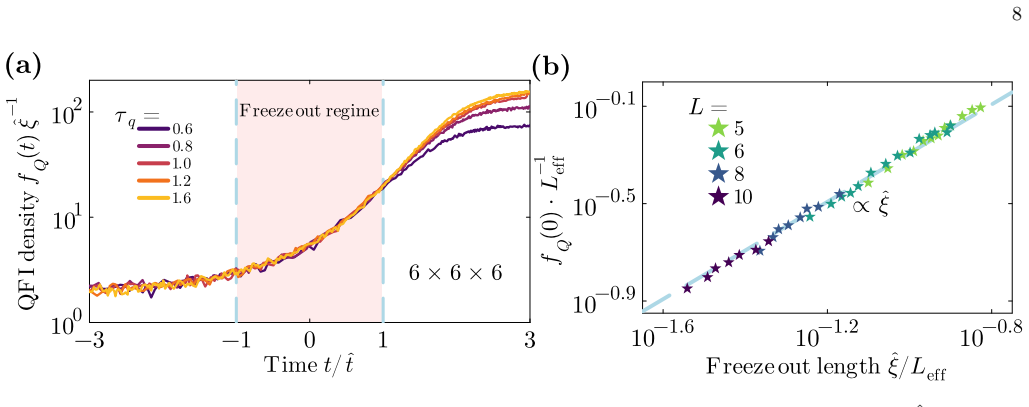
The residual-based convolutional neural quantum state provides a variational representation of the many-body wave function that reliably captures real-time dynamics in the 3D transverse-field Ising model on lattices up to 1000 qubits. For finite-rate quenches to the critical point, incorporating logarithmic corrections from renormalization-group flow equations produces data collapse for the correlation function, excess energy, and quantum Fisher information, with agreement to the expected scaling dimensions of the 3D quantum Kibble-Zurek mechanism.
What carries the argument
Residual-based convolutional neural quantum state architecture on cubic spin lattices, which variationally approximates the time-evolved wave function to enable dynamics simulations where entanglement grows rapidly.
If this is right
- NQS can now be applied to explore other nonequilibrium phenomena in 3D quantum systems at large scales.
- The quantum Fisher information accesses universal multipartite entanglement dynamics during critical quenches.
- Logarithmic corrections must be accounted for when analyzing scaling at the upper critical dimension.
- Distinct regimes such as collapse-and-revival dynamics are accessible with the same framework.
Where Pith is reading between the lines
- The convolutional architecture may generalize to other 3D lattice models or geometries for broader critical dynamics studies.
- These large-scale results could provide benchmarks for experimental 3D quantum simulators once such devices reach comparable sizes.
- Further refinements might permit longer evolution times or larger lattices to investigate additional nonequilibrium effects.
Load-bearing premise
The neural quantum state maintains controlled variational accuracy for the time-evolved wave function during quenches to the critical point despite rapid entanglement growth.
What would settle it
Absence of data collapse across system sizes when the observables are rescaled with the derived forms that include logarithmic corrections, or mismatch between simulated values and the predicted scaling dimensions, would show that the representation fails to capture the dynamics.
Figures




read the original abstract
Exponential complexity of many-body wave functions limits accurate numerical simulations of real-time dynamics, especially beyond 1D, where rapid entanglement growth poses severe challenges. Neural Quantum States (NQS) have emerged as a powerful approach for real-time dynamics in 2D, but their scalability and accuracy in 3D have remained an open challenge. Here, we establish NQS as a scalable framework for 3D quantum dynamics by introducing a residual-based convolutional architecture tailored to cubic spin lattices. Focusing on the 3D transverse-field Ising model, we demonstrate that NQS reliably capture distinct quench regimes, including collapse-and-revival dynamics and, most challengingly, the dynamics following a sudden quench to the quantum critical point. We perform finite-rate quenches to the critical point on lattices containing up to $1000$ qubits, an unprecedented system size for numerical simulations of real-time dynamics beyond 1D. This enables the first large-scale numerical demonstration of the 3D quantum Kibble--Zurek mechanism. The QKZM in 3D is particularly intriguing because it lies at the upper critical dimension of the Ising universality class, where the standard power laws are modified by logarithmic factors together with prominent sub-leading logarithmic corrections. By deriving these corrections from renormalization-group flow equations up to two-loop order, we obtain a robust data collapse across all simulated system sizes for the correlation function, the excess energy, and the quantum Fisher information, the latter revealing universal multipartite-entanglement dynamics. In all cases, we find compelling agreement with the expected scaling dimensions. Our findings establish NQS as a scalable and reliable tool for exploring nonequilibrium phenomena in 3D quantum matter and for providing numerical benchmarks for 3D quantum simulators.
Editorial analysis
A structured set of objections, weighed in public.
Referee Report
Summary. The manuscript introduces a residual convolutional Neural Quantum State (NQS) architecture for real-time dynamics of the 3D transverse-field Ising model. It simulates quenches on lattices up to 1000 qubits, captures collapse-and-revival and critical-quench regimes, and provides the first large-scale numerical demonstration of the 3D quantum Kibble-Zurek mechanism. Logarithmic corrections to scaling (derived from two-loop RG flow equations) are tested via data collapse of the correlation function, excess energy, and quantum Fisher information, yielding agreement with expected scaling dimensions.
Significance. If the variational accuracy is confirmed, the work establishes NQS as a scalable tool for 3D nonequilibrium quantum dynamics at sizes far beyond prior reach. It supplies the first numerical test of QKZM at the upper critical dimension of the Ising class, where logarithmic corrections dominate, and generates concrete benchmarks for quantum simulators. The RG-derived corrections and cross-quantity data collapse constitute a strong, falsifiable prediction that the numerics can validate.
major comments (1)
- [Results section on QKZM data collapse] The central claim that the residual convolutional NQS yields a faithful representation of the time-evolved state up to 1000 qubits (enabling the reported data collapse) is load-bearing but lacks quantitative support. No energy-variance bounds, infidelity estimates, or convergence diagnostics are supplied for the largest lattices, nor are direct comparisons to exact results shown for intermediate sizes to demonstrate that variational bias remains controlled during critical quenches where entanglement grows rapidly.
Simulated Author's Rebuttal
We thank the referee for their careful reading and constructive feedback on our manuscript. We address the major comment regarding quantitative validation of the NQS accuracy below, and commit to revisions that strengthen this aspect without altering the core claims.
read point-by-point responses
-
Referee: [Results section on QKZM data collapse] The central claim that the residual convolutional NQS yields a faithful representation of the time-evolved state up to 1000 qubits (enabling the reported data collapse) is load-bearing but lacks quantitative support. No energy-variance bounds, infidelity estimates, or convergence diagnostics are supplied for the largest lattices, nor are direct comparisons to exact results shown for intermediate sizes to demonstrate that variational bias remains controlled during critical quenches where entanglement grows rapidly.
Authors: We agree that the original manuscript would benefit from explicit diagnostics to support the variational fidelity claim. While exact infidelity is inaccessible for lattices beyond small sizes due to exponential complexity, we monitored the energy variance throughout training and time evolution for all system sizes up to 1000 qubits; these variances converge to low, stable values consistent with the observed dynamics. For intermediate sizes (up to 4x4x4 = 64 sites), we have additional benchmarks against exact diagonalization and matrix-product-state simulations that confirm the NQS reproduces collapse-and-revival features and critical-quench observables with controlled deviations. The multi-observable data collapse itself across system sizes serves as a strong consistency check against uncontrolled bias. In the revised manuscript we will add (i) energy-variance time series for representative large lattices, (ii) direct small-system comparisons, and (iii) a brief discussion of training convergence criteria. revision: yes
Circularity Check
No significant circularity; RG-derived scalings tested by independent NQS numerics
full rationale
The paper derives the two-loop logarithmic corrections to the 3D Ising QKZM scaling from standard renormalization-group flow equations, independent of any simulation data. These predictions are then confronted with NQS-generated observables (correlation function, excess energy, QFI) via data collapse across system sizes up to 1000 qubits. No step reduces a claimed prediction to a fitted parameter, self-definition, or load-bearing self-citation; the NQS architecture and variational accuracy are presented as numerical tools whose fidelity is assessed by agreement with the external RG theory rather than by construction.
Axiom & Free-Parameter Ledger
axioms (1)
- standard math Renormalization-group flow equations for the Ising universality class up to two-loop order
Lean theorems connected to this paper
-
IndisputableMonolith/Foundation/AlexanderDuality.leanalexander_duality_circle_linking (D=3 forcing) unclear?
unclearRelation between the paper passage and the cited Recognition theorem.
We establish NQS as a scalable framework for 3D quantum dynamics by introducing a residual-based convolutional architecture tailored to cubic spin lattices... first large-scale numerical demonstration of the 3D quantum Kibble–Zurek mechanism... at the upper critical dimension d+z=4
-
IndisputableMonolith/Cost/FunctionalEquation.leanwashburn_uniqueness_aczel (J-cost uniqueness) unclear?
unclearRelation between the paper passage and the cited Recognition theorem.
By deriving these corrections from renormalization-group flow equations up to two-loop order, we obtain a robust data collapse... for the correlation function, the excess energy, and the quantum Fisher information
What do these tags mean?
- matches
- The paper's claim is directly supported by a theorem in the formal canon.
- supports
- The theorem supports part of the paper's argument, but the paper may add assumptions or extra steps.
- extends
- The paper goes beyond the formal theorem; the theorem is a base layer rather than the whole result.
- uses
- The paper appears to rely on the theorem as machinery.
- contradicts
- The paper's claim conflicts with a theorem or certificate in the canon.
- unclear
- Pith found a possible connection, but the passage is too broad, indirect, or ambiguous to say the theorem truly supports the claim.
Reference graph
Works this paper leans on
-
[1]
Collapse-and-revival dynamics To assess the numerical reliability of the NQS approach in the collapse-and-revival regime, we study the conver- gence of the dynamics with increasing network depthn. Figure 6 shows results for a 5×5×5 lattice for three ob- servables: the transverse magnetization⟨σ x i (t)⟩, the lon- gitudinal magnetization⟨σ z i (t)⟩, and th...
-
[2]
Figure 7 compares results on a 6×6×6 lattice obtained with network depthsn= 3 andn= 4
A sudden quench to the critical point We next examine the convergence of the NQS dynam- ics following a sudden quench to the quantum critical point. Figure 7 compares results on a 6×6×6 lattice obtained with network depthsn= 3 andn= 4. We analyze the time evolution of the transverse magnetiza- tion⟨σ x i (t)⟩, the correlation function⟨σ z 0σz d⟩ − ⟨σ z 0⟩...
-
[3]
We use network depthn= 3 for most simulations, except forL= 5, where we usen= 2
Finite-rate quenches – QKZM For the finite-rate quenches discussed in the main text, we consider system sizes fromL= 5 toL= 10. We use network depthn= 3 for most simulations, except forL= 5, where we usen= 2. The time evolution is performed fromt=−1.5τ q tot= 0, witht= 0 mark- ing the point at which the ramp reaches criticality. We consider quench times i...
-
[4]
Polkovnikov, K
A. Polkovnikov, K. Sengupta, A. Silva, and M. Vengalat- tore, Colloquium: Nonequilibrium dynamics of closed in- teracting quantum systems, Rev. Mod. Phys.83, 863 (2011)
2011
-
[5]
D’Alessio, Y
L. D’Alessio, Y. Kafri, A. Polkovnikov, and M. Rigol, From quantum chaos and eigenstate thermalization to statistical mechanics and thermodynamics, Advances in Physics65, 239 (2016)
2016
-
[6]
Dziarmaga, Dynamics of a quantum phase transition and relaxation to a steady state, Advances in Physics59, 1063 (2010)
J. Dziarmaga, Dynamics of a quantum phase transition and relaxation to a steady state, Advances in Physics59, 1063 (2010)
2010
-
[7]
A. J. Bray, Theory of phase-ordering kinetics, Advances in Physics43, 357 (1994)
1994
-
[8]
E. H. Lieb and D. W. Robinson, The finite group velocity of quantum spin systems, Commun. Math. Phys.28, 251 (1972)
1972
-
[9]
Calabrese and J
P. Calabrese and J. Cardy, Evolution of entanglement en- tropy in one-dimensional systems, J. Stat. Mech. , P04010 (2005)
2005
-
[10]
Bertini, M
B. Bertini, M. Collura, J. De Nardis, and M. Fagotti, Transport in out-of-equilibrium XXZ chains: Exact pro- files of charges and currents, Phys. Rev. Lett.117, 207201 (2016)
2016
-
[11]
Doyon, Hydrodynamics of integrable systems, Annu
B. Doyon, Hydrodynamics of integrable systems, Annu. Rev. Condens. Matter Phys.11, 239 (2020)
2020
-
[12]
I. M. Georgescu, S. Ashhab, and F. Nori, Quantum sim- ulation, Rev. Mod. Phys.86, 153 (2014)
2014
-
[13]
Labuhn, D
H. Labuhn, D. Barredo, S. Ravets, S. de L´ es´ eleuc, T. Macr` ı, T. Lahaye, and A. Browaeys, Tunable two- dimensional arrays of single Rydberg atoms for realizing quantum Ising models, Nature534, 667 (2016)
2016
-
[14]
Bernien, S
H. Bernien, S. Schwartz, A. Keesling, H. Levine, A. Om- ran, H. Pichler, S. Choi, A. S. Zibrov, M. Endres, M. Greiner, V. Vuleti´ c, and M. D. Lukin, Probing many- body dynamics on a 51-atom quantum simulator, Nature 551, 579 (2017)
2017
-
[15]
Ebadi, T
S. Ebadi, T. T. Wang, H. Levine, A. Keesling, G. Se- meghini, A. Omran, D. Bluvstein, R. Samajdar, H. Pich- ler, W. W. Ho, S. Sachdev, and M. D. Lukin, Quantum phases of matter on a 256-atom programmable quantum simulator, Nature595, 227 (2021)
2021
-
[16]
Gross and I
C. Gross and I. Bloch, Quantum simulations with ultra- cold atoms in optical lattices, Science357, 995 (2017)
2017
-
[17]
Blatt and C
R. Blatt and C. F. Roos, Quantum simulations with trapped ions, Nat. Phys.8, 277 (2012)
2012
-
[18]
J. W. Britton, B. C. Sawyer, A. C. Keith, C.-C. J. Wang, J. K. Freericks, H. Uys, M. J. Biercuk, and J. J. Bollinger, Engineered two-dimensional Ising interactions in a trapped-ion quantum simulator with hundreds of spins, Nature484, 489 (2012)
2012
-
[19]
Zhang, P
J. Zhang, P. W. Hess, A. Kyprianidis, P. Becker, A. Lee, J. Smith, G. Pagano, I.-D. Potirniche, A. C. Potter, A. Vishwanath, and C. Monroe, Observation of a many- body dynamical phase transition with a 53-qubit quan- tum simulator, Nature551, 601 (2017)
2017
-
[20]
A. A. Houck, H. E. T¨ ureci, and J. Koch, On-chip quan- tum simulation with superconducting circuits, Nature Phys.8, 292 (2012)
2012
-
[21]
Yan, Y.-R
Z. Yan, Y.-R. Zhang, M. Gong, Y. Wu, Y. Zheng, S. Li, C. Wang, F. Liang, J. Lin, Y. Xu,et al., Strongly cor- related quantum walks with a 12-qubit superconducting processor, Science364, 753 (2019)
2019
-
[22]
Bloch, J
I. Bloch, J. Dalibard, and W. Zwerger, Many-body physics with ultracold gases, Rev. Mod. Phys.80, 885 (2008)
2008
-
[23]
Bloch, J
I. Bloch, J. Dalibard, and S. Nascimb` ene, Quantum sim- ulations with ultracold quantum gases, Nat. Phys.8, 267 (2012)
2012
-
[24]
Greiner, O
M. Greiner, O. Mandel, T. W. H¨ ansch, and I. Bloch, Collapse and revival of the matter wave field of a bose– einstein condensate, Nature419, 51 (2002)
2002
-
[25]
Kinoshita, T
T. Kinoshita, T. Wenger, and D. S. Weiss, A quantum newton’s cradle, Nature440, 900 (2006)
2006
-
[26]
Vidal, Efficient simulation of one-dimensional quan- tum many-body systems, Phys
G. Vidal, Efficient simulation of one-dimensional quan- tum many-body systems, Phys. Rev. Lett.93, 040502 (2004)
2004
-
[27]
Schollw¨ ock, The density-matrix renormalization group in the age of matrix product states, Ann
U. Schollw¨ ock, The density-matrix renormalization group in the age of matrix product states, Ann. Phys.326, 96 (2011)
2011
-
[28]
Verstraete and J
F. Verstraete and J. I. Cirac, Renormalization algorithms for quantum-many body systems in two and higher di- mensions, Phys. Rev. Lett.93, 227205 (2004)
2004
-
[29]
Shi, L.-M
Y.-j. Shi, L.-M. Duan, and G. Vidal, Classical simula- tion of quantum many-body systems with a tree tensor network, Phys. Rev. A74, 022320 (2006)
2006
-
[30]
Eisert, M
J. Eisert, M. Friesdorf, and C. Gogolin, Quantum many- body systems out of equilibrium, Nat. Phys.11, 124 (2015)
2015
-
[31]
P. C. G. Vlaar and P. Corboz, Simulation of three- dimensional quantum systems with projected entangled- 13 pair states, Phys. Rev. B103, 205137 (2021)
2021
-
[32]
J. Tindall, A. Mello, M. Fishman, M. Stoudenmire, and D. Sels, Dynamics of disordered quantum systems with two- and three-dimensional tensor networks, arXiv (2025), arXiv:2503.05693 [quant-ph]
-
[33]
Beguˇ si´ c and G
T. Beguˇ si´ c and G. K.-L. Chan, Real-time operator evo- lution in two and three dimensions via sparse pauli dy- namics, PRX Quantum6, 020302 (2025)
2025
-
[34]
Georges, G
A. Georges, G. Kotliar, W. Krauth, and M. J. Rozen- berg, Dynamical mean-field theory of strongly correlated fermion systems and the limit of infinite dimensions, Rev. Mod. Phys.68, 13 (1996)
1996
-
[35]
H. Aoki, N. Tsuji, M. Eckstein, M. Kollar, T. Oka, and P. Werner, Nonequilibrium dynamical mean-field theory and its applications, Rev. Mod. Phys.86, 779 (2014)
2014
-
[36]
Carleo and M
G. Carleo and M. Troyer, Solving the quantum many- body problem with artificial neural networks, Science 355, 602 (2017)
2017
-
[37]
Schmitt and M
M. Schmitt and M. Heyl, Quantum many-body dynamics in two dimensions with artificial neural networks, Phys. Rev. Lett.125, 100503 (2020)
2020
-
[38]
Schmitt, M
M. Schmitt, M. M. Rams, J. Dziarmaga, M. Heyl, and W. H. Zurek, Quantum phase transition dynamics in the two-dimensional transverse-field ising model, Science Ad- vances8, eabl6850 (2022)
2022
-
[39]
M. Schmitt and M. Heyl, Simulating dynamics of correlated matter with neural quantum states, arXiv 10.48550/arXiv.2506.03124 (2025), arXiv:2506.03124 [quant-ph]
- [40]
-
[41]
Chen and M
A. Chen and M. Heyl, Empowering deep neural quantum states through efficient optimization, Nature Physics20, 1476 (2024)
2024
- [42]
-
[43]
Jurcevic, H
P. Jurcevic, H. Shen, P. Hauke, C. Maier, T. Brydges, C. Hempel, B. P. Lanyon, M. Heyl, R. Blatt, and C. F. Roos, Direct observation of dynamical quantum phase transitions in an interacting many-body system, Phys. Rev. Lett.119, 080501 (2017)
2017
-
[44]
T. W. B. Kibble, Topology of cosmic domains and strings, J. Phys. A: Math. Gen.9, 1387 (1976)
1976
-
[45]
W. H. Zurek, Cosmological experiments in superfluid he- lium?, Nature317, 505 (1985)
1985
-
[46]
W. H. Zurek, U. Dorner, and P. Zoller, Dynamics of a quantum phase transition, Phys. Rev. Lett.95, 105701 (2005)
2005
-
[47]
Dziarmaga, Dynamics of a quantum phase transition: Exact solution of the quantum ising model, Phys
J. Dziarmaga, Dynamics of a quantum phase transition: Exact solution of the quantum ising model, Phys. Rev. Lett.95, 245701 (2005)
2005
-
[48]
Z. Li, T. Xiao, Z. Zhou, S. Fang, and Y. Deng, Log- arithmic finite-size scaling of the four-dimensional ising model, Phys. Rev. E110, 064139 (2024)
2024
-
[49]
Coester, D
K. Coester, D. G. Joshi, M. Vojta, and K. P. Schmidt, Linked-cluster expansions for quantum magnets on the hypercubic lattice, Phys. Rev. B94, 125109 (2016)
2016
-
[50]
Hornik, Approximation capabilities of multilayer feed- forward networks, Neural Networks4, 251 (1991)
K. Hornik, Approximation capabilities of multilayer feed- forward networks, Neural Networks4, 251 (1991)
1991
-
[51]
H. W. J. Bl¨ ote and Y. Deng, Cluster monte carlo sim- ulation of the transverse ising model, Phys. Rev. E66, 066110 (2002)
2002
-
[52]
Mendes-Santos, M
T. Mendes-Santos, M. Schmitt, A. Angelone, A. Ro- driguez, P. Scholl, H. J. Williams, D. Barredo, T. La- haye, A. Browaeys, M. Heyl, and M. Dalmonte, Wave- function network description and kolmogorov complex- ity of quantum many-body systems, Phys. Rev. X14, 021029 (2024)
2024
-
[53]
Pezz` e, A
L. Pezz` e, A. Smerzi, M. K. Oberthaler, R. Schmied, and P. Treutlein, Quantum metrology with nonclassical states of atomic ensembles, Rev. Mod. Phys.90, 035005 (2018)
2018
-
[54]
Born and V
M. Born and V. Fock, Beweis des adiabatensatzes, Zeitschrift f¨ ur Physik51, 165 (1928)
1928
-
[55]
Sadhukhan, A
D. Sadhukhan, A. Sinha, A. Francuz, J. Stefaniak, M. M. Rams, J. Dziarmaga, and W. H. Zurek, Sonic horizons and causality in phase transition dynamics, Phys. Rev. B101, 144429 (2020)
2020
-
[56]
Cardy,Scaling and Renormalization in Statistical Physics, Cambridge Lecture Notes in Physics (Cam- bridge University Press, 1996)
J. Cardy,Scaling and Renormalization in Statistical Physics, Cambridge Lecture Notes in Physics (Cam- bridge University Press, 1996)
1996
-
[57]
Zinn-Justin,Quantum Field Theory and Critical Phe- nomena(Oxford University Press, 2002)
J. Zinn-Justin,Quantum Field Theory and Critical Phe- nomena(Oxford University Press, 2002)
2002
-
[58]
Goldenfeld,Lectures On Phase Transitions And The Renormalization Group(CRC Press, 1992)
N. Goldenfeld,Lectures On Phase Transitions And The Renormalization Group(CRC Press, 1992)
1992
-
[59]
Kleinert, J
H. Kleinert, J. Neu, N. Schulte-Frohlinde, K. G. Chetyrkin, and S. A. Larin, Five-loop renormalization group functions of O(n)-symmetricφ 4 theory andϵ- expansions of critical exponents up toϵ 5, Physics Letters B272, 39 (1991)
1991
-
[60]
Chandran, A
A. Chandran, A. Erez, S. S. Gubser, and S. L. Sondhi, Kibble-zurek problem: Universality and the scaling limit, Phys. Rev. B86, 064304 (2012)
2012
-
[61]
Francuz, J
A. Francuz, J. Dziarmaga, B. Gardas, and W. H. Zurek, Space and time renormalization in phase transition dy- namics, Phys. Rev. B93, 075134 (2016)
2016
-
[62]
Dziarmaga, M
J. Dziarmaga, M. M. Rams, and W. H. Zurek, Coher- ent many-body oscillations induced by a superposition of broken symmetry states in the wake of a quantum phase transition, Phys. Rev. Lett.129, 260407 (2022)
2022
-
[63]
Kenna, Finite size scaling for o (n)φ4-theory at the upper critical dimension, Nuclear Physics B691, 292 (2004)
R. Kenna, Finite size scaling for o (n)φ4-theory at the upper critical dimension, Nuclear Physics B691, 292 (2004)
2004
-
[64]
Sachdev, Quantum phase transitions, Physics world 12, 33 (1999)
S. Sachdev, Quantum phase transitions, Physics world 12, 33 (1999)
1999
-
[65]
De Grandi and A
C. De Grandi and A. Polkovnikov, Adiabatic perturba- tion theory: From landau–zener problem to quenching through a quantum critical point, inQuantum Quench- ing, Annealing and Computation, edited by A. K. Chan- dra, A. Das, and B. K. Chakrabarti (Springer Berlin Hei- delberg, Berlin, Heidelberg, 2010) pp. 75–114
2010
-
[66]
Hauke, M
P. Hauke, M. Heyl, L. Tagliacozzo, and P. Zoller, Mea- suring multipartite entanglement through dynamic sus- ceptibilities, Nature Physics12, 778 (2016)
2016
-
[67]
Barredo, V
D. Barredo, V. Lienhard, S. De Leseleuc, T. Lahaye, and A. Browaeys, Synthetic three-dimensional atomic struc- tures assembled atom by atom, Nature561, 79 (2018)
2018
-
[68]
Manovitz, S
T. Manovitz, S. H. Li, S. Ebadi, R. Samajdar, A. A. Geim, S. J. Evered, D. Bluvstein, H. Zhou, N. U. Koylu- oglu, J. Feldmeier,et al., Quantum coarsening and col- lective dynamics on a programmable simulator, Nature 638, 86 (2025)
2025
-
[69]
V. D. Naik, Z.-H. Sun, and M. Heyl, Real-time dynam- ics in 3d for up to 1000 qubits with neural quantum states: Quenches and the quantum kibble–zurek mecha- nism, 10.5281/zenodo.19241956 (2026)
-
[70]
Schmitt and M
M. Schmitt and M. Reh, jVMC: Versatile and performant 14 variational Monte Carlo leveraging automated differenti- ation and GPU acceleration, SciPost Phys. Codebases , 2 (2022)
2022
-
[71]
P. K. Mogensen and A. N. Riseth, Optim: A mathe- matical optimization package for Julia, Journal of Open Source Software3, 615 (2018)
2018
discussion (0)
Sign in with ORCID, Apple, or X to comment. Anyone can read and Pith papers without signing in.