Recognition: 2 theorem links
· Lean TheoremSuper-Solar Metallicity and Tentative Evidence for Photochemistry on WASP-96b from JWST and Ground-Based VLT Transmission Spectroscopy
Pith reviewed 2026-05-10 19:04 UTC · model grok-4.3
The pith
WASP-96b shows super-stellar metallicity of 2-6 times the star and moderate evidence for photochemical SO2.
A machine-rendered reading of the paper's core claim, the machinery that carries it, and where it could break.
Core claim
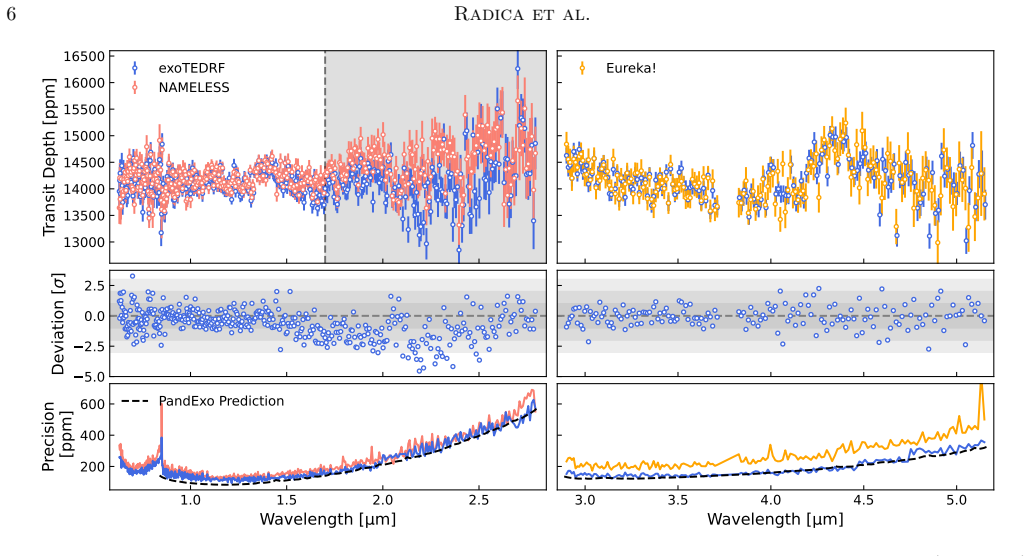
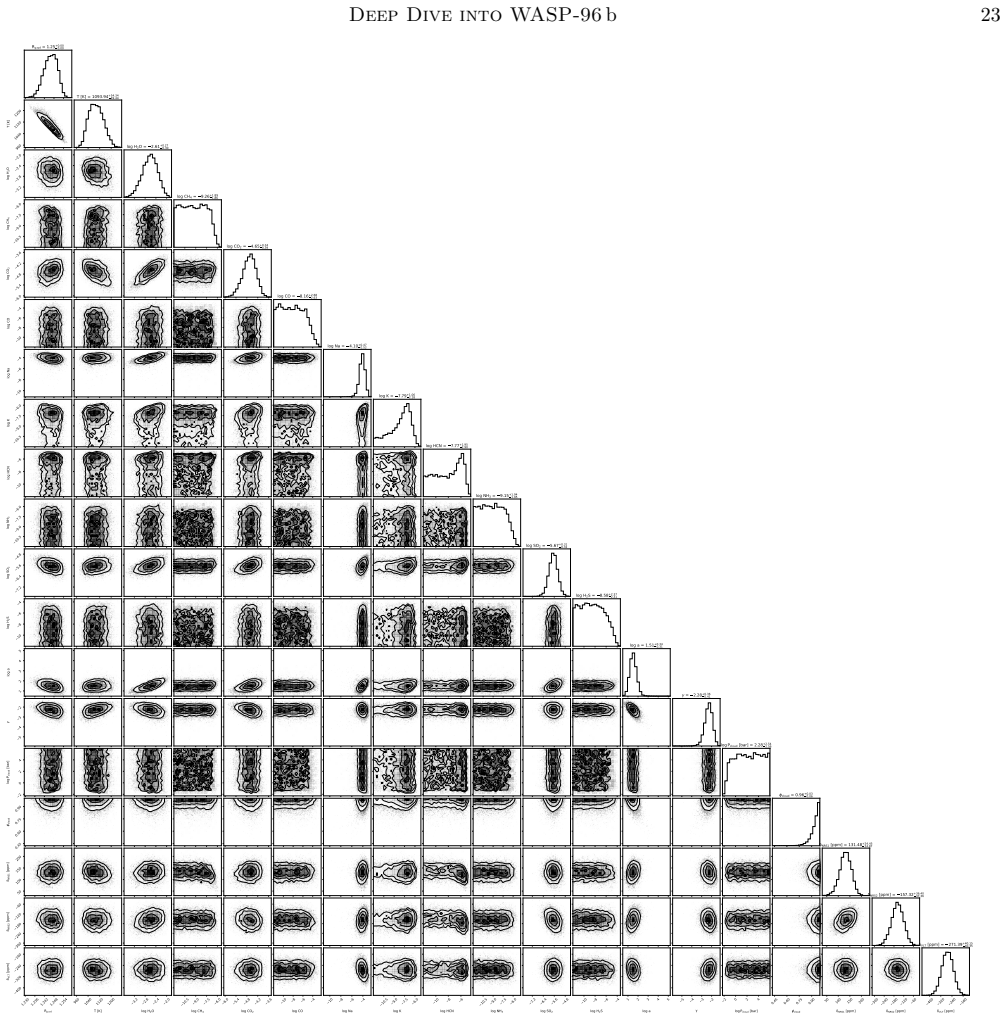
The combined transmission spectrum from JWST and VLT shows clear features of H2O, CO2, and Na. Self-consistent grids retrieve a super-stellar metallicity of 2-6x and a stellar C/O of 0.41, implying formation via core-accretion beyond the H2O snowline followed by volatile accretion. Free retrievals give moderate evidence (ln B = 2.69) for SO2, matching photochemical model abundances and placing the planet on the SO2 shoreline.
What carries the argument
Self-consistent atmospheric grids and Bayesian free retrievals applied to the multi-instrument transmission spectrum to constrain composition, metallicity, and possible photochemical signatures.
Load-bearing premise
The optical slope is produced by scattering aerosols rather than Na line wings or stellar contamination, and the moderate Bayesian evidence for SO2 supports photochemistry.
What would settle it
New high-precision optical transit observations that either resolve sodium line wings or show a smooth aerosol slope, or that measure the SO2 abundance more precisely to confirm or refute the photochemical model match.
Figures




read the original abstract
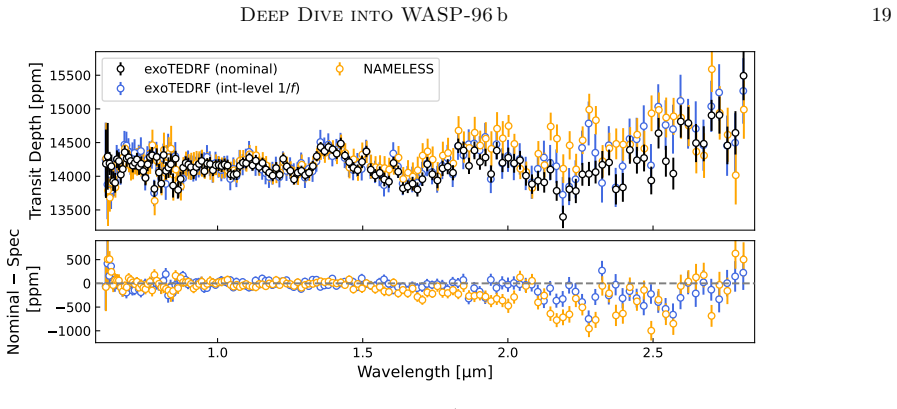
With its expanded wavelength coverage and increased precision compared to previous space-based observatories, JWST provides the opportunity to revisit benchmark planets and view them in a new light. Here, we conduct an in-depth study of the atmosphere of the hot-Saturn WASP-96b combining a new JWST NIRSpec/G395H transit with archival NIRISS/SOSS and VLT/FORS2 transmission spectra. The combined spectrum shows clearly-visible features from H2O, CO2, and Na. CO, though, remains unconstrained, precluding a firm metallicity derivation from free retrievals alone. However, self-consistent grids yield a broadly super-stellar atmospheric metallicity of 2-6x stellar. When combined with a roughly stellar C/O ratio ($0.41^{+0.10}_{-0.09}$ from self-consistent grids), we find that WASP-96b potentially formed via core-accretion beyond the H2O snowline and subsequently accreted volatile-rich material. Free retrievals also find a moderate preference (ln B=2.69) for models with SO2 versus without. WASP-96b falls directly on the proposed "SO2 shoreline" and the retrieved SO2 abundance is well-matched to predictions from photochemical models. Our combined spectrum displays an optical slope, which our models fit with opacity from scattering aerosols -- either small-particle condensate clouds or photochemical hazes -- though we cannot completely rule out the broad wings of Na or the effects of stellar contamination. Future observations are necessary to disentangle these effects. Finally, we explore the possibility for limb asymmetry in WASP-96b's transmission spectrum and provide several tests to identify asymmetries in our data. We encourage the community to prioritize the development of a robust pathway to quantify the presence of limb asymmetry -- particularly for low signal-to-noise cases.
Editorial analysis
A structured set of objections, weighed in public.
Referee Report
Summary. The manuscript combines new JWST NIRSpec/G395H transit observations with archival NIRISS/SOSS and VLT/FORS2 transmission spectra of the hot Saturn WASP-96b. It identifies clear absorption from H2O, CO2, and Na while finding CO unconstrained in free retrievals. Self-consistent atmospheric grids yield a super-stellar metallicity of 2-6x stellar and a near-stellar C/O ratio of 0.41^{+0.10}_{-0.09}, supporting a core-accretion formation scenario beyond the H2O snowline. Free retrievals show moderate evidence (ln B=2.69) for SO2 whose abundance matches photochemical predictions, and the optical slope is modeled with scattering aerosols, though Na wings and stellar contamination are noted as alternatives. The paper also presents tests for limb asymmetry.
Significance. If the derived parameters are robust, the work provides useful constraints on metallicity and C/O for a benchmark hot Saturn, informing formation pathways via core accretion and volatile accretion. The moderate SO2 preference and aerosol modeling add to discussions of disequilibrium chemistry and cloud/haze processes. The multi-instrument dataset and limb-asymmetry tests represent a constructive use of JWST data and a step toward improved analysis practices.
major comments (3)
- [Results from self-consistent grids and free retrievals] The central metallicity (2-6x stellar) and C/O claims rest exclusively on self-consistent grids that assume thermochemical equilibrium. Free retrievals, however, show moderate evidence for SO2 (ln B=2.69) interpreted as photochemistry, which violates equilibrium. This tension is load-bearing for the metallicity derivation and the formation scenario; the manuscript should quantify how disequilibrium processes would bias the grid results or demonstrate why the equilibrium assumption remains appropriate.
- [Modeling of the optical slope] The optical slope is fit with opacity from scattering aerosols, but the text states that broad Na wings or stellar contamination cannot be completely ruled out. Because the slope sets the continuum level and influences all abundance retrievals, a quantitative marginalization or exclusion of these alternatives is required to support the aerosol interpretation.
- [Free retrieval results for CO] CO remains unconstrained in the free retrievals, so the super-stellar metallicity claim depends entirely on the grid models without an independent observational anchor. Explicit sensitivity tests showing how the grid-derived metallicity changes when CO is allowed to vary or when equilibrium is relaxed would strengthen the result.
minor comments (2)
- [Abstract] The abstract states 'broadly super-stellar' without the 2-6x range; adding the numerical interval would improve precision.
- [Methods] The specific grid models or codes employed for the self-consistent calculations should be named and referenced for reproducibility.
Simulated Author's Rebuttal
We thank the referee for their thoughtful and constructive review. Their comments have prompted us to strengthen the discussion of model assumptions and to add quantitative tests. We address each major comment below.
read point-by-point responses
-
Referee: The central metallicity (2-6x stellar) and C/O claims rest exclusively on self-consistent grids that assume thermochemical equilibrium. Free retrievals, however, show moderate evidence for SO2 (ln B=2.69) interpreted as photochemistry, which violates equilibrium. This tension is load-bearing for the metallicity derivation and the formation scenario; the manuscript should quantify how disequilibrium processes would bias the grid results or demonstrate why the equilibrium assumption remains appropriate.
Authors: We agree this tension merits explicit discussion. The SO2 feature is tentative and its retrieved mixing ratio is low enough that it does not materially change the H2O and CO2 abundances recovered in the free retrievals. We have added a dedicated paragraph in Section 4.3 explaining that disequilibrium chemistry is expected to operate primarily above the ~1 mbar level, while the metallicity constraint is driven by the deeper, higher-pressure layers where thermochemical equilibrium remains a reasonable approximation. We also note that the C/O ratio is insensitive to the inclusion of SO2. A full non-equilibrium grid calculation would be the ideal next step but lies beyond the scope of the present work; we therefore flag this as a limitation in the revised text. revision: partial
-
Referee: The optical slope is fit with opacity from scattering aerosols, but the text states that broad Na wings or stellar contamination cannot be completely ruled out. Because the slope sets the continuum level and influences all abundance retrievals, a quantitative marginalization or exclusion of these alternatives is required to support the aerosol interpretation.
Authors: We have performed the requested quantitative tests. In the revised manuscript we present three additional retrieval configurations: (i) scattering aerosols only, (ii) broad Na wings with no aerosols, and (iii) a stellar-contamination model. We report the Bayesian evidence differences (Δln Z) and the resulting shifts in retrieved H2O and CO2 abundances. The aerosol model remains preferred, but the evidence is not decisive; we now state this explicitly and discuss the residual uncertainty in the continuum level and its effect on absolute abundances. revision: yes
-
Referee: CO remains unconstrained in the free retrievals, so the super-stellar metallicity claim depends entirely on the grid models without an independent observational anchor. Explicit sensitivity tests showing how the grid-derived metallicity changes when CO is allowed to vary or when equilibrium is relaxed would strengthen the result.
Authors: We have added the requested sensitivity tests. Using the self-consistent grid framework, we re-derived the metallicity after fixing CO to (a) the 3σ upper limit from the free retrievals and (b) a solar value. In both cases the metallicity remains super-stellar (2–5× stellar). We also discuss the impact of relaxing strict equilibrium by allowing a modest vertical quench for CO; the metallicity posterior shifts by less than 0.3 dex. These tests are now shown in a new appendix figure and summarized in the main text. revision: yes
Circularity Check
No circularity: results from independent spectral modeling on new data
full rationale
The paper derives metallicity (2-6x stellar) and C/O (0.41+0.10-0.09) by fitting self-consistent thermochemical equilibrium grids to the combined JWST+VLT transmission spectrum; free retrievals separately yield ln B=2.69 preference for SO2. Neither step reduces to a fitted parameter renamed as prediction, self-definition, or self-citation chain. The optical slope is modeled with aerosol opacity but alternatives are explicitly noted as not ruled out. All load-bearing steps rest on external model assumptions applied to fresh observations, with no equations or uniqueness theorems that collapse back to the inputs by construction.
Axiom & Free-Parameter Ledger
free parameters (3)
- atmospheric metallicity =
2-6x stellar
- C/O ratio =
0.41
- SO2 abundance
axioms (2)
- domain assumption Self-consistent atmospheric models assume thermochemical equilibrium and radiative-convective balance
- domain assumption Observed spectral features arise primarily from planetary atmosphere rather than stellar contamination
invented entities (1)
-
SO2 shoreline
no independent evidence
Forward citations
Cited by 2 Pith papers
-
HAT-P-70b through the Eyes of MAROON-X: Constraining Elemental Abundances of Metals and Insights on Atmosphere Dynamics
New MAROON-X observations of HAT-P-70b detect multiple neutral and ionized metals with day-to-night wind signatures and demonstrate that ionization-aware retrievals yield abundance ratios closer to solar values except...
-
On the Information Content of Ariel Transmission Spectra: Reassessing the Tier System
Tier 1 Ariel spectra suffice for sub-1.5 dex constraints on H2O and CO2 in giant-planet atmospheres, with higher tiers providing only incremental gains and more molecules in select cases.
Reference graph
Works this paper leans on
-
[1]
Ahrer, E.-M., Stevenson, K. B., Mansfield, M., et al. 2023, Nature, 614, 653, doi: 10.1038/s41586-022-05590-4
-
[2]
2025a, ApJL, 985, L10, doi: 10.3847/2041-8213/add010
Ahrer, E.-M., Radica, M., Piaulet-Ghorayeb, C., et al. 2025a, ApJL, 985, L10, doi: 10.3847/2041-8213/add010
-
[3]
2025b, Monthly Notices of the Royal Astronomical Society, 540, 2535, doi: 10.1093/mnras/staf819
Ahrer, E.-M., Gandhi, S., Alderson, L., et al. 2025b, Monthly Notices of the Royal Astronomical Society, 540, 2535, doi: 10.1093/mnras/staf819
-
[4]
2023, PASP, 135, 075001, doi: 10.1088/1538-3873/acd7a3
Albert, L., Lafreni` ere, D., Ren´ e, D., et al. 2023, PASP, 135, 075001, doi: 10.1088/1538-3873/acd7a3
-
[5]
Alderson, L., Wakeford, H. R., Alam, M. K., et al. 2023, Nature, 614, 664, doi: 10.1038/s41586-022-05591-3
-
[6]
2017, Monthly Notices of the Royal Astronomical Society, 467, 2845–2854, doi: 10.1093/mnras/stx260
Ali-Dib, M. 2017, Monthly Notices of the Royal Astronomical Society, 467, 2845–2854, doi: 10.1093/mnras/stx260
-
[7]
F., Spiegelman, F., & Kielkopf, J
Allard, N. F., Spiegelman, F., & Kielkopf, J. F. 2016, A&A, 589, A21, doi: 10.1051/0004-6361/201628270
-
[8]
F., Spiegelman, F., Leininger, T., & Molliere, P
Allard, N. F., Spiegelman, F., Leininger, T., & Molliere, P. 2019, A&A, 628, A120, doi: 10.1051/0004-6361/201935593
-
[9]
Nature Communications , author =
Allart, R., Coulombe, L.-P., Carteret, Y., et al. 2025, Nature Communications, 16, 10822, doi: 10.1038/s41467-025-66628-5
-
[10]
Asplund, M., Grevesse, N., Sauval, A. J., & Scott, P. 2009, Annual Reviews of Astronomy & Astrophysics, 47, 481, doi: 10.1146/annurev.astro.46.060407.145222 Astropy Collaboration, Robitaille, T. P., Tollerud, E. J., et al. 2013, A&A, 558, A33, doi: 10.1051/0004-6361/201322068 Astropy Collaboration, Price-Whelan, A. M., Sip˝ ocz, B. M., et al. 2018, AJ, 15...
-
[11]
K., Crida, A., Guillot, T., et al
Atreya, S. K., Crida, A., Guillot, T., et al. 2024, The Origin and Evolution of Saturn: A Post-Cassini Perspective. https://arxiv.org/abs/2205.06914
-
[12]
Naumenko, O. V. 2016, MNRAS, 460, 4063, doi: 10.1093/mnras/stw1133
-
[13]
” Rothman et al. (2010) Polyansky et al. (2018) “
Barber, R. J., Strange, J. K., Hill, C., et al. 2014, MNRAS, 437, 1828, doi: 10.1093/mnras/stt2011 22Radica et al. T able 4.Opacity Source and References Parameter POSEIDON NemesisPy Pyrat Bay Aurora ScCHIMERA H2O Polyansky et al. (2018) “ ” Rothman et al. (2010) Polyansky et al. (2018) “ ” CO2 Yurchenko et al. (2020) “ ” Rothman et al. (2010) “ ” Freedma...
-
[14]
Barstow, J. K., Aigrain, S., Irwin, P. G. J., & Sing, D. K. 2017, ApJ, 834, 50, doi: 10.3847/1538-4357/834/1/50
-
[15]
2022, The Journal of Open Source Software, 7, 4503, doi: 10.21105/joss.04503
Bell, T., Ahrer, E.-M., Brande, J., et al. 2022, The Journal of Open Source Software, 7, 4503, doi: 10.21105/joss.04503
-
[16]
J., Welbanks, L., Schlawin, E., et al
Bell, T. J., Welbanks, L., Schlawin, E., et al. 2023, Nature, 623, 709, doi: 10.1038/s41586-023-06687-0
-
[17]
Benneke, B., Roy, P.-A., Coulombe, L.-P., et al. 2024, JWST Reveals CH$ 4$, CO$ 2$, and H$ 2$O in a Metal-rich Miscible Atmosphere on a Two-Earth-Radius Exoplanet, arXiv. http://arxiv.org/abs/2403.03325
-
[18]
M., Ferruit, P., Giardino, G., et al
Birkmann, S. M., Ferruit, P., Giardino, G., et al. 2022, A&A, 661, A83, doi: 10.1051/0004-6361/202142592
-
[19]
2002, A&A, 390, 779, doi: 10.1051/0004-6361:20020555
Borysow, A. 2002, A&A, 390, 779, doi: 10.1051/0004-6361:20020555
-
[20]
1989, ApJ, 341, 549, doi: 10.1086/167515
Borysow, A., & Frommhold, L. 1989, ApJ, 341, 549, doi: 10.1086/167515
-
[21]
1989, ApJ, 336, 495, doi: 10.1086/167027
Borysow, A., Frommhold, L., & Moraldi, M. 1989, ApJ, 336, 495, doi: 10.1086/167027
-
[22]
Borysow, A., Jorgensen, U. G., & Fu, Y. 2001, JQSRT, 68, 235, doi: 10.1016/S0022-4073(00)00023-6
-
[23]
2016, Stat Comput, 26, 383, doi: 10.1007/s11222-014-9512-y
Buchner, J. 2016, Stat Comput, 26, 383, doi: 10.1007/s11222-014-9512-y
-
[24]
Buchner, J., Georgakakis, A., Nandra, K., et al. 2014, Astronomy and Astrophysics, 564, A125, doi: 10.1051/0004-6361/201322971
work page internal anchor Pith review doi:10.1051/0004-6361/201322971 2014
-
[25]
2023, JWST Calibration Pipeline, 1.12.3, Zenodo, doi: 10.5281/zenodo.8404029
Bushouse, H., Eisenhamer, J., Dencheva, N., et al. 2023, JWST Calibration Pipeline, 1.12.3, Zenodo, doi: 10.5281/zenodo.8404029
-
[26]
2025, Effects of Jump Detection and Ramp Fitting Algorithms on NIRISS/SOSS Exoplanet Time-Series Observations, Tech
Carter, A., Espinoza, N., Albert, L., et al. 2025, Effects of Jump Detection and Ramp Fitting Algorithms on NIRISS/SOSS Exoplanet Time-Series Observations, Tech. Rep. Technical Report JWST-STScI-008975, STScI
2025
-
[27]
Carter, A. L., May, E. M., Espinoza, N., et al. 2024, Nat Astron, 8, 1008, doi: 10.1038/s41550-024-02292-x
-
[28]
A., Lothringer, J., & Blake, G
Chachan, Y., Knutson, H. A., Lothringer, J., & Blake, G. A. 2023, ApJ, 943, 112, doi: 10.3847/1538-4357/aca614
-
[29]
Challener, R. C., Welbanks, L., & McGill, P. 2023, AJ, 166, 251, doi: 10.3847/1538-3881/ad0366
-
[30]
Christiansen, J. L., McElroy, D. L., Harbut, M., et al. 2025, Planet. Sci. J., 6, 186, doi: 10.3847/PSJ/ade3c2
-
[31]
L., Tennyson, J., & Yurchenko, S
Chubb, K. L., Tennyson, J., & Yurchenko, S. N. 2020, MNRAS, 493, 1531, doi: 10.1093/mnras/staa229
-
[32]
and Rocchetto, Marco and Yurchenko, Sergei N
Chubb, K. L., Rocchetto, M., Yurchenko, S. N., et al. 2021, A&A, 646, A21, doi: 10.1051/0004-6361/202038350
-
[33]
2019, A&A, 621, A49, doi: 10.1051/0004-6361/201833995
Cloutier, R., Astudillo-Defru, N., Doyon, R., et al. 2019, A&A, 621, A49, doi: 10.1051/0004-6361/201833995
-
[34]
Coles, P. A., Yurchenko, S. N., & Tennyson, J. 2019, MNRAS, 490, 4638, doi: 10.1093/mnras/stz2778
-
[35]
J., Monaghan, C., Benneke, B., & Dang, L
Connors, N. J., Monaghan, C., Benneke, B., & Dang, L. 2025, The Astrophysical Journal Letters, 989, L11, doi: 10.3847/2041-8213/adee0d
-
[36]
2023, Nature, 620, 292, doi: 10.1038/s41586-023-06230-1
Coulombe, L.-P., Benneke, B., Challener, R., et al. 2023, Nature, 620, 292, doi: 10.1038/s41586-023-06230-1
-
[37]
2025, Nat Astron, 9, 512, doi: 10.1038/s41550-025-02488-9
Coulombe, L.-P., Radica, M., Benneke, B., et al. 2025, Nat Astron, 9, 512, doi: 10.1038/s41550-025-02488-9
-
[38]
Cridland, A. J., van Dishoeck, E. F., Alessi, M., & Pudritz, R. E. 2019, Astronomy & Astrophysics, 632, A63, doi: 10.1051/0004-6361/201936105
-
[39]
Crossfield, I. J. M. 2023, ApJL, 952, L18, doi: 10.3847/2041-8213/ace35f Deep Dive into WASP-96b 23 Rp ref = 1.25+0.00 0.00 960 1040 1120 1200 T [K] T [K] = 1093.94+54.34 49.44 3.2 2.8 2.4 2.0 log H2O log H2O = 2.61+0.27 0.30 10.5 9.0 7.5 6.0 log CH4 log CH4 = 9.26+1.89 1.86 6.0 5.4 4.8 4.2 3.6 log CO2 log CO2 = 4.65+0.34 0.39 10 8 6 4 log CO log CO = 8.1...
-
[40]
Crossfield, I. J. M., Ahrer, E.-M., Brande, J., et al. 2025, ApJ, 994, 184, doi: 10.3847/1538-4357/ae17cb
-
[41]
Cubillos, P. E., & Blecic, J. 2021, MNRAS, 505, 2675, doi: 10.1093/mnras/stab1405
-
[42]
Darveau-Bernier, A., Albert, L., Talens, G. J., et al. 2022, PASP, 134, 094502, doi: 10.1088/1538-3873/ac8a77
-
[43]
Davenport, B., Kempton, E. M.-R., Nixon, M. C., et al. 2025, ApJL, 984, L44, doi: 10.3847/2041-8213/adcd76
-
[44]
Doyon, R., Willott, C. J., Hutchings, J. B., et al. 2023, PASP, 135, 098001, doi: 10.1088/1538-3873/acd41b
-
[45]
2024, Nature, 625, 51, doi: 10.1038/s41586-023-06849-0
Dyrek, A., Min, M., Decin, L., et al. 2024, Nature, 625, 51, doi: 10.1038/s41586-023-06849-0
-
[46]
Edwards, J. M., & Slingo, A. 1996, Quarterly Journal of the Royal Meteorological Society, 122, 689, doi: 10.1002/qj.49712253107
-
[47]
2020, Nature, 580, 597, doi: 10.1038/s41586-020-2107-1
Ehrenreich, D., Lovis, C., Allart, R., et al. 2020, Nature, 580, 597, doi: 10.1038/s41586-020-2107-1
-
[48]
2017, The Astrophysical Journal Letters, 838, L9, doi: 10.3847/2041-8213/aa65ca 24Radica et al
Murray-Clay, R. 2017, The Astrophysical Journal Letters, 838, L9, doi: 10.3847/2041-8213/aa65ca 24Radica et al
-
[49]
2021, AJ, 162, 165, doi: 10.3847/1538-3881/ac134d
Espinoza, N., & Jones, K. 2021, AJ, 162, 165, doi: 10.3847/1538-3881/ac134d
-
[50]
Espinoza, N., Kossakowski, D., & Brahm, R. 2019, Monthly Notices of the Royal Astronomical Society, 490, 2262, doi: 10.1093/mnras/stz2688
-
[51]
and Kirk, James and MacDonald, Ryan J
Espinoza, N., Steinrueck, M. E., Kirk, J., et al. 2024, Nature, 632, 1017, doi: 10.1038/s41586-024-07768-4
-
[52]
D., Radica, M., Welbanks, L., et al
Feinstein, A. D., Radica, M., Welbanks, L., et al. 2023, Nature, 614, 670, doi: 10.1038/s41586-022-05674-1
-
[53]
F., Capozziello, S., & Dainotti, M
Feroz, F., Hobson, M. P., & Bridges, M. 2009, Monthly Notices of the Royal Astronomical Society, 398, 1601, doi: 10.1111/j.1365-2966.2009.14548.x
-
[54]
2023, The Astrophysical Journal, 956, 134, doi: 10.3847/1538-4357/acf71b
Fleury, B., Benilan, Y., Venot, O., et al. 2023, The Astrophysical Journal, 956, 134, doi: 10.3847/1538-4357/acf71b
-
[55]
and Lang, Dustin and Goodman, Jonathan , title =
Foreman-Mackey, D., Hogg, D. W., Lang, D., & Goodman, J. 2013, Publications of the Astronomical Society of the Pacific, 125, 306, doi: 10.1086/670067
-
[56]
Fournier-Tondreau, M., MacDonald, R. J., Radica, M., et al. 2024, Monthly Notices of the Royal Astronomical Society, 528, 3354, doi: 10.1093/mnras/stad3813
-
[57]
S., Lustig-Yaeger, J., Fortney, J
Freedman, R. S., Lustig-Yaeger, J., Fortney, J. J., et al. 2014, ApJS, 214, 25, doi: 10.1088/0067-0049/214/2/25
-
[58]
Freedman, R. S., Marley, M. S., & Lodders, K. 2008, ApJS, 174, 504, doi: 10.1086/521793
-
[59]
2024, Nature, 632, 752, doi: 10.1038/s41586-024-07760-y
Fu, G., Welbanks, L., Deming, D., et al. 2024, Nature, 632, 752, doi: 10.1038/s41586-024-07760-y
-
[60]
Fu, G., Mukherjee, S., Stevenson, K. B., et al. 2025, ApJL, 989, L17, doi: 10.3847/2041-8213/adf20f
-
[61]
Fulton, B. J., Petigura, E. A., Blunt, S., & Sinukoff, E. 2018, PASP, 130, 044504, doi: 10.1088/1538-3873/aaaaa8
-
[62]
2022, Monthly Notices of the Royal Astronomical Society, 515, 749, doi: 10.1093/mnras/stac1744
Gandhi, S., Kesseli, A., Snellen, I., et al. 2022, Monthly Notices of the Royal Astronomical Society, 515, 749, doi: 10.1093/mnras/stac1744
-
[63]
Gordon, S., & Mcbride, B. J. 1994, Computer program for calculation of complex chemical equilibrium compositions and applications. Part 1: Analysis, Tech. Rep. 19950013764, NASA Lewis Research Center
1994
-
[64]
Grant, D., & Wakeford, H. R. 2024, JOSS, 9, 6816, doi: 10.21105/joss.06816
-
[65]
Grant, D., Lewis, N. K., Wakeford, H. R., et al. 2023, ApJL, 956, L29, doi: 10.3847/2041-8213/acfc3b
-
[66]
Greene, T. P., Bell, T. J., Ducrot, E., et al. 2023, Nature, 618, 39, doi: 10.1038/s41586-023-05951-7
-
[67]
Hargreaves, R. J., Gordon, I. E., Rey, M., et al. 2020, The Astrophysical Journal Supplement Series, 247, 55, doi: 10.3847/1538-4365/ab7a1a
-
[68]
Harris, C. R., Millman, K. J., van der Walt, S. J., et al. 2020, Nature, 585, 357, doi: 10.1038/s41586-020-2649-2
-
[69]
Harris, G. J., Tennyson, J., Kaminsky, B. M., Pavlenko, Y. V., & Jones, H. R. A. 2006, Monthly Notices of the Royal Astronomical Society, 367, 400, doi: 10.1111/j.1365-2966.2005.09960.x
-
[70]
Hellier, C., Anderson, D. R., Cameron, A. C., et al. 2014, Monthly Notices of the Royal Astronomical Society, 440, 1982, doi: 10.1093/mnras/stu410
-
[71]
2023, Monthly Notices of the Royal Astronomical Society, 524, 377, doi: 10.1093/mnras/stad1580
Holmberg, M., & Madhusudhan, N. 2023, Monthly Notices of the Royal Astronomical Society, 524, 377, doi: 10.1093/mnras/stad1580
-
[72]
Horne, K. 1986, Publications of the Astronomical Society of the Pacific, Vol. 98, p. 609-617 (1986), 98, 609, doi: 10.1086/131801
-
[73]
Hunter, J. D. 2007, Computing in Science & Engineering, 9, 90, doi: 10.1109/MCSE.2007.55
-
[74]
Irwin, P. G. J., Teanby, N. A., de Kok, R., et al. 2008, JQSRT, 109, 1136, doi: 10.1016/j.jqsrt.2007.11.006
-
[75]
Jeffreys, H. 1935, Mathematical Proceedings of the Cambridge Philosophical Society, 31, 203–222, doi: 10.1017/S030500410001330X
-
[76]
M., et al., 2016, in Chiozzi G., Guzman J
Jenkins, J. M., Twicken, J. D., McCauliff, S., et al. 2016, in Society of Photo-Optical Instrumentation Engineers (SPIE) Conference Series, Vol. 9913, Software and Cyberinfrastructure for Astronomy IV, ed. G. Chiozzi & J. C. Guzman, 99133E, doi: 10.1117/12.2233418
-
[77]
2020, Journal of Open Source Software, 7, 2382, doi: 10.21105/joss.02382
Jones, K., & Espinoza, N. 2020, Journal of Open Source Software, 7, 2382, doi: 10.21105/joss.02382
-
[78]
Kempton, E. M.-R., Bean, J. L., Louie, D. R., et al. 2018, PASP, 130, 114401, doi: 10.1088/1538-3873/aadf6f
-
[79]
Kempton, E. M.-R., Zhang, M., Bean, J. L., et al. 2023, Nature, 620, 67, doi: 10.1038/s41586-023-06159-5
-
[80]
Kipping, D. M. 2013, Monthly Notices of the Royal Astronomical Society, 435, 2152, doi: 10.1093/mnras/stt1435
discussion (0)
Sign in with ORCID, Apple, or X to comment. Anyone can read and Pith papers without signing in.