Recognition: 2 theorem links
· Lean TheoremA New Method for Testing Einstein's Theory of Gravity Close to Rapidly Spinning Black Holes
Pith reviewed 2026-05-10 18:57 UTC · model grok-4.3
The pith
Processes similar to collisional Penrose processes near rapidly spinning black holes produce a distinct X-ray spectral component with unique polarization that polarimeters can use to test general relativity and measure spin.
A machine-rendered reading of the paper's core claim, the machinery that carries it, and where it could break.
Core claim
In rapidly spinning black holes in X-ray binaries, processes similar to collisional Penrose processes can give rise to a new spectral component with distinct spectral and polarimetric properties. Observations of this new spectral component with current or future broadband X-ray polarimeters will open a new window into testing Einstein's theory of gravity close to the edge of a black hole and can be used to measure the black hole spin.
What carries the argument
The new spectral component produced by collisional Penrose-like particle interactions, whose polarization and spectrum are shaped by extreme frame dragging near the black hole.
If this is right
- Polarimetric detection of the component would directly test general relativity in the strong-field region near the event horizon.
- The same data would yield an independent measurement of black-hole spin in X-ray binary systems.
- The distinct polarization signature would help separate this emission channel from other X-ray production mechanisms in accretion flows.
- Current and planned broadband X-ray polarimeters are already capable of performing the required observations.
Where Pith is reading between the lines
- If the signature is confirmed, it could be combined with gravitational-wave spin measurements to cross-check black-hole properties across different environments.
- The method might also constrain the geometry and magnetic structure of the inner accretion disk once the polarization is measured at multiple energies.
- Non-detection in a large sample of sources would require revising assumptions about particle acceleration efficiency in the ergosphere.
Load-bearing premise
Processes similar to collisional Penrose processes in X-ray binaries produce a distinct, observable new spectral component with unique polarimetric properties separable from other emission mechanisms.
What would settle it
High-quality polarimetric spectra of known rapidly spinning black-hole candidates in X-ray binaries that show no evidence of the predicted polarized component, or that show a component whose spin dependence does not match the calculated signature.
Figures


read the original abstract
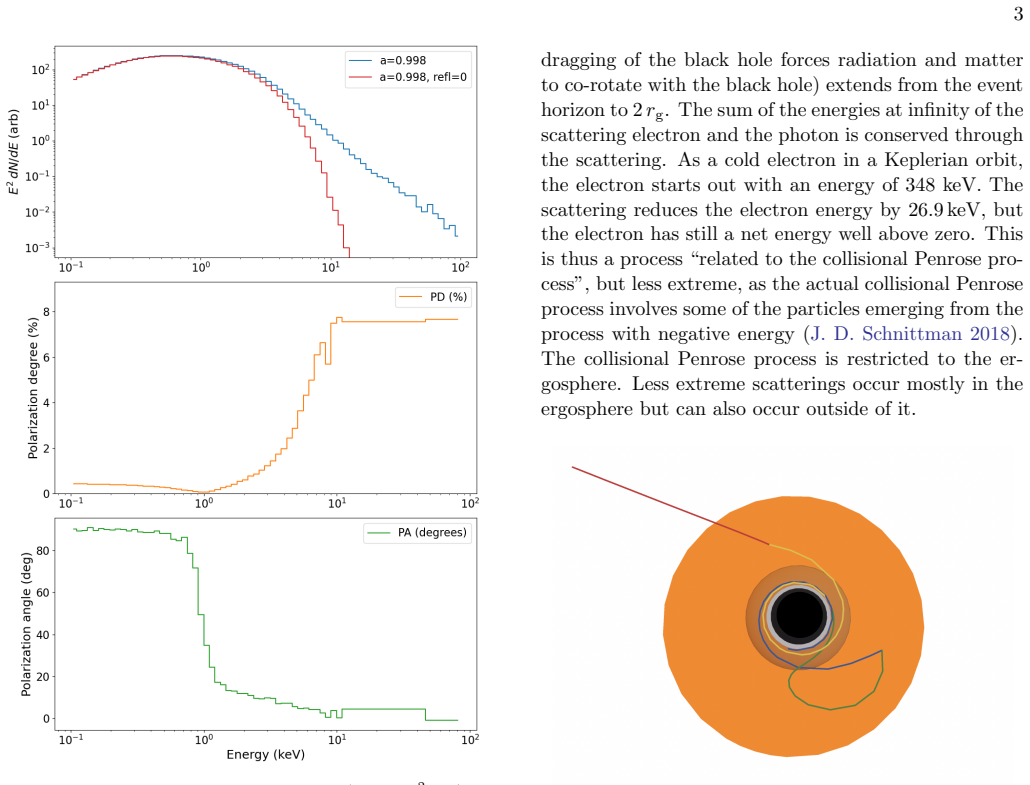
The classical Penrose process and the collisional Penrose processes involve particles decaying or interacting very close to a spinning black hole, in which some particles acquire negative energy and fall into the black hole while others acquire that energy and can leave the system. Both processes involve an extreme form of frame dragging, i.e. the spinning black hole drags spacetime with it, and the spacetime ejects some of the particles with a large energy gain, similar to a projectile in a slingshot. Such extreme forms of frame dragging had long been believed to be unobservable as the efficiency for a black hole energizing particles in this way is very low. Here we report a new observational signature of this extreme sort of frame dragging. In rapidly spinning black holes in X-ray binaries, processes similar to collisional Penrose processes, but slightly less extreme, can give rise to a new spectral component with distinct spectral and polarimetric properties. Observations of this new spectral component with current or future broadband X-ray polarimeters will open a new window into testing Einstein's theory of gravity close to the edge of a black hole and can be used to measure the black hole spin.
Editorial analysis
A structured set of objections, weighed in public.
Referee Report
Summary. The paper proposes that processes similar to collisional Penrose processes occurring near rapidly spinning black holes in X-ray binaries can produce a distinct new spectral component with unique spectral and polarimetric properties. Detection of this component with current or future broadband X-ray polarimeters would provide a new method to test general relativity in the strong-field regime close to the black hole horizon and to measure black hole spin.
Significance. If the proposed component is both energetically significant and polarimetrically separable from standard disk, corona, and reflection emission, the idea would open a novel observational channel for strong-field GR tests and spin measurements. The manuscript offers no quantitative radiative-transfer calculations, luminosity fractions, or Stokes-parameter predictions to establish separability, so the potential significance cannot be assessed from the presented material.
major comments (2)
- [Abstract] Abstract and main text: the central claim that the new component possesses 'distinct spectral and polarimetric properties' separable from Comptonization, reflection, and disk emission is presented without any explicit calculation of emergent spectrum, flux contribution, or polarization degree/angle. No comparison is made to existing XSPEC models or ray-tracing codes, leaving separability as an untested assumption rather than a demonstrated result.
- [Main text] No section provides a toy model, efficiency estimate, or Monte-Carlo simulation showing that the polarimetric signature cannot be reproduced by standard mechanisms; this quantitative gap is load-bearing for the claim that polarimetry with current/future instruments can test GR near the horizon.
Simulated Author's Rebuttal
We thank the referee for the detailed and constructive report. The comments correctly identify that the manuscript is a conceptual proposal rather than a quantitative study. We address each major comment below and indicate where revisions will be made.
read point-by-point responses
-
Referee: [Abstract] Abstract and main text: the central claim that the new component possesses 'distinct spectral and polarimetric properties' separable from Comptonization, reflection, and disk emission is presented without any explicit calculation of emergent spectrum, flux contribution, or polarization degree/angle. No comparison is made to existing XSPEC models or ray-tracing codes, leaving separability as an untested assumption rather than a demonstrated result.
Authors: We agree that the manuscript contains no radiative-transfer calculations, flux fractions, or Stokes-parameter predictions, nor any direct comparison to XSPEC models or ray-tracing codes. The work is framed as a theoretical proposal that identifies a new physical channel arising from collisional Penrose-like processes in the ergosphere. The distinctness is motivated by the kinematics of negative-energy orbits and extreme frame-dragging, which produce particle trajectories and energy gains absent from standard disk, corona, or reflection scenarios. We will add a dedicated discussion paragraph that qualitatively contrasts the expected polarization signature with those of Comptonization and reflection, and we will explicitly state that full numerical predictions lie beyond the present scope. revision: partial
-
Referee: [Main text] No section provides a toy model, efficiency estimate, or Monte-Carlo simulation showing that the polarimetric signature cannot be reproduced by standard mechanisms; this quantitative gap is load-bearing for the claim that polarimetry with current/future instruments can test GR near the horizon.
Authors: The referee is correct that no toy model, efficiency calculation, or Monte-Carlo run is presented to demonstrate that the polarimetric signature is irreducible to standard mechanisms. Our argument rests on the unique energy-extraction physics of the process, which we believe cannot be replicated by disk or coronal emission. Nevertheless, we accept that this remains an assumption until quantified. We will insert a short section that supplies an order-of-magnitude efficiency estimate based on published Penrose-process literature and will revise the text to present the polarimetric test as a prediction whose separability must be verified by future detailed modeling and observations. revision: partial
Circularity Check
No circularity: conceptual proposal without quantitative derivation or fitted predictions
full rationale
The paper advances a qualitative kinematic idea that processes similar to collisional Penrose processes near rapidly spinning black holes can produce a distinct spectral component with unique polarimetric signatures. No explicit equations, radiative-transfer calculations, efficiency estimates, or Stokes-parameter predictions are supplied that could reduce to fitted parameters, self-citations, or ansatzes. The separability claim is asserted rather than derived, and no self-citation chains or uniqueness theorems are invoked to support the central premise. The derivation chain is therefore self-contained as a hypothesis and exhibits none of the enumerated circularity patterns.
Axiom & Free-Parameter Ledger
axioms (1)
- domain assumption Penrose and collisional Penrose processes occur near rapidly spinning black holes as described by general relativity.
Lean theorems connected to this paper
-
IndisputableMonolith/Foundation/RealityFromDistinction.leanreality_from_one_distinction unclear?
unclearRelation between the paper passage and the cited Recognition theorem.
We model the propagation of photon packages in Kerr spacetime... numerically integrating the geodesic equation... parallel transported along the geodesics.
-
IndisputableMonolith/Foundation/AlexanderDuality.leanalexander_duality_circle_linking unclear?
unclearRelation between the paper passage and the cited Recognition theorem.
processes similar to collisional Penrose processes... extreme form of frame dragging
What do these tags mean?
- matches
- The paper's claim is directly supported by a theorem in the formal canon.
- supports
- The theorem supports part of the paper's argument, but the paper may add assumptions or extra steps.
- extends
- The paper goes beyond the formal theorem; the theorem is a base layer rather than the whole result.
- uses
- The paper appears to rely on the theorem as machinery.
- contradicts
- The paper's claim conflicts with a theorem or certificate in the canon.
- unclear
- Pith found a possible connection, but the passage is too broad, indirect, or ambiguous to say the theorem truly supports the claim.
Reference graph
Works this paper leans on
-
[1]
Beloborodov, A. M. 2017, ApJ, 850, 141, doi: 10.3847/1538-4357/aa8f4f
-
[2]
2021, Astronomy & Astrophysics, 650, A93, doi: 10.1051/0004-6361/202038604
Cangemi, F., Beuchert, T., Siegert, T., et al. 2021, Astronomy & Astrophysics, 650, A93, doi: 10.1051/0004-6361/202038604
-
[3]
Carlstedt, J. L., & Mullikin, T. W. 1966, ApJS, 12, 449, doi: 10.1086/190133
-
[4]
2007, A&A Rv, 15, 1, doi: 10.1007/s00159-007-0006-1
Done, C., Gierli´ nski, M., & Kubota, A. 2007, The Astronomy and Astrophysics Review, 15, 1, doi: 10.1007/s00159-007-0006-1
-
[5]
Fabian, A. C., & Lasenby, A. N. 2019, arXiv e-prints, arXiv:1911.04305, doi: 10.48550/arXiv.1911.04305
-
[6]
George, I. M., & Fabian, A. C. 1991, MNRAS, 249, 352, doi: 10.1093/mnras/249.2.352
-
[7]
1994, ApJL, 432, L95, doi: 10.1086/187520
Haardt, F., Maraschi, L., & Ghisellini, G. 1994, ApJL, 432, L95, doi: 10.1086/187520
-
[8]
Hankla, A. M., Dexter, J., & Scepi, N. 2025, MNRAS, 541, 3184, doi: 10.1093/mnras/staf1169
-
[9]
Hankla, A. M., Scepi, N., & Dexter, J. 2022, MNRAS, 515, 775, doi: 10.1093/mnras/stac1785
-
[10]
Katz, J. I. 1976, ApJ, 206, 910, doi: 10.1086/154455
-
[11]
2012, ApJ, 754, 133, doi: 10.1088/0004-637X/754/2/133
Krawczynski, H. 2012, ApJ, 754, 133, doi: 10.1088/0004-637X/754/2/133
-
[12]
2022, ApJ, 934, 4, doi: 10.3847/1538-4357/ac7725
Krawczynski, H., & Beheshtipour, B. 2022, ApJ, 934, 4, doi: 10.3847/1538-4357/ac7725
-
[13]
2025, ApJ, 993, 54, doi: 10.3847/1538-4357/adfddf
Krawczynski, H., & Hu, K. 2025, ApJ, 993, 54, doi: 10.3847/1538-4357/adfddf
-
[14]
Krawczynski, H. S., Stern, D., Harrison, F. A., et al. 2016, Astroparticle Physics, 75, 8, doi: 10.1016/j.astropartphys.2015.10.009
-
[15]
Li, L.-X., Zimmerman, E. R., Narayan, R., & McClintock, J. E. 2005, ApJS, 157, 335, doi: 10.1086/428089
-
[16]
2025, MNRAS, 544, 2880, doi: 10.1093/mnras/staf1758
Mummery, A., Jiang, J., Ingram, A., Fabian, A., & Rule, J. 2025, MNRAS, 544, 2880, doi: 10.1093/mnras/staf1758
-
[17]
Schnittman, J. D. 2026, arXiv e-prints, arXiv:2601.03349, doi: 10.48550/arXiv.2601.03349
-
[18]
Time-Averaged Structure of Accretion Disk
Page, D. N., & Thorne, K. S. 1974, ApJ, 191, 499, doi: 10.1086/152990
-
[19]
Reynolds, C. S. 2014, SSRv, 183, 277, doi: 10.1007/s11214-013-0006-6
-
[20]
Schnittman, J. D. 2018, General Relativity and Gravitation, 50, 77, doi: 10.1007/s10714-018-2373-5
-
[21]
I., & Sunyaev, R
Shakura, N. I., & Sunyaev, R. A. 1973, A&A, 24, 337
1973
-
[22]
Shapiro, S. L., Lightman, A. P., & Eardley, D. M. 1976, ApJ, 204, 187, doi: 10.1086/154162
-
[23]
Sironi, L., & Beloborodov, A. M. 2020, ApJ, 899, 52, doi: 10.3847/1538-4357/aba622
-
[24]
2024, Galaxies, 12, 47, doi: 10.3390/galaxies12040047
Soffitta, P., Costa, E., De Angelis, N., et al. 2024, Galaxies, 12, 47, doi: 10.3390/galaxies12040047
-
[25]
Beloborodov, A. M. 2025, ApJ, 979, 199, doi: 10.3847/1538-4357/ada385
-
[26]
Zhang, S. N., Cui, W., & Chen, W. 1997, ApJL, 482, L155, doi: 10.1086/310705
discussion (0)
Sign in with ORCID, Apple, or X to comment. Anyone can read and Pith papers without signing in.