Recognition: 1 theorem link
· Lean TheoremTransport and scaling analysis in the relativistic Standard map
Pith reviewed 2026-05-10 18:45 UTC · model grok-4.3
The pith
The relativistic standard map shows diffusion that saturates and escape rates that slow according to scaling laws in the relativity parameter β.
A machine-rendered reading of the paper's core claim, the machinery that carries it, and where it could break.
Core claim
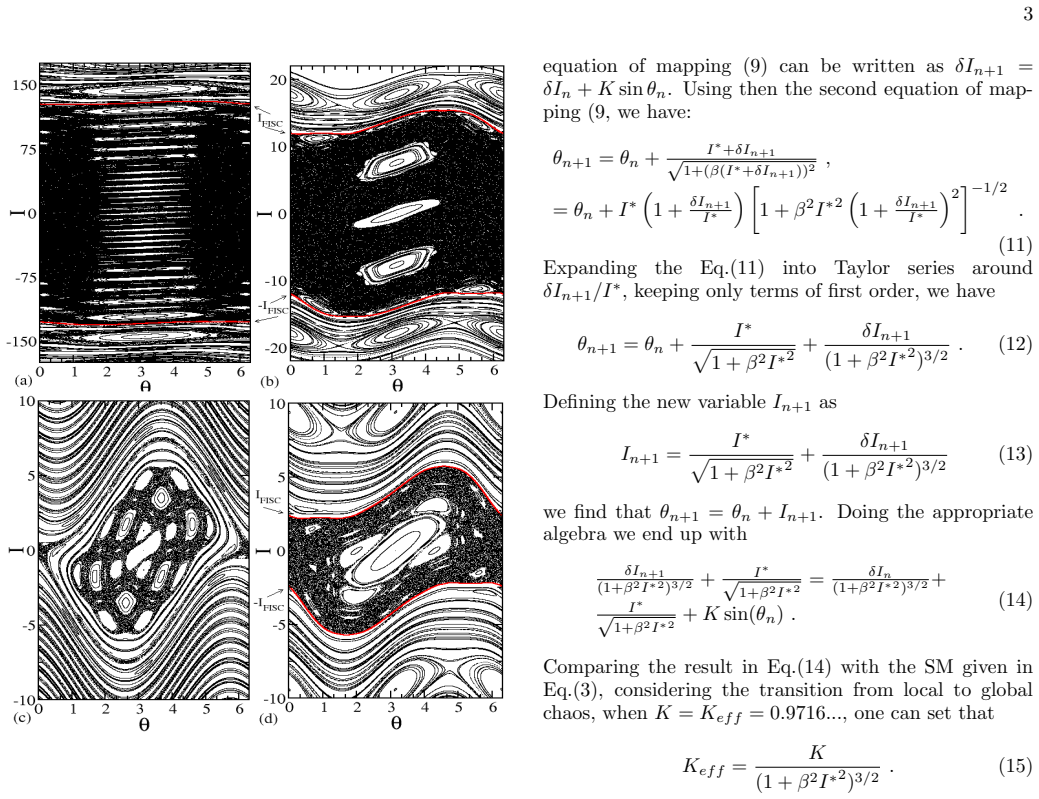
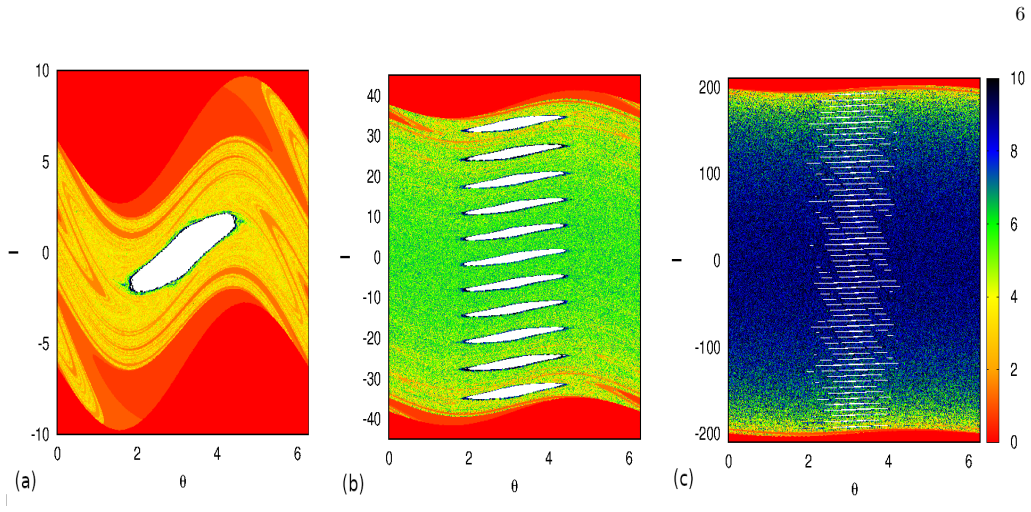
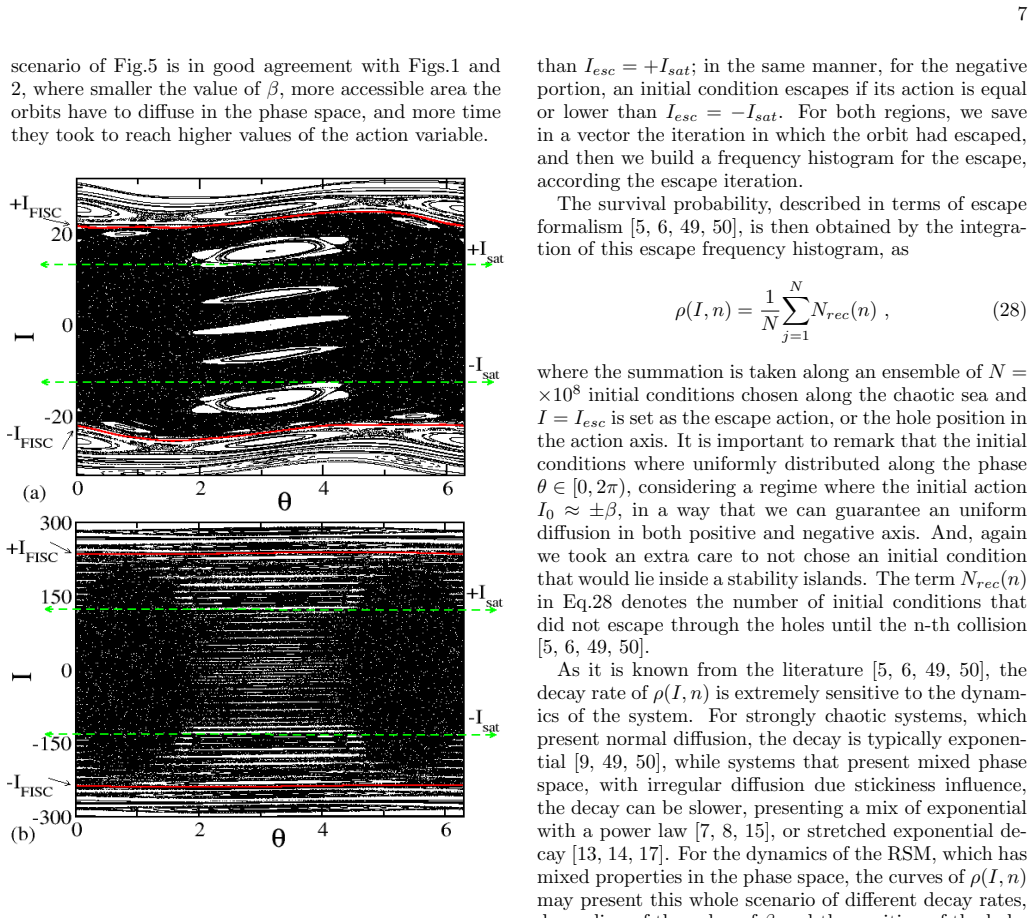
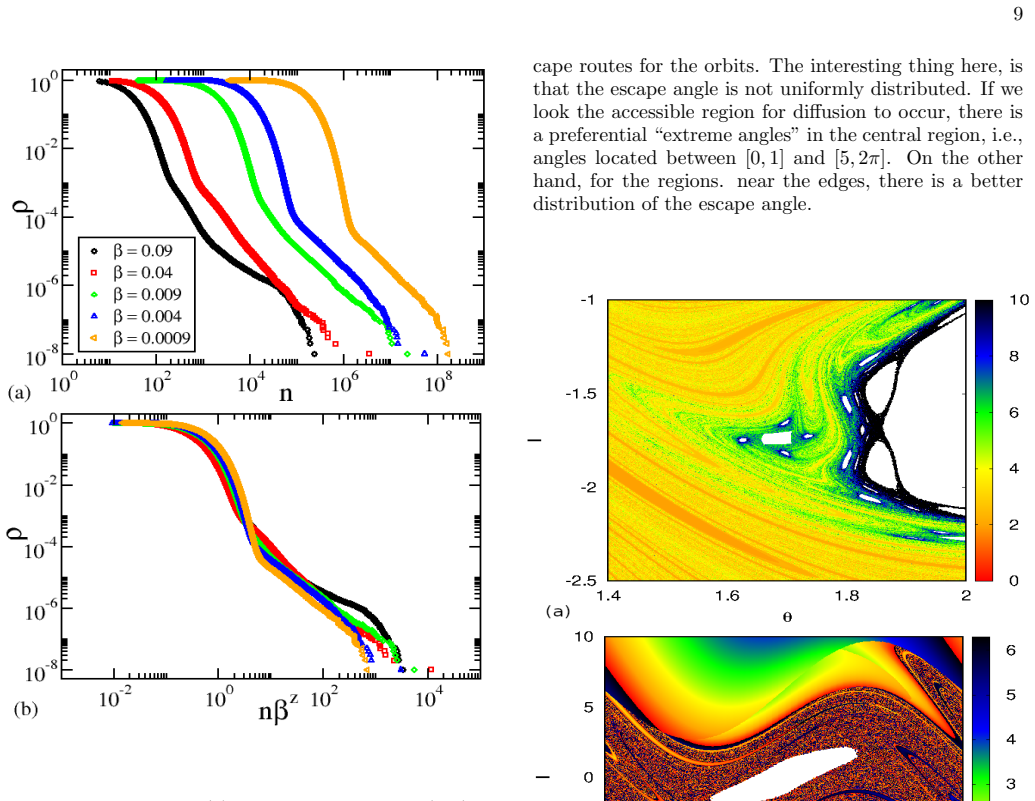
The relativistic standard map displays mixed phase space whose axial symmetry breaks as β decreases, allowing diffusion in action that bends to saturation at long times; the diffusion curves for varying β collapse under appropriate rescaling, and survival probabilities decay exponentially before crossing to power-law tails whose rates also obey a scaling law that slows escape as β drops.
What carries the argument
The relativistic standard map obtained from the wave-packet Hamiltonian, controlled by the nonlinearity K and the relativity parameter β that governs the shift from near-integrable to diffusive regimes.
If this is right
- Root-mean-square action saturates after initial growth, with the saturation value set by β.
- Perfect collapse of diffusion curves for different β demonstrates scaling invariance.
- Survival-probability decay rates become slower with decreasing β and obey the same scaling relation.
- An invariant curve appears at smaller β that limits diffusion and removes axial symmetry.
Where Pith is reading between the lines
- The β-scaling may generalize to other relativistic chaotic maps and help model relativistic particle beams in accelerators.
- Physical realizations approximating the wave-packet dynamics could directly test the predicted saturation levels and escape slowdown.
- β functions as a continuous knob that interpolates between integrable and diffusive transport without changing K.
Load-bearing premise
The map derived from the wave-packet Hamiltonian is assumed to capture the essential transport without higher-order relativistic corrections or quantum effects that would change the observed scaling.
What would settle it
Numerical integration of the full wave-packet dynamics or an experiment measuring particle action distributions that fails to produce the predicted collapse of diffusion curves or the β-dependent slowing of escape rates would falsify the scaling claims.
Figures




read the original abstract
We investigate some statistical and transport properties of the relativistic standard map. Through the Hamiltonian of a wave packet under an electric potential, we are able to obtain a relativistic version of the standard map, where there are two control parameters that rule the dynamics: K, which is the classical intensity parameter, and {\beta}, which controls the relativity. The phase space is mixed and exhibits confined local chaos for {\beta} near unity, approaching integrability. As {\beta} is diminished (entering the semi-classical regime), diffusion in the action variable begins to occur. However, the phase space loses its axial symmetry and an invariant curve appears to limit the diffusion as {\beta} gets smaller. We investigate the diffusion in the action variable as a function of the number of iterations, showing that the root mean square action grows initially and bends towards a saturation regime for long times. Scaling properties were established for this behavior as a function of {\beta}, and a perfect collapse of the curves was obtained, indicating scaling invariance. Additionally, we investigated the transport properties concerning the survival probability of initial conditions. The decay rates of the survival probability are mainly exponential, followed by power-law tails. As we vary the value of {\beta}, the escape rates become slower and also obey a scaling law in their decay.
Editorial analysis
A structured set of objections, weighed in public.
Referee Report
Summary. The manuscript derives a relativistic standard map from the Hamiltonian of a wave packet under an electric potential, introducing control parameters K (nonlinearity) and β (relativity). It examines the resulting mixed phase space, which approaches integrability near β ≈ 1 but develops diffusion in the action variable for smaller β, bounded by an emergent invariant curve. Numerical iterations show initial growth of the root-mean-square action followed by saturation; scaling collapses versus β are reported as evidence of invariance. Survival probabilities exhibit exponential decay with power-law tails, with escape rates slowing and obeying β-dependent scaling.
Significance. If the wave-packet map remains faithful and the numerical collapses are robust, the work would establish concrete scaling relations for transport in a relativistic chaotic system, linking classical diffusion saturation to semi-classical regimes. The data-collapse demonstrations are a methodological strength that could be cited in studies of relativistic plasmas or particle accelerators, though the overall impact hinges on addressing the approximation validity and statistical controls.
major comments (3)
- [map derivation] Section on map derivation: the wave-packet Hamiltonian truncation is used to obtain the two-parameter map, yet no explicit check (e.g., comparison of retained versus omitted O(β^{-2}) terms or stability of the bounding invariant curve) is performed for the β range where diffusion and saturation are reported; if higher-order corrections shift the curve, the observed scaling collapses would be artifacts of the reduced model rather than properties of the intended relativistic dynamics.
- [diffusion analysis] Diffusion and scaling section: the RMS action curves and their β-dependent collapses are presented without ensemble sizes, error bars, or comparisons to alternative functional forms (e.g., logarithmic versus power-law saturation); this absence directly affects the load-bearing claim of 'perfect collapse' and scaling invariance.
- [transport properties] Survival probability section: the reported scaling law for escape rates is inferred from numerical decay curves alone, without a theoretical derivation from the map or a test against known scaling in the non-relativistic standard map; the claim that rates 'obey a scaling law' therefore rests on phenomenology whose robustness cannot be assessed from the given data.
minor comments (2)
- [figures] Figure captions for the phase-space plots and diffusion curves should explicitly state the number of initial conditions, iteration counts, and β values used to generate each panel.
- [methods] The definition of the action variable and the precise form of the relativistic map (including any rescaling) should be collected in a single equation block for clarity.
Simulated Author's Rebuttal
We thank the referee for the careful reading and constructive comments on our manuscript. We address each major comment point by point below, indicating the revisions planned for the updated version.
read point-by-point responses
-
Referee: [map derivation] Section on map derivation: the wave-packet Hamiltonian truncation is used to obtain the two-parameter map, yet no explicit check (e.g., comparison of retained versus omitted O(β^{-2}) terms or stability of the bounding invariant curve) is performed for the β range where diffusion and saturation are reported; if higher-order corrections shift the curve, the observed scaling collapses would be artifacts of the reduced model rather than properties of the intended relativistic dynamics.
Authors: We acknowledge that the derivation relies on a controlled truncation of the wave-packet Hamiltonian. The manuscript justifies the approximation for the β range studied by noting that the retained terms dominate when β is not too small. In the revision we will add a quantitative comparison of the omitted O(β^{-2}) terms versus retained terms for representative β values (0.2–0.8) used in the diffusion analysis. We will also include a numerical robustness test in which small perturbations consistent with truncation error are added to the map; the persistence of the bounding invariant curve and the associated saturation will be verified. revision: yes
-
Referee: [diffusion analysis] Diffusion and scaling section: the RMS action curves and their β-dependent collapses are presented without ensemble sizes, error bars, or comparisons to alternative functional forms (e.g., logarithmic versus power-law saturation); this absence directly affects the load-bearing claim of 'perfect collapse' and scaling invariance.
Authors: We agree that the statistical controls were insufficiently documented. The revised manuscript will explicitly state the ensemble size (typically 10^4 initial conditions per β value), add standard-error bars to the RMS-action plots, and include a supplementary comparison of saturation forms. The data favor a power-law saturation over a logarithmic one, as quantified by lower residuals, thereby supporting the reported scaling collapse. revision: yes
-
Referee: [transport properties] Survival probability section: the reported scaling law for escape rates is inferred from numerical decay curves alone, without a theoretical derivation from the map or a test against known scaling in the non-relativistic standard map; the claim that rates 'obey a scaling law' therefore rests on phenomenology whose robustness cannot be assessed from the given data.
Authors: The scaling is phenomenological, consistent with the numerical focus of the work. In the revision we will add a direct comparison to the non-relativistic standard map (β → 0 limit) and demonstrate that the escape-rate scaling collapse holds across several K values. A complete analytical derivation of the scaling exponent lies beyond the present numerical study; the robustness is nevertheless evidenced by the data collapses already shown. revision: partial
Circularity Check
No circularity: scaling and transport results are numerical observations from iterated map dynamics
full rationale
The paper first derives the two-parameter relativistic standard map from the wave-packet Hamiltonian (an independent modeling step) and then reports purely numerical measurements of action diffusion and survival probabilities. The reported scaling collapses and β-dependent decay laws are obtained by direct iteration and data collapse on the simulated trajectories; they are not obtained by fitting a parameter to a subset and renaming the fit as a prediction, nor by any self-definitional equation that equates the output to the input by construction. No load-bearing self-citations or uniqueness theorems appear in the supplied text, and the central claims remain falsifiable by external simulation of the same map or by higher-order relativistic corrections.
Axiom & Free-Parameter Ledger
free parameters (2)
- K
- β
axioms (2)
- domain assumption The map obtained from the wave-packet Hamiltonian under periodic electric potential is an accurate discrete-time model of the relativistic dynamics.
- standard math Numerical iteration of the map for finite time approximates the infinite-time transport properties.
Reference graph
Works this paper leans on
-
[1]
J. D. Meiss, Chaos,25, 097602, (2015)
2015
-
[2]
A. J. Lichtenberg and M. A. Lieberman,Regular and Chaotic Dynamics. Appl. Math. Sci. 38, Springer Verlag, New York, 1992
1992
-
[3]
G. M. Zaslasvsky,Physics of Chaos in Hamiltonian Sys- tens, Imperial College Press, New York (2007)
2007
-
[4]
G. M. Zaslasvsky,Hamiltonian Chaos and Fractional Dy- namics, Oxford University Press, New York (2008)
2008
-
[5]
Chaos, Scattering and Statistical Mechan- ics
P. Gaspard,“Chaos, Scattering and Statistical Mechan- ics”, Cambridge: Cambridge University Press, (1998)
1998
-
[6]
E. G. Altmann, J. S. E. Portela, and T. T´ el, Rev. Mod. Phys.,85, 869, (2013)
2013
-
[7]
M. R. Sales, M. Mugnaine, J. D. Szezech, R. L. Viana, I. L. Caldas, N. Marwan, J. Kurths, Chaos,33, 033140, (2023)
2023
-
[8]
M. S. Palmero, G. I. D´ ıaz, P. V. E. McClintock, E. D. Leonel, Chaos,30, 013108,(2020)
2020
-
[9]
Borin, A
D. Borin, A. L. P. Livorati, E. D. Leonel, Chaos, Solitons and Fractals,175, 113965, (2023)
2023
-
[10]
Borin, Phys
D. Borin, Phys. Rev. E,110, 064227, (2024)
2024
-
[11]
M. S. Palmero, I. L Caldas, I. M. Sokolov, Chaos,32, 113144 ,(2022)
2022
-
[12]
A. L. P. Livorati, Phys. Lett. A,381, 2214, (2017)
2017
-
[13]
C. P. Dettmann, and E. D. Leonel, Physica D,241, 403, (2012)
2012
-
[14]
E. D. Leonel, and C. P. Dettmann, Phys. Lett. A,376, 1669, (2012)
2012
-
[15]
A. L. P. Livorati, T. Kroetz, C. P. Dettmann, I. L. Cal- das, and E. D. Leonel, Phys. Rev. E,86, 036203, (2012)
2012
-
[16]
A. L. P. Livorati, C. P. Dettmann, I. L. Caldas, and E. D. Leonel, Chaos,25, 103107, (2015)
2015
-
[17]
A. L.P. Livorati, M. S. Palmero, G. D´ ıaz, C. P Dettmann, I. L. Caldas, E. D. Leonel, Commu. Nonl. Sci. Num. Simmu.,55, 225, (2018)
2018
-
[18]
Contopoulos, and M
G. Contopoulos, and M. Harsoula, Celest. Mech. Dyn. Astr.,107, 77, (2010)
2010
-
[19]
Contopoulos, and M
G. Contopoulos, and M. Harsoula, Int. J. Bif. and Chaos, 20, 2005,(2010)
2005
-
[20]
del-Castillo-Negrete, B
D. del-Castillo-Negrete, B. A. Carreras, and V. E. Lynch, Phys. Rev. Lett.,94, 065003 (2005)
2005
-
[21]
Kroetz, M
T. Kroetz, M. Roberto, E. C. da Silva, I. L. Caldas, and R. L. Viana, Phys. of Plasmas,15, 092310 (2008)
2008
-
[22]
J. S. E. Portela, I. L. Caldas, R. L. Viana, Eur. Phys. J. Spec. Top.,165, 195, (2008)
2008
-
[23]
L. C. Souza, M. R. Sales, M. Mugnaine, J. D. Szezech Jr, I.L. Caldas, R.L. Viana, Phys. Rev. E,109, 015202, (2024)
2024
-
[24]
M. S. Palmero, I. L. Caldas, Fund. Plasma Phys.,8, 100027, (2023)
2023
-
[25]
L. A. Osorio-Quiroga, M. Roberto, I.L. Caldas, R.L. Viana, Y. Elskens, Fund. Plasma Phys.,6, 100023, (2023)
2023
-
[26]
L. A. Osorio-Quiroga, M. Roberto, R.L. Viana, Y. Elskens, I.L. Caldas, Phys. of Plasmas,31, 122302,(2024)
2024
-
[27]
T. H. Solomon, E. R. Weeks, and H. L. Swinney, Phys. Rev. Lett.,71, 3975, (1993)
1993
-
[28]
E. G. Altmann, Phys. Rev. A,79, 013830, (2009)
2009
-
[29]
T´ el, A
T. T´ el, A. de Moura, C. Grebogi, and G. K´ arolyi, Phys. Rep.,413, 91, (2005)
2005
-
[30]
L. A. Bunimovich, Nonlinearity,21,T13, (2008)
2008
-
[31]
C. P. Dettmann, Frontiers in the study of chaotic dynam- ical systems with open problems (Ed. Z. Elhadj and J. C. Sprott, World Scientific, 2011)
2011
-
[32]
A. A. Chernikov, T. T´ el, G. Vattay, G. M. Zaslavsky, Phys. Rev. A,40, 4072, 1989
1989
-
[33]
Nomura, Y
Y. Nomura, Y. H. Ichikawa, W. Horton, Phys. Rev. A, 45, 1103, (1992). 11
1992
-
[34]
G. M. Zaslavsky, R. Z. Sagdeev, D. A. Usikov, A. A. Chernikov, Weak Chaos and Quasi-Regular Patterns, Cambridge Nonlinear Science Series, Cambridge Univer- sity Press, 1991
1991
-
[35]
R. Z. Sagdeev, G. M. Zaslavsky,Non-linear phenom- ena in plasma physics and hydrodynamics. Editor R.E. Sagdeev, Mir Publishers, Moscow, 1986
1986
-
[36]
C. E., C. Joshi, C. Darrow, D. Umstadter, F. F. Chen., IEEE Trans. Nucl. Sci.,32, 3551, (1985)
1985
-
[37]
Tajima and J
T. Tajima and J. M. Dawson, Phys. Rev. Lett.,43, 267, (1979)
1979
-
[38]
C. E. Clayton, C. Joshi, C. Darrow, and D. Umstadter, Phys. Rev. Lett.,54, 2343, (1985)
1985
-
[39]
Aubry, Springer Series in Solid-State Sciences,8, 264, (1978)
S. Aubry, Springer Series in Solid-State Sciences,8, 264, (1978)
1978
-
[40]
Axel and S
F. Axel and S. Aubry, J. Phys. A,20, 4873, (1987)
1987
-
[41]
D. F. M. Oliveira, M. Robnik and E. D. Leonel, Chaos, 21, 043122, (2011)
2011
-
[42]
D. F. M. Oliveira, M. Robnik and E. D. Leonel, Chaos, Solitons and Fractals,44, 883, (2011)
2011
-
[43]
D. F. M. Oliveira, E. D. Leonel and M. Robnik, Phys. Lett. A,375, 3365, (2011)
2011
-
[44]
Ciubotariu, L
C. Ciubotariu, L. Badelita and V. Stancu, Chaos, Soli- tons and Fractals,13, 1253, (2002)
2002
-
[45]
B. L. Lan and C. Yapp, Chaos, Solitons and Fractals,37, 1300, (2008)
2008
-
[46]
B. V. Chirikov, Phys. Rep.52, 263, (1979)
1979
-
[47]
E. D. Leonel, J. A. de Oliveira, and F. Saif, J. Phys. A, 44, 302001, (2011)
2011
-
[48]
J. D. V. Hermes, M. Hansen, S. S. Muni, E. D. Leonel, I. L.Caldas, Chaos,35, 033132, (2025)
2025
-
[49]
J. A. M´ endez-Berm´ udez, A. J. Mart´ ınez-Mendoza, A. L. P. Livorati, and E. D. Leonel, J. Phys. A,48, 405101, (2015)
2015
-
[50]
A. L. P Livorati, O. Georgiou, C. P. Dettmann, and E. D. Leonel, Phys. Rev. E,89, 052913, (2014)
2014
discussion (0)
Sign in with ORCID, Apple, or X to comment. Anyone can read and Pith papers without signing in.