Recognition: 2 theorem links
· Lean TheoremInvestigating Ethical Data Communication with Purrsuasion: An Educational Game about Negotiated Data Disclosure
Pith reviewed 2026-05-10 18:36 UTC · model grok-4.3
The pith
Difficulties envisioning an ideal visualization solution lead to satisficing in visualization authoring and difficulties attributing authorial intent.
A machine-rendered reading of the paper's core claim, the machinery that carries it, and where it could break.
Core claim
Purrsuasion demonstrates that when data providers must design visualizations subject to constraints on full disclosure, they often satisfice by creating visualizations that fall short of ideal solutions, and data seekers have trouble correctly inferring the authors' intent behind those choices.
What carries the argument
Purrsuasion, the open-source game in which one player designs visualizations under disclosure limits while the other requests information and awards a contract, to observe real-time ethical judgments and communication.
If this is right
- Visualization courses should include exercises that help students practice envisioning optimal disclosure solutions before they begin authoring.
- Evaluation of student work in ethics contexts requires a rubric that blends adherence checks with sociotechnical context rather than automated metrics alone.
- Games simulating provider-seeker negotiation can surface trust formation and problem-solving dynamics that are hard to observe in traditional assignments.
- Authoring tools might incorporate prompts or previews that reduce the cognitive load of imagining full-disclosure alternatives.
Where Pith is reading between the lines
- If visualization software offered quick ways to compare constrained designs against fuller versions, satisficing might decrease even outside educational settings.
- The same negotiation patterns could appear in other constrained decision domains such as privacy settings or report redaction.
- Longer-term classroom use of the game could test whether repeated exposure reduces intent attribution difficulties over time.
Load-bearing premise
The classroom game mechanics and undergraduate student sample produce behaviors and judgments that generalize to professional ethical data disclosure negotiations.
What would settle it
A study in which professional data practitioners play the same game and show no satisficing or intent attribution problems would directly challenge the central claim.
Figures




read the original abstract
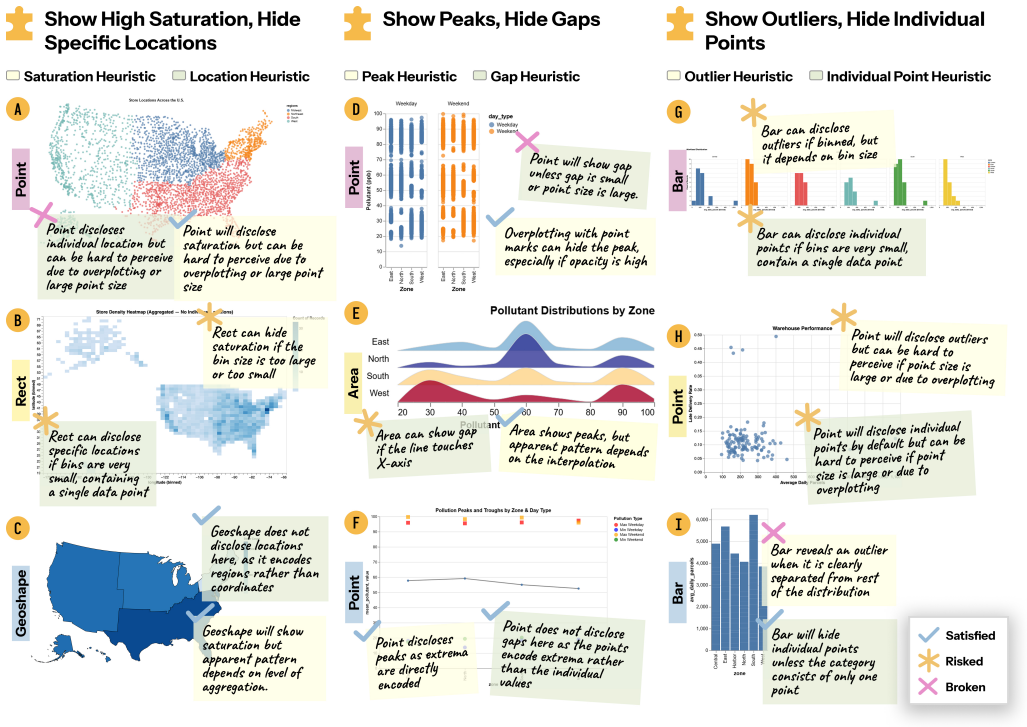
Data communication entails ethical dilemmas where situational constraints forbid full disclosure of source data. Whereas visualization research and pedagogy often frames ethics as a matter of individuals making deceptive design choices or being misled, disclosure problems involve negotiation between pro-social actors. To provide observability into these situated judgments, we contribute Purrsuasion, an open-source visualization game where participants play the roles of (i) data providers designing visualizations subject to disclosure constraints and (ii) data seekers requesting information and awarding a contract. We deploy Purrsuasion in an undergraduate data science class (N = 27), gathering gameplay data to support a mixed-methods analysis of students' communication dynamics, problem solving, and trust formation. We find that difficulties envisioning an ideal visualization solution lead to satisficing in visualization authoring and difficulties attributing authorial intent. Given these challenges, we approach scoring student solutions by developing a heuristic rubric that supports sociotechnical judgments of disclosure adherence.
Editorial analysis
A structured set of objections, weighed in public.
Referee Report
Summary. The paper introduces Purrsuasion, an open-source game in which players alternate between data-provider and data-seeker roles to negotiate visualization-based disclosure under situational constraints. Deployed in a single undergraduate data-science class (N=27), the work collects gameplay logs, reflections, and rubric scores to perform a mixed-methods analysis of communication dynamics, problem solving, and trust formation. The central empirical claim is that difficulties envisioning an ideal visualization solution produce satisficing in authoring and difficulties attributing authorial intent; a heuristic rubric is developed to support sociotechnical scoring of disclosure adherence.
Significance. If the observational patterns hold under broader testing, the contribution is a concrete, observable platform for studying negotiated (rather than unilateral) ethical dilemmas in data visualization, together with an open-source artifact and a rubric that could be reused in pedagogy and research. The shift from individual deception to pro-social negotiation is a useful reframing for the visualization-ethics literature.
major comments (2)
- [Methods] Methods / Deployment: The study rests on a single classroom deployment with N=27 undergraduates and no control condition, baseline comparison, professional cohort, or external validation of the heuristic rubric. Because the central claims about satisficing and intent attribution are drawn directly from these observational logs and reflections, the absence of any contrast leaves open whether the reported behaviors are inherent to negotiated disclosure or artifacts of low-stakes student incentives and limited domain expertise.
- [Analysis] Analysis: No inter-rater reliability, inter-coder agreement statistics, or validation of the heuristic rubric against expert judgments are reported. Since the mixed-methods findings and the scoring of disclosure adherence depend on this rubric, the lack of reliability evidence is load-bearing for the trustworthiness of the quantitative component of the analysis.
minor comments (3)
- [Abstract] Abstract: The abstract states the sample size and key finding but does not mention the absence of controls or the exploratory nature of the rubric; adding one sentence on scope would help readers calibrate expectations.
- [Game Design] Game description: The precise mechanics by which disclosure constraints are enforced (e.g., what information is hidden from which role) could be clarified with a short example or table so that readers can judge whether the observed satisficing is driven by the constraint design itself.
- [Discussion] Discussion: The manuscript could more explicitly temper the generalizability claim by stating that the patterns are observed in an educational setting and require further testing with practitioners.
Simulated Author's Rebuttal
We thank the referee for their constructive and detailed feedback. We address each major comment below, indicating revisions where appropriate to strengthen the manuscript while preserving the exploratory nature of the study.
read point-by-point responses
-
Referee: [Methods] Methods / Deployment: The study rests on a single classroom deployment with N=27 undergraduates and no control condition, baseline comparison, professional cohort, or external validation of the heuristic rubric. Because the central claims about satisficing and intent attribution are drawn directly from these observational logs and reflections, the absence of any contrast leaves open whether the reported behaviors are inherent to negotiated disclosure or artifacts of low-stakes student incentives and limited domain expertise.
Authors: We agree that the single-classroom deployment with N=27 limits generalizability and that the absence of controls or external cohorts leaves open questions about whether the observed patterns are specific to this educational context. The study was intentionally designed as an initial, naturalistic exploration to generate observable data on negotiated disclosure using the Purrsuasion artifact. In the revised manuscript we will add a dedicated Limitations section that explicitly discusses the single deployment, lack of baseline comparisons, potential effects of low-stakes incentives, and student expertise levels. We will also outline concrete plans for future work with professional cohorts and controlled designs to test broader applicability. The current contribution centers on the open-source game and heuristic rubric as reusable tools rather than on definitive causal claims. revision: partial
-
Referee: [Analysis] Analysis: No inter-rater reliability, inter-coder agreement statistics, or validation of the heuristic rubric against expert judgments are reported. Since the mixed-methods findings and the scoring of disclosure adherence depend on this rubric, the lack of reliability evidence is load-bearing for the trustworthiness of the quantitative component of the analysis.
Authors: We acknowledge that explicit reliability reporting would improve transparency for the heuristic rubric. The rubric was developed iteratively by the authors through repeated review of gameplay logs and reflections to support sociotechnical scoring. In the revision we will expand the Methods section with a detailed description of the rubric's iterative development process and will compute and report inter-coder agreement (e.g., Cohen's kappa) on a sample of the scored data to quantify consistency. We note that the rubric's interpretive elements make perfect agreement unlikely, but the added statistics will allow readers to better assess its application. revision: yes
Circularity Check
No significant circularity; empirical observations drawn directly from study data
full rationale
The paper describes the design and deployment of an educational game (Purrsuasion) in a classroom setting, followed by mixed-methods analysis of gameplay logs, student reflections, and rubric scores. No equations, fitted parameters, predictive models, or derivation chains appear in the provided text. Central claims about satisficing and intent attribution are presented as direct findings from the N=27 participant data rather than reductions to prior self-citations or self-definitions. The study is self-contained against its own empirical inputs with no load-bearing self-citation or ansatz smuggling.
Axiom & Free-Parameter Ledger
Lean theorems connected to this paper
-
IndisputableMonolith/Foundation/AbsoluteFloorClosure.leanreality_from_one_distinction unclear?
unclearRelation between the paper passage and the cited Recognition theorem.
We find that difficulties envisioning an ideal visualization solution lead to satisficing in visualization authoring and difficulties attributing authorial intent.
-
IndisputableMonolith/Cost/FunctionalEquation.leanwashburn_uniqueness_aczel unclear?
unclearRelation between the paper passage and the cited Recognition theorem.
heuristic rubric that supports sociotechnical judgments of disclosure adherence
What do these tags mean?
- matches
- The paper's claim is directly supported by a theorem in the formal canon.
- supports
- The theorem supports part of the paper's argument, but the paper may add assumptions or extra steps.
- extends
- The paper goes beyond the formal theorem; the theorem is a base layer rather than the whole result.
- uses
- The paper appears to rely on the theorem as machinery.
- contradicts
- The paper's claim conflicts with a theorem or certificate in the canon.
- unclear
- Pith found a possible connection, but the passage is too broad, indirect, or ambiguous to say the theorem truly supports the claim.
Reference graph
Works this paper leans on
-
[1]
Rensink, Enrico Bertini, and Jean-Daniel Fekete
E. Adar and E. Lee-Robbins. Roboviz: A Game-Centered Project for Information Visualization Education.IEEE Transactions on Visualization and Computer Graphics, 29(1):268–277, Jan. 2023. doi: 10.1109/TVCG. 2022.3209402 2
-
[2]
P. Adelberger, O. Lesota, K. Eckelt, M. Schedl, and M. Streit. Iguanodon: A code-breaking game for improving visualization construction literacy. IEEE Transactions on Visualization and Computer Graphics, 31(9):5713– 5725, 2025. doi: 10.1109/TVCG.2024.3468948 2
-
[3]
D. Akbaba, L. Klein, and M. Meyer. Entanglements for visualization: Changing research outcomes through feminist theory.IEEE Transactions on Visualization and Computer Graphics, 31(1):1279–1289, Jan. 2025. doi: 10.1109/TVCG.2024.3456171 2, 8
- [4]
-
[5]
S. Bai, K. F. Hew, and B. Huang. Does gamification improve student learn- ing outcome? evidence from a meta-analysis and synthesis of qualitative data in educational contexts.Educational Research Review, 30:100322,
-
[6]
doi: 10.1016/j.edurev.2020.100322 2
-
[7]
E. Brandt and J. Messeter. Facilitating collaboration through design games. InProceedings of the Eighth Conference on Participatory Design: Artful Integration: Interweaving Media, Materials and Practices - Volume 1, PDC 04, pp. 121–131. Association for Computing Machinery, New York, NY , USA, 2004. doi: 10.1145/1011870.1011885 2, 9
-
[8]
J. D. Camba, P. Company, and V . L. Byrd. Identifying deception as a critical component of visualization literacy.IEEE Computer Graphics and Applications, 42(1):116–122, 2022. doi: 10.1109/MCG.2021.3132004 2
-
[9]
M. Correll. Ethical dimensions of visualization research. InProceedings of the 2019 CHI Conference on Human Factors in Computing Systems, CHI ’19, pp. 1–13. Association for Computing Machinery, New York, NY , USA, 2019. doi: 10.1145/3290605.3300418 2
-
[10]
M. Correll, E. Bertini, and S. Franconeri. Truncating the y-axis: Threat or menace? InProc. CHI, pp. 1–12. ACM, New York, 2020. doi: 10. 1145/3313831.3376222 1, 2
-
[11]
Correll and J
M. Correll and J. Heer. Black hat visualization. InWorkshop on Dealing with Cognitive Biases in Visualisations (DECISIVe), IEEE VIS, vol. 1, p. 10, 2017. https://idl.cs.washington.edu/files/2017-Bla ckHatVis-DECISIVe.pdf. 1, 2, 5
2017
-
[13]
IEEE Transactions on Pattern Analysis and Machine Intelligence (2025)
Z. Cutler, J. Wilburn, H. Shrestha, Y . Ding, B. Bollen, K. A. Nadib et al. Revisit 2: A full experiment life cycle user study framework.IEEE Transactions on Visualization and Computer Graphics, 32(1):13–23, 2026. doi: 10.1109/TVCG.2025.3633896 3
-
[14]
V . Dibia. LIDA: A tool for automatic generation of grammar-agnostic visu- alizations and infographics using large language models. In D. Bollegala, R. Huang, and A. Ritter, eds.,Proceedings of the 61st Annual Meet- ing of the Association for Computational Linguistics (Volume 3: System Demonstrations), pp. 113–126. Association for Computational Linguistic...
-
[15]
M. Dörk, P. Feng, C. Collins, and S. Carpendale. Critical infovis: exploring the politics of visualization. InCHI ’13 Extended Abstracts on Human Factors in Computing Systems, CHI EA ’13, pp. 2189–2198. Association for Computing Machinery, New York, NY , USA, 2013. doi: 10.1145/ 2468356.2468739 2
-
[16]
Ehmel, V
F. Ehmel, V . Brüggemann, and M. Dörk. Topography of violence: consid- erations for ethical and collaborative visualization design. InComputer Graphics Forum, vol. 40, pp. 13–24. Wiley Online Library, 2021. doi: 10. 1111/cgf.14285 2
2021
-
[17]
M. F. A. R. D. T. (FAIR)†, A. Bakhtin, N. Brown, E. Dinan, G. Farina, C. Flaherty et al. Human-level play in the game of <i>diplomacy</i> by combining language models with strategic reasoning.Science, 378(6624):1067–1074, 2022. doi: 10.1126/science.ade9097 2
-
[18]
Friedman, P
B. Friedman, P. H. Kahn, A. Borning, and A. Huldtgren. Value Sensitive Design and Information Systems. In N. Doorn, D. Schuurbiers, I. van de Poel, and M. E. Gorman, eds.,Early Engagement and New Technologies: Opening up the Laboratory, pp. 55–95. Springer Netherlands, Dordrecht,
-
[19]
doi: 10.1007/978-94-007-7844-3_4 9
-
[20]
L. W. Ge, Y . Cui, and M. Kay. Calvi: Critical thinking assessment for literacy in visualizations. InProc. CHI, art. no. 815, 18 pages. ACM, New York, 2023. doi: 10.1145/3544548.3581406 1, 2
-
[21]
L. W. Ge, Y . Cui, and M. Kay. Avec: An assessment of visual encoding ability in visualization construction. InProceedings of the 2025 CHI Conference on Human Factors in Computing Systems, CHI ’25, art. no. 1166, 16 pages. Association for Computing Machinery, New York, NY , USA, 2025. doi: 10.1145/3706598.3713364 2
-
[22]
S. Ghoshal and S. Dasgupta. Design Values in Action: Toward a Theory of Value Dilution. InProceedings of the 2023 ACM Designing Interactive Systems Conference, DIS ’23, pp. 2347–2361. Association for Computing Machinery. doi: 10.1145/3563657.3596122 9
-
[23]
D. G. Jansson and S. M. Smith. Design fixation.Design Studies, 12(1):3– 11, 1991. doi: 10.1016/0142-694X(91)90003-F 5
-
[24]
S. H. Kerns and J. B. Wilmer. Two graphs walk into a bar: Readout- based measurement reveals the bar-tip limit error, a common, categorical misinterpretation of mean bar graphs.Journal of Vision, 21(12):17–17, 11
-
[25]
doi: 10.1167/jov.21.12.17 1
-
[26]
Y . Kim and J. Heer. Assessing effects of task and data distribution on the effectiveness of visual encodings.Computer Graphics Forum, 37(3):157– 167, 2018. doi: 10.1111/cgf.13409 2, 12
-
[27]
Y .-S. Kim, K. Reinecke, and J. Hullman. Data through others’ eyes: The impact of visualizing others’ expectations on visualization interpretation. IEEE Transactions on Visualization and Computer Graphics, 24(1):760– 769, 2018. doi: 10.1109/TVCG.2017.2745240 7
-
[28]
G. Kindlmann and C. Scheidegger. An algebraic process for visualization design.IEEE Trans. Visual Comput. Graphics, 20(12):2181–2190, 2014. doi: 10.1109/TVCG.2014.2346325 1
-
[29]
S. Lee, S.-H. Kim, and B. C. Kwon. Vlat: Development of a visualization literacy assessment test.IEEE Trans. Visual Comput. Graphics, 23(1):551– 560, 2017. doi: 10.1109/TVCG.2016.2598920 1, 2
-
[30]
E. Lee-Robbins and E. Adar. Affective learning objectives for communica- tive visualizations.IEEE Trans. Visual Comput. Graphics, 29(01):1–11, jan 2023. doi: 10.1109/TVCG.2022.3209500 2
-
[31]
L. Y .-H. Lo, A. Gupta, K. Shigyo, A. Wu, E. Bertini, and H. Qu. Misin- formed by visualization: What do we learn from misinformative visualiza- tions? InComput. Graphics Forum, vol. 41, pp. 515–525. Wiley Online Library, 2022. doi: 10.1111/cgf.14559 2
-
[32]
S. Long and M. Kay. To cut or not to cut? a systematic exploration of y-axis truncation. InProc. CHI, CHI ’24, art. no. 207, 12 pages. ACM, New York, 2024. doi: 10.1145/3613904.3642102 1, 2
-
[33]
P. Maddigan and T. Susnjak. Chat2vis: Generating data visualizations via natural language using chatgpt, codex and gpt-3 large language mod- els.IEEE Access, 11:45181–45193, 2023. doi: 10.1109/ACCESS.2023. 3274199 8
-
[34]
T. W. Malone. Toward a theory of intrinsically motivating instruction.Cog- nitive Science, 5(4):333–369, 1981. doi: 10.1207/s15516709cog0504_2 2
-
[35]
Madaio, Luke Stark, Jennifer Wortman Vaughan, and Hanna Wallach
A. McNutt, G. Kindlmann, and M. Correll. Surfacing visualization mi- rages. InIn Proc. CHI, pp. 1–16. ACM, New York, 2020. doi: 10.1145/ 3313831.3376420 1, 2
-
[36]
K. Mehta, G. Kindlmann, and A. Kale. Designing for disclosure in data visualizations.IEEE Transactions on Visualization and Computer Graphics, 32(1):1317–1327, 2026. doi: 10.1109/TVCG.2025.3634781 1, 2, 4, 5, 7, 9
-
[37]
D. Moritz, C. Wang, G. L. Nelson, H. Lin, A. M. Smith, B. Howe et al. Formalizing visualization design knowledge as constraints: Actionable and extensible models in draco.IEEE Transactions on Visualization and Computer Graphics, 25(1):438–448, 2019. doi: 10.1109/TVCG.2018. 2865240 4
-
[38]
S. Pandey and A. Ottley. Mini-vlat: A short and effective measure of visualization literacy.Computer Graphics Forum, 42(3):1–11, 2023. doi: 10.1111/cgf.14809 2
-
[39]
P. Parsons, P. Shukla, and C. Park. Fixation and creativity in data visualiza- tion design: Experiences and perspectives of practitioners. In2021 IEEE Visualization Conference (VIS), pp. 76–80, 2021. doi: 10.1109/VIS49827. 2021.9623297 5
-
[40]
P. C. Parsons and P. C. Shukla. Beyond problem solving: Framing and problem-solution co-evolution in data visualization design.IEEE Transac- tions on Visualization and Computer Graphics, 32(1):24–34, 2026. doi: 10.1109/TVCG.2025.3633866 9
-
[41]
Priyanka, B
N. Priyanka, B. Johes, H. Xi, H. Jessica, and R. Jennie. Visualizing privacy- utility trade-offs in differentially private data releases.Proceedings on Privacy Enhancing Technologies, 2022(2):601–618, 03 2022. doi: 10. 2478/popets-2022-0058 2
2022
-
[42]
N. H. Riche, C. Hurter, N. Diakopoulos, and S. Carpendale.Data-driven storytelling. CRC Press, 2018. doi: 10.1201/9781315281575 2
-
[43]
J. Riegelsberger, M. Sasse, and J. D. McCarthy. The researcher’s dilemma: evaluating trust in computer-mediated communication.International Journal of Human-Computer Studies, 58(6):759–781, 2003. Trust and Technology. doi: 10.1016/S1071-5819(03)00042-9 2
-
[44]
Sarikaya and M
A. Sarikaya and M. Gleicher. Scatterplots: Tasks, data, and designs.IEEE Transactions on Visualization and Computer Graphics, 24(1):402–412,
-
[45]
doi: 10.1109/TVCG.2017.2744184 2, 12
-
[46]
Shneiderman
B. Shneiderman. The eyes have it: A task by data type taxonomy for information visualizations. InThe Craft of Information Visualization, Interactive Technologies, pp. 364–371. Morgan Kaufmann, San Francisco,
-
[47]
doi: 10.1016/B978-155860915-0/50046-9 2, 8, 12
-
[48]
S. L. Star and J. R. Griesemer. Institutional ecology, ‘translations’ and boundary objects: Amateurs and professionals in berkeley’s museum of vertebrate zoology, 1907-39.Social Studies of Science, 19(3):387–420,
1907
-
[49]
doi: 10.1177/030631289019003001 9
-
[50]
H. Subramonyam, B. Lee, S. O’Modhrain, and E. Adar. Data dialog: Fa- cilitating collaborative decision making through data-driven conversations. InProceedings of the 11th EAI International Conference on Pervasive Computing Technologies for Healthcare, pp. 440–443. ACM, Barcelona Spain, May 2017. doi: 10.1145/3154862.3154921 9
-
[51]
H. Subramonyam, R. Pea, C. Pondoc, M. Agrawala, and C. Seifert. Bridg- ing the gulf of envisioning: Cognitive challenges in prompt based interac- tions with llms. InProceedings of the 2024 CHI Conference on Human Factors in Computing Systems, CHI ’24, art. no. 1039, 19 pages. Asso- ciation for Computing Machinery, New York, NY , USA, 2024. doi: 10. 1145/3...
-
[52]
C. Tanner, D. Schmocker, J. Katsarov, and M. Christen. Educating moral sensitivity in business: An experimental study to evaluate the effectiveness of a serious moral game.Computers & Education, 178:104381, 2022. doi: 10.1016/j.compedu.2021.104381 9
-
[53]
Y . Tian, W. Cui, D. Deng, X. Yi, Y . Yang, H. Zhang et al. Chartgpt: Leveraging llms to generate charts from abstract natural language.IEEE Transactions on Visualization and Computer Graphics, 31(3):1731–1745,
-
[54]
doi: 10.1109/TVCG.2024.3368621 8
-
[55]
Tufte.The Visual Display of Quantitative Information
E. Tufte.The Visual Display of Quantitative Information. Graphics Press, Cheshire, Conn., 1983. https://www.edwardtufte.com/book/the -visual-display-of-quantitative-information/. 1
1983
-
[56]
Wilkinson and G
L. Wilkinson and G. Wills. Scagnostics distributions.Journal of Com- putational and Graphical Statistics, 17(2):473–491, 2008. doi: 10.1198/ 106186008X320465 2, 12
2008
-
[57]
E. Wu and R. Cheng. Design-specific transformations in visualization. IEEE VIS BELIV Workshop, 2024. doi: 10.48550/arXiv.2407.06404 1, 5
-
[58]
J. Ye, Y . Li, W. Zou, and X. Wang. From awareness to action: The effects of experiential learning on educating users about dark patterns. In Proceedings of the 2025 CHI Conference on Human Factors in Computing Systems, CHI ’25, art. no. 224, 22 pages. Association for Computing Machinery, New York, NY , USA, 2025. doi: 10.1145/3706598.3713493 2
-
[59]
J. Zacks and B. Tversky. Bars and lines: a study of graphic communication. Memory & cognition, 27(6):1073–1079, 1999. doi: 10.3758/BF03201236 1
-
[60]
Zhang, J
D. Zhang, J. Hartline, and J. Hullman. Designing shared information displays for agents of varying strategic sophistication.Proc. ACM Hum.- Comput. Interact., 8(CSCW1), art. no. 42, 34 pages, Apr. 2024. doi: 10. 1145/3637319 2 A APPENDICES A.1 Show-Hide Puzzle Prompts and Data Generation Designing puzzles at an appropriate difficulty level was highly iter...
2024
discussion (0)
Sign in with ORCID, Apple, or X to comment. Anyone can read and Pith papers without signing in.