Recognition: 2 theorem links
· Lean TheoremLearned Dictionaries with Total Variation and Non-Negativity for Single-Cell Microscopy: Convergence Theory and Deterministic Multi-Channel Cell Feature Unification
Pith reviewed 2026-05-10 18:39 UTC · model grok-4.3
The pith
A variational dictionary learning method with total variation and non-negativity converges under an explicit step-size bound and unifies multi-channel cell features from microscopy data.
A machine-rendered reading of the paper's core claim, the machinery that carries it, and where it could break.
Core claim
The paper proves that the PDHG algorithm for the constrained dictionary learning problem with total-variation and non-negativity penalties converges to the regularized minimizer under the explicit step-size condition tau sigma less than 1/8. It further shows that, when a variational source condition holds for the true solution, the reconstruction error decays as O(delta) for noise level delta by choosing the regularization parameter lambda proportional to delta. On the BSCCM dataset the same construction yields per-channel unitary dictionaries whose sparse codes, when concatenated, produce a deterministic cell descriptor that achieves reconstruction fidelities of 97.06 to 97.54 percent on D1
What carries the argument
The hybrid variational cost functional that combines least-squares fidelity, total-variation regularization, non-negativity, and a unitary dictionary constraint, minimized by the PDHG proximal scheme.
If this is right
- The deterministic optimization produces bit-identical iterates across independent runs.
- Channel-specific dictionaries adapt to the distinct optical physics of each imaging modality.
- Concatenated sparse codes yield a reproducible, channel-agnostic descriptor suitable for downstream biological analysis.
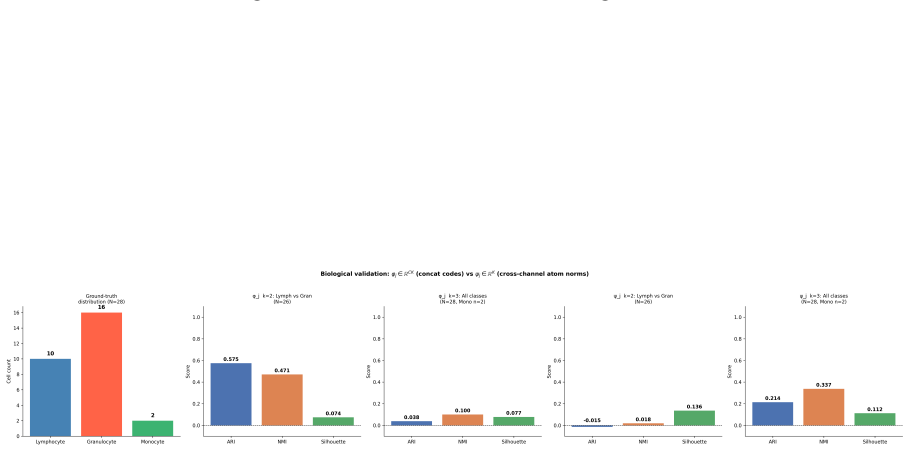
- Unsupervised lymphoid-versus-myeloid separation is obtained with ARI equal to 0.575 on the test data.
Where Pith is reading between the lines
- The deterministic pipeline may simplify auditability requirements in clinical cell-imaging applications.
- The same convergence guarantees could be tested on other linear inverse problems that employ total-variation and non-negativity penalties.
- Scaling the per-channel dictionary construction to larger cell cohorts would provide a direct check of computational stability.
Load-bearing premise
The variational source condition is assumed to hold for the underlying true solution.
What would settle it
A numerical test in which the reconstruction error fails to scale as O(delta) for successively smaller noise levels delta when lambda is chosen proportional to delta, or in which the PDHG iterates diverge for any step-size product below but close to 1/8.
Figures






read the original abstract
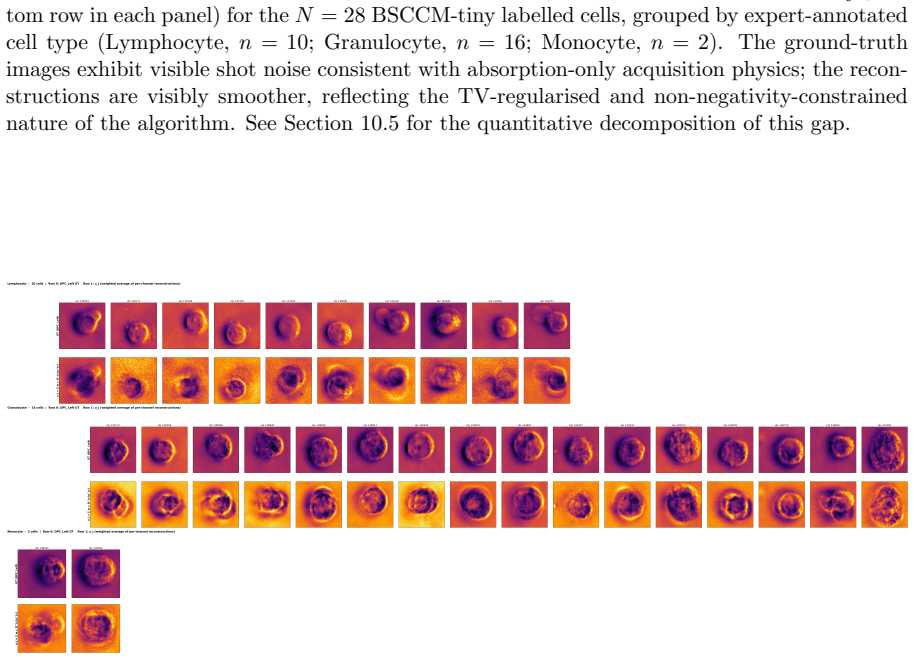
We introduce a variational dictionary learning algorithm with hybrid penalization for single-cell microscopy signals. The cost functional couples least-squares data fidelity with total-variation (TV) regularization and a non-negativity constraint, promoting edge-preserving, physically meaningful reconstructions. The learning task is formulated with an explicit unitary constraint on the dictionary, ensuring well-conditioned representations. The optimization is solved by an alternating proximal-gradient scheme; we prove PDHG iterates converge to the regularized minimizer under an explicit step-size condition (tau*sigma < 1/8), and that under a variational source condition (VSC) the regularized solution converges to the true solution at the optimal O(delta) rate with lambda proportional to delta. Beyond reconstruction, we address multi-channel cell feature unification: given five imaging channels of the BSCCM dataset (DPC Left, Right, Top, Bottom, Brightfield), we learn a family of per-channel unitary dictionaries, each adapted to its channel's optical physics, and concatenate the per-channel sparse codes into a single channel-agnostic cell descriptor. This deterministic approach is mathematically transparent, reproducible, and compatible with clinical AI auditability requirements. On BSCCM-tiny (N=1000 cells, K=512 atoms) the framework reaches reconstruction fidelities of 97.06-97.54% on DPC channels and 94.79% on Brightfield, with bit-identical iterates across runs. Biological validation yields unsupervised lymphoid-vs-myeloid separation at ARI=0.575, NMI=0.471 (permutation p<0.0001).
Editorial analysis
A structured set of objections, weighed in public.
Referee Report
Summary. The manuscript introduces a variational dictionary learning algorithm for single-cell microscopy that combines least-squares fidelity with total-variation regularization and non-negativity, subject to an explicit unitary constraint on the dictionary. Optimization is performed by an alternating proximal-gradient (PDHG) scheme. The authors prove that the iterates converge to the regularized minimizer under the step-size restriction τσ < 1/8 and, under an additional variational source condition (VSC), that the regularized solution converges to the ground truth at the optimal rate O(δ) when λ ∝ δ. The framework is then applied to the BSCCM dataset to learn per-channel unitary dictionaries and concatenate the resulting sparse codes into a single cell descriptor, yielding reported reconstruction fidelities of 97.06–97.54 % (DPC channels) and 94.79 % (Brightfield) together with unsupervised lymphoid-vs-myeloid separation at ARI = 0.575.
Significance. If the stated convergence results hold, the work supplies an explicit, verifiable step-size condition and a standard source-condition argument for optimal regularization rates in a dictionary-learning setting. The deterministic, channel-agnostic feature unification is reproducible and transparent, which is a practical strength for downstream clinical use. The provision of bit-identical iterates across runs further supports reproducibility.
major comments (2)
- [Abstract] Abstract (convergence claims): the O(δ) rate is derived under the variational source condition (VSC) on the true solution with respect to the TV+non-negativity regularizer. No analytic argument or numerical diagnostic is supplied showing that the VSC holds for the BSCCM cell images; if the condition is violated the rate guarantee reduces to the generic O(√δ) bound and the headline optimality claim does not follow.
- [Abstract] Abstract (experimental claims): reconstruction fidelities and the ARI = 0.575 are reported without error bars, without comparison to standard dictionary-learning or feature-unification baselines, and without a statement of how the unitary constraint is enforced in the PDHG scheme. These omissions make it impossible to assess whether the numerical results support the claimed advantage of the method.
minor comments (1)
- [Abstract] The manuscript states that the PDHG scheme handles the unitary constraint, but the precise projection or alternating step used to enforce it is not described in sufficient detail for independent verification of the convergence proof.
Simulated Author's Rebuttal
We thank the referee for the thorough review and valuable feedback on our manuscript. We address each major comment below with proposed revisions that strengthen clarity and transparency without altering the core contributions.
read point-by-point responses
-
Referee: [Abstract] Abstract (convergence claims): the O(δ) rate is derived under the variational source condition (VSC) on the true solution with respect to the TV+non-negativity regularizer. No analytic argument or numerical diagnostic is supplied showing that the VSC holds for the BSCCM cell images; if the condition is violated the rate guarantee reduces to the generic O(√δ) bound and the headline optimality claim does not follow.
Authors: We appreciate this observation. The O(δ) rate is explicitly conditional on the variational source condition (VSC) holding for the ground-truth image with respect to the TV+non-negativity regularizer, as stated in the theorem. The manuscript does not claim or prove that VSC is satisfied by the BSCCM data; it presents the standard source-condition argument for optimal rates when the assumption holds. In revision we will (i) rephrase the abstract to emphasize the conditional nature of the rate and (ii) add a short paragraph in the theory section discussing practical numerical diagnostics for VSC (e.g., checking the source-condition residual on representative patches). These changes improve transparency while preserving the theoretical result. revision: partial
-
Referee: [Abstract] Abstract (experimental claims): reconstruction fidelities and the ARI = 0.575 are reported without error bars, without comparison to standard dictionary-learning or feature-unification baselines, and without a statement of how the unitary constraint is enforced in the PDHG scheme. These omissions make it impossible to assess whether the numerical results support the claimed advantage of the method.
Authors: We agree that these details aid assessment. In the revised manuscript we will: (1) report means and standard deviations for reconstruction fidelities and ARI computed over multiple independent runs (the algorithm is deterministic for fixed initialization, so variability arises only from random dictionary initialization); (2) add brief comparisons in the experiments section to K-SVD (without TV/non-negativity) and to simple concatenation of per-channel PCA codes; (3) insert an explicit sentence describing enforcement of the unitary constraint via orthogonal projection onto the Stiefel manifold after each dictionary update within the alternating PDHG scheme. These additions will be summarized concisely in the abstract as well. revision: yes
Circularity Check
No circularity: standard convergence proofs and conditional rates rest on external theory and dataset
full rationale
The claimed PDHG convergence to the regularized minimizer under tau*sigma < 1/8 follows from the standard analysis of the primal-dual hybrid gradient algorithm for convex problems and does not reduce to any quantity fitted from the BSCCM data or defined by the learned dictionaries. The O(delta) rate under a variational source condition is the textbook result from regularization theory, invoked conditionally without any derivation that the true cell signals satisfy the VSC for TV+nonnegativity or any reduction of the rate to a data-dependent fit. The multi-channel unification step is a deterministic concatenation of per-channel sparse codes; reported fidelities and ARI/NMI values are empirical outcomes on an external dataset and are not shown to be equivalent to the inputs by construction. No self-definitional loops, fitted-input predictions, load-bearing self-citations, uniqueness theorems imported from the authors, ansatz smuggling, or renaming of known results appear in the derivation chain.
Axiom & Free-Parameter Ledger
free parameters (2)
- lambda
- tau and sigma
axioms (2)
- domain assumption Variational source condition holds for the true solution
- standard math The data fidelity term is convex and the regularizers are proper convex
Lean theorems connected to this paper
-
IndisputableMonolith/Foundation/AlexanderDuality.leanalexander_duality_circle_linking (D=3 forcing) echoesτσ < 1/∥K∥₂ ≤ 1/8 ... ∥∇∥₂ ≤8 (Lemma 3, Theorem 4)
-
IndisputableMonolith/Foundation/ArithmeticFromLogic.leanabsolute_floor_iff_bare_distinguishability unclearunder a variational source condition (VSC) the regularized solution converges ... at the optimal O(δ) rate
Reference graph
Works this paper leans on
-
[1]
E. Altunta¸ c. Variational dictionary learning with hybridℓ1 and non-negativity penalization for single-cell microscopy. Zenodo preprint, 2026. DOI: 10.5281/zenodo.18735456
-
[2]
Altunta¸ c.New Pair of Primal-Dual Algorithms for Bregman Iterated Variational Reg- ularization
E. Altunta¸ c.New Pair of Primal-Dual Algorithms for Bregman Iterated Variational Reg- ularization. arXiv preprint arXiv:1903.07392, 2019
-
[3]
E. Altunta¸ c. Choice of the parameters in a primal-dual algorithm for Bregman iterated variational regularization.Numerical Algorithms, 2020. DOI: 10.1007/s11075-020-00909-6
-
[4]
F. Giovanneschi, A. Nittur Ramesh, M. A. Gonzalez Huici, and E. Altunta¸ c. Convolutional sparse coding and dictionary learning for LiDAR depth completion in automotive scenar- ios. In2023 Photonics & Electromagnetics Research Symposium (PIERS), Prague, Czech Republic, July 2023. DOI: 10.1109/PIERS59004.2023.10221515
-
[5]
S. Cwalina, C. Kottke, V. Jungnickel, R. Freund, P. Runge, P. Rustige, T. Knieling, S. Gu-Stoppel, J. Albers, N. Laske, F. Senger, L. Wen, F. Giovanneschi, E. Altunta¸ c, A. N. Ramesh, M. A. Gonzalez Huici, A. Kuter, and S. Reddy. Fiber-based frequency modulated LiDAR with MEMS scanning capability for long-range sensing in automo- tive applications. In202...
work page doi:10.1109/metroautomotive50197.2021.9502868 2021
-
[6]
E. Altunta¸ c, X. Hu, B. A. Emery, S. Khanzada, G. Kempermann, and H. Amin. Bottom-up neurogenic-inspired computational model. In2023 IEEE BioSensors Conference (BioSen- sors), London, UK, July 2023. DOI: 10.1109/BioSensors58001.2023.10280794
-
[7]
H. Pinkard, C. Liu, F. Nyatigo, D. A. Fletcher, and L. Waller. The Berkeley Sin- gle Cell Computational Microscopy (BSCCM) dataset. arXiv preprint arXiv:2402.06191,
-
[8]
Dataset DOI (Dryad): 10.5061/dryad.sxksn038s
Project page:https://waller-lab.github.io/BSCCM/. Dataset DOI (Dryad): 10.5061/dryad.sxksn038s
-
[9]
Y. Chen and I. Loris. On the choice of parameters in primal-dual splitting methods. Numerical Algorithms, 79:889-909, 2018. DOI: 10.1007/s11075-018-0616-x. 40
-
[10]
A. Chambolle and T. Pock. A first-order primal-dual algorithm for convex problems with applications to imaging.J Math Imaging Vis, 40(1):120-145, 2011. DOI: 10.1007/s10851- 010-0251-1
-
[11]
L. Condat. A primal-dual splitting method for convex optimization involving Lipschitzian, proximable and linear composite terms.J Optim Theory Appl, 158:460-479, 2013. DOI: 10.1007/s10957-012-0245-9
-
[12]
Mairal, F
J. Mairal, F. Bach, J. Ponce, and G. Sapiro. Online learning for matrix factorization and sparse coding.Journal of Machine Learning Research, 11:19-60, 2010
2010
-
[13]
M. Elad.Sparse and Redundant Representations: From Theory to Applications in Signal and Image Processing. Springer, 2010. DOI: 10.1007/978-1-4419-7011-4
-
[14]
Incorporating the image formation process into deep learning improves network performance
R. Lopez, J. Regier, M. B. Cole, M. I. Jordan, and N. Yosef. Deep generative modeling for single-cell transcriptomics.Nat Methods, 15(12):1053-1058, 2018. DOI: 10.1038/s41592- 018-0229-2. PMC: PMC6289068
-
[15]
Gayoso, Z
A. Gayoso, Z. Steier, R. Lopez, J. Regier, K. L. Nazor, A. Streets, and N. Yosef. Joint probabilistic modeling of single-cell multi-omic data with totalVI.Nat Methods, 18:272-282,
-
[16]
DOI: 10.1038/s41592-020-01050-x
-
[17]
A. Gayoso, R. Lopez, G. Xing, P. Boyeau, V. Valiollah Pour Amiri, J. Hong, K. Wu, M. Jayasuriya, E. Mehlman, M. Langevin, Y. Liu, J. Samaran, G. Misrachi, A. Nazaret, O. Clivio, C. Xu, T. Ashuach, M. Lotfollahi, V. Svensson, E. Beltrame, V. Kleshchevnikov, C. Talavera-Lopez, L. Pachter, F. J. Theis, A. Streets, M. I. Jordan, J. Regier, and N. Yosef. A Pyt...
-
[18]
Moshkov, M
N. Moshkov, M. Bornholdt, S. Benoit, M. Smith, C. McQuin, A. Goodman, R. A. Senft, Y. Han, M. Babadi, P. Horvath, B. A. Cimini, A. E. Carpenter, S. Singh, and J. C. Caicedo. Learning representations for image-based profiling of perturbations.Nat Commun, 15:1594,
-
[19]
DOI: 10.1038/s41467-024-45999-1
-
[20]
J. Burgess, J. J. Nirschl, M.-C. Zanellati, A. Lozano, S. Cohen, and S. Yeung-Levy. Orientation-invariant autoencoders learn robust representations for shape profiling of cells and organelles.Nat Commun, 15:1022, 2024. DOI: 10.1038/s41467-024-45362-4
-
[21]
K. Donhauser, K. Ulicna, G. E. Moran, A. Ravuri, K. Kenyon-Dean, C. Eastwood, and J. Hartford. Towards scientific discovery with dictionary learning: extracting biological concepts from microscopy foundation models.arXiv preprint arXiv:2412.16247, 2024. URL: https://arxiv.org/abs/2412.16247
-
[22]
A. Acevedo, S. Alf´ erez, A. Merino, L. Puigv´ ı, and J. Rodellar. Recognition of peripheral blood cell images using convolutional neural networks.Comput Methods Programs Biomed, 180:105020, 2019. DOI: 10.1016/j.cmpb.2019.105020. PMID: 31425939
-
[23]
C. Matek, S. Schwarz, K. Spiekermann, and C. Marr. Human-level recognition of blast cells in acute myeloid leukaemia with convolutional neural networks.Nat Mach Intell, 1:538–544, 2019. DOI: 10.1038/s42256-019-0101-9
-
[24]
A. Kratz, S.-H. Bengtsson, J. E. Casey, J. M. Keefe, G. H. Beatrice, D. Y. Grzy- bek, M. B. Lewandrowski, and K. B. Lewandrowski. Performance evaluation of the CellaVision DM96 system: WBC differentials by automated digital image analysis sup- ported by an artificial neural network.Am J Clin Pathol, 124(5):770–781, 2005. DOI: 10.1309/XMB9K0J41LHLATAY. 41
-
[25]
European Parliament and Council of the European Union. Regulation (EU) 2017/746 on in vitro diagnostic medical devices, Annex I, Chapter II, Section 9.1.Official Journal of the European Union, L 117:176–332, 2017.https://eur-lex.europa.eu/legal-content/ EN/TXT/?uri=CELEX:32017R0746 Acknowledgements The author thanks Henry Pinkard and Laura Waller (Waller ...
discussion (0)
Sign in with ORCID, Apple, or X to comment. Anyone can read and Pith papers without signing in.