Recognition: no theorem link
Spike Hijacking in Late-Interaction Retrieval
Pith reviewed 2026-05-10 18:39 UTC · model grok-4.3
The pith
MaxSim pooling concentrates gradients on fewer patches than smoother alternatives in late-interaction retrieval.
A machine-rendered reading of the paper's core claim, the machinery that carries it, and where it could break.
Core claim
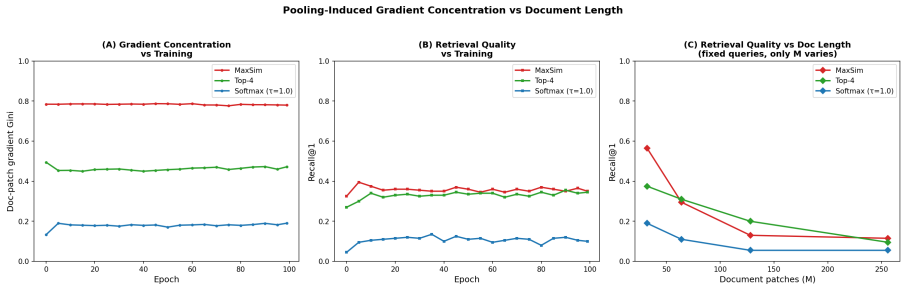
In controlled in-batch contrastive training, MaxSim induces significantly higher patch-level gradient concentration than Top-k pooling and softmax aggregation. While this sparse routing aids early discrimination, it also increases sensitivity to document length: as the number of document patches grows, MaxSim degrades more sharply than mild smoothing variants. The same length-dependent brittleness appears on real multi-vector retrieval benchmarks under controlled document-length sweeps.
What carries the argument
Hard maximum similarity (MaxSim) aggregation, which selects the single highest token-level similarity and thereby concentrates gradients on the winning document patches.
If this is right
- Smoother pooling variants reduce length sensitivity while preserving early discrimination.
- Pooling choice is a structural driver of training dynamics in multi-vector retrieval.
- Document-length sweeps can diagnose pooling-induced brittleness before full-scale deployment.
- Sparse routing trades robustness for early gains, suggesting a need for length-aware aggregation.
Where Pith is reading between the lines
- Similar gradient concentration effects may appear in other winner-take-all layers used for matching or ranking.
- Hybrid pooling that starts sparse and gradually smooths could capture both discrimination and robustness benefits.
- The length sensitivity finding motivates testing adaptive sparsity thresholds that scale with document patch count.
Load-bearing premise
That the controlled synthetic environment with in-batch contrastive training and the document-length sweeps on the real benchmark sufficiently isolate pooling effects from other training and data factors.
What would settle it
Train identical models on the same data but swap only the pooling operator, then measure patch-level gradient norms and retrieval accuracy while sweeping document length; the claim is falsified if MaxSim no longer shows both higher concentration and steeper length degradation.
Figures

read the original abstract
Late-interaction retrieval models rely on hard maximum similarity (MaxSim) to aggregate token-level similarities. Although effective, this winner-take-all pooling rule may structurally bias training dynamics. We provide a mechanistic study of gradient routing and robustness in MaxSim-based retrieval. In a controlled synthetic environment with in-batch contrastive training, we demonstrate that MaxSim induces significantly higher patch-level gradient concentration than smoother alternatives such as Top-k pooling and softmax aggregation. While sparse routing can improve early discrimination, it also increases sensitivity to document length: as the number of document patches grows, MaxSim degrades more sharply than mild smoothing variants. We corroborate these findings on a real-world multi-vector retrieval benchmark, where controlled document-length sweeps reveal similar brittleness under hard max pooling. Together, our results isolate pooling-induced gradient concentration as a structural property of late-interaction retrieval and highlight a sparsity-robustness tradeoff. These findings motivate principled alternatives to hard max pooling in multi-vector retrieval systems.
Editorial analysis
A structured set of objections, weighed in public.
Referee Report
Summary. The paper claims that MaxSim pooling in late-interaction retrieval induces significantly higher patch-level gradient concentration than smoother alternatives (Top-k pooling, softmax aggregation) under in-batch contrastive training. This sparsity improves early discrimination but increases sensitivity to document length, with sharper degradation as patch count grows; the effect is shown in controlled synthetic experiments and corroborated via document-length sweeps on a real multi-vector retrieval benchmark, motivating alternatives to hard max pooling.
Significance. If the central gradient-concentration claim holds after isolating pooling effects, the work supplies a useful mechanistic account of training dynamics in multi-vector retrieval and identifies a concrete sparsity-robustness tradeoff. The synthetic setup with controlled length sweeps is a methodological strength that could generalize to other late-interaction architectures.
major comments (2)
- Synthetic experiments: because the in-batch contrastive loss is computed directly on the pooled (MaxSim or alternative) similarities, any difference in patch-level gradient concentration is necessarily a joint property of the pooling operator and the loss that consumes its output. No ablation that holds the loss fixed while varying only the pooling rule is described, so the attribution of the concentration effect to MaxSim alone is not cleanly established.
- Real-world benchmark section: the document-length sweeps inherit the same ambiguity if the models for each pooling variant were not retrained from identical initializations with every other hyperparameter locked. Without that control, length-dependent brittleness cannot be attributed solely to the pooling operator.
minor comments (2)
- The abstract states that MaxSim 'induces significantly higher' concentration but does not report the number of runs, variance, or statistical test used to support the significance claim.
- Notation for patch-level gradients and the precise definition of 'concentration' (e.g., an equation or algorithm box) would improve reproducibility.
Simulated Author's Rebuttal
We thank the referee for the constructive feedback, which helps clarify the scope of our claims. We address each major comment below by explaining the controls present in our experiments and committing to revisions that make these controls explicit. No new experiments are required; the requested clarifications can be added to the text.
read point-by-point responses
-
Referee: Synthetic experiments: because the in-batch contrastive loss is computed directly on the pooled (MaxSim or alternative) similarities, any difference in patch-level gradient concentration is necessarily a joint property of the pooling operator and the loss that consumes its output. No ablation that holds the loss fixed while varying only the pooling rule is described, so the attribution of the concentration effect to MaxSim alone is not cleanly established.
Authors: We agree that gradient concentration is a joint outcome of the pooling operator and the contrastive loss. Our synthetic experiments hold the loss (in-batch contrastive), model architecture, optimizer, batch construction, and all other training elements fixed while varying only the pooling rule across MaxSim, Top-k, and softmax variants. The observed differences in patch-level gradient concentration are therefore attributable to the pooling operator under this fixed loss. We will revise the experimental setup section to state this control explicitly and to note that the loss remains unchanged across conditions. revision: yes
-
Referee: Real-world benchmark section: the document-length sweeps inherit the same ambiguity if the models for each pooling variant were not retrained from identical initializations with every other hyperparameter locked. Without that control, length-dependent brittleness cannot be attributed solely to the pooling operator.
Authors: Each pooling variant in the real-world benchmark was trained from identical random initializations with all hyperparameters (learning rate, batch size, epochs, embedding dimension, etc.) locked except for the pooling operator. The document-length sweeps then vary only the number of patches at inference time on these fixed models. This isolates the pooling operator as the source of length sensitivity. We will add a dedicated paragraph in the experimental details to document the shared initialization and hyperparameter lock. revision: yes
Circularity Check
No circularity: purely empirical study with direct experimental observations
full rationale
The paper contains no derivations, equations, or first-principles results. All central claims (gradient concentration differences, length sensitivity) are presented as direct outputs of controlled experiments in synthetic in-batch contrastive setups and real-benchmark sweeps. No parameters are fitted then relabeled as predictions, no self-citations serve as load-bearing uniqueness theorems, and no ansatzes or renamings reduce claims to inputs by construction. The work is self-contained against its own experimental benchmarks.
Axiom & Free-Parameter Ledger
Reference graph
Works this paper leans on
-
[1]
ColBERT: Efficient and effective passage search via con- textualized late interaction over bert
author O. Khattab , author M. Zaharia , title ColBERT : Efficient and effective passage search via contextualized late interaction over BERT , in: booktitle Proceedings of the 43rd International ACM SIGIR Conference on Research and Development in Information Retrieval , year 2020 , pp. pages 39--48 . :10.1145/3397271.3401075
-
[2]
Dense Passage Retrieval for Open-Domain Question Answering
author V. Karpukhin , author B. O g uz , author S. Min , author P. Lewis , author L. Wu , author S. Edunov , author D. Chen , author W. tau Yih , title Dense passage retrieval for open-domain question answering , in: booktitle Proceedings of the 2020 Conference on Empirical Methods in Natural Language Processing ( EMNLP ) , year 2020 , pp. pages 6769--678...
-
[3]
In: Inui, K., Jiang, J., Ng, V., Wan, X
author N. Reimers , author I. Gurevych , title Sentence- BERT : Sentence embeddings using siamese BERT -networks , in: booktitle Proceedings of the 2019 Conference on Empirical Methods in Natural Language Processing and the 9th International Joint Conference on Natural Language Processing ( EMNLP-IJCNLP ) , year 2019 , pp. pages 3982--3992 . :10.18653/v1/D19-1410
-
[4]
doi: 10.18653/v1/2022.naacl-main.272
author K. Santhanam , author O. Khattab , author J. Saad-Falcon , author C. Potts , author M. Zaharia , title ColBERTv2 : Effective and efficient retrieval via lightweight late interaction , in: booktitle Proceedings of the 2022 Conference of the North American Chapter of the Association for Computational Linguistics: Human Language Technologies ( NAACL )...
-
[5]
author K. Santhanam , author O. Khattab , author C. Potts , author M. Zaharia , title PLAID : An efficient engine for late interaction retrieval , in: booktitle Proceedings of the 31st ACM International Conference on Information & Knowledge Management ( CIKM ) , year 2022 b , pp. pages 1747--1756 . :10.1145/3511808.3557325
-
[6]
Representation Learning with Contrastive Predictive Coding
author A. van den Oord , author Y. Li , author O. Vinyals , title Representation learning with contrastive predictive coding , journal arXiv preprint arXiv:1807.03748 ( year 2018 )
work page internal anchor Pith review Pith/arXiv arXiv 2018
-
[7]
Gini , title Variabilit\` a e mutabilit\` a : contributo allo studio delle distribuzioni e delle relazioni statistiche
author C. Gini , title Variabilit\` a e mutabilit\` a : contributo allo studio delle distribuzioni e delle relazioni statistiche. [Fasc. I.] , publisher Tipogr. di P. Cuppini , address Bologna , year 1912
1912
-
[8]
author D. P. Kingma , author J. Ba , title Adam: A method for stochastic optimization , in: booktitle International Conference on Learning Representations ( ICLR ) , year 2015 . https://arxiv.org/abs/1412.6980
work page internal anchor Pith review Pith/arXiv arXiv 2015
-
[9]
Faysse , author H
author M. Faysse , author H. Sibille , author T. Wu , title ColQwen2.5-v0.2 : A Qwen2.5-VL -based late-interaction retriever , howpublished https://huggingface.co/vidore/colqwen2.5-v0.2 , year 2024
2024
-
[10]
Faysse , author H
author M. Faysse , author H. Sibille , author T. Wu , author B. Omrani , author G. Viaud , author C. Hudelot , author P. Colombo , title ColPali : Efficient document retrieval with vision language models , in: booktitle International Conference on Learning Representations ( ICLR ) , year 2025
2025
-
[11]
arXiv preprint arXiv:2505.17166 , year=
author Q. Mac\' e , author A. Loison , author M. Faysse , title ViDoRe benchmark V2 : Raising the bar for visual retrieval , journal arXiv preprint arXiv:2505.17166 ( year 2025 )
-
[12]
write newline
" write newline "" before.all 'output.state := FUNCTION n.dashify 't := "" t empty not t #1 #1 substring "-" = t #1 #2 substring "--" = not "--" * t #2 global.max substring 't := t #1 #1 substring "-" = "-" * t #2 global.max substring 't := while if t #1 #1 substring * t #2 global.max substring 't := if while FUNCTION word.in bbl.in ":" * " " * FUNCTION f...
-
[13]
Lamport , title : A Document Preparation System , publisher Addison-Wesley , address Reading, MA
author L. Lamport , title : A Document Preparation System , publisher Addison-Wesley , address Reading, MA. , year 1986
1986
-
[14]
author P. S. Abril , author R. Plant , title The patent holder's dilemma: Buy, sell, or troll? , journal Communications of the ACM volume 50 ( year 2007 ) pages 36--44 . :10.1145/1188913.1188915
-
[15]
Deciding equivalances among conjunctive aggregate queries
author S. Cohen , author W. Nutt , author Y. Sagic , title Deciding equivalances among conjunctive aggregate queries , journal J. ACM volume 54 ( year 2007 ). :10.1145/1219092.1219093
-
[16]
Cohen (Ed.), title Special issue: Digital Libraries , volume volume 39 , year 1996
editor J. Cohen (Ed.), title Special issue: Digital Libraries , volume volume 39 , year 1996
1996
-
[17]
Kosiur , title Understanding Policy-Based Networking , edition 2nd
author D. Kosiur , title Understanding Policy-Based Networking , edition 2nd. ed., publisher Wiley , address New York, NY , year 2001
2001
-
[20]
Editor (Ed.), title The title of book two , The name of the series two, edition 2nd
editor I. Editor (Ed.), title The title of book two , The name of the series two, edition 2nd. ed., publisher University of Chicago Press , address Chicago , year 2008 . :10.1007/3-540-09237-4
-
[21]
author A. Z. Spector , title Achieving application requirements , in: editor S. Mullender (Ed.), booktitle Distributed Systems , edition 2nd. ed., publisher ACM Press , address New York, NY , year 1990 , pp. pages 19--33 . :10.1145/90417.90738
-
[22]
author B. P. Douglass , author D. Harel , author M. B. Trakhtenbrot , title Statecarts in use: structured analysis and object-orientation , in: editor G. Rozenberg , editor F. W. Vaandrager (Eds.), booktitle Lectures on Embedded Systems , volume volume 1494 of series Lecture Notes in Computer Science , publisher Springer-Verlag , address London , year 199...
-
[23]
author D. E. Knuth , title The Art of Computer Programming, Vol. 1: Fundamental Algorithms (3rd. ed.) , publisher Addison Wesley Longman Publishing Co., Inc. , year 1997
1997
-
[24]
author S. Andler , title Predicate path expressions , in: booktitle Proceedings of the 6th. ACM SIGACT-SIGPLAN symposium on Principles of Programming Languages , POPL '79, publisher ACM Press , address New York, NY , year 1979 , pp. pages 226--236 . :10.1145/567752.567774
-
[25]
author S. W. Smith , title An experiment in bibliographic mark-up: Parsing metadata for xml export , in: editor R. N. Smythe , editor A. Noble (Eds.), booktitle Proceedings of the 3rd. annual workshop on Librarians and Computers , volume volume 3 of series LAC '10 , publisher Paparazzi Press , address Milan Italy , year 2010 , pp. pages 422--431 . :99.999...
2010
-
[26]
author M. V. Gundy , author D. Balzarotti , author G. Vigna , title Catch me, if you can: Evading network signatures with web-based polymorphic worms , in: booktitle Proceedings of the first USENIX workshop on Offensive Technologies , WOOT '07, publisher USENIX Association , address Berkley, CA , year 2007
2007
-
[27]
author D. Harel , title LOGICS of Programs: AXIOMATICS and DESCRIPTIVE POWER , type MIT Research Lab Technical Report number TR-200 , Massachusetts Institute of Technology, address Cambridge, MA , year 1978
1978
-
[28]
author K. L. Clarkson , title Algorithms for Closest-Point Problems (Computational Geometry) , Ph.D. thesis, Stanford University, address Palo Alto, CA , year 1985 . note UMI Order Number: AAT 8506171
1985
-
[29]
author D. A. Anisi , title Optimal Motion Control of a Ground Vehicle , Master's thesis, Royal Institute of Technology (KTH), Stockholm, Sweden, year 2003
2003
-
[30]
Thornburg , title Introduction to bayesian statistics , year 2001
author H. Thornburg , title Introduction to bayesian statistics , year 2001 . http://ccrma.stanford.edu/ jos/bayes/bayes.html
2001
-
[31]
Ablamowicz , author B
author R. Ablamowicz , author B. Fauser , title Clifford: a maple 11 package for clifford algebra computations, version 11 , year 2007 . http://math.tntech.edu/rafal/cliff11/index.html
2007
-
[32]
http://www.pkredge.com/statsYYFWWQ.php
author Poker-Edge.Com , title Stats and analysis , year 2006 . http://www.pkredge.com/statsYYFWWQ.php
2006
-
[33]
Obama , title A more perfect union , howpublished Video , year 2008
author B. Obama , title A more perfect union , howpublished Video , year 2008 . http://video.google.com/videoplay?docid=6528042696351994555
2008
-
[34]
Novak , title Solder man , in: booktitle ACM SIGGRAPH 2003 Video Review on Animation theater Program: Part I - Vol
author D. Novak , title Solder man , in: booktitle ACM SIGGRAPH 2003 Video Review on Animation theater Program: Part I - Vol. 145 (July 27--27, 2003) , publisher ACM Press , address New York, NY , year 2003 , p. pages 4 . http://video.google.com/videoplay?docid=6528042696351994555. :99.9999/woot07-S422
2003
-
[35]
Interview with Bill Kinder: January 13, 2005
author N. Lee , title Interview with bill kinder: January 13, 2005 , journal Comput. Entertain. volume 3 ( year 2005 ). :10.1145/1057270.1057278
-
[36]
Scientist , title The fountain of youth , year 2009
author J. Scientist , title The fountain of youth , year 2009 . note Patent No. 12345, Filed July 1st., 2008, Issued Aug. 9th., 2009
2009
-
[37]
Rous , title The enabling of digital libraries , journal Digital Libraries volume 12 ( year 2008 )
author B. Rous , title The enabling of digital libraries , journal Digital Libraries volume 12 ( year 2008 ). note To appear
2008
-
[38]
Saeedi , author M
author M. Saeedi , author M. S. Zamani , author M. Sedighi , title A library-based synthesis methodology for reversible logic , journal Microelectron. J. volume 41 ( year 2010 a ) pages 185--194
2010
-
[39]
Saeedi , author M
author M. Saeedi , author M. S. Zamani , author M. Sedighi , author Z. Sasanian , title Synthesis of reversible circuit using cycle-based approach , journal J. Emerg. Technol. Comput. Syst. volume 6 ( year 2010 b )
2010
-
[40]
author M. Kirschmer , author J. Voight , title Algorithmic enumeration of ideal classes for quaternion orders , journal SIAM J. Comput. volume 39 ( year 2010 ) pages 1714--1747 . http://dx.doi.org/10.1137/080734467. :10.1137/080734467
-
[41]
H \"o rmander , title The analysis of linear partial differential operators
author L. H \"o rmander , title The analysis of linear partial differential operators. IV , volume volume 275 of series Grundlehren der Mathematischen Wissenschaften [Fundamental Principles of Mathematical Sciences] , publisher Springer-Verlag , address Berlin, Germany , year 1985 a . note Fourier integral operators
1985
-
[42]
H \"o rmander , title The analysis of linear partial differential operators
author L. H \"o rmander , title The analysis of linear partial differential operators. III , volume volume 275 of series Grundlehren der Mathematischen Wissenschaften [Fundamental Principles of Mathematical Sciences] , publisher Springer-Verlag , address Berlin, Germany , year 1985 b . note Pseudodifferential operators
1985
-
[43]
IEEE, title Ieee tcsc executive committee , in: booktitle Proceedings of the IEEE International Conference on Web Services , ICWS '04, publisher IEEE Computer Society , address Washington, DC, USA , year 2004 , pp. pages 21--22 . :10.1109/ICWS.2004.64
-
[44]
http://www.tug.org/instmem.html
TUG, title Institutional members of the users group , year 2017 . http://www.tug.org/instmem.html
2017
-
[45]
https://www.R-project.org/
author R Core Team , title R: A language and environment for statistical computing , year 2019 . https://www.R-project.org/
2019
-
[46]
Anzaroot , author A
author S. Anzaroot , author A. McCallum , title UMass citation field extraction dataset , year 2013 . http://www.iesl.cs.umass.edu/data/data-umasscitationfield
2013
discussion (0)
Sign in with ORCID, Apple, or X to comment. Anyone can read and Pith papers without signing in.