Recognition: no theorem link
Extending Tabular Denoising Diffusion Probabilistic Models for Time-Series Data Generation
Pith reviewed 2026-05-10 18:39 UTC · model grok-4.3
The pith
Tabular diffusion models can be extended to generate temporally coherent time-series by adding lightweight adapters and context embeddings for sequences.
A machine-rendered reading of the paper's core claim, the machinery that carries it, and where it could break.
Core claim
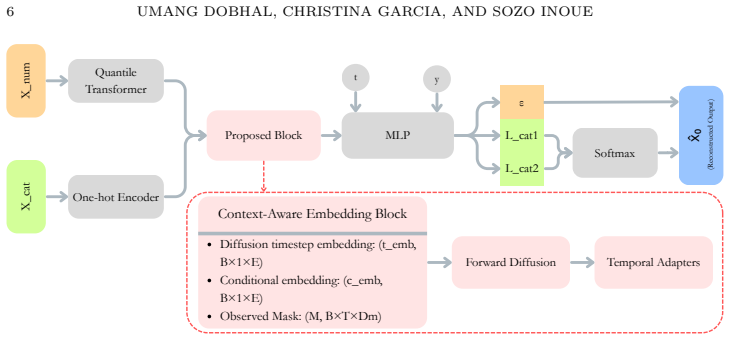
By reformulating sensor data into windowed sequences and explicitly modeling temporal context via timestep embeddings, conditional activity labels, and observed/missing masks, the temporal extension of TabDDPM generates synthetic sequences with improved coherence and realism over baselines and interpolation methods.
What carries the argument
lightweight temporal adapters and context-aware embedding modules that inject sequence awareness into the denoising process
If this is right
- Synthetic time-series preserve statistical properties of real sensor data and support minority class representation in downstream tasks.
- The generated sequences achieve temporal realism measurable through transition matrices and autocorrelation analysis.
- Classification on the synthetic data yields performance close to that obtained from real data.
- The approach provides a flexible way to augment sequential datasets while maintaining alignment with original distributions.
Where Pith is reading between the lines
- The same adapter approach could transfer to other domains with sequential structure such as financial or environmental time series.
- Replacing lightweight adapters with dedicated recurrent or attention-based temporal modules might further strengthen long-range dependency modeling.
- Explicit handling of missing values via masks suggests the method could extend to irregular sampling patterns common in real sensor streams.
Load-bearing premise
That fixed window sizes and the added embeddings capture the necessary temporal dependencies without creating artifacts in the generated sequences.
What would settle it
Direct comparison of autocorrelation functions and bigram transition probabilities between generated and real sequences on data windows longer than those used in training.
Figures



read the original abstract
Diffusion models are increasingly being utilised to create synthetic tabular and time series data for privacy-preserving augmentation. Tabular Denoising Diffusion Probabilistic Models (TabDDPM) generate high-quality synthetic data from heterogeneous tabular datasets but assume independence between samples, limiting their applicability to time-series domains where temporal dependencies are critical. To address this, we propose a temporal extension of TabDDPM, introducing sequence awareness through the use of lightweight temporal adapters and context-aware embedding modules. By reformulating sensor data into windowed sequences and explicitly modeling temporal context via timestep embeddings, conditional activity labels, and observed/missing masks, our approach enables the generation of temporally coherent synthetic sequences. Compared to baseline and interpolation techniques, validation using bigram transition matrices and autocorrelation analysis shows enhanced temporal realism, diversity, and coherence. On the WISDM accelerometer dataset, the suggested system produces synthetic time-series that closely resemble real world sensor patterns and achieves comparable classification performance (macro F1-score 0.64, accuracy 0.71). This is especially advantageous for minority class representation and preserving statistical alignment with real distributions. These developments demonstrate that diffusion based models provide effective and adaptable solutions for sequential data synthesis when they are equipped for temporal reasoning. Future work will explore scaling to longer sequences and integrating stronger temporal architectures.
Editorial analysis
A structured set of objections, weighed in public.
Referee Report
Summary. The paper extends TabDDPM for time-series generation by reformulating sensor data into windowed sequences and introducing lightweight temporal adapters plus context-aware embedding modules that incorporate timestep embeddings, conditional activity labels, and observed/missing masks. This is claimed to produce temporally coherent synthetic sequences. On the WISDM accelerometer dataset, the approach is reported to outperform baselines and interpolation techniques on bigram transition matrices and autocorrelation, while yielding downstream classification performance of macro F1-score 0.64 and accuracy 0.71, with benefits for minority classes and statistical alignment.
Significance. If the attribution to the temporal extensions holds, the work provides a practical route to synthetic time-series data that preserves temporal structure for privacy-preserving augmentation in sensor-based applications. The concrete downstream metrics and use of bigram/autocorrelation comparisons are positive elements that allow direct evaluation of realism and utility.
major comments (2)
- The central claim that the lightweight temporal adapters, timestep embeddings, conditional labels, and masks produce measurably better temporal coherence than a non-temporal TabDDPM baseline rests on comparisons to unspecified 'baseline and interpolation techniques.' No ablation is presented that applies the base TabDDPM to the identical windowed sequences while removing the added temporal components; without this, the reported bigram, autocorrelation, and F1/accuracy gains cannot be attributed specifically to the proposed machinery rather than to windowing alone.
- The experimental validation reports macro F1 0.64 and accuracy 0.71 but provides no details on baseline implementations, whether data splits and hyperparameters were fixed prior to seeing results, or statistical significance testing. This directly affects the soundness of the claim that the generated sequences achieve 'comparable classification performance' and 'enhanced temporal realism.'
minor comments (1)
- The abstract states that the system 'achieves comparable classification performance' yet the manuscript should clarify the exact classifier architecture, training protocol, and whether the same downstream model was used for both real and synthetic data.
Simulated Author's Rebuttal
We thank the referee for the constructive feedback and the recommendation for major revision. We address each major comment point by point below, agreeing where the manuscript requires strengthening and outlining the specific changes we will make.
read point-by-point responses
-
Referee: The central claim that the lightweight temporal adapters, timestep embeddings, conditional labels, and masks produce measurably better temporal coherence than a non-temporal TabDDPM baseline rests on comparisons to unspecified 'baseline and interpolation techniques.' No ablation is presented that applies the base TabDDPM to the identical windowed sequences while removing the added temporal components; without this, the reported bigram, autocorrelation, and F1/accuracy gains cannot be attributed specifically to the proposed machinery rather than to windowing alone.
Authors: We agree that the absence of a direct ablation isolating the temporal adapters from the windowing step limits the strength of attribution. The manuscript presents comparisons against baseline and interpolation techniques applied to the time-series data, but does not explicitly apply the unmodified TabDDPM to the same windowed sequences (e.g., by flattening windows into tabular samples). To address this, we will add a new ablation study in the revised manuscript that applies the base TabDDPM to the identical windowed WISDM sequences without the temporal adapters, timestep embeddings, conditional labels, or masks, and report the resulting bigram, autocorrelation, and downstream metrics for direct comparison. revision: yes
-
Referee: The experimental validation reports macro F1 0.64 and accuracy 0.71 but provides no details on baseline implementations, whether data splits and hyperparameters were fixed prior to seeing results, or statistical significance testing. This directly affects the soundness of the claim that the generated sequences achieve 'comparable classification performance' and 'enhanced temporal realism.'
Authors: We acknowledge that the experimental section is insufficiently detailed on these points. The manuscript reports the macro F1 and accuracy figures but does not describe baseline implementations, confirm that splits and hyperparameters were fixed before evaluation, or include statistical significance tests. In the revision we will expand the experimental section to provide: full implementation details and hyperparameters for all baselines; an explicit statement that data splits and hyperparameters were determined prior to generating or evaluating synthetic data; and results of statistical significance testing (e.g., paired t-tests across multiple random seeds) for the reported F1, accuracy, bigram, and autocorrelation metrics. revision: yes
Circularity Check
No circularity: empirical extension validated against held-out data
full rationale
The paper presents a methodological extension of TabDDPM via windowing, lightweight adapters, timestep/conditional/mask embeddings, and reports direct empirical comparisons (bigram transitions, autocorrelation, downstream F1/accuracy) to baselines on the WISDM dataset. No load-bearing step defines a quantity in terms of itself, renames a fit as a prediction, or relies on a self-citation chain whose cited result is unverified; all performance numbers are measured against external held-out real sequences rather than being forced by construction from the model's own parameters.
Axiom & Free-Parameter Ledger
free parameters (1)
- sequence window length
axioms (1)
- domain assumption Diffusion models trained on independent samples can be extended to capture temporal dependencies by adding lightweight adapters and context embeddings
invented entities (2)
-
lightweight temporal adapters
no independent evidence
-
context-aware embedding modules
no independent evidence
Reference graph
Works this paper leans on
-
[1]
”TabDDPM: Modelling Tab- ular Data with Diffusion Models”.https://arxiv.org/abs/2209.15421
Kotelnikov, A., Baranchuk, D., Rubachev, I., and Babenko, A. ”TabDDPM: Modelling Tab- ular Data with Diffusion Models”.https://arxiv.org/abs/2209.15421
-
[2]
Gorishniy, Y., Rubachev, I., Khrulkov, V., and Babenko, A. ”Revisiting Deep Learning Models for Tabular Data”.https://arxiv.org/abs/2106.11959
-
[3]
Zhang, H., Zhang, J., Srinivasan, B., Shen, Z., Qin, X., Faloutsos, C., Rangwala, H., and Karypis, G. ”Mixed-Type Tabular Data Synthesis with Score-Based Diffusion in Latent Space”.https://arxiv.org/abs/2310.09656
-
[4]
Qian, J., Sun, M., Zhou, S., Wan, B., Li, M., and Chiang, P. ”TimeLDM: Latent Diffusion Model for Unconditional Time Series Generation”.https://arxiv.org/abs/2407.04211
-
[5]
Ma, C., Tschiatschek, S., Turner, R., Hern´ andez-Lobato, J. M., and Zhang, C. ”VAEM: A Deep Generative Model for Heterogeneous Mixed Type Data”.https://arxiv.org/abs/ 2006.11941
-
[6]
Yuan, X. and Qiao, Y. ”Diffusion-TS: Interpretable Diffusion for General Time Series Gen- eration”.https://arxiv.org/abs/2403.01742
-
[7]
”TimeAutoDiff: Combining Autoencoder and Diffusion Model for Time Series Tabular Data Synthesizing”
Suh, N., Yang, Y., Hsieh, D., Luan, Q., Xu, S., Zhu, S., and Cheng, G. ”TimeAutoDiff: Combining Autoencoder and Diffusion Model for Time Series Tabular Data Synthesizing”. https://arxiv.org/abs/2406.16028
-
[8]
”Time-series Generative Adver- sarial Networks”.https://proceedings.neurips.cc/paper_files/paper/2019/file/ c9efe5f26cd17ba6216bbe2a7d26d490-Paper.pdf
Yoon, J., Jarrett, D., and van der Schaar, M. ”Time-series Generative Adver- sarial Networks”.https://proceedings.neurips.cc/paper_files/paper/2019/file/ c9efe5f26cd17ba6216bbe2a7d26d490-Paper.pdf
2019
-
[9]
”Generating and Imputing Tabular Data via Diffusion and Flow-based Gradient-Boosted Trees”.https://arxiv.org/abs/2309
Jolicoeur-Martineau, A., Fatras, K., and Kachman, T. ”Generating and Imputing Tabular Data via Diffusion and Flow-based Gradient-Boosted Trees”.https://arxiv.org/abs/2309. 09968
-
[10]
”SoK: Behind the Accuracy of Complex Human Activity Recog- nition Using Deep Learning”
Nguyen, D., and Le-Khac, N. ”SoK: Behind the Accuracy of Complex Human Activity Recog- nition Using Deep Learning”. arXiv preprint arXiv:2405.00712, 2024.https://arxiv.org/ abs/2405.00712
-
[11]
Chan, S., Hang, Y., Tong, C., Acquah, A., Schonfeldt, A., Gershuny, J., and Doherty, A. ”CAPTURE-24: A Large Dataset of Wrist-Worn Activity Tracker Data Collected in the Wild for Human Activity Recognition”. Scientific Data, vol. 11, no. 1135, 2024.https://doi.org/ 10.1038/s41597-024-03960-3
-
[12]
Arshad, M. H., Bilal, M., and Gani, A. ”Human Activity Recognition: Review, Taxonomy and Open Challenges”. Sensors, vol. 22, no. 17, 6463, 2022.https://doi.org/10.3390/s22176463
-
[13]
R., Weiss, G
Kwapisz, J. R., Weiss, G. M., and Moore, S. A. ”Activity Recognition using Cell Phone Ac- celerometers”.https://www.cis.fordham.edu/wisdm/includes/files/sensorKDD-2010.pdf 16 UMANG DOBHAL, CHRISTINA GARCIA, AND SOZO INOUE
2010
- [14]
-
[15]
Parameter- Efficient Transfer Learning for NLP .arXiv2019, arXiv:1902.00751
Houlsby, N., Giurgiu, A., Jastrzebski, S., Morrone, B., De Laroussilhe, Q., Gesmundo, A., Attariyan, M., and Gelly, S. ”Parameter-Efficient Transfer Learning for NLP”. In Proceedings of the International Conference on Learning Representations (ICLR), 2019.https://arxiv. org/abs/1902.00751
-
[16]
arXiv preprint arXiv:2005.00247 , year=
Pfeiffer, J., Kamath, A., R¨ uckl´ e, A., Cho, K., and Gurevych, I. ”AdapterFusion: Non- Destructive Task Composition for Transfer Learning”. In Proceedings of the 16th Conference of the European Chapter of the Association for Computational Linguistics (EACL), 2021. https://arxiv.org/abs/2005.00247
-
[17]
”Diffusion Adapters: Efficient Fine- Tuning of Diffusion Models”
Ruoss, A., Wertheimer, D., Chen, J., and Engel, J. ”Diffusion Adapters: Efficient Fine- Tuning of Diffusion Models”. arXiv preprint arXiv:2308.05599, 2023.https://arxiv.org/ abs/2308.05599
-
[18]
Denoising Diffusion Probabilistic Models
Ho, J., Jain, A., and Abbeel, P. ”Denoising Diffusion Probabilistic Models.” Advances in Neu- ral Information Processing Systems (NeurIPS), 2020.https://arxiv.org/abs/2006.11239
work page internal anchor Pith review arXiv 2020
-
[19]
Improved denois- ing diffusion probabilistic models.arXiv preprint arXiv:2102.09672,
Nichol, A., and Dhariwal, P. ”Improved Denoising Diffusion Probabilistic Models.” Proceed- ings of the International Conference on Machine Learning (ICML), 2021.https://arxiv. org/abs/2102.09672
-
[20]
Dobhal, U., Garcia, C., and Inoue, S. ”Synthetic Skeleton Data Generation using Large Lan- guage Model for Nurse Activity Recognition.” Companion of the 2024 on ACM International Joint Conference on Pervasive and Ubiquitous Computing (UbiComp ’24), pages 493–499. Association for Computing Machinery, New York, NY, USA, 2024.https://doi.org/10. 1145/3675094.3678445
-
[21]
Dobhal, U., Garcia, C., and Inoue, S. ”Sample Selection Strategy for Synthetic Data Gener- ation on Gesture Phase Recognition.” Proceedings of the International Conference on Ubiq- uitous Computing and Ambient Intelligence (UCAmI), 2025. Kyushu Institute of Technology, Fukuoka, Japan Email address:dobhal-umang638@mail.kyutech.jp Email address:alvarez7.chr...
2025
discussion (0)
Sign in with ORCID, Apple, or X to comment. Anyone can read and Pith papers without signing in.