Recognition: no theorem link
Toward Unified Fine-Grained Vehicle Classification and Automatic License Plate Recognition
Pith reviewed 2026-05-10 18:50 UTC · model grok-4.3
The pith
A new real-world dataset validates fine-grained vehicle attributes using license plate data and benchmarks their joint use with automatic recognition.
A machine-rendered reading of the paper's core claim, the machinery that carries it, and where it could break.
Core claim
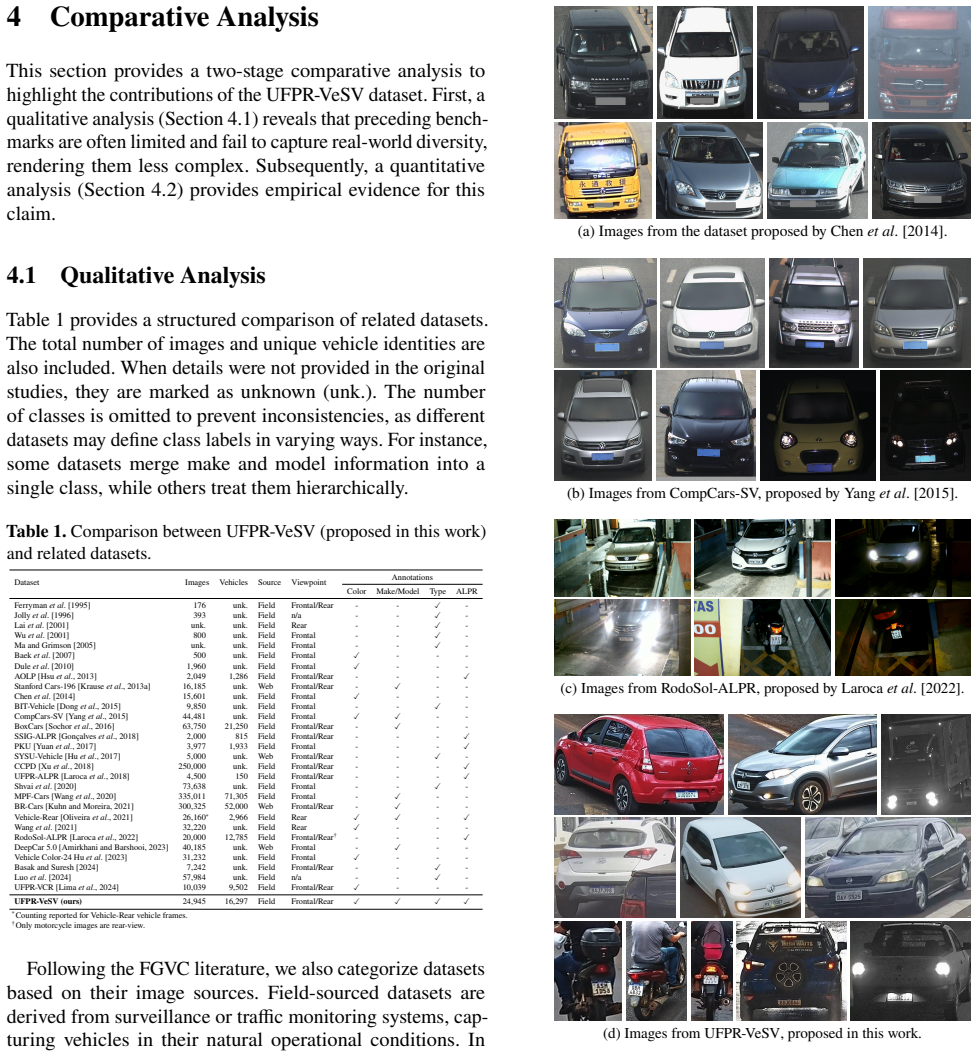
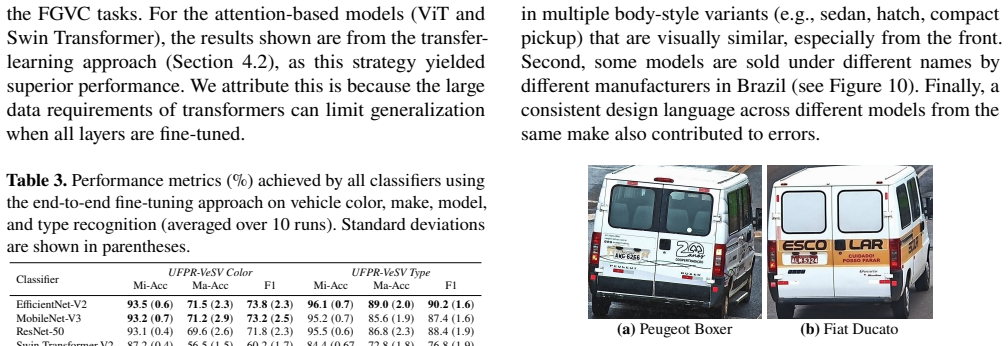
We introduce UFPR-VeSV, a dataset comprising 24,945 images of 16,297 unique vehicles with annotations for 13 colors, 26 makes, 136 models, and 14 types. Collected from the Military Police of Paraná surveillance system, the dataset captures diverse real-world conditions, including partial occlusions, nighttime infrared imaging, and varying lighting. All FGVC annotations were validated using license plate information, with text and corner annotations also being provided. A benchmark using five deep learning models further validated this, revealing specific challenges such as handling multicolored vehicles, infrared images, and distinguishing between vehicle models that share a common platform.
What carries the argument
The UFPR-VeSV dataset, whose fine-grained vehicle labels are cross-validated against license-plate text and corners extracted from the same surveillance images.
If this is right
- Deep learning models must be trained to handle infrared frames and vehicles with multiple colors on the same body.
- Models still struggle to separate vehicle variants built on identical platforms even when given large annotated sets.
- Outputs from fine-grained classification can be combined with plate text to resolve cases where either cue alone is insufficient.
- The dataset supports development of systems that operate under partial occlusion and changing illumination without controlled lighting.
Where Pith is reading between the lines
- Cross-checking visual attributes against plate data could be applied to improve training sets for other vehicle recognition tasks where ground truth is otherwise expensive to obtain.
- An end-to-end network that predicts both attribute vector and plate string in one forward pass might reduce error propagation between the two tasks.
- The identified failure modes suggest that specialized data augmentation for nighttime and occluded views would be a direct next step for practitioners.
- Law-enforcement pipelines could use the joint outputs to flag inconsistencies between reported vehicle details and observed plates.
Load-bearing premise
License plate readings always supply correct and unambiguous ground truth for a vehicle's color, make, model, and type.
What would settle it
A collection of images in which the visible vehicle body and the information readable from its license plate systematically disagree, such as through plate swaps or misreads, would show whether the validation step holds.
Figures





read the original abstract
Extracting vehicle information from surveillance images is essential for intelligent transportation systems, enabling applications such as traffic monitoring and criminal investigations. While Automatic License Plate Recognition (ALPR) is widely used, Fine-Grained Vehicle Classification (FGVC) offers a complementary approach by identifying vehicles based on attributes such as color, make, model, and type. Although there have been advances in this field, existing studies often assume well-controlled conditions, explore limited attributes, and overlook FGVC integration with ALPR. To address these gaps, we introduce UFPR-VeSV, a dataset comprising 24,945 images of 16,297 unique vehicles with annotations for 13 colors, 26 makes, 136 models, and 14 types. Collected from the Military Police of Paran\'a (Brazil) surveillance system, the dataset captures diverse real-world conditions, including partial occlusions, nighttime infrared imaging, and varying lighting. All FGVC annotations were validated using license plate information, with text and corner annotations also being provided. A qualitative and quantitative comparison with established datasets confirmed the challenging nature of our dataset. A benchmark using five deep learning models further validated this, revealing specific challenges such as handling multicolored vehicles, infrared images, and distinguishing between vehicle models that share a common platform. Additionally, we apply two optical character recognition models to license plate recognition and explore the joint use of FGVC and ALPR. The results highlight the potential of integrating these complementary tasks for real-world applications. The UFPR-VeSV dataset is publicly available at: https://github.com/Lima001/UFPR-VeSV-Dataset.
Editorial analysis
A structured set of objections, weighed in public.
Referee Report
Summary. The manuscript introduces the UFPR-VeSV dataset comprising 24,945 images of 16,297 unique vehicles captured from Brazilian police surveillance cameras under diverse real-world conditions including occlusions, nighttime infrared, and varying lighting. It provides FGVC annotations for 13 colors, 26 makes, 136 models, and 14 types, plus license plate text and corner annotations, with the claim that all FGVC labels were validated using license plate information from police records. The work benchmarks five deep learning models on FGVC, identifies concrete challenges (multicolored vehicles, infrared images, platform-sharing models), compares the dataset qualitatively/quantitatively to prior collections, and explores joint FGVC-ALPR using two OCR models, with the dataset released publicly.
Significance. If the annotations are verifiably accurate, the dataset offers a useful public resource for real-world vehicle recognition research by combining scale, attribute richness, and challenging conditions not fully covered in existing collections. The explicit identification of model failure modes and the preliminary joint FGVC-ALPR experiments provide actionable insights for intelligent transportation applications.
major comments (1)
- [Dataset description and annotation validation] Dataset description and annotation validation (abstract and corresponding methods section): the central claim that 'All FGVC annotations were validated using license plate information' is load-bearing for the reliability of the reported benchmarks and the identified challenges (e.g., distinguishing platform-sharing models). However, no quantitative validation error rate, description of the matching procedure (e.g., registry lookup under OCR failures or plate swaps), or independent visual re-annotation cross-check is supplied. This omission leaves the ground-truth quality unquantified and risks systematic label noise affecting the benchmark conclusions.
minor comments (2)
- [Abstract] Abstract: limited detail on training protocols, exact performance numbers, and statistical significance of the joint FGVC-ALPR experiments reduces the ability to assess results at a glance; adding key metrics would strengthen the summary.
- [Comparison section] Comparison with established datasets: ensure the qualitative/quantitative comparison section explicitly cites prior FGVC and ALPR datasets and tabulates key differences (e.g., attribute coverage, condition diversity) for clarity.
Simulated Author's Rebuttal
We thank the referee for their constructive feedback, which helps strengthen the presentation of our dataset and its validation. We address the major comment below and will revise the manuscript to provide the requested details.
read point-by-point responses
-
Referee: Dataset description and annotation validation (abstract and corresponding methods section): the central claim that 'All FGVC annotations were validated using license plate information' is load-bearing for the reliability of the reported benchmarks and the identified challenges (e.g., distinguishing platform-sharing models). However, no quantitative validation error rate, description of the matching procedure (e.g., registry lookup under OCR failures or plate swaps), or independent visual re-annotation cross-check is supplied. This omission leaves the ground-truth quality unquantified and risks systematic label noise affecting the benchmark conclusions.
Authors: We agree that the current manuscript provides insufficient detail on the annotation validation process. In the revised version, we will expand the methods section with a new subsection describing the validation procedure in full. This will include: (i) the exact matching workflow between image-derived license plates and the police registry records, (ii) explicit handling of OCR failures and potential plate swaps or mismatches, and (iii) the results of an independent visual re-annotation cross-check performed on a random subset of samples. We will also report the quantitative validation error rate (number of discrepancies found and how they were resolved). These additions will allow readers to assess ground-truth reliability directly and mitigate concerns about label noise. revision: yes
Circularity Check
No circularity: dataset release and standard benchmarks are self-contained
full rationale
The paper introduces the UFPR-VeSV dataset with FGVC annotations (validated via external license plate records from police sources) and runs benchmarks on five off-the-shelf deep learning models. No equations, parameter fitting, or predictions appear in the provided text. No self-citations are invoked as load-bearing uniqueness theorems or ansatzes. The annotation validation step is a procedural claim about data collection, not a derivation that reduces to its own inputs by construction. This matches the default expectation of no significant circularity for a dataset-plus-benchmark paper.
Axiom & Free-Parameter Ledger
Reference graph
Works this paper leans on
-
[1]
write newline
" write newline "" before.all 'output.state := FUNCTION fin.entry add.period write newline FUNCTION new.sentence output.state after.block = 'skip output.state before.all = 'skip after.sentence 'output.state := if if FUNCTION not #0 #1 if FUNCTION and 'skip pop #0 if FUNCTION or pop #1 'skip if FUNCTION new.block.checkb empty swap empty and 'skip 'new.bloc...
-
[2]
Amirkhani, A. and Barshooi, A. H. (2023). Deepcar 5.0: Vehicle make and model recognition under challenging conditions. IEEE Transactions on Intelligent Transportation Systems , 24(1):541--553. doi:10.1109/TITS.2022.3212921 https://doi.org/10.1109/TITS.2022.3212921
-
[3]
Baek, N., Park, S.-M., Kim, K.-J., and Park, S.-B. (2007). Vehicle color classification based on the support vector machine method. In International Conference on Intelligent Computing , pages 1133--1139. doi:10.1007/978-3-540-74282-1\_127 https://doi.org/10.1007/978-3-540-74282-1\_127
-
[4]
Basak, S. and Suresh, S. (2024). Vehicle detection and type classification in low resolution congested traffic scenes using image super resolution. Multimedia Tools and Applications , 83(8):21825--21847. doi:10.1007/s11042-023-16337-2 https://doi.org/10.1007/s11042-023-16337-2
-
[5]
Bautista, D. and Atienza, R. (2022). Scene text recognition with permuted autoregressive sequence models. In European Conference on Computer Vision (ECCV) , pages 178--196. doi:10.1007/978-3-031-19815-1\_11 https://doi.org/10.1007/978-3-031-19815-1\_11
-
[6]
Caruana, R. (1997). Multitask learning. Machine learning , 28:41--75. doi:10.1023/A:1007379606734 https://doi.org/10.1023/A:1007379606734
-
[7]
Celestino, M. (2021). 10 marcas que mais venderam carros na década. https://www.webmotors.com.br/wm1/noticias/10-marcas-que-mais-venderam-carros-na-decada. Accessed: 2025-02-19
2021
-
[8]
Chen, P., Bai, X., and Liu, W. (2014). Vehicle color recognition on urban road by feature context. IEEE Transactions on Intelligent Transportation Systems , 15(5):2340--2346. doi:10.1109/TITS.2014.2308897 https://doi.org/10.1109/TITS.2014.2308897
-
[9]
Trevor Hastie, Andrea Montanari, Saharon Rosset, and Ryan J
Cubuk, E. D., Zoph, B., Shlens, J., and Le, Q. V. (2020). Randaugment: Practical automated data augmentation with a reduced search space. In 2020 IEEE/CVF Conference on Computer Vision and Pattern Recognition Workshops (CVPRW) , pages 3008--3017. doi:10.1109/CVPRW50498.2020.00359 https://doi.org/10.1109/CVPRW50498.2020.00359
-
[10]
Deng, J., Guo, J., Ververas, E., Kotsia, I., and Zafeiriou, S. (2020). RetinaFace : Single-shot multi-level face localisation in the wild. In IEEE/CVF Conference on Computer Vision and Pattern Recognition (CVPR) , pages 5202--5211. doi:10.1109/CVPR42600.2020.00525 https://doi.org/10.1109/CVPR42600.2020.00525
-
[11]
Deng, J., Krause, J., and Fei-Fei, L. (2013). Fine-grained crowdsourcing for fine-grained recognition. In IEEE Conference on Computer Vision and Pattern Recognition (CVPR) . doi:10.1109/CVPR.2013.81 https://doi.org/10.1109/CVPR.2013.81
-
[12]
Dong, Z., Wu, Y., Pei, M., and Jia, Y. (2015). Vehicle type classification using a semisupervised convolutional neural network. IEEE Transactions on Intelligent Transportation Systems , 16(4):2247--2256. doi:10.1109/TITS.2015.2402438 https://doi.org/10.1109/TITS.2015.2402438
-
[13]
Dosovitskiy , A., Beyer, L., Kolesnikov, A., Weissenborn, D., Zhai, X., Unterthiner, T., Dehghani, M., Minderer, M., Heigold, G., Gelly, S., Uszkoreit, J., and Houlsby, N. (2021). An image is worth 16x16 words: Transformers for image recognition at scale. In International Conference on Learning Representations (ICLR) , pages 1--22
2021
-
[14]
Du, Y., Chen, Z., Su, Y., Jia, C., and Jiang, Y.-G. (2025). Instruction-guided scene text recognition. IEEE Transactions on Pattern Analysis and Machine Intelligence , pages 1--16. doi:10.1109/TPAMI.2025.3525526 https://doi.org/10.1109/TPAMI.2025.3525526
-
[15]
Dule, E., G\" o kmen, M., and Berato g lu, M. S. (2010). A convenient feature vector construction for vehicle color recognition. In WSEAS International Conference on Neural Networks, Evolutionary Computing and Fuzzy systems , page 250–255. doi:10.5555/1863431.1863473 https://doi.org/10.5555/1863431.1863473
-
[16]
Fan, X. and Zhao, W. (2022). Improving robustness of license plates automatic recognition in natural scenes. IEEE Transactions on Intelligent Transportation Systems , 23(10):18845--18854. doi:10.1109/TITS.2022.3151475 https://doi.org/10.1109/TITS.2022.3151475
-
[17]
and Croquer, G
Farias, V. and Croquer, G. (2023). Por que o carro colorido sumiu? 67\ https://g1.globo.com/economia/noticia/2023/08/20/por-que-o-carro-colorido-sumiu-67percent-dos-veiculos-no-brasil-sao-brancos-pretos-ou-cinzas.ghtml. Accessed: 2025-02-19
2023
-
[18]
Ferryman, J. M., Worrall, A. D., Sullivan, G. D., and Baker, K. D. (1995). A generic deformable model for vehicle recognition. In British Machine Vision Conference (BMVC) , page 127–136. doi:10.5555/236190.236202 https://doi.org/10.5555/236190.236202
-
[19]
Fu, H., Ma, H., Wang, G., Zhang, X., and Zhang, Y. (2020). MCFF-CNN : Multiscale comprehensive feature fusion convolutional neural network for vehicle color recognition based on residual learning. Neurocomputing , 395:178--187. doi:10.1016/j.neucom.2018.02.111 https://doi.org/10.1016/j.neucom.2018.02.111
-
[20]
Geifman, Y. and El-Yaniv, R. (2017). Selective classification for deep neural networks. In International Conference on Neural Information Processing Systems (NeurIPS) , page 4885–4894. doi:10.5555/3295222.3295241 https://doi.org/10.5555/3295222.3295241
-
[21]
https://doi.org/10.1109/fg.2018.00021
Gon c alves , G. R., Diniz , M. A., Laroca , R., Menotti , D., and Schwartz , W. R. (2018). Real-time automatic license plate recognition through deep multi-task networks. In Conference on Graphics, Patterns and Images (SIBGRAPI) , pages 110--117. doi:10.1109/SIBGRAPI.2018.00021 https://doi.org/10.1109/SIBGRAPI.2018.00021
-
[22]
Guo, C., Pleiss, G., Sun, Y., and Weinberger, K. Q. (2017). On calibration of modern neural networks. In Precup, D. and Teh, Y. W., editors, Proceedings of the 34th International Conference on Machine Learning , volume 70 of Proceedings of Machine Learning Research , pages 1321--1330. PMLR. doi:10.5555/3305381.3305518 https://doi.org/10.5555/3305381.3305518
-
[23]
Han, K., Xiao, A., Wu, E., Guo, J., XU, C., and Wang, Y. (2021). Transformer in transformer. In Ranzato, M., Beygelzimer, A., Dauphin, Y., Liang, P., and Vaughan, J. W., editors, Advances in Neural Information Processing Systems , volume 34, pages 15908--15919. Curran Associates, Inc. doi:10.5555/3540261.3541478 https://doi.org/10.5555/3540261.3541478
-
[24]
Hassan, A., Ali, M., Durrani, N. M., and Tahir, M. A. (2021). An empirical analysis of deep learning architectures for vehicle make and model recognition. IEEE Access , 9:91487--91499. doi:10.1109/ACCESS.2021.3090766 https://doi.org/10.1109/ACCESS.2021.3090766
-
[25]
He, C., Wang, D., Cai, Z., Zeng, J., and Fu, F. (2024a). A vehicle matching algorithm by maximizing travel time probability based on automatic license plate recognition data. IEEE Transactions on Intelligent Transportation Systems , 25(8):9103--9114. doi:10.1109/TITS.2024.3358625 https://doi.org/10.1109/TITS.2024.3358625
-
[26]
He, K., Zhang, X., Ren, S., and Sun, J. (2016). Deep residual learning for image recognition. In IEEE Conference on Computer Vision and Pattern Recognition (CVPR) , pages 770--778. doi:10.1109/CVPR.2016.90 https://doi.org/10.1109/CVPR.2016.90
-
[27]
He, L., Zhou, Y., Liu, L., and Ma, J. (2024b). Research and application of YOLOv11 -based object segmentation in intelligent recognition at construction sites. Buildings , 14(12). doi:10.3390/buildings14123777 https://doi.org/10.3390/buildings14123777
-
[28]
Howard, A., Sandler, M., Chen, B., Wang, W., Chen, L.-C., Tan, M., Chu, G., Vasudevan, V., Zhu, Y., Pang, R., Adam, H., and Le, Q. (2019). Searching for MobileNetV3 . In IEEE/CVF International Conference on Computer Vision (ICCV) , pages 1314--1324. doi:10.1109/ICCV.2019.00140 https://doi.org/10.1109/ICCV.2019.00140
-
[29]
Hsu, G.-S., Chen, J.-C., and Chung, Y.-Z. (2013). Application-oriented license plate recognition. IEEE Transactions on Vehicular Technology , 62(2):552--561. doi:10.1109/TVT.2012.2226218 https://doi.org/10.1109/TVT.2012.2226218
-
[30]
Hu, B., Lai, J.-H., and Guo, C.-C. (2017). Location-aware fine-grained vehicle type recognition using multi-task deep networks. Neurocomputing , 243:60--68. doi:10.1016/j.neucom.2017.02.085 https://doi.org/10.1016/j.neucom.2017.02.085
-
[31]
Hu, C., Bai, X., Qi, L., Chen, P., Xue, G., and Mei, L. (2015). Vehicle color recognition with spatial pyramid deep learning. IEEE Transactions on Intelligent Transportation Systems , 16(5):2925--2934. doi:10.1109/TITS.2015.2430892 https://doi.org/10.1109/TITS.2015.2430892
-
[32]
Hu, M., Bai, L., Fan, J., Zhao, S., and Chen, E. (2023). Vehicle color recognition based on smooth modulation neural network with multi-scale feature fusion. Frontiers of Computer Science , 17(3):173321. doi:10.1007/s11704-022-1389-x https://doi.org/10.1007/s11704-022-1389-x
-
[33]
Huang, C., Li, Y., Loy, C. C., and Tang, X. (2016). Learning deep representation for imbalanced classification. In 2016 IEEE Conference on Computer Vision and Pattern Recognition (CVPR) , pages 5375--5384. doi:10.1109/CVPR.2016.580 https://doi.org/10.1109/CVPR.2016.580
-
[34]
Huang, G., Liu, Z., van der Maaten, L., and Weinberger, K. Q. (2017). Densely connected convolutional networks. In IEEE Conference on Computer Vision and Pattern Recognition (CVPR) . doi:10.1109/CVPR.2017.243 https://doi.org/10.1109/CVPR.2017.243
-
[35]
Jolly, M.-P., Lakshmanan, S., and Jain, A. (1996). Vehicle segmentation and classification using deformable templates. IEEE Transactions on Pattern Analysis and Machine Intelligence , 18(3):293--308. doi:10.1109/34.485557 https://doi.org/10.1109/34.485557
-
[36]
YOLOv11: An Overview of the Key Architectural Enhancements
Khanam, R. and Hussain, M. (2024). YOLOv11 : An overview of the key architectural enhancements. arXiv preprint . doi:10.48550/arXiv.2410.17725 https://doi.org/10.48550/arXiv.2410.17725
work page internal anchor Pith review doi:10.48550/arxiv.2410.17725 2024
-
[37]
Krause, J., Deng, J., Stark, M., and Fei-Fei, L. (2013a). Collecting a large-scale dataset of fine-grained cars. In Second Workshop on Fine-Grained Visual Categorisation (FGVC), in conjunction with CVPR . available at https://ai.stanford.edu/ jkrause/papers/fgvc13.pdf
-
[38]
Krause, J., Stark, M., Deng, J., and Fei-Fei, L. (2013b). 3d object representations for fine-grained categorization. In 2013 IEEE International Conference on Computer Vision Workshops , pages 554--561. doi:10.1109/ICCVW.2013.77 https://doi.org/10.1109/ICCVW.2013.77
-
[39]
Kuhn, D. M. and Moreira, V. P. (2021). BRCars : a dataset for fine-grained classification of car images. In 2021 34th SIBGRAPI Conference on Graphics, Patterns and Images (SIBGRAPI) , pages 231--238. doi:10.1109/SIBGRAPI54419.2021.00039 https://doi.org/10.1109/SIBGRAPI54419.2021.00039
-
[40]
Lai, A., Fung, G., and Yung, N. (2001). Vehicle type classification from visual-based dimension estimation. In IEEE Intelligent Transportation Systems Conference (ITSC) , pages 201--206. doi:10.1109/ITSC.2001.948656 https://doi.org/10.1109/ITSC.2001.948656
-
[41]
Laroca , R., Araujo , A. B., Zanlorensi , L. A., De Almeida , E. C., and Menotti , D. (2021). Towards image-based automatic meter reading in unconstrained scenarios: A robust and efficient approach. IEEE Access , 9:67569--67584. doi:10.1109/ACCESS.2021.3077415 https://doi.org/10.1109/ACCESS.2021.3077415
-
[42]
Laroca , R., Cardoso , E. V., Lucio , D. R., Estevam , V., and Menotti , D. (2022). On the cross-dataset generalization in license plate recognition. In International Conference on Computer Vision Theory and Applications (VISAPP) , pages 166--178. doi:10.5220/0010846800003124 https://doi.org/10.5220/0010846800003124
-
[43]
Laroca , R., Estevam , V., Britto Jr. , A. S., Minetto , R., and Menotti , D. (2023a). Do we train on test data? T he impact of near-duplicates on license plate recognition. In International Joint Conference on Neural Networks (IJCNN) , pages 1--8. doi:10.1109/IJCNN54540.2023.10191584 https://doi.org/10.1109/IJCNN54540.2023.10191584
-
[44]
Laroca , R., Estevam , V., Moreira , G. J. P., Minetto , R., and Menotti , D. (2025). Advancing multinational license plate recognition through synthetic and real data fusion: A comprehensive evaluation. IET Intelligent Transport Systems , 19(1):e70086. doi:10.1049/itr2.70086 https://doi.org/10.1049/itr2.70086
-
[45]
A Robust Real-Time Automatic License Plate Recognition Based on the
Laroca , R., Severo , E., Zanlorensi , L. A., Oliveira , L. S., Gon c alves , G. R., Schwartz , W. R., and Menotti , D. (2018). A robust real-time automatic license plate recognition based on the YOLO detector. In International Joint Conference on Neural Networks (IJCNN) , pages 1--10. doi:10.1109/IJCNN.2018.8489629 https://doi.org/10.1109/IJCNN.2018.8489629
-
[46]
A., Estevam , V., Minetto , R., and Menotti , D
Laroca , R., Zanlorensi , L. A., Estevam , V., Minetto , R., and Menotti , D. (2023b). Leveraging model fusion for improved license plate recognition. In Iberoamerican Congress on Pattern Recognition (CIARP) , pages 60--75. doi:10.1007/978-3-031-49249-5\_5 https://doi.org/10.1007/978-3-031-49249-5\_5
-
[47]
Lima , G. E., Laroca , R., Santos , E., Nascimento Jr. , E., and Menotti , D. (2024). Toward enhancing vehicle color recognition in adverse conditions: A dataset and benchmark. In Conference on Graphics, Patterns and Images (SIBGRAPI) , pages 1--6. doi:10.1109/SIBGRAPI62404.2024.10716307 https://doi.org/10.1109/SIBGRAPI62404.2024.10716307
-
[48]
Liu, Q., Chen, S.-L., Chen, Y.-X., and Yin, X.-C. (2024). Improving license plate recognition via diverse stylistic plate generation. Pattern Recognition Letters , 183:117--124. doi:10.1016/j.patrec.2024.05.005 https://doi.org/10.1016/j.patrec.2024.05.005
-
[49]
Liu , Y.-Y., Liu, Q., Chen, S.-L., Chen, F., and Yin, X.-C. (2024). Irregular license plate recognition via global information integration. In International Conference on Multimedia Modeling , pages 325--339. doi:10.1007/978-3-031-53308-2\_24 https://doi.org/10.1007/978-3-031-53308-2\_24
-
[50]
Liu, Z., Hu, H., Lin, Y., Yao, Z., Xie, Z., Wei, Y., Ning, J., Cao, Y., Zhang, Z., Dong, L., Wei, F., and Guo, B. (2022). Swin transformer v2: Scaling up capacity and resolution. In IEEE/CVF Conference on Computer Vision and Pattern Recognition (CVPR) , pages 11999--12009. doi:10.1109/CVPR52688.2022.01170 https://doi.org/10.1109/CVPR52688.2022.01170
-
[51]
Lu, L., Cai, Y., Huang, H., and Wang, P. (2023). An efficient fine-grained vehicle recognition method based on part-level feature optimization. Neurocomputing , 536:40--49. doi:10.1016/j.neucom.2023.03.035 https://doi.org/10.1016/j.neucom.2023.03.035
-
[52]
Fully Dynamic Maximal Independent Set with Polylogarithmic Update Time , booktitle =
Lucio, D. R., Laroca, R., Zanlorensi, L. A., Moreira, G., and Menotti, D. (2019). Simultaneous iris and periocular region detection using coarse annotations. In Conference on Graphics, Patterns and Images (SIBGRAPI) , pages 178--185. doi:10.1109/SIBGRAPI.2019.00032 https://doi.org/10.1109/SIBGRAPI.2019.00032
-
[53]
Luo, R., Song, Y., Ye, L., and Su, R. (2024). Dense-tnt: Efficient vehicle type classification neural network using satellite imagery. Sensors , 24(23). doi:10.3390/s24237662 https://doi.org/10.3390/s24237662
-
[54]
Ma, X. and Grimson, W. (2005). Edge-based rich representation for vehicle classification. In IEEE International Conference on Computer Vision (ICCV) , pages 1185--1192. doi:10.1109/ICCV.2005.80 https://doi.org/10.1109/ICCV.2005.80
-
[55]
Minderer, M., Djolonga, J., Romijnders, R., Hubis, F., Zhai, X., Houlsby, N., Tran, D., and Lucic, M. (2021). Revisiting the calibration of modern neural networks. In Ranzato, M., Beygelzimer, A., Dauphin, Y., Liang, P., and Vaughan, J. W., editors, Advances in Neural Information Processing Systems , volume 34, pages 15682--15694. Curran Associates, Inc. ...
-
[56]
Frota nacional (junho de 2024)
Ministério dos Transportes (2024). Frota nacional (junho de 2024). https://www.gov.br/transportes/pt-br/assuntos/transito/conteudo-Senatran/frota-de-veiculos-2024. Accessed: 2025-02-19
2024
-
[57]
Nascimento, V., Laroca, R., Ribeiro, R. O., Schwartz, W. R., and Menotti, D. (2024). Enhancing license plate super-resolution: A layout-aware and character-driven approach. Conference on Graphics, Patterns and Images (SIBGRAPI) , pages 1--6. doi:10.1109/SIBGRAPI62404.2024.10716303 https://doi.org/10.1109/SIBGRAPI62404.2024.10716303
-
[58]
Nascimento , V., Lima , G. E., Ribeiro , R. O., Schwartz , W. R., Laroca , R., and Menotti , D. (2025). Toward advancing license plate super-resolution in real-world scenarios: A dataset and benchmark. Journal of the Brazilian Computer Society , 1(31):435--449. doi:10.5753/jbcs.2025.5159 https://doi.org/10.5753/jbcs.2025.5159
-
[59]
Nyi Myo, N., Boonkong, A., Khampitak, K., and Hormdee, D. (2025). A two-point association tracking system incorporated with YOLOv11 for real-time visual tracking of laparoscopic surgical instruments. IEEE Access , 13:12225--12238. doi:10.1109/ACCESS.2025.3529710 https://doi.org/10.1109/ACCESS.2025.3529710
-
[60]
Ochal, M., Patacchiola, M., Vazquez, J., Storkey, A., and Wang, S. (2023). Few-shot learning with class imbalance. IEEE Transactions on Artificial Intelligence , 4(5):1348--1358. doi:10.1109/TAI.2023.3298303 https://doi.org/10.1109/TAI.2023.3298303
-
[61]
O., Laroca , R., Menotti , D., Fonseca , K
Oliveira , I. O., Laroca , R., Menotti , D., Fonseca , K. V. O., and Minetto , R. (2021). Vehicle-Rear : A new dataset to explore feature fusion for vehicle identification using convolutional neural networks. IEEE Access , 9:101065--101077. doi:10.1109/ACCESS.2021.3097964 https://doi.org/10.1109/ACCESS.2021.3097964
-
[62]
Rao, Z., Yang, D., Chen, N., and Liu, J. (2024). License plate recognition system in unconstrained scenes via a new image correction scheme and improved CRNN . Expert Systems with Applications , 243:122878. doi:10.1016/j.eswa.2023.122878 https://doi.org/10.1016/j.eswa.2023.122878
-
[63]
R., Cogswell, M., Das, A., Vedantam, R., Parikh, D., and Batra, D
Selvaraju, R. R., Cogswell, M., Das, A., Vedantam, R., Parikh, D., and Batra, D. (2017). Grad-cam: Visual explanations from deep networks via gradient-based localization. In 2017 IEEE International Conference on Computer Vision (ICCV) , pages 618--626. doi:10.1109/ICCV.2017.74 https://doi.org/10.1109/ICCV.2017.74
-
[64]
Shvai, N., Hasnat, A., Meicler, A., and Nakib, A. (2020). Accurate classification for automatic vehicle-type recognition based on ensemble classifiers. IEEE Transactions on Intelligent Transportation Systems , 21(3):1288--1297. doi:10.1109/TITS.2019.2906821 https://doi.org/10.1109/TITS.2019.2906821
-
[65]
Sochor, J., Herout, A., and Havel, J. (2016). BoxCars: 3D boxes as CNN input for improved fine-grained vehicle recognition. In IEEE Conference on Computer Vision and Pattern Recognition (CVPR) , pages 3006--3015. doi:10.1109/CVPR.2016.328 https://doi.org/10.1109/CVPR.2016.328
-
[66]
Son, J.-W., Park, S.-B., and Kim, K.-J. (2007). A convolution kernel method for color recognition. In International Conference on Advanced Language Processing and Web Information Technology , pages 242--247. doi:10.1109/ALPIT.2007.28 https://doi.org/10.1109/ALPIT.2007.28
-
[67]
and Le, Q
Tan, M. and Le, Q. (2021). EfficientNetV2 : Smaller models and faster training. In International Conf. on Machine Learning , pages 10096--10106
2021
-
[68]
Ultralytics (2025). YOLOv11 . https://docs.ultralytics.com/models/yolo11/. Accessed: 2025-03-04
2025
-
[69]
Wang, H., Peng, J., Zhao, Y., and Fu, X. (2020). Multi-path deep CNNs for fine-grained car recognition. IEEE Transactions on Vehicular Technology , 69(10):10484--10493. doi:10.1109/TVT.2020.3009162 https://doi.org/10.1109/TVT.2020.3009162
-
[70]
Wang, Y., Wang, C., Zheng, Y., Fu, H., and Ma, H. (2021). Transformer based neural network for fine-grained classification of vehicle color. In International Conference on Multimedia Information Processing and Retrieval (MIPR) , pages 118--124. doi:10.1109/MIPR51284.2021.00025 https://doi.org/10.1109/MIPR51284.2021.00025
-
[71]
E., Nascimento , V., Nascimento Jr
Wojcik , L., Lima , G. E., Nascimento , V., Nascimento Jr. , E., Laroca , R., and Menotti , D. (2025). LPLC : A dataset for license plate legibility classification. Conference on Graphics, Patterns and Images (SIBGRAPI) , pages 1--6. doi:10.1109/SIBGRAPI67909.2025.11223367 https://doi.org/10.1109/SIBGRAPI67909.2025.11223367
-
[72]
Wolf, S., Loran, D., and Beyerer, J. (2024). Knowledge-distillation-based label smoothing for fine-grained open-set vehicle recognition. In IEEE/CVF Winter Conference on Applications of Computer Vision Workshops (WACVW) , pages 330--340. doi:10.1109/WACVW60836.2024.00041 https://doi.org/10.1109/WACVW60836.2024.00041
-
[73]
Wu, W., QiSen, Z., and Mingjun, W. (2001). A method of vehicle classification using models and neural networks. In IEEE Vehicular Technology Conference , pages 3022--3026. doi:10.1109/VETECS.2001.944158 https://doi.org/10.1109/VETECS.2001.944158
-
[74]
Xu, Z., Yang, W., Meng, A., Lu, N., Huang, H., Ying, C., and Huang, L. (2018). Towards end-to-end license plate detection and recognition: A large dataset and baseline. In European Conference on Computer Vision (ECCV) . doi:10.1007/978-3-030-01261-8\_16 https://doi.org/10.1007/978-3-030-01261-8\_16
-
[75]
Yang, L., Luo, P., Loy, C. C., and Tang, X. (2015). A large-scale car dataset for fine-grained categorization and verification. In IEEE Conference on Computer Vision and Pattern Recognition (CVPR) , pages 3973--3981. doi:10.1109/CVPR.2015.7299023 https://doi.org/10.1109/CVPR.2015.7299023
-
[76]
Yu, Y., Liu, H., Fu, Y., Jia, W., Yu, J., and Yan, Z. (2022). Embedding pose information for multiview vehicle model recognition. IEEE Transactions on Circuits and Systems for Video Technology , 32(8):5467--5480. doi:10.1109/TCSVT.2022.3151116 https://doi.org/10.1109/TCSVT.2022.3151116
-
[77]
Yuan, Y., Zou, W., Zhao, Y., Wang, X., Hu, X., and Komodakis, N. (2017). A robust and efficient approach to license plate detection. IEEE Transactions on Image Processing , 26(3):1102--1114. doi:10.1109/TIP.2016.2631901 https://doi.org/10.1109/TIP.2016.2631901
-
[78]
Zhang, L., Wang, P., Li, H., Li, Z., Shen, C., and Zhang, Y. (2021). A robust attentional framework for license plate recognition in the wild. IEEE Transactions on Intelligent Transportation Systems , 22(11):6967--6976. doi:10.1109/TITS.2020.3000072 https://doi.org/10.1109/TITS.2020.3000072
-
[79]
Zhang, Q., Zhuo, L., Li, J., Zhang, J., Zhang, H., and Li, X. (2018). Vehicle color recognition using multiple-layer feature representations of lightweight convolutional neural network. Signal Processing , 147:146--153. doi:10.1016/j.sigpro.2018.01.021 https://doi.org/10.1016/j.sigpro.2018.01.021
discussion (0)
Sign in with ORCID, Apple, or X to comment. Anyone can read and Pith papers without signing in.