Recognition: no theorem link
Equilibrated fraction of QCD matter in high-energy oxygen--oxygen collisions
Pith reviewed 2026-05-10 19:46 UTC · model grok-4.3
The pith
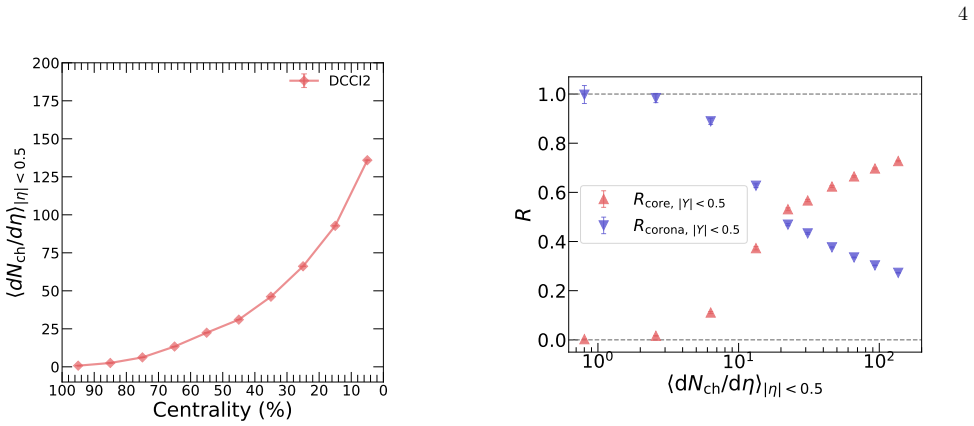
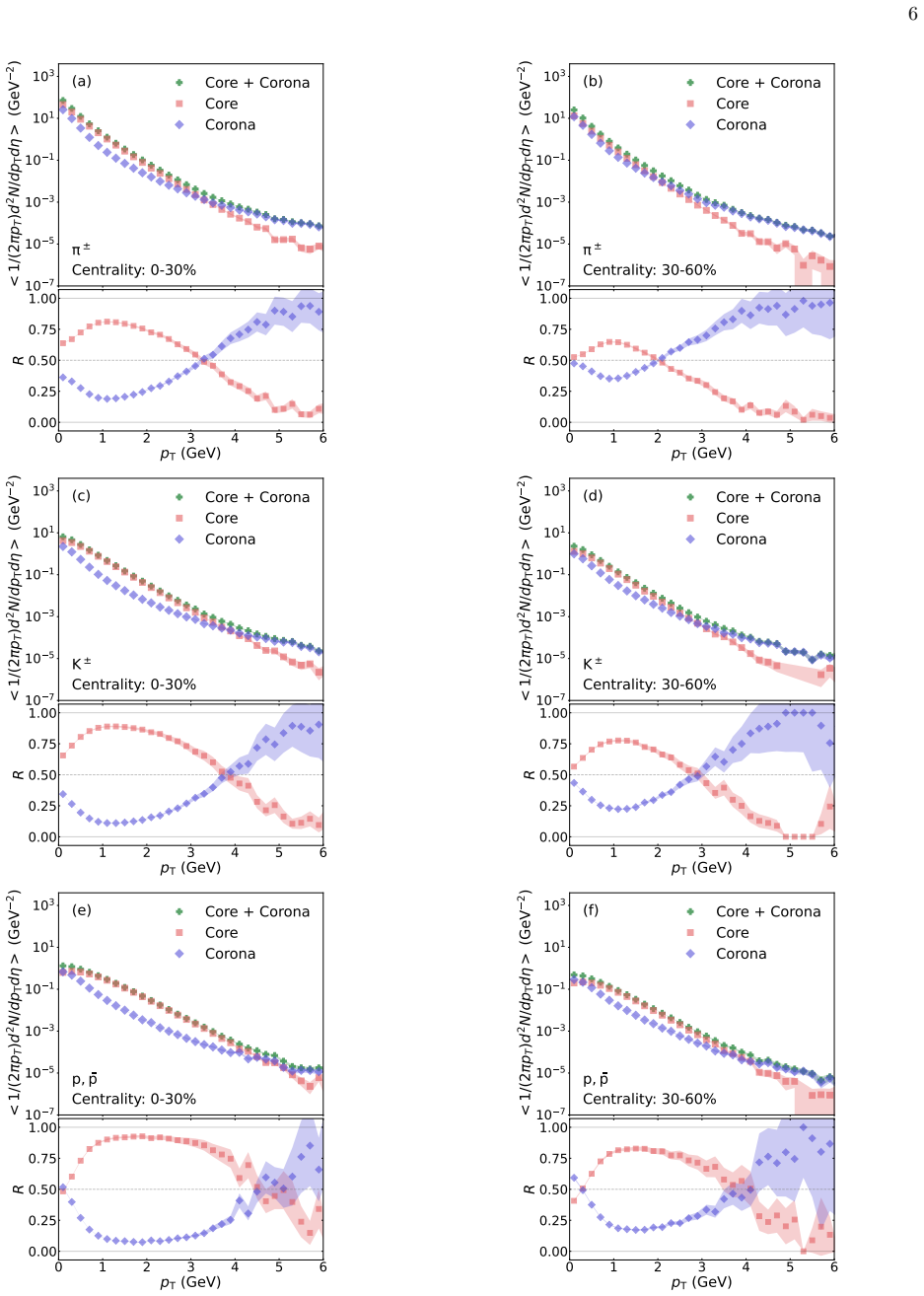
In oxygen-oxygen collisions the equilibrated core of QCD matter exceeds the nonequilibrated corona only above midrapidity multiplicity of about 20, yet the corona remains sizable even centrally.
A machine-rendered reading of the paper's core claim, the machinery that carries it, and where it could break.
Core claim
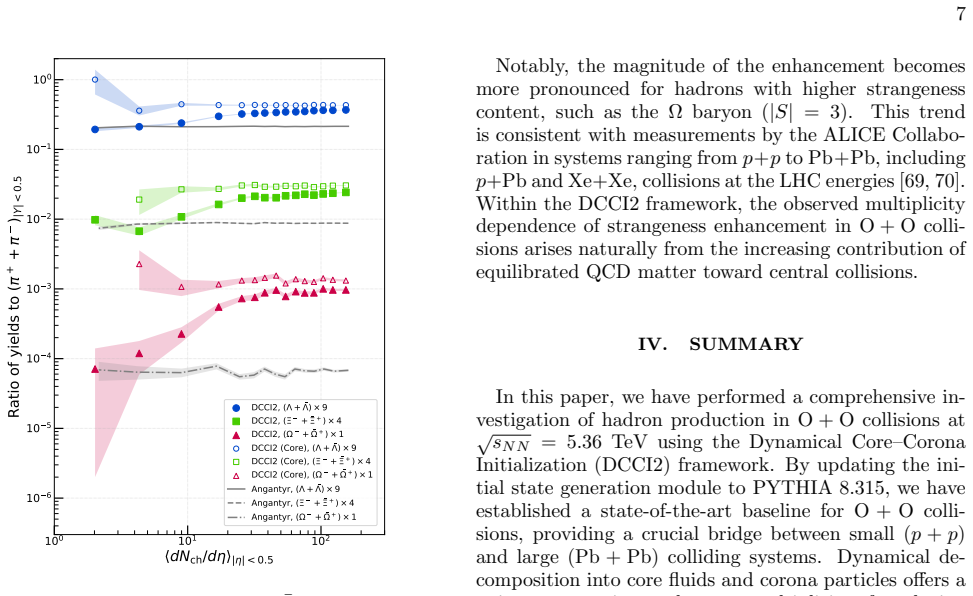
Contributions from the core become larger than those from the corona above charged-particle multiplicity at midrapidity ⟨dN_ch/dη⟩_|η|<0.5 ≈ 20. Nonnegligible contributions from the corona still remain even in central O+O collisions. The yield ratios of strange baryons to charged pions exhibit an increasing behavior with increasing multiplicity at midrapidity but remain smaller than those obtained under the assumption of complete chemical equilibrium.
What carries the argument
The core-corona framework that partitions the collision evolution into a locally equilibrated fluid core and a nonequilibrium corona of particles, with their relative weights determined from multiplicity and particle ratios.
If this is right
- Purely hydrodynamic simulations miss essential nonequilibrium dynamics in O+O collisions.
- Strange-particle ratios serve as a direct experimental indicator of the core fraction.
- Hybrid core-corona modeling is required for any intermediate-size collision system whose multiplicity lies near or below the transition point.
- The equilibrated fraction grows with system size and multiplicity, consistent with larger systems reaching closer to full equilibrium.
Where Pith is reading between the lines
- Measurements of multiplicity-binned particle ratios in p+Pb or d+Au collisions at similar multiplicities could test whether the same core-corona transition occurs in even smaller systems.
- If the corona persists across a range of small systems, full chemical equilibrium may require collision volumes larger than those achieved in central O+O events.
Load-bearing premise
The core-corona separation correctly isolates equilibrated and nonequilibrated components and the model parameters are appropriate for O+O collisions at this energy.
What would settle it
Observation that strange-baryon-to-pion ratios in central O+O collisions reach the same values as those measured in central Pb+Pb collisions under full chemical equilibrium would contradict the claim of persistent corona contributions.
Figures



read the original abstract
We quantify to what degree the QCD matter created in high-energy oxygen--oxygen ($\mathrm{O}+\mathrm{O}$) collisions at $\sqrt{s_{NN}} = 5.36$ TeV reaches a locally equilibrated state. For this purpose, we employ a novel framework based on the core--corona picture that describes the dynamics of both locally equilibrated fluids (the core) and nonequilibrium particles (the corona). Contributions from the core become larger than those from the corona above charged-particle multiplicity at midrapidity, $\langle dN_{\mathrm{ch}}/d\eta\rangle_{|\eta|<0.5} \approx 20$. We also find that nonnegligible contributions from the corona still remain even in central $\mathrm{O}+\mathrm{O}$ collisions. The yield ratios of strange baryons to charged pions exhibit an increasing behavior with increasing multiplicity at midrapidity. However, these ratios are smaller than those obtained when assuming that QCD matter has reached complete chemical equilibrium. These results demonstrate that a purely hydrodynamic approach is insufficient and that the inclusion of a corona component is essential for describing the dynamics of intermediate-size systems such as $\mathrm{O}+\mathrm{O}$ collisions.
Editorial analysis
A structured set of objections, weighed in public.
Referee Report
Summary. The manuscript employs a core-corona hybrid model to quantify the fraction of locally equilibrated QCD matter in O+O collisions at √s_NN = 5.36 TeV. It reports that core contributions exceed corona contributions for midrapidity charged-particle multiplicities above ⟨dN_ch/dη⟩_|η|<0.5 ≈ 20, yet non-negligible corona fractions persist even in central events. Strange baryon-to-pion yield ratios increase with multiplicity but remain below values expected for full chemical equilibrium, leading to the conclusion that purely hydrodynamic descriptions are insufficient and a corona component is required for intermediate-size systems.
Significance. If the core-corona partition proves robust, the work supplies a timely, quantitative benchmark for the degree of equilibration in small-to-intermediate collision systems ahead of LHC O+O runs. It supplies falsifiable multiplicity-dependent predictions for strangeness ratios and demonstrates that hybrid modeling is necessary rather than optional, strengthening the case for including nonequilibrium components in interpretations of light-ion data.
major comments (2)
- [§3] §3 (core-corona implementation): The separation criterion (local energy-density or binary-collision threshold) is stated as fixed and appears calibrated primarily on Pb+Pb systems; no variation of this threshold is shown for O+O. Consequently the reported crossover multiplicity ⟨dN_ch/dη⟩ ≈ 20 and the non-negligible central corona fraction (Figs. 4–5) are not demonstrated to be stable, directly affecting the central claim that corona contributions remain essential even in central O+O events.
- [§4.2–4.3] §4.2–4.3 and Fig. 7: The strange-baryon/pion ratios are asserted to lie below full chemical equilibrium, yet the plotted curves incorporate the model-dependent corona fraction without propagated uncertainty bands arising from plausible changes to the core-corona threshold. This omission weakens the quantitative statement that the ratios are “smaller than those obtained when assuming complete chemical equilibrium.”
minor comments (2)
- [Abstract, §1] The abstract and §1 cite the multiplicity threshold ≈20 without an accompanying reference to the precise definition of the midrapidity window or the underlying transport model used to generate the initial conditions.
- [Figs. 6–7] Figure captions for the multiplicity-dependent ratios (Figs. 6–7) do not list the specific strange baryons included or the normalization procedure for the pion denominator.
Simulated Author's Rebuttal
We thank the referee for the careful reading of our manuscript and the constructive comments, which help clarify the robustness of our core-corona results. We address the major comments point by point below.
read point-by-point responses
-
Referee: [§3] §3 (core-corona implementation): The separation criterion (local energy-density or binary-collision threshold) is stated as fixed and appears calibrated primarily on Pb+Pb systems; no variation of this threshold is shown for O+O. Consequently the reported crossover multiplicity ⟨dN_ch/dη⟩ ≈ 20 and the non-negligible central corona fraction (Figs. 4–5) are not demonstrated to be stable, directly affecting the central claim that corona contributions remain essential even in central O+O events.
Authors: We acknowledge that the energy-density threshold used to separate core and corona is fixed in the present manuscript and was chosen following values established in earlier core-corona studies of larger systems. The manuscript does not currently contain a dedicated variation study for O+O collisions. We agree that showing the stability of the reported crossover multiplicity and the persistent corona fraction under reasonable changes to this threshold would strengthen the central claim. In the revised manuscript we will add a sensitivity analysis in which the threshold is varied within a physically motivated range; the resulting bands on the core fraction versus multiplicity and on the central-event corona contribution will be presented alongside the original results. revision: yes
-
Referee: [§4.2–4.3] §4.2–4.3 and Fig. 7: The strange-baryon/pion ratios are asserted to lie below full chemical equilibrium, yet the plotted curves incorporate the model-dependent corona fraction without propagated uncertainty bands arising from plausible changes to the core-corona threshold. This omission weakens the quantitative statement that the ratios are “smaller than those obtained when assuming complete chemical equilibrium.”
Authors: We agree that the lack of uncertainty bands propagated from variations in the core-corona threshold limits the quantitative force of the comparison to full chemical equilibrium. In the revised manuscript we will augment Fig. 7 with uncertainty bands obtained from the same threshold-variation study described above. This will allow us to demonstrate explicitly that the strange-baryon-to-pion ratios remain below the full-equilibrium expectation even after accounting for this source of model uncertainty. revision: yes
Circularity Check
No significant circularity in derivation chain
full rationale
The paper applies an established core-corona framework to simulate O+O collisions at a specific energy and reports relative contributions as outputs of that dynamical model. The multiplicity threshold at which core exceeds corona and the residual corona fraction in central events are computed results from the simulation, not quantities defined in terms of themselves or obtained by fitting a parameter to the target observable and relabeling it a prediction. No load-bearing self-citation chain, ansatz smuggled via prior work, or uniqueness theorem imported from the same authors is required to reach the central statements; the model assumptions are stated explicitly and the numerical outcomes follow from running the dynamics. The analysis is therefore self-contained against external benchmarks and does not reduce to its inputs by construction.
Axiom & Free-Parameter Ledger
Reference graph
Works this paper leans on
-
[1]
K. Yagi, T. Hatsuda, and Y. Miake,Quark-gluon plasma: From big bang to little bang, Vol. 23 (Cambridge Univer- sity Press, 2005)
2005
-
[2]
I. Arseneet al.(BRAHMS), Quark gluon plasma and color glass condensate at RHIC? The Perspective from the BRAHMS experiment, Nucl. Phys. A757, 1 (2005), arXiv:nucl-ex/0410020
-
[3]
K. Adcoxet al.(PHENIX), Formation of dense partonic matter in relativistic nucleus-nucleus collisions at RHIC: Experimental evaluation by the PHENIX collaboration, Nucl. Phys. A757, 184 (2005), arXiv:nucl-ex/0410003
- [4]
- [5]
- [6]
-
[7]
K. Dusling, W. Li, and B. Schenke, Novel collec- tive phenomena in high-energy proton–proton and pro- ton–nucleus collisions, Int. J. Mod. Phys. E25, 1630002 (2016), arXiv:1509.07939 [nucl-ex]
- [8]
- [9]
-
[10]
Schenke, The smallest fluid on Earth, Rept
B. Schenke, The smallest fluid on Earth, Rept. Prog. Phys.84, 082301 (2021), arXiv:2102.11189 [nucl-th]
-
[11]
Progress and challenges in small systems,
J. Noronha, B. Schenke, C. Shen, and W. Zhao, Progress and challenges in small systems, Int. J. Mod. Phys. E33, 2430005 (2024), arXiv:2401.09208 [nucl-th]
- [12]
-
[13]
Ollitrault, Anisotropy as a signature of transverse collective flow, Phys
J.-Y. Ollitrault, Anisotropy as a signature of transverse collective flow, Phys. Rev. D46, 229 (1992)
1992
-
[14]
A. M. Poskanzer and S. A. Voloshin, Methods for ana- lyzing anisotropic flow in relativistic nuclear collisions, Phys. Rev. C58, 1671 (1998), arXiv:nucl-ex/9805001
work page Pith review arXiv 1998
- [15]
- [16]
-
[17]
B. Alver and G. Roland, Collision geometry fluctuations and triangular flow in heavy-ion collisions, Phys. Rev. C81, 054905 (2010), [Erratum: Phys.Rev.C 82, 039903 (2010)], arXiv:1003.0194 [nucl-th]
-
[18]
G. Giacalone, J. Jia, and C. Zhang, Impact of Nu- clear Deformation on Relativistic Heavy-Ion Collisions: Assessing Consistency in Nuclear Physics across En- ergy Scales, Phys. Rev. Lett.127, 242301 (2021), arXiv:2105.01638 [nucl-th]
-
[19]
J. Jiaet al., Imaging the initial condition of heavy-ion collisions and nuclear structure across the nuclide chart, Nucl. Sci. Tech.35, 220 (2024), arXiv:2209.11042 [nucl- ex]
- [20]
-
[21]
G. Giacaloneet al., Nuclear Physics Confronts Relativis- tic Collisions Of Isobars, (2025), arXiv:2507.01454 [nucl- ex]
-
[22]
S. Huang, Measurements of azimuthal anisotropies in 16O+16O andγ+Au collisions from STAR (2023) arXiv:2312.12167 [nucl-ex]
- [23]
- [24]
-
[25]
G. Aadet al.(ATLAS), Measurement of the azimuthal anisotropy of charged particles in √sNN = 5.36 TeV 16O+16O and 20Ne+20Ne collisions with the ATLAS de- 9 tector, (2025), arXiv:2509.05171 [nucl-ex]
work page internal anchor Pith review Pith/arXiv arXiv 2025
-
[26]
Observation of suppressed charged-particle production in ultrarelativistic oxygen-oxygen collisions
A. Hayrapetyanet al.(CMS), Discovery of suppressed charged-particle production in ultrarelativistic oxygen- oxygen collisions, (2025), arXiv:2510.09864 [nucl-ex]
work page internal anchor Pith review Pith/arXiv arXiv 2025
-
[27]
A. Hayrapetyanet al.(CMS), Observation of long- range collective flow in OO and NeNe collisions and implications for nuclear structure studies, (2025), arXiv:2510.02580 [nucl-ex]
-
[28]
CMS Collaboration, Measurement of charged particle pseudorapidity distributions in o + o collisions at 5.36 tev, CMS PAS HIN-25-010 (2025)
2025
- [29]
- [30]
-
[31]
Wei, Y.-L
K. Wei, Y.-L. Ye, and Z.-H. Yang, Clustering in nu- clei: progress and perspective, Nuclear Science and Tech- niques35, 216 (2024)
2024
-
[32]
W. Broniowski and E. Ruiz Arriola, Signatures of αClustering in Light Nuclei from Relativistic Nu- clear Collisions, Phys. Rev. Lett.112, 112501 (2014), arXiv:1312.0289 [nucl-th]
- [33]
-
[34]
M. Rybczy´ nski, M. Piotrowska, and W. Broniowski, Signatures ofαclustering in ultrarelativistic collisions with light nuclei, Phys. Rev. C97, 034912 (2018), arXiv:1711.00438 [nucl-th]
- [35]
-
[36]
M. Rybczy´ nski and W. Broniowski, Glauber Monte Carlo predictions for ultrarelativistic collisions with 16O, Phys. Rev. C100, 064912 (2019), arXiv:1910.09489 [hep-ph]
- [37]
-
[38]
N. Summerfield, B.-N. Lu, C. Plumberg, D. Lee, J. Noronha-Hostler, and A. Timmins, 16O 16O collisions at energies available at the BNL Relativistic Heavy Ion Collider and at the CERN Large Hadron Collider com- paringαclustering versus substructure, Phys. Rev. C 104, L041901 (2021), arXiv:2103.03345 [nucl-th]
- [39]
- [40]
-
[41]
G. Giacaloneet al., Exploiting Ne20 Isotopes for Preci- sion Characterizations of Collectivity in Small Systems, Phys. Rev. Lett.135, 012302 (2025), arXiv:2402.05995 [nucl-th]
- [42]
-
[43]
K. Shafi and S. Chatterjee, Probing nuclear geome- try through multi-particle azimuthal correlations and rapidity-even dipolar flow in 16O+16O collisions, Eur. Phys. J. C86, 93 (2026), arXiv:2505.11713 [nucl-th]
- [44]
-
[45]
C. Loizides, Glauber predictions for oxygen and neon collisions at energies available at the CERN Large Hadron Collider, Phys. Rev. C113, 014914 (2026), arXiv:2507.05853 [nucl-th]
-
[46]
L. Constantin, N. G¨ otz, C. B. Rosenkvist, and H. Elfner, Collective effects in O-O and Ne-Ne collisions at√sNN=5.36 TeV from a hybrid approach, (2025), arXiv:2509.05613 [nucl-th]
work page internal anchor Pith review arXiv 2025
-
[47]
Werner, Core-corona separation in ultra-relativistic heavy ion collisions, Phys
K. Werner, Core-corona separation in ultra-relativistic heavy ion collisions, Phys. Rev. Lett.98, 152301 (2007), arXiv:0704.1270 [nucl-th]
-
[48]
K. Werner, F.-M. Liu, and T. Pierog, Parton ladder split- ting and the rapidity dependence of transverse momen- tum spectra in deuteron-gold collisions at RHIC, Phys. Rev. C74, 044902 (2006), arXiv:hep-ph/0506232
work page Pith review arXiv 2006
- [49]
-
[50]
EPOS LHC : test of collective hadronization with LHC data
T. Pierog, I. Karpenko, J. M. Katzy, E. Yatsenko, and K. Werner, EPOS LHC: Test of collective hadronization with data measured at the CERN Large Hadron Collider, Phys. Rev. C92, 034906 (2015), arXiv:1306.0121 [hep- ph]
work page Pith review arXiv 2015
- [51]
-
[52]
Y. Kanakubo, Y. Tachibana, and T. Hirano, Unified de- scription of hadron yield ratios from dynamical core- corona initialization, Phys. Rev. C101, 024912 (2020), arXiv:1910.10556 [nucl-th]
-
[53]
Y. Kanakubo, Y. Tachibana, and T. Hirano, Interplay between core and corona components in high-energy nuclear collisions, Phys. Rev. C105, 024905 (2022), arXiv:2108.07943 [nucl-th]
-
[54]
Y. Kanakubo, Y. Tachibana, and T. Hirano, Nonequi- librium components in the region of very low transverse momentum in high-energy nuclear collisions, Phys. Rev. C106, 054908 (2022), arXiv:2207.13966 [nucl-th]
-
[55]
Y. Kanakubo,Unified description of high-energy nuclear collisions based on dynamical core–corona picture, Ph.D. thesis, Sophia U. (2022), arXiv:2208.07029 [nucl-th]
-
[56]
Sj¨ ostrand, S
T. Sj¨ ostrand, S. Mrenna, and P. Skands, A brief intro- duction to pythia 8.1, Comput. Phys. Commun.178, 852 (2008)
2008
-
[57]
C. Bierlich, G. Gustafson, L. L¨ onnblad, and H. Shah, The Angantyr model for Heavy-Ion Collisions in PYTHIA8, JHEP10, 134, arXiv:1806.10820 [hep-ph]. 10
-
[58]
M. Rybczynski, G. Stefanek, W. Broniowski, and P. Bozek, GLISSANDO 2 : GLauber Initial-State Sim- ulation AND mOre. . . , ver. 2, Comput. Phys. Commun. 185, 1759 (2014), arXiv:1310.5475 [nucl-th]
-
[59]
The detailed modeling of nuclear geometry has recently become an active topic in high-energy nu- clear collisions
Although the GLISSANDO 2 model employs a Woods–Saxon nuclear density profile and is therefore pri- marily optimized for heavier nuclei, it is adopted here for consistency. The detailed modeling of nuclear geometry has recently become an active topic in high-energy nu- clear collisions. In the present work, our aim is to estab- lish a controlled baseline f...
-
[60]
Sjöstrand, The Development of MPI Modeling in Pythia , Adv
T. Sj¨ ostrand, The Development of MPI Modeling in Pythia, Adv. Ser. Direct. High Energy Phys.29, 191 (2018), arXiv:1706.02166 [hep-ph]
- [61]
-
[62]
M. McNelis, D. Everett, and U. Heinz, Particlization in fluid dynamical simulations of heavy-ion collisions: The i S3D module, Comput. Phys. Commun.258, 107604 (2021), arXiv:1912.08271 [nucl-th]
-
[63]
Cooper and G
F. Cooper and G. Frye, Comment on the Single Particle Distribution in the Hydrodynamic and Statistical Ther- modynamic Models of Multiparticle Production, Phys. Rev. D10, 186 (1974)
1974
-
[64]
Y. Nara, N. Otuka, A. Ohnishi, K. Niita, and S. Chiba, Relativistic nuclear collisions at 10agev energies from p+ Be to au+au with the hadronic cascade model, Phys. Rev. C61, 024901 (1999)
1999
-
[65]
T. Hirano and Y. Nara, Interplay between soft and hard hadronic components for identified hadrons in relativistic heavy ion collisions at RHIC, Phys. Rev. C69, 034908 (2004), arXiv:nucl-th/0307015
-
[66]
Rafelski and B
J. Rafelski and B. M¨ uller, Strangeness production in the quark-gluon plasma, Phys. Rev. Lett.48, 1066 (1982)
1982
-
[67]
P. Koch, J. Rafelski, and W. Greiner, Strange hadrons in hot nuclear matter, Physics Letters B123, 151 (1983)
1983
- [68]
- [69]
-
[70]
J. Adamet al.(ALICE), Enhanced production of multi- strange hadrons in high-multiplicity proton-proton col- lisions, Nature Phys.13, 535 (2017), arXiv:1606.07424 [nucl-ex]
discussion (0)
Sign in with ORCID, Apple, or X to comment. Anyone can read and Pith papers without signing in.