Recognition: 2 theorem links
· Lean TheoremGenerative Channel Knowledge Base With Environmental Information for Joint Source-Channel Coding in Semantic Communications
Pith reviewed 2026-05-10 19:51 UTC · model grok-4.3
The pith
A generative channel knowledge base built from environmental data enables superior joint source-channel coding in semantic communication systems.
A machine-rendered reading of the paper's core claim, the machinery that carries it, and where it could break.
Core claim
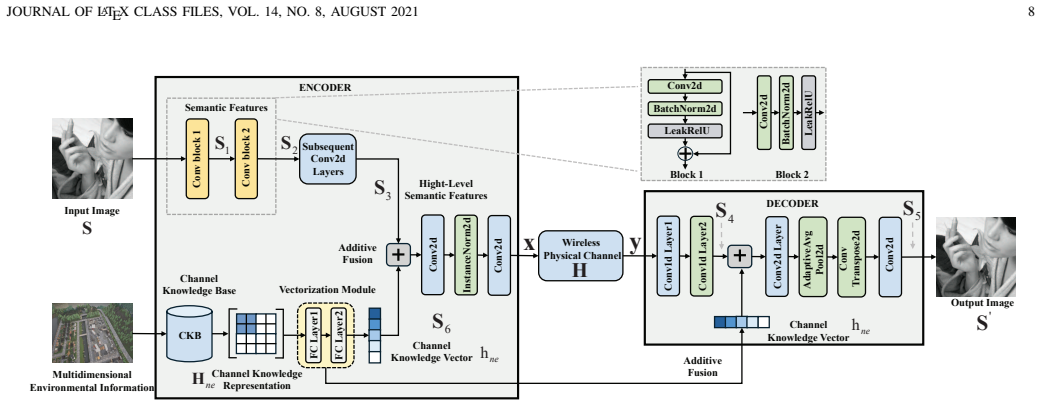
The central claim is that a generative channel knowledge base constructed from environmental information, using a Transformer to map multidimensional features to channel matrices, when integrated into the JSCC architecture by providing priors to both encoder and decoder, allows semantic communications to jointly exploit source semantics and channel-environment information, resulting in superior performance.
What carries the argument
The Transformer-based generative framework with self-attention that fuses heterogeneous environmental features to build a structured channel knowledge base for injection into semantic coding.
Load-bearing premise
The collected environment-aware dataset and the learned generative mapping from multidimensional features to channel matrices will generalize to unseen real-world propagation scenarios beyond the training distribution.
What would settle it
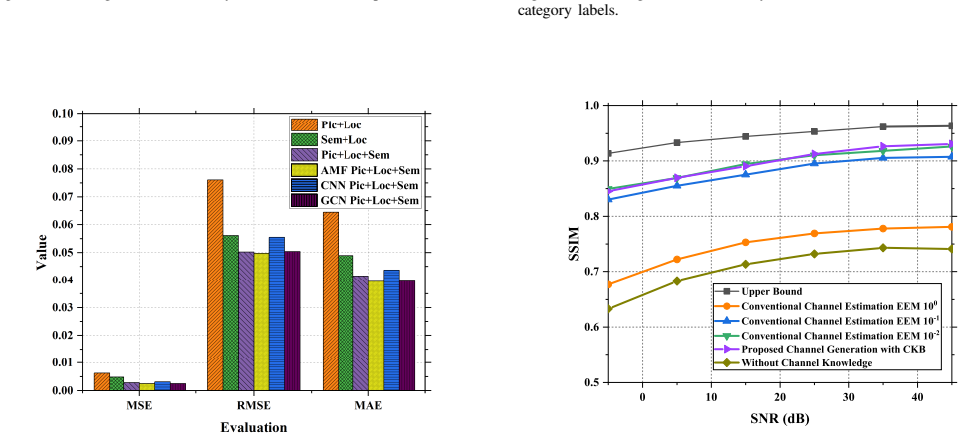
Measuring channel estimation error and transmission performance in a propagation environment outside the training data distribution; if error stays below the 10^{-3} level and performance exceeds benchmarks then the claim holds.
Figures




read the original abstract
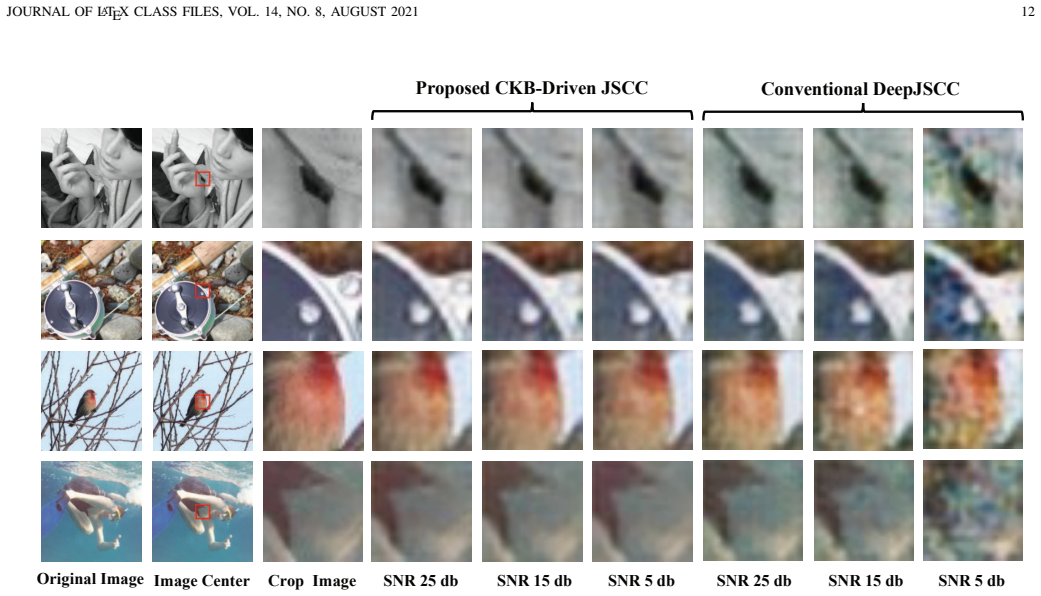
Semantic knowledge bases are regarded as a promising technology for upcoming 6G communications. However, existing studies mainly focus on source-side semantic modeling while overlooking the structural impact of propagation environments on semantic transmission performance. To address this issue, we propose a generative channel knowledge base (CKB) with environmental information to facilitate joint source-channel coding (JSCC) in semantic communications (SemCom) systems. First, to enable the construction of the CKB, an environment-aware dataset is established by collecting spatial position information, global image features, fine-grained semantic features, and the corresponding channel matrices. A region-of-interest (ROI)-based filtering algorithm is further designed to remove semantic components that are irrelevant to signal propagation. Second, a Transformer-based generative framework is developed to learn the mapping between multidimensional environmental information and channel matrices. A self-attention mechanism is introduced to adaptively fuse heterogeneous features, enabling the construction of a structured CKB. Third, a CKB-driven JSCC SemCom architecture is proposed, where the generated channel knowledge is injected into both of the encoder and decoder to jointly exploit source semantics and channel-environment priors in an end-to-end manner. Experimental results demonstrate that the proposed multidimensional feature fusion method achieves a channel matrix estimation error at the $10^{-3}$ level. Moreover, the CKB-driven JSCC SemCom framework integrated into SemCom systems significantly outperforms existing benchmark schemes in terms of transmission performance.
Editorial analysis
A structured set of objections, weighed in public.
Referee Report
Summary. The paper proposes a generative Channel Knowledge Base (CKB) that incorporates environmental information (spatial positions, images, semantic features) to improve joint source-channel coding (JSCC) in semantic communication systems. It describes constructing an environment-aware dataset, an ROI-based filtering algorithm to remove irrelevant semantic components, a Transformer-based generative model with self-attention fusion to map multidimensional features to channel matrices, and injecting the resulting channel priors into both the JSCC encoder and decoder for end-to-end training. Experiments report channel matrix estimation error at the 10^{-3} level and superior transmission performance over benchmark schemes.
Significance. If the central claims hold under broader validation, the work could meaningfully advance semantic communications by providing a structured, data-driven mechanism to exploit environmental context for channel-aware JSCC, addressing an under-explored aspect of 6G SemCom systems. The generative CKB construction and feature-fusion approach represent a concrete technical contribution, though its impact hinges on whether the learned mappings transfer beyond the training distribution.
major comments (2)
- [Experimental Results] Experimental section: the headline claim that the CKB-driven JSCC 'significantly outperforms existing benchmark schemes' is supported only by results on held-out samples drawn from the same data-collection process. No cross-environment validation, different propagation conditions, or out-of-distribution testing is reported, which directly undermines the generalization assumption required for the CKB to deliver usable channel priors in deployment.
- [Generative Framework and JSCC Architecture] §3 (generative framework) and §4 (JSCC architecture): the precise mechanism by which the generated channel knowledge is injected into the encoder and decoder is described at a high level only. Without explicit equations or pseudocode showing how the priors modify the JSCC loss or network inputs, it is impossible to assess whether the reported gains are attributable to the CKB or to other architectural choices.
minor comments (2)
- [Abstract and Experiments] The abstract and experimental claims reference 'existing benchmark schemes' without naming them or providing implementation details; this should be expanded in the main text with explicit citations and hyperparameter settings.
- [Experimental Results] No error bars, statistical significance tests, or dataset scale (number of samples, environments) are mentioned alongside the 10^{-3} estimation error; these should be added for reproducibility.
Simulated Author's Rebuttal
We thank the referee for the detailed and constructive review. The comments highlight important aspects of experimental validation and architectural clarity. We address each major comment below and have revised the manuscript to incorporate additional details and discussion where feasible.
read point-by-point responses
-
Referee: [Experimental Results] Experimental section: the headline claim that the CKB-driven JSCC 'significantly outperforms existing benchmark schemes' is supported only by results on held-out samples drawn from the same data-collection process. No cross-environment validation, different propagation conditions, or out-of-distribution testing is reported, which directly undermines the generalization assumption required for the CKB to deliver usable channel priors in deployment.
Authors: We agree that the reported results are obtained on held-out samples from the same data-collection campaign and that this limits claims about generalization across environments. The current evaluation demonstrates the effectiveness of the proposed feature-fusion approach within the considered indoor scenario. To address the concern, we have added a dedicated paragraph in the experimental section acknowledging this limitation and outlining conditions under which the CKB priors may transfer. We also performed an additional split of the dataset by spatial regions to provide a limited form of cross-region validation. Full cross-environment testing would require new measurement campaigns, which we identify as important future work. revision: partial
-
Referee: [Generative Framework and JSCC Architecture] §3 (generative framework) and §4 (JSCC architecture): the precise mechanism by which the generated channel knowledge is injected into the encoder and decoder is described at a high level only. Without explicit equations or pseudocode showing how the priors modify the JSCC loss or network inputs, it is impossible to assess whether the reported gains are attributable to the CKB or to other architectural choices.
Authors: We apologize for the insufficient detail in the original submission. In the revised manuscript we have expanded Section 4 with explicit equations showing the injection process: the estimated channel matrix Ĥ is concatenated as an additional input feature to the JSCC encoder and is used to compute a channel-aware attention mask inside the decoder. We also added pseudocode in the appendix that illustrates the end-to-end forward pass and the modified loss function that incorporates the CKB prior. These additions make the contribution of the generated channel knowledge traceable and separable from other architectural choices. revision: yes
Circularity Check
No significant circularity; empirical evaluation on held-out data is independent of inputs
full rationale
The paper collects an environment-aware dataset, trains a Transformer generative model to learn the mapping from multidimensional features (positions, images, semantics) to channel matrices via self-attention fusion, and injects the resulting CKB into a JSCC encoder/decoder for end-to-end training. All performance claims (10^{-3} estimation error, outperformance over benchmarks) are obtained from experimental results on held-out samples from the same collection process. No equations or steps reduce by construction to fitted parameters; the generative mapping is learned independently rather than defined in terms of the target JSCC performance. No self-citation load-bearing, uniqueness theorems, or ansatz smuggling appear in the derivation chain. Minor score accounts for standard ML practice of reporting test-set metrics without external OOD validation.
Axiom & Free-Parameter Ledger
free parameters (1)
- Transformer model hyperparameters
axioms (1)
- domain assumption Neural networks can learn a useful mapping from heterogeneous environmental features to channel matrices
invented entities (1)
-
Generative Channel Knowledge Base (CKB)
no independent evidence
Lean theorems connected to this paper
-
IndisputableMonolith/Cost/FunctionalEquation.leanwashburn_uniqueness_aczel unclear?
unclearRelation between the paper passage and the cited Recognition theorem.
a Transformer-based generative framework is developed to learn the mapping between multidimensional environmental information and channel matrices. A self-attention mechanism is introduced to adaptively fuse heterogeneous features
-
IndisputableMonolith/Foundation/AbsoluteFloorClosure.leanreality_from_one_distinction unclear?
unclearRelation between the paper passage and the cited Recognition theorem.
ROI-based filtering algorithm is further designed to remove semantic components that are irrelevant to signal propagation
What do these tags mean?
- matches
- The paper's claim is directly supported by a theorem in the formal canon.
- supports
- The theorem supports part of the paper's argument, but the paper may add assumptions or extra steps.
- extends
- The paper goes beyond the formal theorem; the theorem is a base layer rather than the whole result.
- uses
- The paper appears to rely on the theorem as machinery.
- contradicts
- The paper's claim conflicts with a theorem or certificate in the canon.
- unclear
- Pith found a possible connection, but the passage is too broad, indirect, or ambiguous to say the theorem truly supports the claim.
Reference graph
Works this paper leans on
-
[1]
From semantic communic ation to semantic-aware networking: Model, architecture, and open problems,
G. Shi, Y . Xiao, Y . Li, and X. Xie, “From semantic communic ation to semantic-aware networking: Model, architecture, and open problems,” IEEE Commun. Mag. , vol. 59, no. 8, pp. 44–50, Aug. 2021
2021
-
[2]
Beyond transmitting bits: Conte xt, seman- tics, and task-oriented communications,
D. G¨ und¨ uz, Z. Qin, I. E. Aguerri, H. S. Dhillon, Z. Y ang, A. Y ener, K. K. Wong, and C.-B. Chae, “Beyond transmitting bits: Conte xt, seman- tics, and task-oriented communications,” IEEE J. Sel. Areas Commun. , vol. 41, no. 1, pp. 5–41, Jan. 2022
2022
-
[3]
Image semantic ste ganog- raphy: A way to hide information in semantic communication,
Y . Huo, S. Xiang, X. Luo, and X. Zhang, “Image semantic ste ganog- raphy: A way to hide information in semantic communication, ” IEEE Trans. Circuits Syst. Video Technol. , Oct. 2024
2024
-
[4]
Semantic communications for future in ternet: Fundamentals, applications, and challenges,
W. Y ang, H. Du, Z. Q. Liew, W. Y . B. Lim, Z. Xiong, D. Niyato, X. Chi, X. Shen, and C. Miao, “Semantic communications for future in ternet: Fundamentals, applications, and challenges,” IEEE Commun. Surveys Tuts., vol. 25, no. 1, pp. 213–250, Nov. 2022
2022
-
[5]
Agentic AI-enhanced semantic communications: Foundations, architecture, and applications,
H. Gao, M. Sun, R. Zhang, Y . Wang, X. Xu, N. Ma, D. Niyato, an d P . Zhang, “Agentic AI-enhanced semantic communications: Foundations, architecture, and applications,” arXiv preprint arXiv:2512.23294 , Dec. 2025
-
[6]
Semantic knowledge base empowered generative semantic communication,
S. Li, Y . Sun, J. Zhang, K. Cai, S. Cui, and X. Xu, “Semantic knowledge base empowered generative semantic communication,” IEEE Trans. Commun., Jul. 2025
2025
-
[7]
Semantic V2X communications for image transmission in 6G systems,
J. M. Gimenez-Guzman, I. Leyva-Mayorga, and P . Popovski , “Semantic V2X communications for image transmission in 6G systems,” IEEE Network, vol. 38, no. 6, pp. 48–54, Jun. 2024
2024
-
[8]
6G channel modeling: Requirement, measure- ment, methodology and simulator,
J. Zhang, J. Lin, P . Tang, Y . Zhang, H. Xu, T. Gao, H. Miao, Z . Chai, Z. Zhou, Y . Li et al. , “Channel measurement, modeling, and simulation for 6G: A survey and tutorial,” arXiv preprint arXiv:2305.16616 , May 2023
-
[9]
Channel knowledge map (CKM)-assisted multi-uav wireless network: CKM constr uction and uav placement,
H. Li, P . Li, G. Cheng, J. Xu, J. Chen, and Y . Zeng, “Channel knowledge map (CKM)-assisted multi-uav wireless network: CKM constr uction and uav placement,” J. Commun. Inf. Netw. , vol. 8, no. 3, pp. 256–270, Sep. 2023. JOURNAL OF LATEX CLASS FILES, VOL. 14, NO. 8, AUGUST 2021 13
2023
-
[10]
When generative ai meets semantic communication: Optimizing ra dio map construction and distribution in future mobile networks,
L. Zhou, X. Deng, Z. Ning, H. Zhao, J. Wei, and V . C. Leung, “When generative ai meets semantic communication: Optimizing ra dio map construction and distribution in future mobile networks,” IEEE Network, Jan. 2025
2025
-
[11]
Efficient CKM exchan ge via semantic communications,
Y . Shen, S. Wang, X. Xu, and Y . Zeng, “Efficient CKM exchan ge via semantic communications,” in 2025 IEEE 101st V ehicular Technology Conference (VTC2025-Spring). IEEE, Sep. 2025, pp. 1–5
2025
-
[12]
Channel knowledge map construction: Recent adva nces and open challenges,
Z. Ren, J. Zhou, J. Xu, L. Qiu, Y . Zeng, H. Hu, J. Zhang, and R. Zhang, “Channel knowledge map construction: Recent adva nces and open challenges,” arXiv preprint arXiv:2511.04944 , 2025
-
[13]
A recent surve y on radio map estimation methods for wireless networks,
B. Feng, M. Zheng, W. Liang, and L. Zhang, “A recent surve y on radio map estimation methods for wireless networks,” Electronics, vol. 14, no. 8, p. 1564, 2025
2025
-
[14]
X. Liu, S. Sun, M. Tao, A. Kaushik, and H. Y an, “Channel kn owledge maps for 6g wireless networks: construction, applications , and future challenges,” arXiv preprint arXiv:2505.24151 , 2025
-
[15]
Adaptive deep joint source- channel coding via meta learning for semantic communicatio n,
J. Huang, X. Wang, J. Xia, and C. Li, “Adaptive deep joint source- channel coding via meta learning for semantic communicatio n,” Physical Communication, p. 102899, 2025
2025
-
[16]
Nonlinear transform source-channel coding for semantic communicati ons,
J. Dai, S. Wang, K. Tan, Z. Si, X. Qin, K. Niu, and P . Zhang, “Nonlinear transform source-channel coding for semantic communicati ons,” IEEE J. Sel. Areas Commun. , vol. 40, no. 8, pp. 2300–2316, Aug. 2022
2022
-
[17]
Rate-adaptive coding mechanism for semantic communications with multi-modal data,
Y . He, G. Y u, and Y . Cai, “Rate-adaptive coding mechanism for semantic communications with multi-modal data,” IEEE Trans. Commun., vol. 72, no. 3, pp. 1385–1400, Mar. 2023
2023
-
[18]
Visual fidelity index fo r generative semantic communications with critical information embedd ing,
J. Huang, Q. Zeng, and K. Huang, “Visual fidelity index fo r generative semantic communications with critical information embedd ing,” arXiv preprint arXiv:2505.10405, May 2025
-
[19]
Semantic communications with discrete-time analog transmission: A papr perspective,
Y . Shao and D. G¨ und¨ uz, “Semantic communications with discrete-time analog transmission: A papr perspective,” IEEE Wireless Commun. Lett. , vol. 12, no. 3, pp. 510–514, Mar. 2022
2022
-
[20]
Deep jo int source- channel coding for wireless image transmission,
E. Bourtsoulatze, D. B. Kurka, and D. G¨ und¨ uz, “Deep jo int source- channel coding for wireless image transmission,” IEEE J. Sel. Areas Commun., vol. 5, no. 3, pp. 567–579, Sep. 2019
2019
-
[21]
Knowl- edge base enabled semantic communication: A generative per spective,
J. Ren, Z. Zhang, J. Xu, G. Chen, Y . Sun, P . Zhang, and S. Cu i, “Knowl- edge base enabled semantic communication: A generative per spective,” IEEE Wireless Commun. , vol. 31, no. 4, pp. 14–22, Aug. 2024
2024
-
[22]
Semantic kno wledge base-enabled zero-shot multi-level feature transmission optimization,
Y . Sun, H. Chen, X. Xu, P . Zhang, and S. Cui, “Semantic kno wledge base-enabled zero-shot multi-level feature transmission optimization,” IEEE Trans. Wireless Commun. , vol. 23, no. 5, pp. 4904–4917, Oct. 2023
2023
-
[23]
MOC-RVQ: Multilevel codebook-assisted digital generative semantic communication,
Y . Zhou, Y . Sun, G. Chen, X. Xu, H. Chen, B. Huang, S. Cui, a nd P . Zhang, “MOC-RVQ: Multilevel codebook-assisted digital generative semantic communication,” in GLOBECOM 2024-2024 IEEE Global Communications Conference. IEEE, Dec. 2024, pp. 2078–2083
2024
-
[24]
Knowledge e n- hanced semantic communication receiver,
B. Wang, R. Li, J. Zhu, Z. Zhao, and H. Zhang, “Knowledge e n- hanced semantic communication receiver,” IEEE Communications Let- ters, vol. 27, no. 7, pp. 1794–1798, May 2023
2023
-
[25]
Deep learning-e mpowered semantic communication systems with a shared knowledge bas e,
P . Yi, Y . Cao, X. Kang, and Y .-C. Liang, “Deep learning-e mpowered semantic communication systems with a shared knowledge bas e,” IEEE Trans. Wireless Commun. , vol. 23, no. 6, pp. 6174–6187, Nov. 2023
2023
-
[26]
Cooperative semantic knowledge base update policy for multiple semanti c communi- cation pairs,
S. Li, Y . Sun, J. Zhang, K. Cai, H. Chen, S. Cui, and X. Xu, “ Cooperative semantic knowledge base update policy for multiple semanti c communi- cation pairs,” in GLOBECOM 2024-2024 IEEE Global Communications Conference. IEEE, Mar. 2024, pp. 2178–2183
2024
-
[27]
Robust semantic communications with masked VQ-V AE enabled codebook,
Q. Hu, G. Zhang, Z. Qin, Y . Cai, G. Y u, and G. Y . Li, “Robust semantic communications with masked VQ-V AE enabled codebook,” IEEE Trans. Wireless Commun., vol. 22, no. 12, pp. 8707–8722, Apr. 2023
2023
-
[28]
Deep joint source-channel coding for semantic communications,
J. Xu, T.-Y . Tung, B. Ai, W. Chen, Y . Sun, and D. G¨ und¨ uz,“Deep joint source-channel coding for semantic communications,” IEEE Commun. Mag., vol. 61, no. 11, pp. 42–48, Nov. 2023
2023
-
[29]
Deep joint source-channel coding for adaptive image transmissi on over MIMO channels,
H. Wu, Y . Shao, C. Bian, K. Mikolajczyk, and D. G¨ und¨ uz, “Deep joint source-channel coding for adaptive image transmissi on over MIMO channels,” IEEE Trans. Wireless Commun. , Jul. 2024
2024
-
[30]
Vision aided env ironment semantics extraction and its application in mmWave beam sel ection,
F. Wen, W. Xu, F. Gao, C. Pan, and G. Liu, “Vision aided env ironment semantics extraction and its application in mmWave beam sel ection,” IEEE Commun. Lett. , vol. 27, no. 7, pp. 1894–1898, Jul. 2023
2023
-
[31]
Millimeter wa ve drones with cameras: Computer vision aided wireless beam predicti on,
G. Charan, A. Hredzak, and A. Alkhateeb, “Millimeter wa ve drones with cameras: Computer vision aided wireless beam predicti on,” in ICC W orkshops 2023. IEEE, Oct. 2023, pp. 1896–1901
2023
-
[32]
Env ironment information-based channel prediction method assisted by g raph neural network,
Y . Sun, J. Zhang, Y . Zhang, L. Y u, Q. Wang, and G. Liu, “Env ironment information-based channel prediction method assisted by g raph neural network,” China Commun. , vol. 19, no. 11, pp. 1–15, Nov. 2022
2022
-
[33]
A tutorial on environment-aware communicati ons via channel knowledge map for 6G,
Y . Zeng, J. Chen, J. Xu, D. Wu, X. Xu, S. Jin, X. Gao, D. Gesb ert, S. Cui, and R. Zhang, “A tutorial on environment-aware communicati ons via channel knowledge map for 6G,” IEEE Commun. Surveys Tuts. , vol. 26, no. 3, pp. 1478–1519, Feb. 2024
2024
-
[34]
Channel gain map track- ing via distributed kriging,
E. Dall’Anese, S.-J. Kim, and G. B. Giannakis, “Channel gain map track- ing via distributed kriging,” IEEE Trans. V ehicular Technol. , vol. 60, no. 3, pp. 1205–1211, Mar. 2011
2011
-
[35]
Deep completion autoencoder s for radio map estimation,
Y . Teganya and D. Romero, “Deep completion autoencoder s for radio map estimation,” IEEE Trans. Wireless Commun. , vol. 21, no. 3, pp. 1710–1724, Mar. 2021
2021
-
[36]
CKM-assisted los ide ntification and predictive beamforming for cellular-connected uav,
S. Zeng, X. Xu, Y . Zeng, and F. Liu, “CKM-assisted los ide ntification and predictive beamforming for cellular-connected uav,” i n IEEE Int. Conf. Commun. (ICC 2023) . IEEE, Oct. 2023, pp. 2877–2882
2023
-
[37]
Point cloud environment-based channel knowledge map constructi on,
Y . Wang, W. Guo, G. Chen, Y . Zhang, and S. Cui, “Point cloud environment-based channel knowledge map constructi on,” arXiv preprint arXiv:2506.21112, Jun. 2025
-
[38]
5g v2x communication at millimeter wave: Rate maps an d use cases,
W. Zheng, A. Ali, N. Gonz´ alez-Prelcic, R. Heath, A. Kla utau, and E. M. Pari, “5g v2x communication at millimeter wave: Rate maps an d use cases,” in VTC2020-Spring. IEEE, Jun. 2020, pp. 1–5
2020
-
[39]
Kernel-based adaptive online reconstruction o f coverage maps with side information,
M. Kasparick, R. L. Cavalcante, S. V alentin, S. Sta´ ncz ak, and M. Y ukawa, “Kernel-based adaptive online reconstruction o f coverage maps with side information,” IEEE Trans. V ehicular Technol., vol. 65, no. 7, pp. 5461–5473, Jul. 2015
2015
-
[40]
Toward environment-aware 6G communi cations via channel knowledge map,
Y . Zeng and X. Xu, “Toward environment-aware 6G communi cations via channel knowledge map,” IEEE Wireless Commun. , vol. 28, no. 3, pp. 84–91, Jun. 2021
2021
-
[41]
Resnet in resnet: Generalizing residual architectures,
S. Targ, D. Almeida, and K. Lyman, “Resnet in resnet: Gen eralizing residual architectures,” arXiv preprint arXiv:1603.08029 , 2016
-
[42]
Pyramid scene parsing network,
H. Zhao, J. Shi, X. Qi, X. Wang, and J. Jia, “Pyramid scene parsing network,” in Proceedings of the IEEE conference on computer vision and pattern recognition , Jun. 2017, pp. 2881–2890
2017
-
[43]
CARLA: An open urban driving simulator,
A. Dosovitskiy, G. Ros, F. Codevilla, A. Lopez, and V . Ko ltun, “CARLA: An open urban driving simulator,” in Conference on Robot Learning. PMLR, 2017, pp. 1–16
2017
-
[44]
A novel traffic simulation framework for testing autonomous vehicles using sumo and carla,
P . Li, A. Kusari, and D. J. LeBlanc, “A novel traffic simul ation framework for testing autonomous vehicles using SUMO and CA RLA,” arXiv preprint arXiv:2110.07111 , Oct. 2021
-
[45]
A review on different ve rsions and interfaces of Blender software,
L. Soni, A. Kaur, and A. Sharma, “A review on different ve rsions and interfaces of Blender software,” in ICOEI 2023 . IEEE, May 2023, pp. 882–887
2023
-
[46]
DeepMIMO: A Generic Deep Learning Dataset for Millimeter Wave and Massive MIMO Applications
A. Alkhateeb, “DeepMIMO: A generic deep learning datas et for millimeter wave and massive MIMO applications,” arXiv preprint arXiv:1902.06435, Feb. 2019
work page Pith review arXiv 1902
-
[47]
arXiv preprint arXiv:1806.00451 , year=
B. Recht, R. Roelofs, L. Schmidt, and V . Shankar, “Do CIF AR-10 classifiers generalize to CIFAR-10?” arXiv preprint arXiv:1806.00451 , Jun. 2018
-
[48]
ImageNet: A large-scale hierarchical image database,
J. Deng, W. Dong, R. Socher, L.-J. Li, K. Li, and L. Fei-Fe i, “ImageNet: A large-scale hierarchical image database,” in 2009 IEEE Conference on Computer Vision and Pattern Recognition . IEEE, Aug. 2009, pp. 248– 255
2009
discussion (0)
Sign in with ORCID, Apple, or X to comment. Anyone can read and Pith papers without signing in.