Recognition: no theorem link
Mass generation in graphs
Pith reviewed 2026-05-10 19:28 UTC · model grok-4.3
The pith
Treating a graph's degree as a scalar field and coupling it to incidence matrices produces massive excitations separated by a mass gap.
A machine-rendered reading of the paper's core claim, the machinery that carries it, and where it could break.
Core claim
By treating the degree of each vertex as a scalar field and coupling it to a vector-like field constructed from the incidence matrices, the system develops a mass gap. This separates a massless ground state from a set of massive excitations that propagate as emergent particles inside the graph. The properties of the mass gap and the localization of these particles vary with the graph's size and density.
What carries the argument
The coupling between the scalar degree field and the vector-like field from incidence matrices, which generates the mass spectrum with a gap.
If this is right
- The mass gap depends on the graph size and the ratio of edges to vertices.
- The most massive excitations localize on high-density regions with high-degree vertices.
- The least massive excitations localize on fewer vertices with smaller degrees.
- Intermediate mass excitations spread over more vertices.
- The excitations behave as particles propagating within the graph.
Where Pith is reading between the lines
- This suggests that different network topologies could produce different particle mass spectra in discrete models.
- It opens the possibility of studying emergence of mass in purely combinatorial systems without continuous spacetime.
- Extensions to dynamic graphs might show how evolving connectivity affects particle properties.
Load-bearing premise
That the spectrum obtained from the coupled fields truly corresponds to physical mass generation in the discrete setting, as opposed to a mathematical feature labeled by analogy to the Higgs mechanism.
What would settle it
Compute the full spectrum and eigenvectors for the coupled system on a small, regular graph such as a cycle graph and check if the massive modes localize or propagate in ways predicted by their assigned masses and the local degree distribution.
Figures




read the original abstract
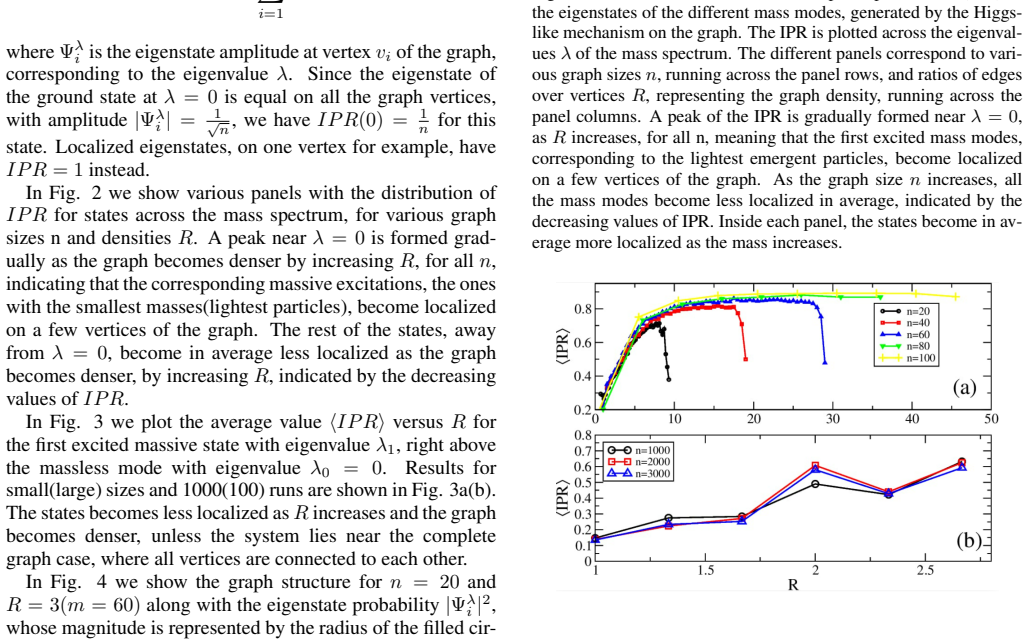
We demonstrate a mechanism for the production of massive excitations in graphs. We treat the number of neighbors at each vertex in the graph (degree) as a scalar field. Then we introduce a mechanism inspired by the Higgs mechanism in quantum field theory(QFT), that couples the degree field to a vector-like field, introduced via the graph edges, represented mathematically by the incident matrices of the graph. The coupling between the two fields produces a massless ground state and massive excitations, separated by a mass gap. The excitations can be treated as emergent massive particles, propagating inside the graph. We study how the size of the graph and its density, represented by the ratio of edges over vertices, affects the mass gap and the localization properties of the massive excitations. We show that the most massive excitations, corresponding to the heaviest emergent particles, localize on regions of the graph with high density, consisting of vertices with a large degree. On the other hand, the least massive excitations, corresponding to the lightest emergent particles localize on a few vertices but with a smaller degree. Excitations with intermediate masses are less localized, spreading on more vertices instead. Our study shows that emergence of matter-like structures with various mass properties, is possible in discrete physical models, relying only on a few fundamental properties like the connectivity of the models.
Editorial analysis
A structured set of objections, weighed in public.
Referee Report
Summary. The manuscript proposes a discrete analog of the Higgs mechanism on graphs: the vertex degree sequence is treated as a scalar field and coupled to a vector-like field constructed from the graph's incidence matrices. The resulting coupled operator is claimed to produce a spectrum with a massless ground state separated by a finite mass gap from massive modes; these modes are interpreted as emergent massive particles whose localization properties depend on local degree. The authors study the dependence of the gap and localization on graph size and edge-to-vertex density, reporting that the heaviest modes concentrate on high-degree vertices while lighter modes are less localized.
Significance. If the construction can be shown to generate a non-tautological mass gap and genuinely emergent localization (rather than a direct algebraic consequence of degree-weighted coupling), the work would supply a minimal graph-theoretic toy model for mass generation in discrete systems. Such a result could be of interest to the condensed-matter and complex-systems communities as an example of how connectivity alone might produce particle-like excitations with varying masses.
major comments (3)
- [Abstract / model section] Abstract and the model definition: the claim that the coupling 'produces a massless ground state and massive excitations, separated by a mass gap' is not supported by any explicit operator, eigenvalue equation, or derivation in the provided text. Without the concrete form of the coupled matrix (e.g., how the degree field enters the quadratic form or the precise incidence-matrix construction), it is impossible to verify whether the gap is emergent or imposed by construction.
- [Results on localization] Localization claim: the reported correlation that 'the most massive excitations localize on regions of the graph with high density' follows immediately from any degree-dependent weighting of the quadratic form or adjacency operator. Standard results on eigenvector localization in weighted graphs predict precisely this concentration on high-degree vertices; the manuscript does not demonstrate that the observed localization exceeds this algebraic expectation or arises from the dynamical coupling itself.
- [Spectrum analysis] Mass-gap definition and independence: the paper does not compare the coupled spectrum to the uncoupled incidence-matrix spectrum or to a null model with randomized degrees. Consequently, it remains unclear whether the reported gap and the separation into 'massless' and 'massive' modes are independent of the graph data used to define both the degree field and the incidence structure.
minor comments (2)
- [Abstract] The abstract and introduction repeatedly use the phrase 'emergent massive particles' without a precise definition of what 'particle' means in this finite-graph setting (e.g., dispersion relation, propagation, or scattering).
- [Abstract] No numerical values, figures, or tables are referenced in the abstract; the dependence on 'size of the graph and its density' is stated qualitatively only.
Simulated Author's Rebuttal
We thank the referee for their careful reading and constructive comments, which help clarify the presentation of our discrete analog of the Higgs mechanism. We address each major comment below and will incorporate the suggested clarifications and comparisons into the revised manuscript.
read point-by-point responses
-
Referee: [Abstract / model section] Abstract and the model definition: the claim that the coupling 'produces a massless ground state and massive excitations, separated by a mass gap' is not supported by any explicit operator, eigenvalue equation, or derivation in the provided text. Without the concrete form of the coupled matrix (e.g., how the degree field enters the quadratic form or the precise incidence-matrix construction), it is impossible to verify whether the gap is emergent or imposed by construction.
Authors: We agree that the model section lacks sufficient explicit detail for independent verification. In the revised manuscript we will add the precise definition of the coupled operator: the incidence matrices B (oriented edge-vertex incidence) define the vector-like field on edges, while the degree sequence d enters as a diagonal scalar field that couples through a term of the form B^T diag(d) B in the quadratic form. The resulting eigenvalue problem is (B^T diag(d) B) v = λ v, where the kernel (λ=0) corresponds to the constant mode on vertices and a finite gap opens for modes orthogonal to it due to the non-uniformity of d. We will derive this explicitly and show that the gap is generated by the coupling rather than imposed by hand. revision: yes
-
Referee: [Results on localization] Localization claim: the reported correlation that 'the most massive excitations localize on regions of the graph with high density' follows immediately from any degree-dependent weighting of the quadratic form or adjacency operator. Standard results on eigenvector localization in weighted graphs predict precisely this concentration on high-degree vertices; the manuscript does not demonstrate that the observed localization exceeds this algebraic expectation or arises from the dynamical coupling itself.
Authors: While degree-dependent weighting does induce localization on high-degree vertices, our construction generates the effective weighting dynamically through the coupling of the scalar degree field to the incidence vector fields rather than by fiat. In the revision we will include a side-by-side comparison of the eigenvector localization (via participation ratio or inverse participation ratio) for the coupled operator versus a control operator that applies the same degree weighting directly to the incidence matrix without the full coupling structure. This will quantify whether the mass-dependent localization pattern is modified by the dynamical interaction. revision: partial
-
Referee: [Spectrum analysis] Mass-gap definition and independence: the paper does not compare the coupled spectrum to the uncoupled incidence-matrix spectrum or to a null model with randomized degrees. Consequently, it remains unclear whether the reported gap and the separation into 'massless' and 'massive' modes are independent of the graph data used to define both the degree field and the incidence structure.
Authors: We accept that benchmarking against uncoupled and null models is required to establish that the gap is a genuine consequence of the coupling. The revised manuscript will add explicit spectral comparisons: (i) the spectrum of the uncoupled incidence operator B^T B, which possesses a known kernel whose dimension relates to the cycle space, and (ii) a null-model ensemble in which the degree sequence is randomly reassigned while the incidence structure is held fixed. These will demonstrate that both the finite gap and the separation into massless and massive modes disappear or change character when the coupling to the actual degree field is removed. revision: yes
Circularity Check
No significant circularity; model construction is self-contained
full rationale
The paper proposes a discrete model that couples a degree-based scalar field to an incidence-matrix vector field, then examines the spectrum of the resulting operator for a mass gap and localization properties. This spectrum and its degree-dependent features are direct outputs of the defined coupling, but the paper frames the work as introducing an analogy to the Higgs mechanism rather than deriving an independent physical result from unrelated inputs or fitting data. No equations, self-citations, uniqueness theorems, or ansatzes are quoted that reduce the central claims to tautological redefinitions or forced predictions. The localization on high-degree vertices is an expected model consequence presented as a finding, not a circularly relabeled input. The derivation remains self-contained against external benchmarks.
Axiom & Free-Parameter Ledger
free parameters (1)
- coupling strength
axioms (2)
- domain assumption The incidence matrix of an undirected graph can be interpreted as a vector-like field whose components transform appropriately under the coupling.
- ad hoc to paper The resulting spectrum after coupling contains a massless ground state separated by a finite gap from massive modes.
invented entities (1)
-
emergent massive particles
no independent evidence
Reference graph
Works this paper leans on
-
[1]
Erd ˝os, T
P. Erd ˝os, T. Gallai, ”Gr ´afokel˝o´ırt foksz ´am´u pontokkal”, Matematikai Lapok,11: 264-274 (1960)
1960
-
[2]
Aigner, E
M. Aigner, E. Triesch, Discrete Math.136, 3-20 (1994)
1994
-
[3]
I. J. Farkas, I. Der ´enyi, A.-L. Barab ´asi, and T. Vicsek, Phys. Rev. E64, 026704 (2001)
2001
-
[4]
M. E. J. Newman Networks: An Introduction Oxford Univer- sity Press, Oxford (2010)
2010
-
[5]
Frieze, M
A. Frieze, M. Karonski, Introduction to random graphs. Cam- bridge University Press (2015)
2015
-
[6]
Berg and M
J. Berg and M. Lassig., Phys. Rev. Lett.89, 228701 (2002)
2002
-
[7]
Mizutaka and T
S. Mizutaka and T. Hasegawa, Journal of Physics: Complexity 1, 035007 (2020)
2020
-
[8]
Kleftogiannis and I
I. Kleftogiannis and I. Amanatidis, Phys. Rev. E105, 024141 (2022)
2022
-
[9]
I. Kleftogiannis and I. Amanatidis, arXiv:2210.00963 [cond- mat.dis-nn] (2022)
-
[10]
I. Kleftogiannis and I. Amanatidis, arXiv:2507.01468 [cond- mat.dis-nn](2024)
-
[11]
G. J. Bianconi, J. phys. Complex.2, 035022 (2021)
2021
-
[12]
G. J. Bianconi, J. Phys. A: Math. Theor.57, 015001 (2023)
2023
-
[13]
Jonathan L Gross, Jay Yellen, Graph Theory and its applica- tions, second edition, 2006 (p 97, Incidence Matrices for undi- rected graphs; p 98, incidence matrices for digraphs)
2006
-
[14]
173 (3rd ed.), Springer-Verlag, ISBN 3-540- 26183-4
Diestel, Reinhard (2005), Graph Theory, Graduate Texts in Mathematics, vol. 173 (3rd ed.), Springer-Verlag, ISBN 3-540- 26183-4
2005
-
[15]
Bollob ´as B. 1998. In Modern Graph Theory, ed. S Axler, FW Gehring, KA Ribet, pp. 215–52. New York: Springer Sci. Bus. Media
1998
-
[16]
Rovelli, Class
C. Rovelli, Class. Quantum Grav.28, 153002 (2011)
2011
-
[17]
Rovelli, Living Rev
C. Rovelli, Living Rev. Relativ.11, 5 (2008)
2008
-
[18]
Bombelli, J
L. Bombelli, J. Lee, D. Meyer and R. D. Sorkin, Phys. Rev. Lett.59, 521-524 (1987)
1987
-
[19]
Dowker, Annals of the New York Academy of Sciences1326, 18-25, (2014)
F. Dowker, Annals of the New York Academy of Sciences1326, 18-25, (2014)
2014
-
[20]
Dowker and S
F. Dowker and S. Zalel, C R Physique1, 8:246-253 (2017)
2017
-
[21]
Surya, Living Rev
S. Surya, Living Rev. Rel.22, 5 (2019)
2019
-
[22]
Wolfram, Complex Systems29, (2) pp
S. Wolfram, Complex Systems29, (2) pp. 107-536 (2020)
2020
-
[23]
Gorard, Complex Systems,29, (2) pp
J. Gorard, Complex Systems,29, (2) pp. 599-654 (2020)
2020
-
[24]
Konopka, F
T. Konopka, F. Markopoulou and S. Severini, Phys. Rev. D77, 104029 (2008)
2008
-
[25]
Trugenberger, J
C.A. Trugenberger, J. High Energ. Phys. 45 (2017)
2017
-
[26]
Kelly, C
C. Kelly, C. Trugenberger, and F. Biancalana, Class. Quantum Grav.38, 075008 (2021)
2021
-
[27]
Englert and R
F. Englert and R. Brout, Phys. Rev. Lett.13, 321 (1964)
1964
-
[28]
P. W. Higgs, Phys. Rev. Lett.13, 508 (1964)
1964
-
[29]
G. S. Guralnik, C. R. Hagen, and T. W. Kibble, Phys. Rev. Lett. 13, 585 (1964)
1964
-
[30]
Balaban, J
T. Balaban, J. Imbrie, A. M. Jaffe, and D. Brydges, Annals of Physics158281 (1984)
1984
-
[31]
ATLAS Collaboration, Phys. Lett. B716, 1 (2012)
2012
-
[32]
Proc.1444, 45–57 (2012)
Abdelhak Djouadi, AIP Conf. Proc.1444, 45–57 (2012)
2012
-
[33]
Dedushenko, International Journal of Modern Physics A38 04n05 (2023)
M. Dedushenko, International Journal of Modern Physics A38 04n05 (2023)
2023
discussion (0)
Sign in with ORCID, Apple, or X to comment. Anyone can read and Pith papers without signing in.