Recognition: 2 theorem links
· Lean TheoremFrom Large Language Model Predicates to Logic Tensor Networks: Neurosymbolic Offer Validation in Regulated Procurement
Pith reviewed 2026-05-10 19:57 UTC · model grok-4.3
The pith
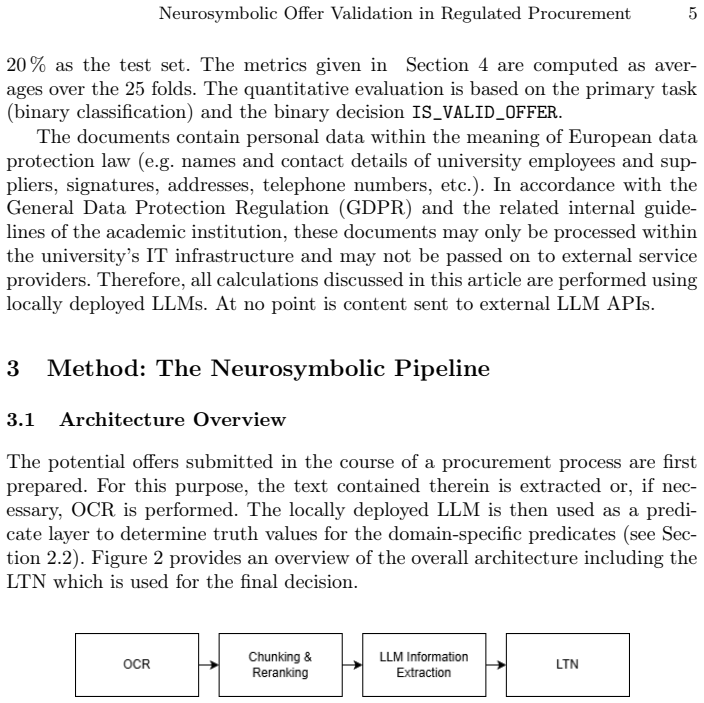
A neurosymbolic pipeline extracts predicates from offer documents with a language model and validates them via Logic Tensor Networks to produce auditable decisions.
A machine-rendered reading of the paper's core claim, the machinery that carries it, and where it could break.
Core claim
By employing a language model to extract information from offer documents and then aggregating the results with a Logic Tensor Network, the approach produces decisions that are both factually correct and legally verifiable. These decisions can be justified by predicate values, rule truth values, and corresponding text passages, enabling rule checking based on a real corpus. Experiments show performance comparable to existing models, with the key advantage lying in interpretability, modular predicate extraction, and explicit support for XAI.
What carries the argument
Logic Tensor Network (LTN) that evaluates the truth of domain rules over predicates extracted by the language model from offer documents.
If this is right
- Decisions can be justified by referencing specific predicate values, rule truth values, and the original text passages.
- Domain-specific knowledge can be linked directly to the semantic understanding provided by language models.
- The modular predicate extraction allows rules to be updated or extended without retraining the language model.
- The structure provides explicit support for Explainable AI through auditable rule checking.
Where Pith is reading between the lines
- The same predicate-to-LTN structure could be reused in other regulated text domains such as contract compliance or grant application review.
- Human review of the extracted predicates before LTN evaluation could serve as a practical safeguard against extraction errors.
- If predicate accuracy improves with newer language models, overall decision quality could exceed purely neural baselines while retaining traceability.
Load-bearing premise
The predicates extracted by the language model are sufficiently accurate and complete for the Logic Tensor Network rules to produce legally correct decisions on unseen offer documents.
What would settle it
A test corpus of offer documents with independent legal-expert validity labels where the pipeline produces decisions that systematically disagree with the ground truth on cases involving clear rule violations.
Figures
read the original abstract
We present a neurosymbolic approach, i.e., combining symbolic and subsymbolic artificial intelligence, to validating offer documents in regulated public institutions. We employ a language model to extract information and then aggregate with an LTN (Logic Tensor Network) to make an auditable decision. In regulated public institutions, decisions must be made in a manner that is both factually correct and legally verifiable. Our neurosymbolic approach allows existing domain-specific knowledge to be linked to the semantic text understanding of language models. The decisions resulting from our pipeline can be justified by predicate values, rule truth values, and corresponding text passages, which enables rule checking based on a real corpus of offer documents. Our experiments on a real corpus show that the proposed pipeline achieves performance comparable to existing models, while its key advantage lies in its interpretability, modular predicate extraction, and explicit support for XAI (Explainable AI).
Editorial analysis
A structured set of objections, weighed in public.
Referee Report
Summary. The manuscript proposes a neurosymbolic pipeline for validating offer documents in regulated public procurement. A large language model extracts predicates from text, which are then aggregated via Logic Tensor Networks (LTNs) using domain-specific rules to produce auditable decisions. The authors claim that this approach achieves performance comparable to existing models on a real corpus while providing advantages in interpretability, modularity, predicate-level justification, and explicit support for XAI through rule truth values and linked text passages.
Significance. If the empirical claims are substantiated, the work offers a concrete demonstration of combining LLM semantic extraction with symbolic logical reasoning in a high-stakes legal domain. The emphasis on auditability and XAI could address regulatory requirements for verifiable decisions, potentially increasing trust in automated procurement systems.
major comments (2)
- [Abstract] Abstract: The central claim that 'the proposed pipeline achieves performance comparable to existing models' is unsupported by any reported metrics, baselines, corpus split details, labeling process, or error analysis. Without these, the performance assertion cannot be evaluated.
- [Experiments] Experiments (as described in the abstract and skeptic analysis): The legal verifiability claim rests on the assumption that LM-extracted predicates are accurate and complete enough for LTN rules to yield correct decisions. No predicate-level validation (precision/recall vs. expert annotations, inter-annotator agreement, or error analysis on extracted predicates) is provided; only end-to-end performance is referenced. This is load-bearing for the interpretability and XAI advantages.
minor comments (1)
- [Abstract] Abstract: The phrase 'neurosymbolic approach' is introduced without a short definition or citation to foundational LTN or neurosymbolic literature, which may hinder accessibility for readers outside the subfield.
Simulated Author's Rebuttal
We thank the referee for the constructive and detailed feedback. We address each major comment below and will revise the manuscript to strengthen the empirical presentation.
read point-by-point responses
-
Referee: [Abstract] Abstract: The central claim that 'the proposed pipeline achieves performance comparable to existing models' is unsupported by any reported metrics, baselines, corpus split details, labeling process, or error analysis. Without these, the performance assertion cannot be evaluated.
Authors: We agree that the abstract's performance claim requires concrete supporting details to be properly evaluated. The current version states the claim at a high level based on the experiments but does not include the specific metrics or procedural details in the abstract. We will revise the abstract to report key performance metrics, baselines, corpus split details, labeling process, and a summary of error analysis, ensuring the claim is fully substantiated and evaluable. revision: yes
-
Referee: [Experiments] Experiments (as described in the abstract and skeptic analysis): The legal verifiability claim rests on the assumption that LM-extracted predicates are accurate and complete enough for LTN rules to yield correct decisions. No predicate-level validation (precision/recall vs. expert annotations, inter-annotator agreement, or error analysis on extracted predicates) is provided; only end-to-end performance is referenced. This is load-bearing for the interpretability and XAI advantages.
Authors: We concur that the accuracy and completeness of the LLM-extracted predicates are foundational to the legal verifiability, interpretability, and XAI claims. The manuscript currently emphasizes end-to-end results. We will add a dedicated predicate-level evaluation in the revised experiments section, reporting precision and recall against expert annotations, inter-annotator agreement, and a detailed error analysis on the extracted predicates. These additions will directly bolster the support for the modularity and explainability advantages. revision: yes
Circularity Check
No circularity in derivation chain; empirical pipeline with no equations or self-referential reductions
full rationale
The paper presents a neurosymbolic pipeline that extracts predicates via language model and aggregates them using Logic Tensor Networks for auditable decisions on offer documents. Central claims rest on experiments showing performance comparable to baselines plus advantages in interpretability and XAI support. No equations, derivations, fitted parameters, or self-citations appear in the provided text that would reduce any prediction or result to its inputs by construction. The approach invokes domain knowledge and empirical validation on a real corpus without self-definitional loops, uniqueness theorems imported from prior author work, or ansatzes smuggled via citation. This matches the default expectation of no significant circularity for an empirical methods paper.
Axiom & Free-Parameter Ledger
axioms (1)
- domain assumption Decisions in regulated public institutions must be both factually correct and legally verifiable.
Lean theorems connected to this paper
-
IndisputableMonolith/Cost/FunctionalEquation.leanwashburn_uniqueness_aczel unclearLTN aggregates predicate truth values p(d)∈[0,1]^11 with fuzzy operators (Gödel min/max, Łukasiewicz, Product) and rules R1: Tc(d)→Obase(d), R5: NOTs(d)→¬Obase(d) to decide IS_VALID_OFFER
-
IndisputableMonolith/Foundation/ArithmeticFromLogic.leanLogicNat recovery from Law of Logic unclearPredicate layer uses 8 domain predicates (OFFER_TITLE, NOT_AN_OFFER, …) with LLM-derived soft truth values in [0,1]
Reference graph
Works this paper leans on
-
[1]
doi: https://doi.org/10.1016/j.artint
Badreddine, S., d’Avila Garcez, A., Serafini, L., Spranger, M.: Logic tensor net- works. Artificial Intelligence303, 103649 (2022). https://doi.org/10.1016/j.artint. 2021.103649
-
[2]
Bai, J., Bai, S., Chu, Y., Cui, Z., Dang, K., Deng, X., Fan, Y., Ge, W., Han, Y., Huang, F., Hui, B., Ji, L., Li, M., Lin, J., Lin, R., Liu, D., Liu, G., Lu, C., Lu, K., Ma, J., Men, R., Ren, X., Ren, X., Tan, C., Tan, S., Tu, J., Wang, P., Wang, S., Wang, W., Wu, S., Xu, B., Xu, J., Yang, Yang, H., Yang, J., Yang, S., Yao, Y., Yu, B., Yuan, H., Yuan, Z.,...
work page internal anchor Pith review Pith/arXiv arXiv 2023
-
[3]
Neural-symbolic learning and reasoning: A survey and interpretation
Besold, T.R., d’Avila Garcez, A., Bader, S., Bowman, H., Domingos, P., Hitzler, P., Kühnberger, K.U., Lamb, L.C., Lima, P.M.V., de Penning, L., Pinkas, G., Poon, H., Zaverucha, G.: Chapter 1. Neural-symbolic learning and reasoning: A survey and interpretation. In: Hitzler, P., Sarker, M.K. (eds.) Neuro-symbolic ar- tificial intelligence: the state of the ...
-
[4]
In: Cao, T., Das, A., Kumarage, T., Wan, Y., Krishna, S., Mehrabi, N., Dhamala, J., Ra- makrishna, A., Galystan, A., Kumar, A., Gupta, R., Chang, K.W
Bodhwani, U., Ling, Y., Dong, S., Feng, Y., Li, H., Goyal, A.: A calibrated reflection approach for enhancing confidence estimation in LLMs. In: Cao, T., Das, A., Kumarage, T., Wan, Y., Krishna, S., Mehrabi, N., Dhamala, J., Ra- makrishna, A., Galystan, A., Kumar, A., Gupta, R., Chang, K.W. (eds.) Pro- ceedings of the 5th Workshop on Trustworthy NLP (Trus...
2025
-
[5]
https://doi.org/10.18653/v1/2025.trustnlp-main.26
Association for Computational Linguistics, Stroudsburg, PA, USA (2025). https://doi.org/10.18653/v1/2025.trustnlp-main.26
-
[6]
BERT: Pre-training of deep bidi- rectional transformers for language understanding
Devlin,J.,Chang,M.W.,Lee,K.,Toutanova,K.:Bert:Pre-trainingofdeepbidirec- tional transformers for language understanding. In: Burstein, J., Doran, C., Solorio, T. (eds.) Proceedings of the 2019 Conference of the North American Chapter of the 14 C. Haufe and F. Stolzenburg Association for Computational Linguistics: Human Language Technologies, Vol- ume1(Lon...
-
[7]
Donadello, I., Serafini, L., d’Avila Garcez, A.: Logic tensor networks for semantic image interpretation. In: Sierra, C. (ed.) International Joint Conferences on Arti- ficial Intelligence (IJCAI 2017). pp. 1596–1602. Curran Associates Inc, Red Hook, NY (2017). https://doi.org/10.24963/ijcai.2017/221
-
[8]
Garcez, A.d., Lamb, L.C.: Neurosymbolic AI: the 3rd wave. Artificial Intelligence Review56(11), 12387–12406 (2023). https://doi.org/10.1007/s10462-023-10448-w
-
[9]
Hájek, P.: Metamathematics of fuzzy logic, Trends in logic, vol. 4. Kluwer Aca- demic, Dordrecht (1998). https://doi.org/10.1007/978-94-011-5300-3
-
[10]
In: Proceedings of the 14th International Joint Conference on Artificial Intelligence – Volume 2
Kohavi, R.: A study of cross-validation and bootstrap for accuracy estimation and model selection. In: Proceedings of the 14th International Joint Conference on Artificial Intelligence – Volume 2. pp. 1137–1143. IJCAI’95, Morgan Kaufmann Publishers Inc, San Francisco, CA, USA (1995). https://doi.org/10.5555/1643031. 1643047
-
[11]
Lewis, P., Perez, E., Piktus, A., Petroni, F., Karpukhin, V., Goyal, N., Küttler, H., Lewis, M., Yih, W.t., Rocktäschel, T., Riedel, S., Kiela, D.: Retrieval-augmented generation for knowledge-intensive nlp tasks. In: H. Larochelle, M. Ranzato, R. Hadsell, M.F. Balcan, H. Lin (eds.) Advances in Neural Information Processing Systems. vol. 33, pp. 9459–9474...
-
[12]
Lin, J., Nogueira, R., Yates, A.: Pretrained Transformers for Text Ranking: BERT and Beyond. Synthesis Lectures on Human Language Technologies, Springer In- ternational Publishing and Imprint Springer, Cham, 1st ed. 2022 edn. (2022). https://doi.org/10.1007/978-3-031-02181-7
-
[13]
Evaluation: from precision, recall and f-measure to roc, informedness, markedness and correlation,
Powers, D.M.W.: Evaluation: from precision, recall and F-measure to ROC, in- formedness, markedness and correlation. International Journal of Machine Learn- ing Technology 2:1 (2011) (2011), https://arxiv.org/pdf/2010.16061
-
[14]
Richmond, K.M., Muddamsetty, S.M., Gammeltoft-Hansen, T., Olsen, H.P., Moes- lund, T.B.: Explainable AI and law: An evidential survey. Digital Society3(1), 1 (2023). https://doi.org/10.1007/s44206-023-00081-z
-
[15]
The probabilistic relevance framework: Bm25 and beyond
Robertson, S., Zaragoza, H.: The probabilistic relevance framework: BM25 and beyond. Foundations and Trends® in Information Retrieval3(4), 333–389 (2009). https://doi.org/10.1561/1500000019
-
[16]
Rudin, C.: Stop explaining black box machine learning models for high stakes decisions and use interpretable models instead. Nature machine intelligence1(5), 206–215 (2019). https://doi.org/10.1038/s42256-019-0048-x
-
[17]
In: Adorni, G., Cagnoni, S., Gori, M., Maratea, M
Serafini, L., d’Avila Garcez, A.S.: Learning and reasoning with logic tensor net- works. In: Adorni, G., Cagnoni, S., Gori, M., Maratea, M. (eds.) AI*IA 2016: ad- vances in artificial intelligence, Lecture Notes in Artificial Intelligence, vol. 10037, pp. 334–348. Springer, Cham (2016). https://doi.org/10.1007/978-3-319-49130-1_ 25
-
[18]
Sokolova, M., Lapalme, G.: A systematic analysis of performance measures for classification tasks. Information Processing & Management45(4), 427–437 (2009). https://doi.org/10.1016/j.ipm.2009.03.002
-
[19]
In: Che, W., Nabende, J., Shutova, E., Pilehvar, M.T
Taubenfeld, A., Sheffer, T., Ofek, E., Feder, A., Goldstein, A., Gekhman, Z., Yona, G.: Confidence improves self-consistency in LLMs. In: Che, W., Nabende, J., Shutova, E., Pilehvar, M.T. (eds.) Findings of the Association for Computational Neurosymbolic Offer Validation in Regulated Procurement 15 Linguistics: ACL 2025. pp. 20090–20111. Association for C...
discussion (0)
Sign in with ORCID, Apple, or X to comment. Anyone can read and Pith papers without signing in.