Recognition: 2 theorem links
· Lean TheoremCosmological collider signals of modular spontaneous CP breaking
Pith reviewed 2026-05-10 20:08 UTC · model grok-4.3
The pith
Modular invariance lets evolving CP phases during inflation create enhanced one-loop collider signals from Standard Model fermions.
A machine-rendered reading of the paper's core claim, the machinery that carries it, and where it could break.
Core claim
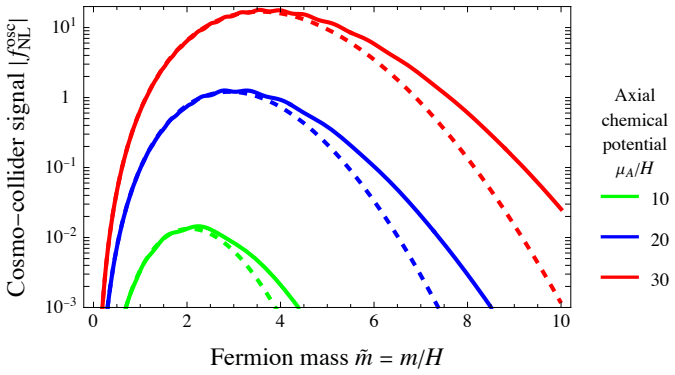
In a modular-invariant extension of the Standard Model with the modulus as inflaton, the evolution of CP-violating phases in the Yukawa couplings during inflation favors a Higgs condensate, enabling Standard Model fermions to mediate an enhanced one-loop cosmological collider signal boosted by chemical potentials. Next-generation experiments can thereby probe sub-Planckian values of the modulus decay constant. Precise expressions are supplied for Dirac fermions with chemical potentials in de Sitter.
What carries the argument
The modular-invariant extension in which the modulus acts as inflaton and drives CP-phase evolution to produce a Higgs condensate that amplifies the fermion-mediated one-loop cosmological collider signal.
Where Pith is reading between the lines
- The mechanism could tie spontaneous modular CP breaking to observable features in the cosmic microwave background or large-scale structure.
- Similar chemical-potential enhancements might appear in other inflationary scenarios that generate Higgs condensates.
- Future collider analyses could place upper bounds on the modulus scale independent of Planck-scale assumptions.
Load-bearing premise
The modulus must be the inflaton and the CP-violating phases of the Yukawa couplings must evolve during inflation in a manner that favors a Higgs condensate.
What would settle it
Absence of the predicted enhanced one-loop fermion signals in next-generation cosmological collider data at sub-Planckian modulus scales, or mismatch between the derived de Sitter expressions and direct measurements of fermion distributions in de Sitter backgrounds.
Figures


read the original abstract
We consider a modular-invariant extension of the Standard Model. Assuming that the modulus is the inflaton, the CP-violating phases of the Yukawa couplings evolve during inflation. This dynamics favours a Higgs condensate, so that Standard Model fermions mediate a one-loop cosmological collider signal enhanced by chemical potentials. Next-generation experiments can probe sub-Planckian values of the modulus decay constant. We provide precise expressions for Dirac fermions with chemical potentials in de Sitter.
Editorial analysis
A structured set of objections, weighed in public.
Referee Report
Summary. The paper considers a modular-invariant extension of the Standard Model in which the modulus serves as the inflaton. During inflation the CP-violating phases of the Yukawa couplings are assumed to evolve in a manner that favors a Higgs condensate; Standard Model fermions then mediate an enhanced one-loop cosmological collider signal through chemical-potential effects in de Sitter space. Precise expressions for the propagators of Dirac fermions with chemical potentials are derived, and the authors conclude that next-generation experiments can probe sub-Planckian values of the modulus decay constant.
Significance. If the dynamical assumptions are verified, the work would link modular symmetry, spontaneous CP violation, and cosmological collider observables in a novel way, offering a potential probe of high-scale physics via non-Gaussianity. The technical expressions for fermions with chemical potentials in de Sitter constitute a useful, reusable result independent of the model-building assumptions.
major comments (2)
- [Abstract and §2] Abstract and §2 (model setup): The central claim that CP-violating phases evolve during inflation to favor a sustained Higgs condensate (thereby generating the chemical-potential enhancement) is load-bearing for the observable signal and the sub-Planckian reach. No explicit modular-invariant potential, beta-function flow, or numerical integration of the phase equations is referenced or shown; without this, it is unclear whether the phases relax to CP-conserving minima or whether the condensate persists for sufficient e-folds.
- [§4] §4 (signal calculation): The enhancement of the one-loop collider signal is stated to arise from the chemical potentials induced by the condensate. If the phase dynamics do not produce the assumed condensate, the signal reduces to the standard (unenhanced) case and the claimed sensitivity to sub-Planckian f is lost; this dependence must be quantified with explicit parameter scans or analytic limits.
minor comments (2)
- [§2] Notation for the modulus decay constant f and the chemical potential μ should be introduced with a clear relation to the inflaton potential parameters already in §2.
- [§3] The abstract claims 'precise expressions' for Dirac fermions with chemical potentials; these should be cross-checked against existing de Sitter literature (e.g., the standard Bunch-Davies propagators) to highlight the new chemical-potential terms.
Simulated Author's Rebuttal
We thank the referee for the careful reading and constructive feedback. The comments highlight important points regarding the dynamical assumptions underlying the CP phase evolution and the resulting signal enhancement. We address each major comment below and will revise the manuscript to provide greater explicit detail on these aspects while preserving the core results on the fermion propagators and collider signals.
read point-by-point responses
-
Referee: [Abstract and §2] Abstract and §2 (model setup): The central claim that CP-violating phases evolve during inflation to favor a sustained Higgs condensate (thereby generating the chemical-potential enhancement) is load-bearing for the observable signal and the sub-Planckian reach. No explicit modular-invariant potential, beta-function flow, or numerical integration of the phase equations is referenced or shown; without this, it is unclear whether the phases relax to CP-conserving minima or whether the condensate persists for sufficient e-folds.
Authors: Section 2 presents the modular-invariant extension and argues that the slow-roll evolution of the modulus (as inflaton) induces a flow in the CP phases of the Yukawa couplings via the modular symmetry, favoring a Higgs condensate over a range of initial conditions. The effective potential is constructed to be modular invariant, and the phase dynamics follow from the associated beta functions. While the current version emphasizes the qualitative outcome rather than a full numerical scan, the behavior is consistent with known results on modular spontaneous CP breaking. To address the concern directly, we will add an appendix with the explicit modular-invariant potential for the phases, the relevant beta-function equations, and a numerical integration example showing that the condensate can be sustained for the necessary number of e-folds without relaxing to a CP-conserving minimum for suitable parameter choices. revision: yes
-
Referee: [§4] §4 (signal calculation): The enhancement of the one-loop collider signal is stated to arise from the chemical potentials induced by the condensate. If the phase dynamics do not produce the assumed condensate, the signal reduces to the standard (unenhanced) case and the claimed sensitivity to sub-Planckian f is lost; this dependence must be quantified with explicit parameter scans or analytic limits.
Authors: The one-loop signal calculation in §4 is performed under the assumption that the Higgs condensate is present, yielding the chemical-potential enhancement to the fermion propagators in de Sitter space. We note that in the absence of the condensate the chemical potentials vanish and the result reverts to the standard unenhanced one-loop cosmological collider signal. To quantify this dependence, we will revise §4 to include analytic limits for the signal amplitude with and without the enhancement, together with a brief parameter scan over the modulus decay constant and representative initial phase values. This will explicitly delineate the region of parameter space in which the enhanced signal permits probes of sub-Planckian f, while indicating the reduction factor when the condensate is not sustained. revision: yes
Circularity Check
No significant circularity; central expressions derived independently of assumptions
full rationale
The paper states its assumptions explicitly (modulus as inflaton, phase evolution favoring Higgs condensate) and then derives precise expressions for Dirac fermions with chemical potentials in de Sitter space. These expressions constitute the technical core and do not reduce to the input assumptions by algebraic identity or by fitting a parameter to the target observable. No self-citation chain is invoked to justify a uniqueness theorem or to smuggle an ansatz; the cosmological collider signal follows from standard one-loop de Sitter propagators once the chemical potentials are postulated. The sub-Planckian probe claim is a model-dependent implication rather than a definitional tautology. Because no load-bearing step equates a prediction to its own fitted input or prior self-citation, the derivation remains self-contained.
Axiom & Free-Parameter Ledger
free parameters (1)
- modulus decay constant
axioms (2)
- domain assumption The extension of the Standard Model is modular-invariant
- ad hoc to paper The modulus is the inflaton
Lean theorems connected to this paper
-
IndisputableMonolith/Cost/FunctionalEquation.leanwashburn_uniqueness_aczel unclear?
unclearRelation between the paper passage and the cited Recognition theorem.
We consider a modular-invariant extension of the Standard Model. Assuming that the modulus is the inflaton, the CP-violating phases of the Yukawa couplings evolve during inflation.
-
IndisputableMonolith/Foundation/AbsoluteFloorClosure.leanreality_from_one_distinction unclear?
unclearRelation between the paper passage and the cited Recognition theorem.
We provide precise expressions for Dirac fermions with chemical potentials in de Sitter.
What do these tags mean?
- matches
- The paper's claim is directly supported by a theorem in the formal canon.
- supports
- The theorem supports part of the paper's argument, but the paper may add assumptions or extra steps.
- extends
- The paper goes beyond the formal theorem; the theorem is a base layer rather than the whole result.
- uses
- The paper appears to rely on the theorem as machinery.
- contradicts
- The paper's claim conflicts with a theorem or certificate in the canon.
- unclear
- Pith found a possible connection, but the passage is too broad, indirect, or ambiguous to say the theorem truly supports the claim.
Reference graph
Works this paper leans on
-
[1]
Ferrara, D
S. Ferrara, D. Lust, A.D. Shapere, S. Theisen, ‘Modular Invariance in Supersymmetric Field Theories’, Phys.Lett.B 225 (1989) 363
1989
-
[2]
Dixon, V
L.J. Dixon, V. Kaplunovsky, J. Louis,‘Mod- uli dependence of string loop corrections to gauge coupling constants’, Nucl.Phys.B 355 (1991) 649
1991
- [3]
-
[4]
Strumia,‘Solving the strong CP problem’ [arXiv:2501.16427]
A. Strumia,‘Solving the strong CP problem’ [arXiv:2501.16427]
-
[5]
Feruglio,Are neutrino masses modular forms?, pp
F. Feruglio,‘Are neutrino masses modular forms?’[arXiv:1706.08749]
-
[6]
F. Feruglio, A. Strumia, A. Titov,‘Modular in- variance and the QCD angle’, JHEP 07 (2023) 027 [arXiv:2305.08908]
- [7]
-
[8]
G.-J. Ding, S.-Y. Jiang, W. Zhao,‘Modular in- variant slow roll inflation’, JCAP 10 (2024) 016 [arXiv:2405.06497]
-
[9]
G.F. Casas, L.E. Ib´ a˜ nez,‘Modular invariant Starobinsky inflation and the Species Scale’, JHEP 04 (2025) 041 [arXiv:2407.12081]
-
[10]
G.-J. Ding, S.-Y. Jiang, Y. Xu, W. Zhao,‘Mod- ular invariant inflation, reheating and lepto- genesis’[arXiv:2411.18603]
- [11]
-
[12]
Signatures of Supersymmetry from the Early Universe,
D. Baumann, D. Green,‘Signatures of Su- persymmetry from the Early Universe’, Phys.Rev.D 85 (2012) 103520 [arXiv:1109.0292]
-
[13]
Effective Field Theory Approach to Quasi-Single-Field Inflation and Effects of Heavy Fields,
T. Noumi, M. Yamaguchi, D. Yokoyama,‘Effec- tive field theory approach to quasi-single field inflation and effects of heavy fields’, JHEP 06 (2013) 051 [arXiv:1211.1624]
-
[14]
N. Arkani-Hamed, J. Maldacena,‘Cosmological Collider Physics’[arXiv:1503.08043]
- [15]
- [16]
- [17]
- [18]
-
[19]
L.-T. Wang, Z.-Z. Xianyu,‘In Search of Large Signals at the Cosmological Collider’, JHEP 02 (2020) 044 [arXiv:1910.12876]
-
[20]
The Scalar Chemical Potential in Cosmological Collider Physics,
A. Bodas, S. Kumar, R. Sundrum,‘The Scalar Chemical Potential in Cosmologi- cal Collider Physics’, JHEP 02 (2021) 079 [arXiv:2010.04727]
-
[21]
F. Feruglio, A. Marrone, A. Strumia, A. Titov, ‘Solving the strong CP problem in string- inspired theories with modular invariance’, JHEP 08 (2025) 076 [arXiv:2505.20395]. 19
-
[22]
Witten, J
E. Witten, J. Bagger,‘Quantization of New- ton’s Constant in Certain Supergravity The- ories’, Phys.Lett.B 115 (1982) 202
1982
-
[23]
Ferrara, C
S. Ferrara, C. Kounnas, D. Lust, F. Zwirner, ‘Duality invariant partition functions and automorphic superpotentials for (2,2) string compactifications’, Nucl.Phys.B 365 (1991) 431
1991
- [24]
-
[25]
Investigating the near-criticality of the Higgs boson
D. Buttazzo, G. Degrassi, P.P. Giardino, G.F. Giudice, F. Sala, A. Salvio, A. Strumia,‘Inves- tigating the near-criticality of the Higgs bo- son’, JHEP 12 (2013) 089 [arXiv:1307.3536]
work page Pith review arXiv 2013
-
[26]
Vachaspati,‘Magnetic fields from cosmo- logical phase transitions’, Phys.Lett.B 265 (1991) 258
T. Vachaspati,‘Magnetic fields from cosmo- logical phase transitions’, Phys.Lett.B 265 (1991) 258
1991
-
[27]
P. Adshead, L. Pearce, M. Peloso, M.A. Roberts, L. Sorbo,‘Phenomenology of fermion produc- tion during axion inflation’, JCAP 06 (2018) 020 [arXiv:1803.04501]
-
[28]
P. Adshead, E.I. Sfakianakis,‘Fermion produc- tion during and after axion inflation’, JCAP 11 (2015) 021 [arXiv:1508.00891]
- [29]
- [30]
-
[31]
X. Chen, Y. Wang, Z.-Z. Xianyu,‘Schwinger- Keldysh Diagrammatics for Primor- dial Perturbations’, JCAP 12 (2017) 006 [arXiv:1703.10166]
work page Pith review arXiv 2017
- [32]
- [33]
-
[34]
Non-Gaussian features of primordial fluctuations in single field inflationary models
J.M. Maldacena,‘Non-Gaussian features of primordial fluctuations in single field in- flationary models’, JHEP 05 (2003) 013 [arXiv:astro-ph/0210603]
work page Pith review arXiv 2003
-
[35]
P. Creminelli, M. Zaldarriaga,‘Single field con- sistency relation for the 3-point function’, JCAP 10 (2004) 006 [arXiv:astro-ph/0407059]
-
[36]
N. Barnaby, E. Pajer, M. Peloso,‘Gauge Field Production in Axion Inflation: Con- sequences for Monodromy, non-Gaussianity in the CMB, and Gravitational Waves at In- terferometers’, Phys.Rev.D 85 (2012) 023525 [arXiv:1110.3327]
- [37]
-
[38]
R. von Eckardstein, M. Peloso, K. Schmitz, O. Sobol, L. Sorbo,‘Axion inflation in the strong-backreaction regime: decay of the Anber-Sorbo solution’, JHEP 11 (2023) 183 [arXiv:2309.04254]. 20
discussion (0)
Sign in with ORCID, Apple, or X to comment. Anyone can read and Pith papers without signing in.