Recognition: no theorem link
Physics-Aligned Spectral Mamba: Decoupling Semantics and Dynamics for Few-Shot Hyperspectral Target Detection
Pith reviewed 2026-05-10 19:37 UTC · model grok-4.3
The pith
SpecMamba decouples stable semantic representations from agile spectral adaptation using a frequency-domain Mamba adapter on frozen transformers for few-shot hyperspectral target detection.
A machine-rendered reading of the paper's core claim, the machinery that carries it, and where it could break.
Core claim
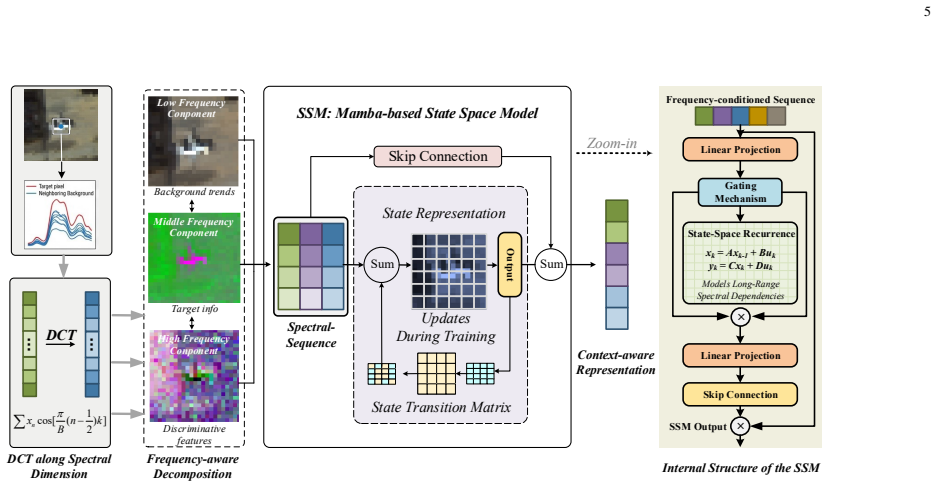
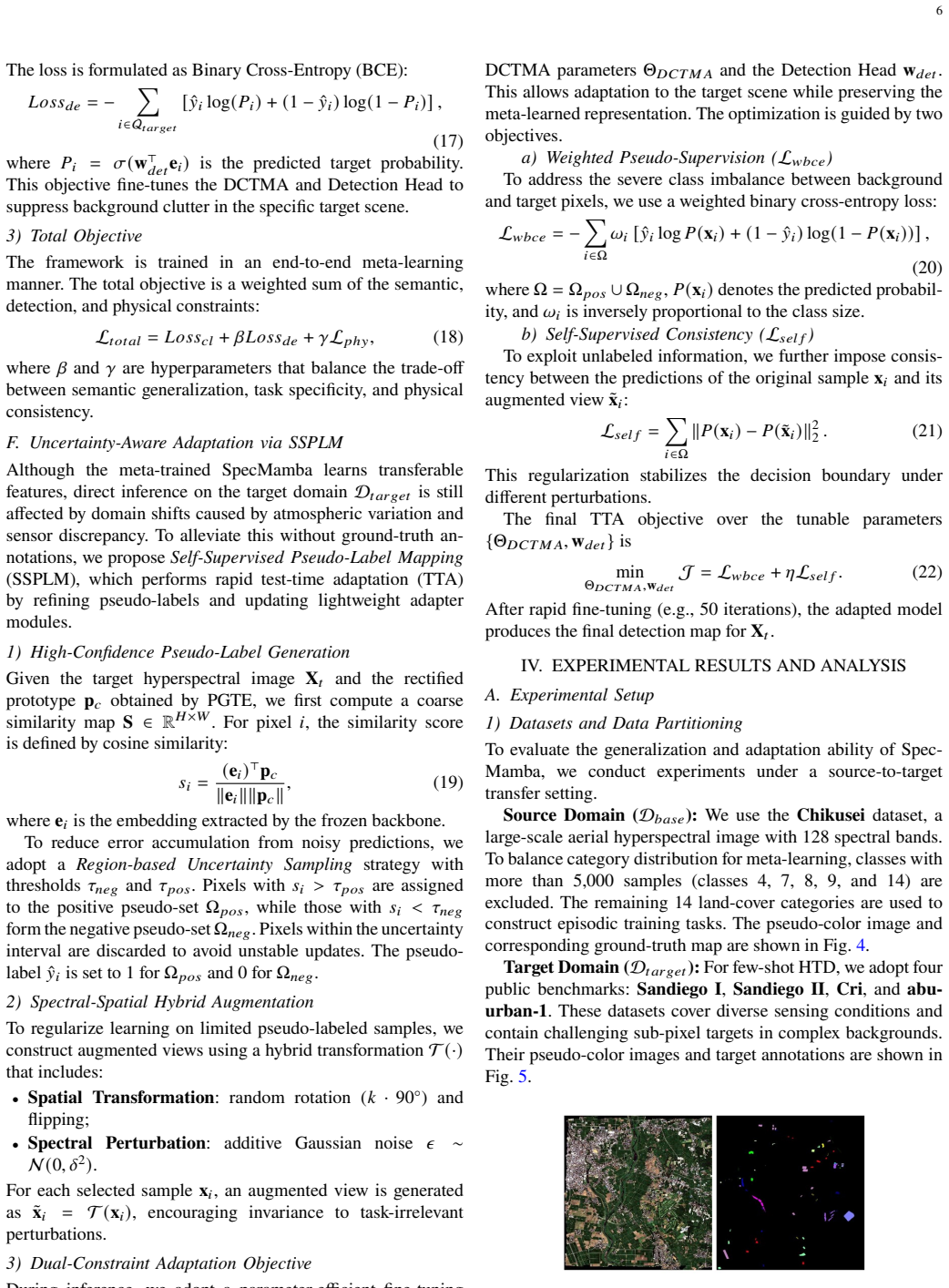
SpecMamba decouples stable semantic representation from agile spectral adaptation by introducing a Discrete Cosine Transform Mamba Adapter (DCTMA) on top of frozen Transformer representations. The DCTMA projects spectral features into the frequency domain via DCT and leverages Mamba's linear-complexity state-space recursion to capture global spectral dependencies and band continuity. A Prior-Guided Tri-Encoder (PGTE) incorporates laboratory spectral priors to guide adapter optimization, and a Self-Supervised Pseudo-Label Mapping (SSPLM) enables test-time adaptation through uncertainty-aware sampling and dual-path consistency.
What carries the argument
The Discrete Cosine Transform Mamba Adapter (DCTMA), which projects spectral features into the frequency domain via DCT and applies Mamba state-space recursion to capture global dependencies and band continuity without full fine-tuning.
If this is right
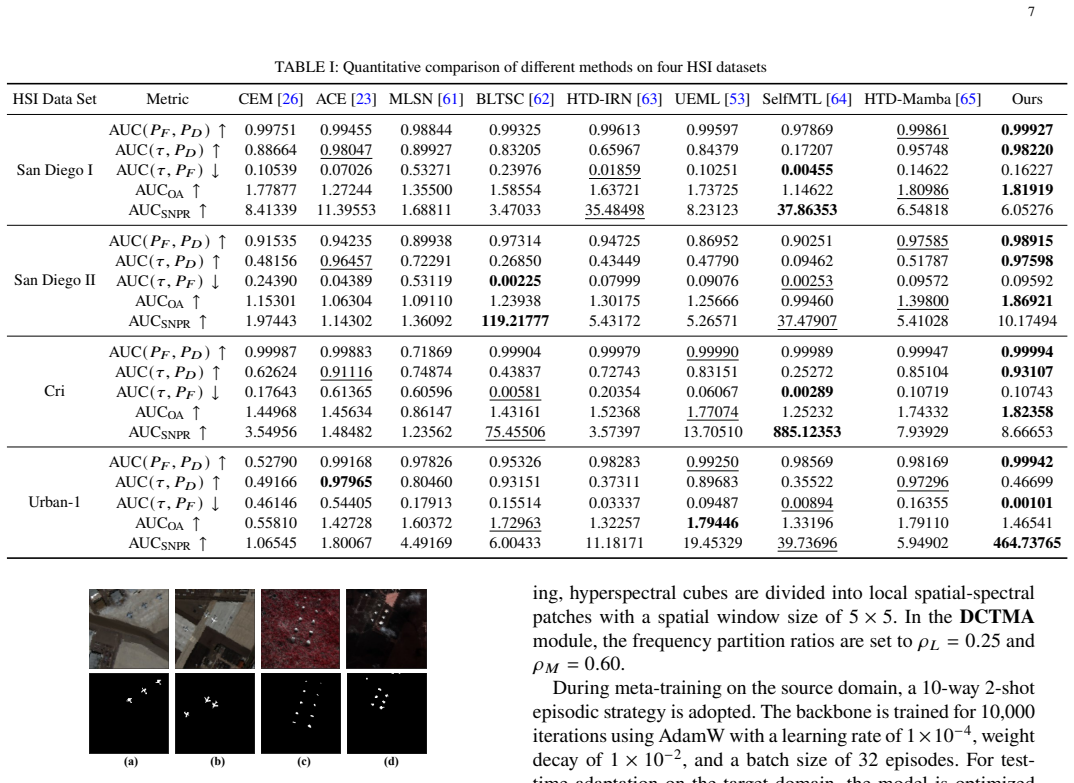
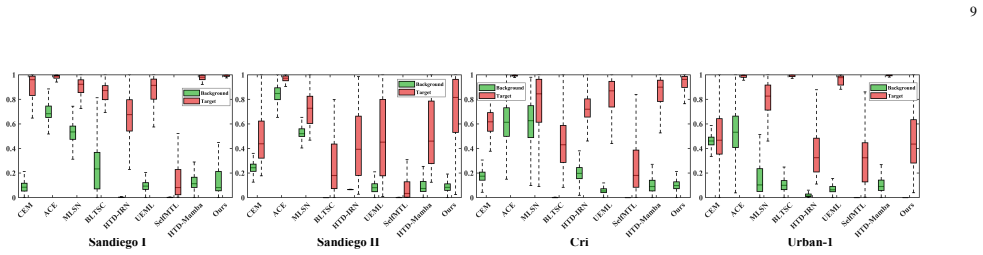
- SpecMamba achieves higher detection accuracy than prior state-of-the-art methods across multiple public hyperspectral datasets.
- The framework improves cross-domain generalization in few-shot regimes by keeping semantic features fixed while adapting only spectral dynamics.
- Parameter efficiency is obtained by freezing the transformer backbone and training only the lightweight adapter plus encoders.
- Test-time refinement via SSPLM sharpens decision boundaries using pseudo-labels derived from uncertainty sampling and consistency constraints.
Where Pith is reading between the lines
- The same decoupling pattern could extend to other sequential or band-structured data types, such as time-series spectroscopy or multi-band medical imaging, where stable semantics must be preserved amid variable dynamics.
- If the frequency-domain projection proves robust, it suggests state-space models may offer advantages over attention for low-data spectral tasks because of their linear scaling with sequence length.
- The reliance on laboratory priors raises the possibility of hybrid systems that combine measured reference spectra with image-derived features for even stronger guidance in novel domains.
Load-bearing premise
Projecting spectral features into the frequency domain via DCT and applying Mamba recursion will reliably capture global spectral dependencies and band continuity without introducing artifacts that degrade detection in real hyperspectral data.
What would settle it
A controlled test on a hyperspectral dataset containing strong band discontinuities or sensor-specific artifacts where SpecMamba shows no accuracy gain or underperforms non-frequency baselines would falsify the claim that the DCTMA reliably extracts useful dependencies.
Figures






read the original abstract
Meta-learning facilitates few-shot hyperspectral target detection (HTD), but adapting deep backbones remains challenging. Full-parameter fine-tuning is inefficient and prone to overfitting, and existing methods largely ignore the frequency-domain structure and spectral band continuity of hyperspectral data, limiting spectral adaptation and cross-domain generalization.To address these challenges, we propose SpecMamba, a parameter-efficient and frequency-aware framework that decouples stable semantic representation from agile spectral adaptation. Specifically, we introduce a Discrete Cosine Transform Mamba Adapter (DCTMA) on top of frozen Transformer representations. By projecting spectral features into the frequency domain via DCT and leveraging Mamba's linear-complexity state-space recursion, DCTMA explicitly captures global spectral dependencies and band continuity while avoiding the redundancy of full fine-tuning. Furthermore, to address prototype drift caused by limited sample sizes, we design a Prior-Guided Tri-Encoder (PGTE) that allows laboratory spectral priors to guide the optimization of the learnable adapter without disrupting the stable semantic feature space. Finally, a Self-Supervised Pseudo-Label Mapping (SSPLM) strategy is developed for test-time adaptation, enabling efficient decision boundary refinement through uncertainty-aware sampling and dual-path consistency constraints. Extensive experiments on multiple public datasets demonstrate that SpecMamba consistently outperforms state-of-the-art methods in detection accuracy and cross-domain generalization.
Editorial analysis
A structured set of objections, weighed in public.
Referee Report
Summary. The paper proposes SpecMamba, a parameter-efficient and frequency-aware framework for few-shot hyperspectral target detection (HTD). It decouples stable semantic representations (from frozen Transformer backbones) from agile spectral adaptation via three components: the Discrete Cosine Transform Mamba Adapter (DCTMA), which projects features into the frequency domain using DCT and applies Mamba state-space recursion to capture global spectral dependencies and band continuity; the Prior-Guided Tri-Encoder (PGTE), which incorporates laboratory spectral priors to mitigate prototype drift; and the Self-Supervised Pseudo-Label Mapping (SSPLM) for test-time adaptation via uncertainty-aware sampling and consistency constraints. The central claim is that this approach consistently outperforms state-of-the-art methods in detection accuracy and cross-domain generalization on multiple public datasets while avoiding the inefficiency and overfitting of full fine-tuning.
Significance. If the empirical results and ablations hold, the work has moderate significance for few-shot learning in hyperspectral imaging. It addresses practical challenges of adapting deep models to spectral data with limited labels by incorporating frequency-domain structure and linear-complexity recursion, which could improve efficiency and generalization in remote-sensing applications. The explicit use of physics-aligned priors and Mamba for spectral continuity is a constructive direction, though its advantage depends on validation against the frequency-domain assumptions.
major comments (1)
- [§3.2 (DCTMA)] §3.2 (DCTMA): The load-bearing premise that DCT projection plus Mamba recursion 'explicitly captures global spectral dependencies and band continuity' without introducing artifacts (phase shifts, aliasing, or loss of fine-grained absorption features) is not supported by any derivation, comparison to alternative bases (e.g., wavelets or learned filters), or ablation isolating DCT-induced distortion on real hyperspectral signatures. If this premise fails, the claimed decoupling, avoidance of full fine-tuning redundancy, and cross-domain gains collapse.
minor comments (2)
- The abstract and method descriptions would benefit from explicit dataset names, quantitative metrics (e.g., AUC improvements with error bars), and statistical significance tests to ground the 'consistent outperformance' claim.
- [§3.2] Notation for the Mamba recursion and DCT coefficients should be defined with equations in §3.2 for reproducibility.
Simulated Author's Rebuttal
We thank the referee for the constructive comment on the DCTMA design. We address the concern directly below and agree that additional support is warranted to substantiate the frequency-domain claims.
read point-by-point responses
-
Referee: [§3.2 (DCTMA)] §3.2 (DCTMA): The load-bearing premise that DCT projection plus Mamba recursion 'explicitly captures global spectral dependencies and band continuity' without introducing artifacts (phase shifts, aliasing, or loss of fine-grained absorption features) is not supported by any derivation, comparison to alternative bases (e.g., wavelets or learned filters), or ablation isolating DCT-induced distortion on real hyperspectral signatures. If this premise fails, the claimed decoupling, avoidance of full fine-tuning redundancy, and cross-domain gains collapse.
Authors: We acknowledge that the current manuscript provides no formal derivation of artifact-free behavior, no direct comparison against wavelets or learned bases, and no ablation that isolates DCT-induced distortion on hyperspectral absorption lines. DCT was selected for its real-valued, energy-compacting, and invertible properties that align with the band-continuous nature of reflectance spectra; the subsequent Mamba recursion then models long-range dependencies across the resulting coefficients at linear cost. Nevertheless, these design choices remain empirically motivated rather than theoretically proven within the paper. To close this gap we will (i) add a short paragraph in §3.2 deriving the invertibility and continuity-preserving properties of DCT for band-limited signals, (ii) expand the ablation study with wavelet and learned-filter baselines, and (iii) include signature-reconstruction visualizations that quantify preservation of fine absorption features before and after the DCTMA block. These revisions will appear in the main text and supplementary material. revision: yes
Circularity Check
No significant circularity; claims rest on architectural design using standard transforms and external priors
full rationale
The paper proposes SpecMamba with DCTMA (DCT projection + Mamba recursion on frozen Transformers), PGTE (lab priors guiding adapters), and SSPLM (self-supervised test-time adaptation). These are presented as new modules that decouple semantics from spectral adaptation, with no equations shown that define a quantity in terms of itself, fit a parameter to data then rename the fit as a prediction, or rely on self-citations for uniqueness theorems. The abstract and described components use standard DCT and Mamba as building blocks without tautological reduction; performance claims are evaluated on public datasets rather than forced by internal definitions. This qualifies as self-contained with independent content.
Axiom & Free-Parameter Ledger
Reference graph
Works this paper leans on
-
[1]
Collaborative-guided spectral abundance learning with bilinear mixing model for hyperspectral subpixel target detection,
D. Zhu, B. Du, M. Hu, Y. Dong, and L. Zhang, “Collaborative-guided spectral abundance learning with bilinear mixing model for hyperspectral subpixel target detection,”Neural Networks, vol. 163, pp. 205–218, 2023
2023
-
[2]
Hyperspectral tar- get detection with target prior augmentation and background suppression- based multidetector fusion,
T. Guo, F. Luo, J. Guo, Y. Duan, X. Huang, and G. Shi, “Hyperspectral tar- get detection with target prior augmentation and background suppression- based multidetector fusion,”IEEE Journal of Selected Topics in Applied Earth Observations and Remote Sensing, vol. 17, pp. 1765–1780, 2024
2024
-
[3]
Guided real image dehazing using ycbcr color space,
W. Fang, J. Fan, Y. Zheng, J. Weng, Y. Tai, and J. Li, “Guided real image dehazing using ycbcr color space,” inProceedings of the AAAI conference on artificial intelligence, vol. 39, no. 3, 2025, pp. 2906–2914
2025
-
[4]
Advances in hyperspectral image and signal processing: A comprehensive overview of the state of the art,
P. Ghamisi, N. Yokoya, J. Li, W. Liao, S. Liu, J. Plaza, B. Rasti, and A. Plaza, “Advances in hyperspectral image and signal processing: A comprehensive overview of the state of the art,”IEEE Geoscience and Remote Sensing Magazine, vol. 5, no. 4, pp. 37–78, 2017
2017
-
[5]
Meta-learning based hyperspectral target detection using siamese network,
Y. Wang, X. Chen, F. Wang, M. Song, and C. Yu, “Meta-learning based hyperspectral target detection using siamese network,”IEEE Transactions on Geoscience and Remote Sensing, vol. 60, p. 1–13, 2022. [Online]. Available: http://dx.doi.org/10.1109/tgrs.2022.3169970
-
[6]
Deep spatial–spectral joint-sparse prior encoding network for hyperspectral target detection,
W. Dong, X. Wu, J. Qu, P. Gamba, S. Xiao, A. Vizziello, and Y. Li, “Deep spatial–spectral joint-sparse prior encoding network for hyperspectral target detection,” Jun 2024
2024
-
[7]
Data- augmented matched subspace detector for hyperspectral subpixel target detection,
X. Yang, M. Dong, Z. Wang, L. Gao, L. Zhang, and J.-H. Xue, “Data- augmented matched subspace detector for hyperspectral subpixel target detection,”Pattern Recognition, vol. 106, p. 107464, 2020
2020
-
[8]
Hyperspectral remote sensing image subpixel target detection based on supervised metric learning,
L. Zhang, L. Zhang, D. Tao, X. Huang, and B. Du, “Hyperspectral remote sensing image subpixel target detection based on supervised metric learning,”IEEE Transactions on Geoscience and Remote Sensing, vol. 52, no. 8, pp. 4955–4965, 2014
2014
-
[9]
Target detection with spatial- spectral adaptive sample generation and deep metric learning for hyper- spectral imagery,
D. Zhu, B. Du, Y. Dong, and L. Zhang, “Target detection with spatial- spectral adaptive sample generation and deep metric learning for hyper- spectral imagery,”IEEE Transactions on Multimedia, vol. 25, pp. 6538– 6550, 2023
2023
-
[10]
Hyperspectral target detection based on interpretable representation network,
D. Shen, X. Ma, W. Kong, J. Liu, J. Wang, and H. Wang, “Hyperspectral target detection based on interpretable representation network,”IEEE Transactions on Geoscience and Remote Sensing, vol. 61, pp. 1–16, 2023
2023
-
[11]
J. Zhao, G. Wang, B. Zhou, J. Ying, and J. Liu, “Exploring an application-oriented land-based hyperspectral target detection framework based on 3d–2d cnn and transfer learning,”EURASIP Journal on Advances in Signal Processing, vol. 2024, no. 1, Mar 2024. [Online]. Available: http://dx.doi.org/10.1186/s13634-024-01136-0
-
[12]
Triplet spectralwise transformer network for hyperspectral target detection,
J. Jiao, Z. Gong, and P. Zhong, “Triplet spectralwise transformer network for hyperspectral target detection,”IEEE Trans. Geosci. Remote Sens., vol. 61, Art. no. 5519817, 2023
2023
-
[13]
Spectral discrepancy and cross-modal semantic consistency learning for object detection in hyperspectral images,
X. He, C. Tang, X. Liu, W. Zhang, Z. Gao, C. Li, S. Qiu, and J. Xu, “Spectral discrepancy and cross-modal semantic consistency learning for object detection in hyperspectral images,”IEEE Transactions on Multimedia, 2025
2025
-
[14]
Htd-ts3: Weakly supervised hyperspec- tral target detection based on transformer via spectral–spatial similarity,
H. Qin, W. Xie, Y. Li, and Q. Du, “Htd-ts3: Weakly supervised hyperspec- tral target detection based on transformer via spectral–spatial similarity,” IEEE Transactions on Neural Networks and Learning Systems, vol. 35, no. 11, pp. 16 816–16 830, 2024
2024
-
[15]
Semantic modeling of hyperspectral target detection with weak labels,
C. Jiao, B. Yang, L. Liu, C. Chen, X. Chen, W. Yang, and L. Jiao, “Semantic modeling of hyperspectral target detection with weak labels,” Signal Processing, vol. 209, p. 109016, 2023
2023
-
[16]
Transfer learning of spatial features from high-resolution rgb images for large-scale and robust hyperspectral remote sensing target detection,
Y. Wu, Z. Li, B. Zhao, Y. Song, and B. Zhang, “Transfer learning of spatial features from high-resolution rgb images for large-scale and robust hyperspectral remote sensing target detection,”IEEE Transactions on Geoscience and Remote Sensing, vol. 62, pp. 1–32, 2024
2024
-
[17]
Proxy-enhanced prototype memory network for weakly supervised hyperspectral target detection,
B. Yang, J. Wu, and C. Jiao, “Proxy-enhanced prototype memory network for weakly supervised hyperspectral target detection,”IEEE Transactions on Geoscience and Remote Sensing, vol. 63, pp. 1–14, 2025
2025
-
[18]
Spatial–frequency domain transformation for infrared small target detection,
Y. Liu, B. Tu, B. Liu, Y. He, J. Li, and A. Plaza, “Spatial–frequency domain transformation for infrared small target detection,”IEEE Transactions on Geoscience and Remote Sensing, vol. 63, pp. 1–16, 2025
2025
-
[19]
Hyperspectral time-series target detection based on spectral perception and spatial–temporal tensor decomposition,
X. Zhao, K. Liu, K. Gao, and W. Li, “Hyperspectral time-series target detection based on spectral perception and spatial–temporal tensor decomposition,”IEEE Transactions on Geoscience and Remote Sensing, vol. 61, pp. 1–12, 2023
2023
-
[20]
Spectrum-driven 10 mixed-frequency network for hyperspectral salient object detection,
P. Liu, T. Xu, H. Chen, S. Zhou, H. Qin, and J. Li, “Spectrum-driven 10 mixed-frequency network for hyperspectral salient object detection,”IEEE Transactions on Multimedia, vol. 26, pp. 5296–5310, 2024
2024
-
[21]
The spectral image processing system (SIPS)—interactive visualization and analysis of imaging spectrometer data,
F. A. Kruse, A. Lefkoff, y. J. Boardman, K. Heidebrecht, A. Shapiro, P. Barloon, and A. Goetz, “The spectral image processing system (SIPS)—interactive visualization and analysis of imaging spectrometer data,”Remote Sens. Environ., vol. 44, no. 2, pp. 145–163, 1993
1993
-
[22]
An information-theoretic approach to spectral variability, similarity, and discrimination for hyperspectral image analysis,
C.-I. Chang, “An information-theoretic approach to spectral variability, similarity, and discrimination for hyperspectral image analysis,”IEEE Trans. Inf. Theory, vol. 46, no. 5, pp. 1927–1932, 2000
1927
-
[23]
The cfar adaptive subspace detector is a scale- invariant glrt,
S. Kraut and L. Scharf, “The cfar adaptive subspace detector is a scale- invariant glrt,”IEEE Trans. Signal Process., vol. 47, no. 9, pp. 2538–2541, 1999
1999
-
[24]
Hyperspectral image classification and dimensionality reduction: an orthogonal subspace projection approach,
J. Harsanyi and C.-I. Chang, “Hyperspectral image classification and dimensionality reduction: an orthogonal subspace projection approach,” IEEE Trans. Geosci. Remote Sens., vol. 32, no. 4, pp. 779–785, 1994
1994
-
[25]
Orthogonal subspace projection (osp) revisited: A compre- hensive study and analysis,
C.-I. Chang, “Orthogonal subspace projection (osp) revisited: A compre- hensive study and analysis,”IEEE Trans. Geosci. Remote Sens., vol. 43, no. 3, pp. 502–518, 2005
2005
-
[26]
A comparative study for orthogonal subspace projection and constrained energy minimization,
Q. Du, H. Ren, and C.-I. Chang, “A comparative study for orthogonal subspace projection and constrained energy minimization,”IEEE Trans. Geosci. Remote Sens., vol. 41, no. 6, pp. 1525–1529, 2003
2003
-
[27]
Constrained subpixel target detection for remotely sensed imagery,
C.-I. Chang and D. Heinz, “Constrained subpixel target detection for remotely sensed imagery,”IEEE Trans. Geosci. Remote Sens., vol. 38, no. 3, pp. 1144–1159, 2000
2000
-
[28]
Hierarchical suppression method for hyperspectral target detection,
Z. Zou and Z. Shi, “Hierarchical suppression method for hyperspectral target detection,”IEEE Trans. Geosci. Remote Sens., vol. 54, no. 1, pp. 330–342, 2015
2015
-
[29]
Ensemble-based cascaded constrained energy minimization for hyperspectral target detection,
R. Zhao, Z. Shi, Z. Zou, and Z. Zhang, “Ensemble-based cascaded constrained energy minimization for hyperspectral target detection,” Remote Sens., vol. 11, no. 11, p. 1310, 2019
2019
-
[30]
Kernel matched subspace detectors for hyperspectral target detection,
H. Kwon and N. M. Nasrabadi, “Kernel matched subspace detectors for hyperspectral target detection,”IEEE Trans. Pattern Anal. Mach. Intell., vol. 28, no. 2, pp. 178–194, 2006
2006
-
[31]
Combined sparse and collaborative representation for hyperspectral target detection,
W. Li, Q. Du, and B. Zhang, “Combined sparse and collaborative representation for hyperspectral target detection,”Pattern Recognition, vol. 48, no. 12, pp. 3904–3916, 2015
2015
-
[32]
A hybrid sparsity and distance-based discrimination detector for hyperspectral images,
X. Lu, W. Zhang, and X. Li, “A hybrid sparsity and distance-based discrimination detector for hyperspectral images,”IEEE Transactions on Geoscience and Remote Sensing, vol. 56, no. 3, pp. 1704–1717, 2018
2018
-
[33]
Learning tensor low-rank representation for hyperspectral anomaly detection,
M. Wang, Q. Wang, D. Hong, S. K. Roy, and J. Chanussot, “Learning tensor low-rank representation for hyperspectral anomaly detection,”IEEE Transactions on Cybernetics, vol. 53, no. 1, pp. 679–691, 2023
2023
-
[34]
Hyperspectral target detection based on generative self-supervised learning with wavelet transform,
H. Qin, S. Wang, Y. Li, W. Xie, K. Jiang, and K. Cao, “Hyperspectral target detection based on generative self-supervised learning with wavelet transform,”IEEE Transactions on Geoscience and Remote Sensing, vol. 63, pp. 1–15, 2025
2025
-
[35]
Hyperspectral target detection using diffusion model and convolutional gated linear unit,
Z. Li, F. Mo, X. Zhao, C. Liu, X. Gong, W. Li, Q. Du, and B. Yuan, “Hyperspectral target detection using diffusion model and convolutional gated linear unit,”IEEE Transactions on Geoscience and Remote Sensing, vol. 63, pp. 1–13, 2025
2025
-
[36]
A signature- constrained two-stage framework for hyperspectral target detection based on generative self-supervised learning,
H. Qin, S. Wang, Y. Li, W. Xie, K. Jiang, and K. Cao, “A signature- constrained two-stage framework for hyperspectral target detection based on generative self-supervised learning,”IEEE Transactions on Geo- science and Remote Sensing, vol. 63, pp. 1–17, 2025
2025
-
[37]
Transferred deep learning for hyperspectral target detection,
W. Li, G. Wu, and Q. Du, “Transferred deep learning for hyperspectral target detection,” inProc. IEEE Int. Geosci. Remote Sens. Symp., 2017, pp. 5177–5180
2017
-
[38]
HTD-Net: A deep convolutional neural network for target detection in hyperspectral imagery,
G. Zhang, S. Zhao, W. Li, Q. Du, Q. Ran, and R. Tao, “HTD-Net: A deep convolutional neural network for target detection in hyperspectral imagery,”Remote Sens., vol. 12, no. 9, 2020
2020
-
[39]
Hyperspectral target detection based on interpretable representation network,
D. Shen, X. Ma, W. Kong, J. Liu, J. Wang, and H. Wang, “Hyperspectral target detection based on interpretable representation network,”IEEE Trans. Geosci. Remote Sens., vol. 61, pp. 1–16, 2023
2023
-
[40]
Htd-net: A deep convolutional neural network for target detection in hyperspectral imagery,
G. Zhang, S. Zhao, W. Li, Q. Du, Q. Ran, and R. Tao, “Htd-net: A deep convolutional neural network for target detection in hyperspectral imagery,”Remote Sensing, vol. 12, no. 9, 2020
2020
-
[41]
Siamese transformer network for hyperspectral image target detection,
W. Rao, L. Gao, Y. Qu, X. Sun, B. Zhang, and J. Chanussot, “Siamese transformer network for hyperspectral image target detection,”IEEE Trans. Geosci. Remote Sens., vol. 60, Art. no. 5526419, 2022
2022
-
[42]
Htdformer: Hyperspectral target detection based on transformer with distributed learning,
Y. Li, H. Qin, and W. Xie, “Htdformer: Hyperspectral target detection based on transformer with distributed learning,”IEEE Trans. Geosci. Remote Sens., vol. 61, 2023
2023
-
[43]
Self-supervised spectral- level contrastive learning for hyperspectral target detection,
Y. Wang, X. Chen, E. Zhao, and M. Song, “Self-supervised spectral- level contrastive learning for hyperspectral target detection,”IEEE Trans. Geosci. Remote Sens., vol. 61, Art. no. 5510515, 2023
2023
-
[44]
Deformable convolution- enhanced hierarchical transformer with spectral-spatial cluster attention for hyperspectral image classification,
Y. Fang, L. Sun, Y. Zheng, and Z. Wu, “Deformable convolution- enhanced hierarchical transformer with spectral-spatial cluster attention for hyperspectral image classification,”IEEE Trans. Image Process., vol. 34, pp. 701–716, 2025
2025
-
[45]
Deep- growing neural network with manifold constraints for hyperspectral image classification,
J. Shi, T. Wu, A. K. Qin, T. Shao, Y. Lei, and G. Jeon, “Deep- growing neural network with manifold constraints for hyperspectral image classification,”IEEE Trans. Neural Netw. Learn. Syst., vol. 36, no. 1, pp. 210–221, 2025
2025
-
[46]
An unsupervised mo- mentum contrastive learning based transformer network for hyperspectral target detection,
Y. Wang, X. Chen, E. Zhao, M. Song, and C. Yu, “An unsupervised mo- mentum contrastive learning based transformer network for hyperspectral target detection,”Remote Sens., vol. 17, no. 19, pp. 9053–9068, 2024
2024
-
[47]
Adaptive temperature- driven ternary contrastive autoencoder framework for hyperspectral target detection,
J. Li, H. Liu, H. Xu, C. Wang, Y. Li, and Q. Du, “Adaptive temperature- driven ternary contrastive autoencoder framework for hyperspectral target detection,”IEEE Transactions on Geoscience and Remote Sensing, vol. 63, pp. 1–13, 2025
2025
-
[48]
Sensor-independent hyperspectral target detection with semisupervised domain adaptive few-shot learning,
Y. Shi, J. Li, Y. Li, and Q. Du, “Sensor-independent hyperspectral target detection with semisupervised domain adaptive few-shot learning,”IEEE Trans. Geosci. Remote Sens., vol. 59, no. 8, pp. 6894–6906, 2021
2021
-
[49]
Meta-learning based hyperspectral target detection using siamese network,
Y. Wang, X. Chen, Y. Fang, M. Song, and C. Yu, “Meta-learning based hyperspectral target detection using siamese network,”IEEE Trans. Geosci. Remote Sens., vol. 60, 2022
2022
-
[50]
Regularized tensor representative coefficient model for hyperspectral target detection,
W. Shang, M. Jouni, Z. Wu, Y. Xu, M. D. Mura, and Z. Wei, “Regularized tensor representative coefficient model for hyperspectral target detection,” IEEE Geoscience and Remote Sensing Letters, vol. 20, pp. 1–5, 2023
2023
-
[51]
Background learning based on target suppression constraint for hyperspectral target detection,
W. Xie, X. Zhang, Y. Yang, K. Li, W. Wang, and Q. Du, “Background learning based on target suppression constraint for hyperspectral target detection,”IEEE J. Sel. Topics Appl. Earth Observ. Remote Sens., vol. 13, pp. 5887–5897, 2021
2021
-
[52]
Transformer-based cross-domain few-shot learning for hyperspectral target detection,
S. Feng, X. Wang, R. Feng, F. Xiong, C. Zhao, W. Li, and R. Tao, “Transformer-based cross-domain few-shot learning for hyperspectral target detection,”IEEE Transactions on Geoscience and Remote Sensing, vol. 63, pp. 1–16, 2025
2025
-
[53]
Unbalanced episode meta-learning with bi-sparse contrastive network for hyperspectral target detection,
Q. Liu, Y. Xu, Z. Wu, J. Peng, and Z. Wei, “Unbalanced episode meta-learning with bi-sparse contrastive network for hyperspectral target detection,”Pattern Recognition, vol. 170, p. 112030, 2026
2026
-
[54]
Mamba: Linear-Time Sequence Modeling with Selective State Spaces
A. Gu and T. Dao, “Mamba: Linear-time sequence modeling with selective state spaces,”arXiv preprint arXiv:2312.00752, 2023
work page internal anchor Pith review Pith/arXiv arXiv 2023
-
[55]
Efficiently Modeling Long Sequences with Structured State Spaces
A. Gu, K. Goel, and C. Re, “Efficiently modeling long sequences with structured state spaces,”arXiv preprint arXiv:2111.00396, 2021
work page internal anchor Pith review arXiv 2021
-
[56]
Sedgm: A structure-enhanced spatial–spectral dynamic gating mamba for hyperspectral image classification,
Y. Jiang, S. Zhang, C. Wang, G. Zhang, M. Tan, B. Du, and X. Shen, “Sedgm: A structure-enhanced spatial–spectral dynamic gating mamba for hyperspectral image classification,”IEEE Transactions on Geoscience and Remote Sensing, vol. 63, pp. 1–22, 2025
2025
-
[57]
3dss-mamba: 3d-spectral- spatial mamba for hyperspectral image classification,
Y. He, B. Tu, B. Liu, J. Li, and A. Plaza, “3dss-mamba: 3d-spectral- spatial mamba for hyperspectral image classification,”IEEE Transactions on Geoscience and Remote Sensing, 2024
2024
-
[58]
Spectral–spatial feature extraction network with ssm–cnn for hyperspectral–multispectral image collaborative classification,
Q. Wang, X. Fan, J. Huang, S. Li, and T. Shen, “Spectral–spatial feature extraction network with ssm–cnn for hyperspectral–multispectral image collaborative classification,”IEEE Journal of Selected Topics in Applied Earth Observations and Remote Sensing, 2024
2024
-
[59]
Meta-learning of neural state-space models using data from similar systems,
A. Chakrabarty, G. Wichern, and C. R. Laughman, “Meta-learning of neural state-space models using data from similar systems,”IFAC- PapersOnLine, vol. 56, no. 2, pp. 1490–1495, 2023
2023
-
[60]
Cascaded state space and contrastive learning for cross-domain few-shot segmentation,
F. Xiao, J. Zhang, P. Han, S. Chen, and H. Zhang, “Cascaded state space and contrastive learning for cross-domain few-shot segmentation,”IEEE Transactions on Industrial Informatics, 2025
2025
-
[61]
Meta-learning based hyperspectral target detection using siamese network,
Y. Wang, X. Chen, F. Wang, M. Song, and C. Yu, “Meta-learning based hyperspectral target detection using siamese network,”IEEE Trans. Geosci. Remote Sens., vol. 60, Art. no. 5527913, 2022
2022
-
[62]
Background learning based on target suppression constraint for hyperspectral target detection,
W. Xie, X. Zhang, Y. Li, K. Wang, and Q. Du, “Background learning based on target suppression constraint for hyperspectral target detection,”IEEE J. Sel. Topics Appl. Earth Observ. Remote Sens., vol. 13, pp. 5887–5897, 2020
2020
-
[63]
Hyperspectral target detection based on interpretable representation network,
D. Shen, X. Ma, W. Kong, J. Liu, J. Wang, and H. Wang, “Hyperspectral target detection based on interpretable representation network,”IEEE Trans. Geosci. Remote Sens., vol. 61, Art. no. 5519416, 2023
2023
-
[64]
Selfmtl: Self-supervised meta-transfer learning via contrastive representation for hyperspectral target detection,
F. Luo, S. Shi, K. Qin, T. Guo, C. Fu, and Z. Lin, “Selfmtl: Self-supervised meta-transfer learning via contrastive representation for hyperspectral target detection,”IEEE Transactions on Geoscience and Remote Sensing, vol. 63, pp. 1–13, 2025
2025
-
[65]
Htd-mamba: Efficient hyperspectral target detection with pyramid state space model,
D. Shen, X. Zhu, J. Tian, J. Liu, Z. Du, H. Wang, and X. Ma, “Htd-mamba: Efficient hyperspectral target detection with pyramid state space model,” IEEE Transactions on Geoscience and Remote Sensing, vol. 63, pp. 1–15, 2025. 11 Appendix This supplementary material provides additional experimental evidence to complement the main paper. In particular, we fur...
2025
-
[66]
These results provide a more complete understanding of the robustness and effectiveness of the proposed framework, and further support the conclusions drawn in the main text
parameter sensitivity under the 10-way 2-shot protocol, including contextual, adaptation, and optimization-related hy- perparameters; and 2) ablation studies on the core modules and internal design choices. These results provide a more complete understanding of the robustness and effectiveness of the proposed framework, and further support the conclusions...
discussion (0)
Sign in with ORCID, Apple, or X to comment. Anyone can read and Pith papers without signing in.