Recognition: no theorem link
Investigation of Transit Timing and an Optical Transmission Spectrum of the Hot Jupiter WASP-11 b
Pith reviewed 2026-05-10 19:36 UTC · model grok-4.3
The pith
Updated transit observations of hot Jupiter WASP-11 b show no orbital decay and no signs of additional planets, while revealing a Rayleigh scattering slope in its transmission spectrum.
A machine-rendered reading of the paper's core claim, the machinery that carries it, and where it could break.
Core claim
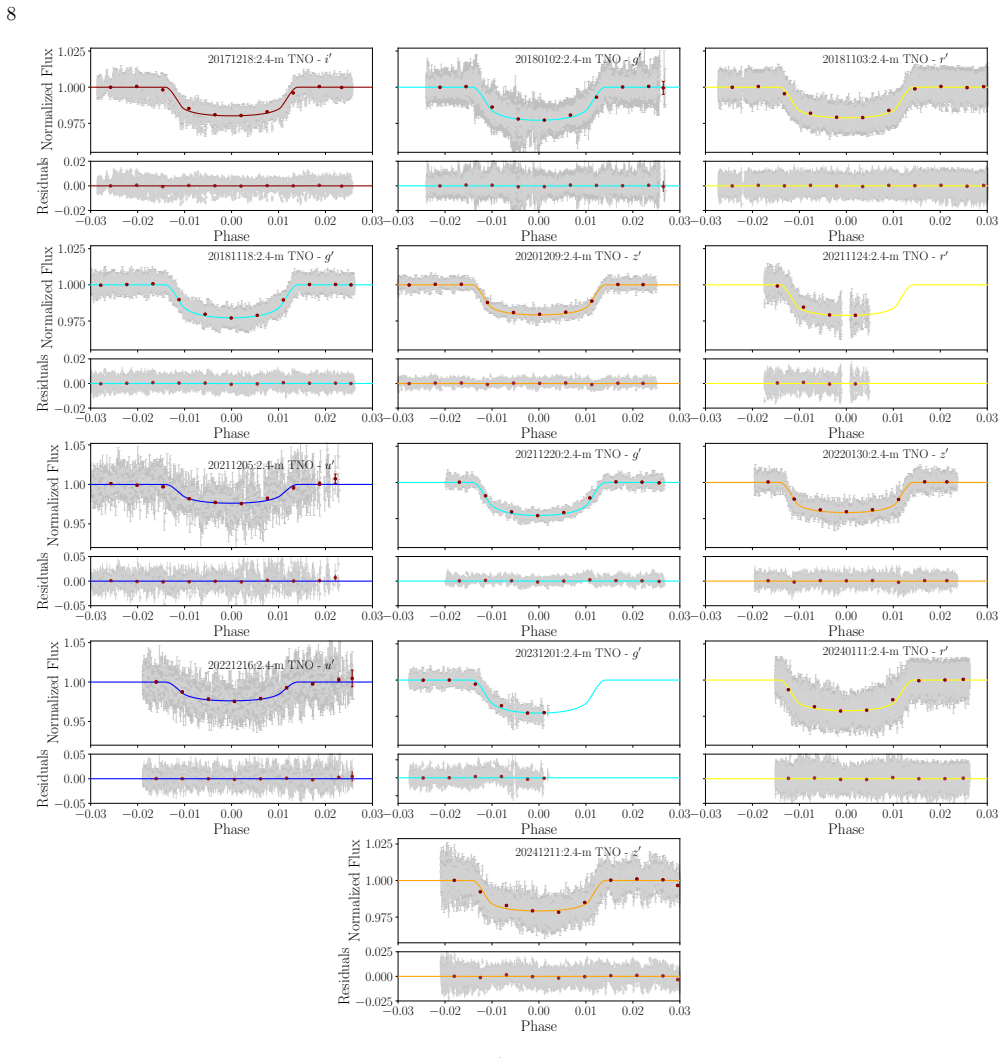
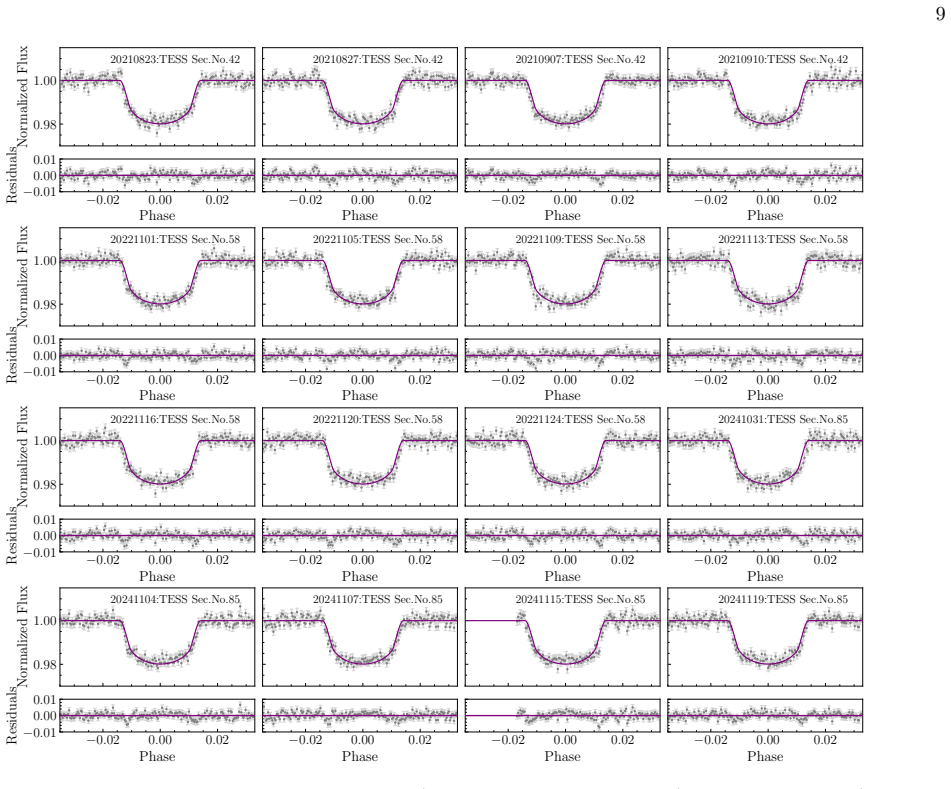
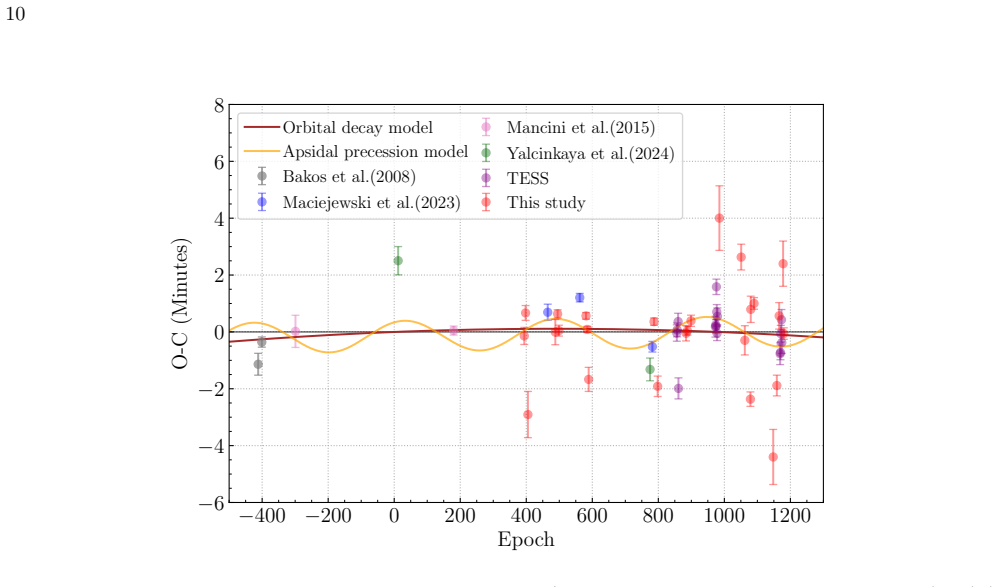
Combining 31 new ground-based transits with prior observations and TESS data, the timing analysis finds the observed minus calculated transit times consistent with a fixed orbital period, providing no evidence for orbital decay or additional planets through transit timing variations. The transmission spectrum from multi-band photometry displays a pronounced negative slope toward shorter wavelengths, characteristic of Rayleigh scattering that could originate in the planetary atmosphere or arise from contamination by stellar activity or the companion star.
What carries the argument
The O-C diagram tracking transit timing deviations over 16 years to test for period changes, paired with wavelength-dependent transit depth measurements to build an optical transmission spectrum.
If this is right
- The planet maintains a stable orbit without measurable shrinkage over the 16-year baseline.
- No periodic signals in timing data rule out detectable additional planets in this system.
- The strong short-wavelength slope in the spectrum suggests scattering particles that future observations can probe.
- Contamination from the companion star must be accounted for when interpreting atmospheric features.
Where Pith is reading between the lines
- If the scattering is atmospheric, it implies high-altitude hazes that could be common in hot Jupiters.
- Longer baseline monitoring could eventually detect very slow orbital changes.
- High-resolution imaging or spectroscopy might separate the companion's light contribution to confirm the source of the slope.
Load-bearing premise
That the observed wavelength-dependent transit depths primarily reflect the planet after standard corrections for systematics, stellar activity, and companion light.
What would settle it
A measurement of the companion star's contribution to the total flux in each observing band that, when subtracted, removes the observed slope in the transmission spectrum.
Figures



read the original abstract
WASP-11~b/HAT-P-10~b is an inflated hot Jupiter, which has a low density that makes it a good target for atmospheric studies using the transmission spectroscopy technique. In this work, we present 31 new transit light curves of WASP-11~b/HAT-P-10~b, obtained through the SPEARNET network. These data were analyzed along with previously published ground-based observations and space-based data from \texttt{TESS}. We refine the planetary parameters of WASP-11~b/HAT-P-10~b and perform a transit timing analysis using data spanning 16 years. The updated ($O-C$) diagram shows no significant evidence of orbital decay. The TTV analysis reveals no significant signals indicative of additional planets. Atmospheric analysis using multi-band optical observations indicates a strong Rayleigh scattering slope in the transmission spectra, which may originate from the planetary atmosphere itself or be influenced by contamination such as stellar activity or light from the companion star.
Editorial analysis
A structured set of objections, weighed in public.
Referee Report
Summary. The manuscript reports 31 new ground-based transit light curves of the hot Jupiter WASP-11 b/HAT-P-10 b obtained via the SPEARNET network. Combined with prior observations and TESS data spanning 16 years, the authors refine the system parameters, construct an O-C diagram showing no significant orbital decay, perform TTV analysis finding no evidence for additional planets, and derive a multi-band optical transmission spectrum exhibiting a strong Rayleigh scattering slope whose origin is attributed possibly to the planetary atmosphere or to contamination from stellar activity or the unresolved companion star.
Significance. If the timing results hold, the 16-year baseline strengthens constraints on orbital stability for this inflated hot Jupiter and adds to the sample of systems without detectable TTVs or decay. The optical transmission spectrum contributes to the catalog of Rayleigh-like slopes in hot Jupiters. The long ground-based temporal coverage is a clear strength for the O-C and TTV portions of the work.
major comments (1)
- [Transmission spectrum analysis] Transmission spectrum analysis (abstract and corresponding results section): The reported strong Rayleigh scattering slope is presented with an explicit caveat that it 'may originate from the planetary atmosphere itself or be influenced by contamination such as stellar activity or light from the companion star,' yet no quantitative modeling, dilution corrections, or upper limits on the wavelength-dependent contributions from the companion or spot-induced variability are provided. Standard differential photometry and limb-darkening corrections alone do not isolate these effects; if companion dilution or activity reaches a few percent in the blue, it can produce or erase a slope of the reported magnitude. This renders the atmospheric attribution ambiguous and load-bearing for the central atmospheric claim.
minor comments (2)
- [Abstract] Abstract: The phrase 'strong Rayleigh scattering slope' is used without quoting the measured slope value (e.g., in units of scale heights per 1000 Å), its uncertainty, or the wavelength range over which it is detected.
- [Methods/Observations] The manuscript would benefit from a brief statement in the methods or results on whether simultaneous activity monitoring or resolved photometry of the companion was obtained or used in the transmission-spectrum reduction.
Simulated Author's Rebuttal
We thank the referee for their constructive review and positive assessment of the significance of the timing analysis and long-baseline coverage. We address the single major comment below.
read point-by-point responses
-
Referee: Transmission spectrum analysis (abstract and corresponding results section): The reported strong Rayleigh scattering slope is presented with an explicit caveat that it 'may originate from the planetary atmosphere itself or be influenced by contamination such as stellar activity or light from the companion star,' yet no quantitative modeling, dilution corrections, or upper limits on the wavelength-dependent contributions from the companion or spot-induced variability are provided. Standard differential photometry and limb-darkening corrections alone do not isolate these effects; if companion dilution or activity reaches a few percent in the blue, it can produce or erase a slope of the reported magnitude. This renders the atmospheric attribution ambiguous and load-bearing for the central atmospheric claim.
Authors: We agree that the current presentation leaves the origin of the slope ambiguous without quantitative constraints. In the revised manuscript we will add a new subsection to the transmission-spectrum analysis that (1) estimates the dilution contribution from the known unresolved companion using its reported magnitude difference and assumed spectral type, (2) derives the maximum wavelength-dependent slope that could be produced by plausible levels of stellar activity (spot coverage and temperature contrast), and (3) places upper limits on the fractional contamination required to fully explain or erase the observed slope. These calculations will be performed with the same photometric bands used for the spectrum and will be presented alongside the existing data so that readers can directly assess the robustness of an atmospheric interpretation. revision: yes
Circularity Check
No circularity: results are direct empirical outputs from transit photometry and timing data
full rationale
The paper collects 31 new ground-based transit light curves, combines them with archival data spanning 16 years including TESS, and applies standard timing (O-C) and multi-band photometric analysis. The reported absence of orbital decay, lack of TTV signals, and presence of a Rayleigh slope are direct measurements from the data fits; no equations, parameters, or claims are shown to reduce to their own inputs by construction, nor do any self-citations serve as load-bearing premises for the central results. The noted ambiguity in slope origin is an interpretive caveat, not a circular step.
Axiom & Free-Parameter Ledger
axioms (1)
- domain assumption Standard assumptions of spherical planet, quadratic limb darkening, and Keplerian orbit in transit modeling
Reference graph
Works this paper leans on
-
[1]
2023, AJ, 166, 223, doi: 10.3847/1538-3881/acfeea
A-thano, N., Awiphan, S., Jiang, I.-G., et al. 2023, AJ, 166, 223, doi: 10.3847/1538-3881/acfeea
-
[2]
Agol, E., Steffen, J., Sari, R., & Clarkson, W. 2005, MNRAS, 359, 567, doi: 10.1111/j.1365-2966.2005.08922.x
-
[3]
2016, MNRAS, 463, 2574, doi: 10.1093/mnras/stw2148
Awiphan, S., Kerins, E., Pichadee, S., et al. 2016, MNRAS, 463, 2574, doi: 10.1093/mnras/stw2148
-
[4]
2022, MNRAS, 512, 3113, doi: 10.1093/mnras/stac623
Bai, L., Gu, S., Wang, X., et al. 2022, MNRAS, 512, 3113, doi: 10.1093/mnras/stac623
-
[5]
´A., P´ al, A., Torres, G., et al
Bakos, G. ´A., P´ al, A., Torres, G., et al. 2009, ApJ, 696, 1950, doi: 10.1088/0004-637X/696/2/1950
-
[6]
Bertin, E., & Arnouts, S. 1996, A&AS, 117, 393, doi: 10.1051/aas:1996164
-
[7]
S., Desidera, S., Benatti, S., et al
Bonomo, A. S., Desidera, S., Benatti, S., et al. 2017, A&A, 602, A107, doi: 10.1051/0004-6361/201629882
-
[8]
Bouma, L. G., Winn, J. N., Howard, A. W., et al. 2020, ApJL, 893, L29, doi: 10.3847/2041-8213/ab8563
-
[9]
Carter, A. L., Nikolov, N., Sing, D. K., et al. 2020, MNRAS, 494, 5449, doi: 10.1093/mnras/staa1078
-
[10]
P., et al
Czesla, S., Schr¨ oter, S., Schneider, C. P., et al. 2019, PyA: Python astronomy-related packages. http://ascl.net/1906.010
2019
-
[11]
Dhillon, V. S., Marsh, T. R., Atkinson, D. C., et al. 2014, MNRAS, 444, 4009, doi: 10.1093/mnras/stu1660
-
[12]
2023, AJ, 166, 158, doi: 10.3847/1538-3881/acea77
Edwards, B., Changeat, Q., Tsiaras, A., et al. 2023, AJ, 166, 158, doi: 10.3847/1538-3881/acea77
-
[13]
Er, H., Karaman, N., ¨Ozd¨ onmez, A., Nasiroglu,˙I., & G¨ urbulak, B. B. 2024, NewA, 107, 102138, doi: 10.1016/j.newast.2023.102138
-
[14]
Fairman, C., Wakeford, H. R., & MacDonald, R. J. 2024, AJ, 167, 240, doi: 10.3847/1538-3881/ad3454
-
[15]
Feroz, F., Hobson, M. P., & Bridges, M. 2009, MNRAS, 398, 1601, doi: 10.1111/j.1365-2966.2009.14548.x
-
[16]
Foreman-Mackey, D., Hogg, D. W., Lang, D., & Goodman, J. 2013, PASP, 125, 306, doi: 10.1086/670067
-
[17]
Fulton, B. J., Petigura, E. A., Blunt, S., & Sinukoff, E. 2018, PASP, 130, 044504, doi: 10.1088/1538-3873/aaaaa8
-
[18]
Fulton, B. J., Shporer, A., Winn, J. N., et al. 2011, The Astronomical Journal, 142, 84, doi: 10.1088/0004-6256/142/3/84 Gim´ enez, A., & Bastero, M. 1995, Ap&SS, 226, 99, doi: 10.1007/BF00626903
-
[19]
1966, Icarus, 5, 375, doi: https://doi.org/10.1016/0019-1035(66)90051-0
Goldreich, P., & Soter, S. 1966, Icarus, 5, 375, doi: 10.1016/0019-1035(66)90051-0 Gr¨ ubel, F., Molaverdikhani, K., Ercolano, B., et al. 2025, MNRAS, 536, 324, doi: 10.1093/mnras/stae2532
-
[20]
Hayes, J. J. C., Priyadarshi, A., Kerins, E., et al. 2024, MNRAS, 527, 4936, doi: 10.1093/mnras/stad3353
-
[21]
O., Wende-von Berg, S., Dreizler, S., et al
Husser, T. O., Wende-von Berg, S., Dreizler, S., et al. 2013, A&A, 553, A6, doi: 10.1051/0004-6361/201219058
-
[22]
Irwin, J. B. 1952, ApJ, 116, 211, doi: 10.1086/145604
-
[23]
Ivshina, E. S., & Winn, J. N. 2022, ApJS, 259, 62, doi: 10.3847/1538-4365/ac545b
-
[24]
Jenkins, J. M., Twicken, J. D., McCauliff, S., et al. 2016, in Society of Photo-Optical Instrumentation Engineers (SPIE) Conference Series, Vol. 9913, Software and Cyberinfrastructure for Astronomy IV, ed. G. Chiozzi & J. C. Guzman, 99133E, doi: 10.1117/12.2233418
-
[25]
2021, A&A, 656, A114, doi: 10.1051/0004-6361/202141824
Jiang, C., Chen, G., Pall´ e, E., et al. 2021, A&A, 656, A114, doi: 10.1051/0004-6361/202141824
-
[26]
2018, Research Notes of the AAS, 2, 4, doi: 10.3847/2515-5172/aaa4b7
Kanodia, S., & Wright, J. 2018, Research Notes of the AAS, 2, 4, doi: 10.3847/2515-5172/aaa4b7
-
[27]
Kirk, J., Wheatley, P. J., Louden, T., et al. 2017, MNRAS, 468, 3907, doi: 10.1093/mnras/stx752
-
[28]
Knutson, H. A., Fulton, B. J., Montet, B. T., et al. 2014, ApJ, 785, 126, doi: 10.1088/0004-637X/785/2/126
-
[29]
2023, ApJS, 265, 4, doi: 10.3847/1538-4365/ac9da4
Kokori, A., Tsiaras, A., Edwards, B., et al. 2023, ApJS, 265, 4, doi: 10.3847/1538-4365/ac9da4
-
[30]
2015, Publications of the Astronomical Society of the Pacific, 127, 1161, doi: 10.1086/683602
Kreidberg, L. 2015, PASP, 127, 1161, doi: 10.1086/683602
-
[31]
2010, AJ, 139, 1782, doi: 10.1088/0004-6256/139/5/1782
Lang, D., Hogg, D. W., Mierle, K., Blanton, M., & Roweis, S. 2010, AJ, 139, 1782, doi: 10.1088/0004-6256/139/5/1782 Lecavelier Des Etangs, A., Pont, F., Vidal-Madjar, A., &
-
[32]
2008, A&A, 481, L83, doi: 10.1051/0004-6361:200809388
Sing, D. 2008, A&A, 481, L83, doi: 10.1051/0004-6361:200809388
-
[33]
Lomb, N. R. 1976, Ap&SS, 39, 447, doi: 10.1007/BF00648343
-
[34]
Maciejewski, G., Fern´ andez, M., Aceituno, F., et al. 2021, A&A, 656, A88, doi: 10.1051/0004-6361/202142424 17 0.0078 0.0084 0.0090 0.0096 T0 + 2456263.56 78.4 79.2 80.0 80.8 P ×10−6 + 3.7224 −22.5−22.2−21.9−21.6−21.3 log f 0.00780.00840.00900.0096 T0 + 2456263.56 −22.5 −22.2 −21.9 −21.6 −21.3 log f 0.0080 0.0085 0.0090 0.0095 T0 + 2456263.56 −5.0 −2.5 0...
-
[35]
2016, A&A, 588, L6, doi: 10.1051/0004-6361/201628312
Maciejewski, G., Dimitrov, D., Fern´ andez, M., et al. 2016, A&A, 588, L6, doi: 10.1051/0004-6361/201628312
-
[36]
2023, AcA, 73, 57, doi: 10.32023/0001-5237/73.1.4
Maciejewski, G., Fern´ andez, M., Sota, A., et al. 2023, AcA, 73, 57, doi: 10.32023/0001-5237/73.1.4
-
[37]
2015, A&A, 579, A136, doi: 10.1051/0004-6361/201526030
Mancini, L., Esposito, M., Covino, E., et al. 2015, A&A, 579, A136, doi: 10.1051/0004-6361/201526030
-
[38]
K., Thakur, P., Jiang, I.-G., et al
Mannaday, V. K., Thakur, P., Jiang, I.-G., et al. 2020, AJ, 160, 47, doi: 10.3847/1538-3881/ab9818
-
[39]
K., Thakur, P., Southworth, J., et al
Mannaday, V. K., Thakur, P., Southworth, J., et al. 2022, AJ, 164, 198, doi: 10.3847/1538-3881/ac91c2
-
[40]
Ngo, H., Knutson, H. A., Hinkley, S., et al. 2015, ApJ, 800, 138, doi: 10.1088/0004-637X/800/2/138
-
[41]
Nikolov, N., Sing, D. K., Burrows, A. S., et al. 2015, MNRAS, 447, 463, doi: 10.1093/mnras/stu2433
-
[42]
2015, MNRAS, 453, 3821, doi: 10.1093/mnras/stv1857 19
Parviainen, H., & Aigrain, S. 2015, MNRAS, 453, 3821, doi: 10.1093/mnras/stv1857 19
-
[43]
Patra, K. C., Winn, J. N., Holman, M. J., et al. 2017, AJ, 154, 4, doi: 10.3847/1538-3881/aa6d75
-
[44]
Penev, K., Bouma, L. G., Winn, J. N., & Hartman, J. D. 2018, AJ, 155, 165, doi: 10.3847/1538-3881/aaaf71
-
[45]
Ricker, G. R., Winn, J. N., Vanderspek, R., et al. 2014, in Society of Photo-Optical Instrumentation Engineers (SPIE) Conference Series, Vol. 9143, Space Telescopes and Instrumentation 2014: Optical, Infrared, and Millimeter Wave, ed. J. Oschmann, Jacobus M., M. Clampin, G. G. Fazio, & H. A. MacEwen, 914320, doi: 10.1117/12.2063489
-
[46]
Seager, S., & Sasselov, D. D. 2000, ApJ, 537, 916, doi: 10.1086/309088
-
[47]
Sing, D. K., Fortney, J. J., Nikolov, N., et al. 2016, Nature, 529, 59, doi: 10.1038/nature16068
-
[48]
Speagle, J. S. 2020, MNRAS, 493, 3132, doi: 10.1093/mnras/staa278
-
[49]
Spyratos, P., Nikolov, N. K., Constantinou, S., et al. 2023, MNRAS, 521, 2163, doi: 10.1093/mnras/stad637 TESS Team. 2021, TESS Light Curves - All Sectors, STScI/MAST, doi: 10.17909/T9-NMC8-F686
-
[50]
1986, in Society of Photo-Optical Instrumentation Engineers (SPIE) Conference Series, Vol
Tody, D. 1986, in Society of Photo-Optical Instrumentation Engineers (SPIE) Conference Series, Vol. 627, Instrumentation in astronomy VI, ed. D. L. Crawford, 733, doi: 10.1117/12.968154
-
[51]
1993, in Astronomical Society of the Pacific Conference Series, Vol
Tody, D. 1993, in Astronomical Society of the Pacific Conference Series, Vol. 52, Astronomical Data Analysis Software and Systems II, ed. R. J. Hanisch, R. J. V. Brissenden, & J. Barnes, 173
1993
-
[52]
2024, ApJS, 270, 14, doi: 10.3847/1538-4365/ad0847
Wang, W., Zhang, Z., Chen, Z., et al. 2024, ApJS, 270, 14, doi: 10.3847/1538-4365/ad0847
-
[53]
2014, AJ, 147, 92, doi: 10.1088/0004-6256/147/4/92
Wang, X.-b., Gu, S.-h., Collier Cameron, A., et al. 2014, AJ, 147, 92, doi: 10.1088/0004-6256/147/4/92
-
[54]
G., Collier Cameron, A., Hebb, L., et al
West, R. G., Collier Cameron, A., Hebb, L., et al. 2009, A&A, 502, 395, doi: 10.1051/0004-6361/200810973
-
[55]
2020, AJ, 159, 234, doi: 10.3847/1538-3881/ab880d Yal¸ cınkaya, S., Esmer, E
Wong, I., Benneke, B., Gao, P., et al. 2020, AJ, 159, 234, doi: 10.3847/1538-3881/ab880d Yal¸ cınkaya, S., Esmer, E. M., Ba¸ st¨ urk,¨O., et al. 2024, MNRAS, 530, 2475, doi: 10.1093/mnras/stae854
-
[56]
Yee, S. W., Winn, J. N., Knutson, H. A., et al. 2020, ApJL, 888, L5, doi: 10.3847/2041-8213/ab5c16
-
[57]
Zechmeister, M., & K¨ urster, M. 2009, A&A, 496, 577, doi: 10.1051/0004-6361:200811296
-
[58]
Zhang, M., Chachan, Y., Kempton, E. M. R., & Knutson, H. A. 2019, PASP, 131, 034501, doi: 10.1088/1538-3873/aaf5ad
discussion (0)
Sign in with ORCID, Apple, or X to comment. Anyone can read and Pith papers without signing in.