Recognition: 2 theorem links
· Lean TheoremTaylor dispersion in a soft channel
Pith reviewed 2026-05-10 19:36 UTC · model grok-4.3
The pith
Softness of channel walls increases both the effective advection velocity and the dispersion coefficient of solutes.
A machine-rendered reading of the paper's core claim, the machinery that carries it, and where it could break.
Core claim
In a soft axisymmetric channel where walls deform linearly with local pressure according to the Winkler model, the effective advection velocity and dispersion coefficient for solutal transport are both enhanced compared to a rigid channel, as derived from the modified macro-transport equation obtained via multiple-time-scale analysis, for both steady and pulsatile flows.
What carries the argument
The Winkler response, a linear local deformation of the channel wall proportional to the hydrodynamic pressure, which modifies the flow profile and thereby increases solutal advection and dispersion.
Load-bearing premise
The channel walls deform instantaneously and locally in direct proportion to the pressure without inertia, bending stiffness, or effects from neighboring regions.
What would settle it
Measure the effective dispersion coefficient in a soft-walled microfluidic channel under known pressure-driven flow and compare it to the rigid-channel prediction; a significant increase would support the claim.
Figures


read the original abstract
Diffusion of a solute along a channel is enhanced by hydrodynamic flow, a phenomenon known as Taylor dispersion. In microfluidic applications, the compliance of the channel boundaries modifies the hydrodynamic flow and thus solutal transport. Here, we develop the theory of solutal dispersion in a soft, axisymmetric channel where the channel walls respond to the hydrodynamic pressure through a Winkler response. By deriving the modified macro-transport equation for the solutal concentration dynamics based on multiple-time-scale analysis, we explore the influence of softness on solutal transport for steady and pulsatile configurations. Our main finding is that softness enhances the effective advection velocity and dispersion coefficient, which might have practical implication in biology and microfluidic technology.
Editorial analysis
A structured set of objections, weighed in public.
Referee Report
Summary. The manuscript develops a theory for Taylor dispersion of a solute in a soft axisymmetric channel whose walls deform locally and linearly with hydrodynamic pressure according to the Winkler foundation model. Starting from the Navier-Stokes and advection-diffusion equations with this fluid-structure boundary condition, the authors apply multiple-time-scale analysis to derive an effective one-dimensional macro-transport equation. They obtain closed-form expressions for the effective advection velocity and dispersion coefficient and report that both quantities increase with channel softness (i.e., with the Winkler compliance constant) for both steady Poiseuille-like flow and pulsatile driving.
Significance. If the central derivation holds, the work supplies an analytically tractable framework for solutal transport in compliant microfluidic channels and biological conduits. The use of systematic asymptotic averaging rather than post-hoc fitting yields explicit dependence of the effective coefficients on the single compliance parameter, which is a methodological strength. The result that softness enhances both advection and dispersion has direct relevance to design in soft microfluidics and to physiological transport problems.
major comments (2)
- [§2] §2 (model formulation): the Winkler boundary condition is introduced as the sole fluid-structure coupling; the manuscript does not quantify the regime of validity (small deformation, negligible bending stiffness, local response) or test whether the reported enhancement persists when a bending term or nonlocal elastic kernel is added, even though the stress-test note indicates that the sign of the correction can reverse under such modifications.
- [§4] §4 (pulsatile-flow results): the effective dispersion coefficient is obtained by averaging over the fast time scale while treating the wall deformation as quasi-static; for driving frequencies comparable to the elastic relaxation time, inertial wall effects omitted from the Winkler model could alter the phase lag between pressure and radius and therefore the net dispersion enhancement.
minor comments (3)
- [Abstract] The abstract states the enhancement without indicating the range of the compliance parameter over which the linearised model remains consistent with the small-deformation assumption.
- Notation for the effective velocity U_eff and dispersion D_eff could be introduced earlier and used consistently when comparing the soft-channel expressions to the rigid-channel limits.
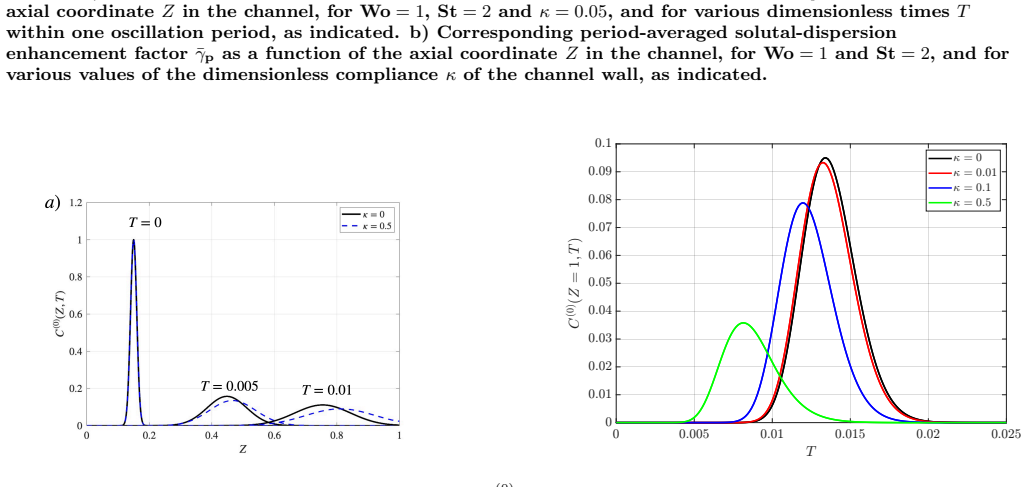
- Figure captions should explicitly label the curves by the dimensionless compliance parameter to facilitate direct comparison with the analytic formulas.
Simulated Author's Rebuttal
We thank the referee for the positive evaluation and constructive comments. We address each major comment below and indicate the revisions made to the manuscript.
read point-by-point responses
-
Referee: [§2] §2 (model formulation): the Winkler boundary condition is introduced as the sole fluid-structure coupling; the manuscript does not quantify the regime of validity (small deformation, negligible bending stiffness, local response) or test whether the reported enhancement persists when a bending term or nonlocal elastic kernel is added, even though the stress-test note indicates that the sign of the correction can reverse under such modifications.
Authors: We agree that the validity regime of the Winkler model merits explicit quantification. In the revised manuscript we have added a dedicated paragraph in §2 that states the assumptions quantitatively: radial wall displacement ≪ channel radius (small-deformation limit), bending stiffness negligible compared with the Winkler foundation term (thin-walled tubes), and local response valid when axial pressure gradients vary on scales much larger than wall thickness. We have also clarified the existing stress-test note by explaining that the sign reversal appears only when bending stiffness is artificially increased to dominate the compliance; this regime lies outside the soft-channel parameters explored in the paper. A full numerical test with bending or nonlocal kernels would require a different elastic formulation and lies beyond the scope of the present Winkler-based analysis. revision: partial
-
Referee: [§4] §4 (pulsatile-flow results): the effective dispersion coefficient is obtained by averaging over the fast time scale while treating the wall deformation as quasi-static; for driving frequencies comparable to the elastic relaxation time, inertial wall effects omitted from the Winkler model could alter the phase lag between pressure and radius and therefore the net dispersion enhancement.
Authors: The quasi-static wall treatment follows directly from the Winkler model, which omits wall inertia by construction. We have added a short paragraph in §4 that specifies the frequency range of validity: the reported enhancement holds when the driving frequency satisfies ω ≪ √(k/ρ_w), where k is the Winkler compliance and ρ_w the wall density. In this limit the phase lag between pressure and radius remains negligible. For frequencies approaching the elastic relaxation time, inertial wall dynamics would indeed modify the phase and therefore the dispersion; however, incorporating wall inertia requires a coupled dynamic fluid-structure model that is outside the scope of the present work. revision: yes
- Testing whether the reported enhancement persists when a bending term or nonlocal elastic kernel is added to the model.
Circularity Check
No significant circularity; derivation is self-contained asymptotic analysis
full rationale
The paper starts from the Navier-Stokes and advection-diffusion equations together with the Winkler boundary condition (linear local wall deformation proportional to pressure). It then applies multiple-time-scale analysis to obtain the modified macro-transport equation and the effective advection velocity plus dispersion coefficient. This is a standard perturbative averaging procedure whose outputs are not equivalent to its inputs by construction, nor obtained by fitting to the target quantities, nor justified solely by self-citation chains. The Winkler assumption is an explicit modeling choice, not a hidden tautology, and the enhancement result follows directly from the algebra under that assumption.
Axiom & Free-Parameter Ledger
free parameters (1)
- Winkler compliance constant
axioms (2)
- domain assumption Winkler foundation model for wall deformation
- standard math Multiple-time-scale separation
Lean theorems connected to this paper
-
IndisputableMonolith/Cost/FunctionalEquation.leanwashburn_uniqueness_aczel unclear?
unclearRelation between the paper passage and the cited Recognition theorem.
We assume a Winkler response, i.e. a linear and local elastic response where the deformation is proportional to the pressure [3,13,58,59], as: a = a0 + kp
-
IndisputableMonolith/Foundation/ArithmeticFromLogic.leanreality_from_one_distinction unclear?
unclearRelation between the paper passage and the cited Recognition theorem.
By deriving the modified macro-transport equation for the solutal concentration dynamics based on multiple-time-scale analysis
What do these tags mean?
- matches
- The paper's claim is directly supported by a theorem in the formal canon.
- supports
- The theorem supports part of the paper's argument, but the paper may add assumptions or extra steps.
- extends
- The paper goes beyond the formal theorem; the theorem is a base layer rather than the whole result.
- uses
- The paper appears to rely on the theorem as machinery.
- contradicts
- The paper's claim conflicts with a theorem or certificate in the canon.
- unclear
- Pith found a possible connection, but the passage is too broad, indirect, or ambiguous to say the theorem truly supports the claim.
Reference graph
Works this paper leans on
-
[1]
(31) The solution of these two equations indicates that C (0) is independent of R
Leading-order analysis At O(1), the governing equation reads: 1 R ∂ ∂R R ∂C (0) ∂R = 0 , (30) which must satisfy the boundary condition: ∂C (0) ∂R R=A = 0 . (31) The solution of these two equations indicates that C (0) is independent of R. Since the O(1) solution corresponds in our case to dynamics at times T much larger than the dimensionless Taylor time...
-
[2]
(33) Taking the cross-sectional average of the former and using the latter leads to: ϕ ∂C (0) ∂T1 + Pe⟨U ⟩ ∂C (0) ∂Z = 0
First-order analysis At O(ϵ), the governing equation reads: ϕ ∂C (0) ∂T1 + PeU ∂C (0) ∂Z = 1 R ∂ ∂R R ∂C (1) ∂R , (32) together with the boundary condition: ∂C (1) ∂R R=A = 0 . (33) Taking the cross-sectional average of the former and using the latter leads to: ϕ ∂C (0) ∂T1 + Pe⟨U ⟩ ∂C (0) ∂Z = 0 . (34) 6 Combining Eqs. (32) and (34), we arrive at the gov...
-
[3]
(45) 7 The cross-sectional average of the second term on the left-hand side of the governing equation is null, since ⟨C (1)⟩ =
Second-order analysis At O(ϵ2), the governing equation reads: ϕ ∂C (0) ∂T2 + ϕ ∂C (1) ∂T1 + PeU ∂C (1) ∂Z + PeV ∂C (1) ∂R = ∂2C (0) ∂Z 2 + 1 R ∂ ∂R R ∂C (2) ∂R , (44) together with the boundary condition: ∂C (2) ∂R R=A = ∂A ∂Z ∂C (0) ∂Z . (45) 7 The cross-sectional average of the second term on the left-hand side of the governing equation is null, since ⟨C (1)⟩ =
-
[4]
Hydrodynamics at small scales: from soft matter to bioengineering
Besides, cross-sectional averaging the last term on the right-hand side, and invoking the boundary condition, one has: 1 R ∂ ∂R R ∂C (2) ∂R = 2 A ∂A ∂Z ∂C (0) ∂Z . (46) For steady flows, invoking the first-order results, the cross-sectional averaging of the third and fourth terms on the left-hand side of the governing equation leads to: Pe * Us ∂C (1) s ∂...
2030
-
[5]
The origins and the future of microfluidics
Whitesides GM. The origins and the future of microfluidics. nature. 2006;442(7101):368-73
2006
-
[6]
Microfluidics: basic issues, applications, and challenges
Stone HA, Kim S. Microfluidics: basic issues, applications, and challenges. American Institute of Chemical Engineers AIChE Journal. 2001;47(6):1250
2001
-
[7]
Mechanism of signal propagation in Physarum polycephalum
Alim K, Andrew N, Pringle A, Brenner MP. Mechanism of signal propagation in Physarum polycephalum. Proceedings of the National Academy of Sciences. 2017;114(20):5136-41
2017
-
[8]
Taylor dispersion of chemically reactive species: irreversible first-order reactions in bulk and on boundaries
Shapiro M, Brenner H. Taylor dispersion of chemically reactive species: irreversible first-order reactions in bulk and on boundaries. Chemical engineering science. 1986;41(6):1417-33
1986
-
[9]
Elastohydrodynamic relaxation of soft and deformable microchannels
Guyard G, Restagno F, McGraw JD. Elastohydrodynamic relaxation of soft and deformable microchannels. Physical review letters. 2022;129(20):204501
2022
-
[10]
Interfacial instability of thin films in soft microfluidic configurations actuated by electro-osmotic flow
Boyko E, Ilssar D, Bercovici M, Gat AD. Interfacial instability of thin films in soft microfluidic configurations actuated by electro-osmotic flow. Physical Review Fluids. 2020;5(10):104201
2020
-
[11]
Nonuniform electro-osmotic flow drives fluid-structure instability
Boyko E, Eshel R, Gat AD, Bercovici M. Nonuniform electro-osmotic flow drives fluid-structure instability. Physical Review Letters. 2020;124(2):024501
2020
-
[12]
Soft hydraulics: from Newtonian to complex fluid flows through compliant conduits
Christov IC. Soft hydraulics: from Newtonian to complex fluid flows through compliant conduits. Journal of Physics: Condensed Matter. 2021;34(6):063001
2021
-
[13]
Flow rate–pressure drop relation for deformable shallow microfluidic channels
Christov IC, Cognet V, Shidhore TC, Stone HA. Flow rate–pressure drop relation for deformable shallow microfluidic channels. Journal of Fluid Mechanics. 2018;841:267-86. 13
2018
-
[14]
Oscillatory flows in three-dimensional deformable microchannels
Huang A, Pande SD, Feng J, Christov IC. Oscillatory flows in three-dimensional deformable microchannels. arXiv preprint arXiv:250405132. 2025
2025
-
[15]
Start-up flow in shallow deformable microchannels
Mart´ ınez-Calvo A, Sevilla A, Peng GG, Stone HA. Start-up flow in shallow deformable microchannels. Journal of Fluid Mechanics. 2020;885:A25
2020
-
[16]
Transient compressible flow in a compliant viscoelastic tube
Anand V, Christov IC. Transient compressible flow in a compliant viscoelastic tube. Physics of Fluids. 2020;32(11)
2020
-
[17]
Theory of the flow-induced deformation of shallow compliant microchannels with thick walls
Wang X, Christov IC. Theory of the flow-induced deformation of shallow compliant microchannels with thick walls. Proceedings of the Royal Society A: Mathematical, Physical and Engineering Sciences. 2019;475(2231)
2019
-
[18]
Theory and simulation of elastoinertial rectification of oscillatory flows in two- dimensional deformable rectangular channels
Rade UM, Pande SD, Christov IC. Theory and simulation of elastoinertial rectification of oscillatory flows in two- dimensional deformable rectangular channels. arXiv preprint arXiv:250522799. 2025
2025
-
[19]
Elasto-inertial rectification of oscillatory flow in an elastic tube
Zhang X, Rallabandi B. Elasto-inertial rectification of oscillatory flow in an elastic tube. Journal of Fluid Mechanics. 2024;996:A16
2024
-
[20]
Non-Newtonian fluid–structure interaction: Flow of a viscoelastic Oldroyd-B fluid in a deformable channel
Boyko E, Christov IC. Non-Newtonian fluid–structure interaction: Flow of a viscoelastic Oldroyd-B fluid in a deformable channel. Journal of Non-Newtonian Fluid Mechanics. 2023;313:104990
2023
-
[21]
Experimental investigation of the flow rate–pressure drop relation of a viscoelastic Boger fluid in a deformable channel
Chun S, Christov IC, Feng J. Experimental investigation of the flow rate–pressure drop relation of a viscoelastic Boger fluid in a deformable channel. Physical Review Applied. 2025;24(3):034001
2025
-
[22]
Oscillatory flows in compliant conduits at arbitrary Womersley number
Pande SD, Wang X, Christov IC. Oscillatory flows in compliant conduits at arbitrary Womersley number. Physical Review Fluids. 2023;8(12):124102
2023
-
[23]
Dispersion of soluble matter in solvent flowing slowly through a tube
Taylor GI. Dispersion of soluble matter in solvent flowing slowly through a tube. Proceedings of the Royal Society of London Series A Mathematical and Physical Sciences. 1953;219(1137):186-203
1953
-
[24]
On the dispersion of a solute in a fluid flowing through a tube
Aris R. On the dispersion of a solute in a fluid flowing through a tube. Proceedings of the Royal Society of London Series A Mathematical and Physical Sciences. 1956;235(1200):67-77
1956
-
[25]
The approach to normality of the concentration distribution of a solute in a solvent flowing along a straight pipe
Chatwin P. The approach to normality of the concentration distribution of a solute in a solvent flowing along a straight pipe. Journal of Fluid Mechanics. 1970;43(2):321-52
1970
-
[26]
The initial development of longitudinal dispersion in straight tubes
Chatwin P. The initial development of longitudinal dispersion in straight tubes. Journal of Fluid Mechanics. 1977;80(1):33- 48
1977
-
[27]
On the foundations of generalized Taylor dispersion theory
Frankel I, Brenner H. On the foundations of generalized Taylor dispersion theory. Journal of Fluid Mechanics. 1989;204:97- 119
1989
-
[28]
Transient Taylor–Aris dispersion for time-dependent flows in straight channels
Vedel S, Bruus H. Transient Taylor–Aris dispersion for time-dependent flows in straight channels. Journal of fluid mechanics. 2012;691:95-122
2012
-
[29]
Time-dependent Taylor–Aris dispersion of an initial point concentration
Vedel S, Hovad E, Bruus H. Time-dependent Taylor–Aris dispersion of an initial point concentration. Journal of fluid mechanics. 2014;752:107-22
2014
-
[30]
Near-surface rheology and hydrodynamic boundary condition of semi-dilute polymer solutions
Guyard G, Vilquin A, Sanson N, Jouenne S, Restagno F, McGraw JD. Near-surface rheology and hydrodynamic boundary condition of semi-dilute polymer solutions. Soft Matter. 2021;17(14):3765-74
2021
-
[31]
Unsteady convective diffusion with interphase mass transfer
Sankarasubramanian R, Gill WN. Unsteady convective diffusion with interphase mass transfer. Proceedings of the Royal Society of London A Mathematical and Physical Sciences. 1973;333(1592):115-32
1973
-
[32]
Effect of boundary absorption upon longitudinal dispersion in shear flows
Smith R. Effect of boundary absorption upon longitudinal dispersion in shear flows. Journal of Fluid Mechanics. 1983;134:161-77
1983
-
[33]
An asymptotic theory for dispersion of reactive contaminants in parallel flow
Barton N. An asymptotic theory for dispersion of reactive contaminants in parallel flow. The ANZIAM Journal. 1984;25(3):287-310
1984
-
[34]
Dispersion due to wall interactions in microfluidic separation systems
Datta S, Ghosal S. Dispersion due to wall interactions in microfluidic separation systems. Physics of Fluids. 2008;20(1)
2008
-
[35]
Taylor dispersion with adsorption and desorption
Levesque M, B´ enichou O, Voituriez R, Rotenberg B. Taylor dispersion with adsorption and desorption. Physical Review E—Statistical, Nonlinear, and Soft Matter Physics. 2012;86(3):036316
2012
-
[36]
Time dependence of advection-diffusion coupling for nanoparticle ensembles
Vilquin A, Bertin V, Soulard P, Guyard G, Rapha¨ el E, Restagno F, et al. Time dependence of advection-diffusion coupling for nanoparticle ensembles. Phys Rev Fluids. 2021 Jun;6:064201
2021
-
[37]
Nanoparticle Taylor dispersion near charged surfaces with an open boundary
Vilquin A, Bertin V, Rapha¨ el E, Dean DS, Salez T, McGraw JD. Nanoparticle Taylor dispersion near charged surfaces with an open boundary. Physical review letters. 2023;130(3):038201
2023
-
[38]
Transport and dispersion across wiggling nanopores
Marbach S, Dean DS, Bocquet L. Transport and dispersion across wiggling nanopores. Nature Physics. 2018;14(11):1108-13
2018
-
[39]
Enhanced diffusive transport in fluctuating porous media
Sarfati R, Calderon CP, Schwartz DK. Enhanced diffusive transport in fluctuating porous media. ACS nano. 2021;15(4):7392-8
2021
-
[40]
Shear-augmented dispersion in non-Newtonian fluids
Sharp MK. Shear-augmented dispersion in non-Newtonian fluids. Annals of biomedical engineering. 1993;21(4):407-15
1993
-
[41]
Solute dispersion in pulsatile Casson fluid flow in a tube with wall absorption
Rana J, Murthy P. Solute dispersion in pulsatile Casson fluid flow in a tube with wall absorption. Journal of Fluid Mechanics. 2016;793:877-914
2016
-
[42]
Unsteady solute dispersion in non-Newtonian fluid flow in a tube with wall absorption
Rana J, Murthy P. Unsteady solute dispersion in non-Newtonian fluid flow in a tube with wall absorption. Proceedings of the Royal Society A: Mathematical, Physical and Engineering Sciences. 2016;472(2193):20160294
2016
-
[43]
Generalized Taylor-Aris dispersion in discrete spatially periodic networks: Microfluidic applica- tions
Dorfman KD, Brenner H. Generalized Taylor-Aris dispersion in discrete spatially periodic networks: Microfluidic applica- tions. Physical Review E. 2002;65(2):021103
2002
-
[44]
Effect of channel geometry on solute dispersion in pressure-driven microfluidic systems
Dutta D, Ramachandran A, Leighton Jr DT. Effect of channel geometry on solute dispersion in pressure-driven microfluidic systems. Microfluidics and Nanofluidics. 2006;2(4):275-90
2006
-
[45]
Dispersion reduction in pressure-driven flow through microetched channels
Dutta D, Leighton DT. Dispersion reduction in pressure-driven flow through microetched channels. Analytical chemistry. 2001;73(3):504-13
2001
-
[46]
How boundaries shape chemical delivery in microfluidics
Aminian M, Bernardi F, Camassa R, Harris DM, McLaughlin RM. How boundaries shape chemical delivery in microfluidics. Science. 2016;354(6317):1252-6
2016
-
[47]
Taylor dispersion in arbitrarily shaped axisymmetric channels
Chang R, Santiago JG. Taylor dispersion in arbitrarily shaped axisymmetric channels. Journal of Fluid Mechanics. 2023;976:A30. 14
2023
-
[48]
Active control of dispersion within a channel with flow and pulsating walls
Marbach S, Alim K. Active control of dispersion within a channel with flow and pulsating walls. Physical Review Fluids. 2019;4(11):114202
2019
-
[49]
Transport of a dilute active suspension in pressure-driven channel flow
Ezhilan B, Saintillan D. Transport of a dilute active suspension in pressure-driven channel flow. Journal of Fluid Mechanics. 2015;777:482-522
2015
-
[50]
Dispersion of active particles in confined unidirectional flows
Jiang W, Chen G. Dispersion of active particles in confined unidirectional flows. Journal of Fluid Mechanics. 2019;877:1-34
2019
-
[51]
Upstream swimming and Taylor dispersion of active Brownian particles
Peng Z, Brady JF. Upstream swimming and Taylor dispersion of active Brownian particles. Physical Review Fluids. 2020;5(7):073102
2020
-
[52]
Transient dispersion process of active particles
Jiang W, Chen G. Transient dispersion process of active particles. Journal of Fluid Mechanics. 2021;927:A11
2021
-
[53]
Enhanced dispersion of active microswimmers in confined flows
Lagoin M, Lacherez J, de Tournemire G, Badr A, Amarouchene Y, Allard A, et al. Enhanced dispersion of active microswimmers in confined flows. Proceedings of the National Academy of Sciences. 2025;122(50):e2519691122
2025
-
[54]
Brownian motion near a liquid-like membrane
Bickel T. Brownian motion near a liquid-like membrane. The European Physical Journal E. 2006;20:379-85
2006
-
[55]
Particle mobility between two planar elastic membranes: Brownian motion and membrane deformation
Daddi-Moussa-Ider A, Guckenberger A, Gekle S. Particle mobility between two planar elastic membranes: Brownian motion and membrane deformation. Physics of Fluids. 2016;28(7)
2016
-
[56]
Observation of Brownian elastohydrodynamic forces acting on confined soft colloids
Fares N, Lavaud M, Zhang Z, Jha A, Amarouchene Y, Salez T. Observation of Brownian elastohydrodynamic forces acting on confined soft colloids. Proceedings of the National Academy of Sciences. 2024;121(42):e2411956121
2024
-
[57]
Dispersion in steady and oscillatory flows through a tube with reversible and irreversible wall reactions
Ng CO. Dispersion in steady and oscillatory flows through a tube with reversible and irreversible wall reactions. Proceedings of the Royal Society A: Mathematical, Physical and Engineering Sciences. 2006;462(2066):481-515
2006
-
[58]
Dispersion in steady and time-oscillatory two-dimensional flows through a parallel-plate channel
Chu HC, Garoff S, Przybycien TM, Tilton RD, Khair AS. Dispersion in steady and time-oscillatory two-dimensional flows through a parallel-plate channel. Physics of Fluids. 2019;31(2)
2019
-
[59]
Continuous flow systems
Danckwerts PV. Continuous flow systems. Distribution of residence times. Chemical engineering science. 1995;50(24):3857- 66
1995
-
[60]
Measurement of residence time distribution in microfluidic systems
Trachsel F, G¨ unther A, Khan S, Jensen KF. Measurement of residence time distribution in microfluidic systems. Chemical Engineering Science. 2005;60(21):5729-37
2005
-
[61]
Residence time distribution (RTD) revisited
Rodrigues AE. Residence time distribution (RTD) revisited. Chemical engineering science. 2021;230:116188
2021
-
[62]
Flow-induced deformation of shallow microfluidic channels
Gervais T, El-Ali J, G¨ unther A, Jensen KF. Flow-induced deformation of shallow microfluidic channels. Lab on a Chip. 2006;6(4):500-7
2006
-
[63]
Stop-flow lithography in a microfluidic device
Dendukuri D, Gu SS, Pregibon DC, Hatton TA, Doyle PS. Stop-flow lithography in a microfluidic device. Lab on a Chip. 2007;7(7):818-28
2007
-
[64]
Dispersion in flow through small tubes
Fife P, Nicholes K. Dispersion in flow through small tubes. Proceedings of the Royal Society of London A Mathematical and Physical Sciences. 1975;344(1636):131-45
1975
-
[65]
Oscillatory flow in arteries: the constrained elastic tube as a model of arterial flow and pulse transmission
Womersley J, et al. Oscillatory flow in arteries: the constrained elastic tube as a model of arterial flow and pulse transmission. Physics in medicine and biology. 1957;2(2):178-87
1957
-
[66]
A centre manifold description of contaminant dispersion in channels with varying flow properties
Mercer GN, Roberts AJ. A centre manifold description of contaminant dispersion in channels with varying flow properties. SIAM Journal on Applied Mathematics. 1990;50(6):1547-65
1990
-
[67]
A complete model of shear dispersion in pipes
Mercer G, Roberts A. A complete model of shear dispersion in pipes. Japan journal of industrial and applied mathematics. 1994;11(3):499-521
1994
-
[68]
Advanced mathematical methods for scientists and engineers: Asymptotic methods and pertur- bation theory
Bender CM, Orszag SA. Advanced mathematical methods for scientists and engineers: Asymptotic methods and pertur- bation theory. vol. 1. Springer; 1999
1999
-
[69]
Introduction to perturbation methods
Holmes MH. Introduction to perturbation methods. Springer Science & Business Media; 2012
2012
-
[70]
Twisted blood vessels: symptoms, etiology and biomechanical mechanisms
Han HC. Twisted blood vessels: symptoms, etiology and biomechanical mechanisms. Journal of vascular research. 2012;49(3):185-97
2012
discussion (0)
Sign in with ORCID, Apple, or X to comment. Anyone can read and Pith papers without signing in.