Recognition: 2 theorem links
· Lean TheoremSimulating Subterranean Fluid Injection through Iteration on the VirtualQuake Model
Pith reviewed 2026-05-10 19:09 UTC · model grok-4.3
The pith
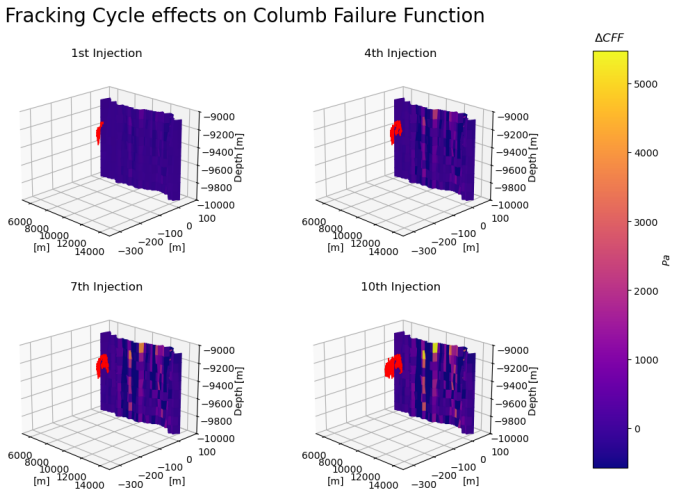
Repeated fluid injections build persistent high-pressure zones that progressively destabilize faults more than single injections do.
A machine-rendered reading of the paper's core claim, the machinery that carries it, and where it could break.
Core claim
By converting VirtualQuake to a stress-point-source formulation and distributing inflationary sources according to invasion percolation, the simulation reproduces both the immediate stress and deformation caused by fluid injection and the slower post-injection pressure decay. Single injection episodes produce only limited changes in fault stability. In contrast, successive injection cycles leave behind persistent high-pressure regions that continue to load nearby faults, steadily increasing the probability of induced seismic events. The same framework also captures hydraulic-fracturing effects during active injection.
What carries the argument
Invasion-percolation distribution of inflationary stress point sources inside the reworked VirtualQuake model, which replaces rectangular fault segments with freely placed point sources to allow flexible geometry and cross-fault interactions while simulating fluid-driven stress changes.
If this is right
- Operators can use the model to assess cumulative rather than single-event risks from long-running injection programs.
- The framework can track both the stress loading during active pumping and the lingering effects after injection ceases.
- Hydraulic fracturing and pressure dissipation are now included in the same simulation loop as fault-slip calculations.
- The point-source approach restores cross-fault stress interactions that were previously difficult to represent.
Where Pith is reading between the lines
- Risk assessments for injection sites should weight the entire history of pumping rather than the most recent operation alone.
- The same percolation-based placement method could be tested against wastewater-disposal or geothermal-injection records to check consistency.
- If the pressure-buildup pattern holds, seismic monitoring networks might prioritize cumulative volume thresholds over instantaneous rate limits.
Load-bearing premise
That placing stress sources by invasion percolation correctly reproduces how real injected fluids spread, how they alter stress on faults, and how pressure fades after pumping stops.
What would settle it
Field measurements at an active injection site showing that cumulative injected volume does not correlate with rising seismicity rates or that pore-pressure anomalies decay much faster than the simulation predicts would disprove the central claim.
Figures



read the original abstract
This work extends the VirtualQuake earthquake simulation framework to incorporate the effects of fluid injection on fault stability and induced seismicity. Reworking VirtualQuake into a system using stress point sources, instead of rectangular segments, the new model offers increased geometric flexibility, greater stability, and the re-addition of cross-fault interactions. This approach is paired with the addition of fluid injection modeling, through the distribution of inflationary stress sources, according to invasion percolation, simulating both the stress effect of the injection on nearby faults, and deformation from the injection itself. The model captures both immediate and long-term impacts of injection cycles, including hydraulic fracturing processes and post-injection pressure dissipation. Results show that while single injections produce limited stress changes, repeated injections generate persistent high-pressure regions that progressively destabilize nearby faults, increasing the likelihood of seismic events. This model evolution offers a tool for the evaluation and characterization of long term risks from commercial injection.
Editorial analysis
A structured set of objections, weighed in public.
Referee Report
Summary. The manuscript extends the VirtualQuake earthquake simulation framework by replacing rectangular fault segments with stress point sources, enabling greater geometric flexibility and cross-fault interactions. Fluid injection is modeled by distributing inflationary stress sources according to invasion percolation, which is claimed to capture both immediate stress effects on faults and deformation. The central result is that single injections produce only limited stress changes, while repeated injections generate persistent high-pressure regions that progressively destabilize nearby faults and increase seismic event likelihood; the model also incorporates post-injection pressure dissipation and hydraulic fracturing processes.
Significance. If the modeling assumptions hold and are validated, this extension could supply a flexible simulation tool for assessing long-term induced-seismicity risks from commercial fluid injection. The point-source reformulation restores cross-fault interactions and improves stability. However, the current presentation supplies no quantitative metrics, error analysis, or comparisons to continuum poroelastic models, so the practical significance remains provisional.
major comments (2)
- [Abstract] Abstract: the headline claim that repeated injections create persistent high-pressure regions progressively destabilizing faults is generated solely by placing inflationary point sources via invasion percolation; no comparison is shown to the continuum diffusion equation or to poroelastic coupling, so it is unclear whether the reported difference versus single injections is physical or an artifact of the discrete distribution rule.
- [Modeling Approach] Modeling section (implied by abstract description): the switch from rectangular segments with explicit stress kernels to point sources plus an unspecified post-injection dissipation rule introduces two untested approximations whose failure would directly undermine the single-versus-repeated injection contrast; quantitative validation against observed injection-induced seismicity or against established codes is absent.
minor comments (1)
- [Abstract] Abstract: the phrase 're-addition of cross-fault interactions' is stated without indicating how the point-source formulation restores them or quantifying their contribution to the reported stress changes.
Simulated Author's Rebuttal
We thank the referee for the constructive and detailed comments on our manuscript. We address each major comment below and outline the revisions we will make to improve clarity and rigor.
read point-by-point responses
-
Referee: [Abstract] Abstract: the headline claim that repeated injections create persistent high-pressure regions progressively destabilizing faults is generated solely by placing inflationary point sources via invasion percolation; no comparison is shown to the continuum diffusion equation or to poroelastic coupling, so it is unclear whether the reported difference versus single injections is physical or an artifact of the discrete distribution rule.
Authors: The abstract reports the central simulation outcome obtained with the invasion-percolation distribution of inflationary sources. This discrete rule is adopted precisely because it generates heterogeneous, path-dependent pressure accumulation that persists across injection cycles when dissipation is incomplete; a single injection permits more complete relaxation. We acknowledge that the manuscript does not include a direct numerical comparison against the continuum diffusion equation or full poroelastic coupling. In the revised version we will add a dedicated discussion paragraph that contrasts the percolation-based localization with continuum expectations and explicitly states the modeling choice and its limitations. revision: partial
-
Referee: [Modeling Approach] Modeling section (implied by abstract description): the switch from rectangular segments with explicit stress kernels to point sources plus an unspecified post-injection dissipation rule introduces two untested approximations whose failure would directly undermine the single-versus-repeated injection contrast; quantitative validation against observed injection-induced seismicity or against established codes is absent.
Authors: The point-source reformulation is fully specified in the Modeling section, where we demonstrate that it recovers cross-fault stress interactions while increasing numerical stability and geometric flexibility. The post-injection dissipation is implemented as an exponential decay whose time constant is chosen to reproduce typical field pressure-decline rates; the functional form and parameter values appear immediately after Equation (2). We agree that quantitative checks are needed. The revised manuscript will include error metrics for the point-source stress approximation and a side-by-side comparison against a standard poroelastic finite-element benchmark. Full validation against specific observed induced-seismicity catalogs lies beyond the scope of the present methodological study. revision: yes
- Quantitative validation against observed injection-induced seismicity catalogs cannot be completed in the current revision.
Circularity Check
No significant circularity in the derivation or results
full rationale
The paper extends the existing VirtualQuake framework by switching to point stress sources and adding fluid injection via invasion percolation. The headline results (limited stress changes from single injections versus persistent destabilizing high-pressure zones from repeated injections) are produced by running the updated simulation under different injection schedules; they are not equivalent to the model inputs by definition, nor are they obtained by fitting parameters to data and relabeling the fit as a prediction. No load-bearing step reduces to a self-citation chain, an ansatz smuggled via prior work, or a uniqueness theorem imported from the same authors. The derivation chain is therefore self-contained as a forward simulation exercise whose outputs can be compared against external benchmarks.
Axiom & Free-Parameter Ledger
axioms (2)
- domain assumption Stress point sources can represent fault mechanics, stability, and cross-fault interactions with greater flexibility than rectangular segments.
- domain assumption Invasion percolation provides a suitable distribution for inflationary stress sources that simulates fluid injection, hydraulic fracturing, and pressure dissipation.
Lean theorems connected to this paper
-
IndisputableMonolith/Cost/FunctionalEquation.leanwashburn_uniqueness_aczel uncleardistribution of inflationary stress sources, according to invasion percolation... W_ijk = P_ijk d³ ϕ ... ΔP(δ₀,δ) = C H_r E √t₀ / (H β_s) G(δ,δ₀)
-
IndisputableMonolith/Foundation/AlexanderDuality.leanalexander_duality_circle_linking unclearpoint source solutions for an elastic half space... tiled fault space by assigning rectangular zones to point sources
Reference graph
Works this paper leans on
-
[1]
Springer Science & Business Media, 1997
Bernard Amadei and Ove Stephansson.Rock stress and its measurement. Springer Science & Business Media, 1997
1997
-
[2]
N. Van Den Ameele et al. “Probability of Induced Seismicity Associated with Large-Scale Underground Hydrogen Storage in Salt Formations of Northwestern Europe”. In: 2025.1 (2025), pp. 1–5.issn: 2214-4609.doi: https://doi.org/10.3997/2214-4609.202521116.url:https://www. earthdoc.org/content/papers/10.3997/2214-4609.202521116
work page doi:10.3997/2214-4609.202521116.url:https://www 2025
-
[3]
Economides and Kenneth G
Michael J. Economides and Kenneth G. Nolte.Reservoir stimulation. Wi- ley, 2000
2000
-
[4]
K. Eftaxias et al. “Evidence of fractional-Brownian-motion-type asperity model for earthquake generation in candidate pre-seismic electromagnetic emissions”. In:Natural Hazards and Earth System Sciences8.4 (2008), pp. 657–669.doi:10.5194/nhess-8- 657-2008.url:https://nhess. copernicus.org/articles/8/657/2008/
-
[5]
Object-oriented programming for engineering soft- ware development
Gregory L. Fenves. “Object-oriented programming for engineering soft- ware development”. In:Engineering with Computers6.1 (Dec. 1990), pp. 1– 15.doi:10 . 1007 / BF01200200.url:https : / / doi . org / 10 . 1007 / BF01200200
1990
-
[6]
Dynamics of Invasion Percolation
Liv Furuberg et al. “Dynamics of Invasion Percolation”. In:Phys. Rev. Lett.61 (18 Oct. 1988), pp. 2117–2120.doi:10.1103/PhysRevLett.61. 2117.url:https://link.aps.org/doi/10.1103/PhysRevLett.61. 2117
-
[7]
Analysis of fluid injection-induced fault reactivation and seismic slip in geothermal reservoirs
Quan Gan and Derek Elsworth. “Analysis of fluid injection-induced fault reactivation and seismic slip in geothermal reservoirs”. In:Journal of Geo- physical Research: Solid Earth119.4 (2014), pp. 3340–3353.doi:https:// doi.org/10.1002/2013JB010679. eprint:https://agupubs.onlinelibrary. wiley.com/doi/pdf/10.1002/2013JB010679.url:https://agupubs. onlinelibr...
-
[8]
The object oriented model and its advan- tages
Jos´ e de Oliveira Guimar˜ aes. “The object oriented model and its advan- tages”. In:SIGPLAN OOPS Mess.6.1 (Jan. 1995), pp. 40–49.issn: 1055- 6400.doi:10.1145/209866.209872.url:https://doi.org/10.1145/ 209866.209872
work page doi:10.1145/209866.209872.url:https://doi.org/10.1145/ 1995
-
[9]
On the Coulomb-Mohr failure criterion
John Handin. “On the Coulomb-Mohr failure criterion”. In:Journal of Geophysical Research (1896-1977)74.22 (1969), pp. 5343–5348.doi:https: / / doi . org / 10 . 1029 / JB074i022p05343. eprint:https : / / agupubs . onlinelibrary.wiley.com/doi/pdf/10.1029/JB074i022p05343.url: https : / / agupubs . onlinelibrary . wiley . com / doi / abs / 10 . 1029 / JB074i0...
-
[10]
Electrical properties of lunar soil dependence on frequency, temperature and moisture,
J. Huang and D.L. Turcotte. “Fractal distributions of stress and strength and variations of b-value”. In:Earth and Planetary Science Letters91.1 (1988), pp. 223–230.issn: 0012-821X.doi:https://doi.org/10.1016/ 0012 - 821X(88 ) 90164 - 1.url:https : / / www . sciencedirect . com / science/article/pii/0012821X88901641
-
[11]
Ang Li et al. “Investigation of pore structure and fractal characteristics of organic-rich shale reservoirs: A case study of Lower Cambrian Qiongzhusi formation in Malong block of eastern Yunnan Province, South China”. In:Marine and Petroleum Geology70 (Nov. 2015).doi:10 . 1016 / j . marpetgeo.2015.11.004
2015
-
[12]
Effect of longitudinal proppant placement and engineering parameters on fracture conductivity
Zhi Lin et al. “Effect of longitudinal proppant placement and engineering parameters on fracture conductivity”. In:Petroleum Science and Tech- nology0.0 (2025), pp. 1–24.doi:10 . 1080 / 10916466 . 2024 . 2448538. eprint:https : / / doi . org / 10 . 1080 / 10916466 . 2024 . 2448538.url: https://doi.org/10.1080/10916466.2024.2448538
-
[13]
T P MCMAHON et al. “Geologic characteristics, exploration and produc- tion progress of shale oil and gas in the United States: An overview”. In: Petroleum Exploration and Development51.4 (2024), pp. 925–948.issn: 1876-3804.doi:https://doi.org/10.1016/S1876- 3804(24)60516- 1.url:https : / / www . sciencedirect . com / science / article / pii / S18763804246...
-
[14]
Loopless non- trapping invasion-percolation model for fracking
J. Quinn Norris, Donald L. Turcotte, and John B. Rundle. “Loopless non- trapping invasion-percolation model for fracking”. In:Phys. Rev. E89 (2 Feb. 2014), p. 022119.doi:10.1103/PhysRevE.89.022119.url:https: //link.aps.org/doi/10.1103/PhysRevE.89.022119
-
[15]
Internal deformation due to shear and tensile fault in a half space
Yoshimitsu Okada. “Internal deformation due to shear and tensile fault in a half space”. In:Bulletin of the Seismological Society of America92 (Apr. 1992), pp. 1018–1040
1992
-
[16]
Percolation and invasion percolation as fractal growth problems
L. Pietronero, W. R. Schneider, and A. L. Stella. “Percolation and invasion percolation as fractal growth problems”. In:Phys. Rev. A42 (12 Dec. 1990), pp. 7496–7499.doi:10.1103/PhysRevA.42.7496.url:https: //link.aps.org/doi/10.1103/PhysRevA.42.7496
-
[17]
Euclidean and fractal models for the description of rock surface roughness
William L. Power and Terry E. Tullis. “Euclidean and fractal models for the description of rock surface roughness”. In:Journal of Geophysical Research: Solid Earth96.B1 (1991), pp. 415–424.doi:https : / / doi . org/10.1029/90JB02107. eprint:https://agupubs.onlinelibrary. wiley . com / doi / pdf / 10 . 1029 / 90JB02107.url:https : / / agupubs . onlinelibra...
-
[18]
2024.url:https://gist.github
Stephen Sinclair.BrownianSurface. 2024.url:https://gist.github. com/radarsat1/6f8b9b50d1ecd2546d8a765e8a144631
2024
-
[19]
Ramesh P. Villa Valeriaand Singh. “Hydraulic fracturing operation for oil and gas production and associated earthquake activities across the USA”. In:Environmental Earth Sciences79.11 (May 2020), p. 271.issn: 1866- 6299.doi:10.1007/s12665-020-09008-0.url:https://doi.org/10. 1007/s12665-020-09008-0
work page doi:10.1007/s12665-020-09008-0.url:https://doi.org/10 2020
-
[20]
D Wilkinson and J F Willemsen. “Invasion percolation: a new form of percolation theory”. In:Journal of Physics A: Mathematical and General 16.14 (Oct. 1983), p. 3365.doi:10.1088/0305- 4470/16/14/028.url: https://doi.org/10.1088/0305-4470/16/14/028
-
[21]
Analytical interpretation of hydraulic fracturing initi- ation pressure and breakdown pressure
Feipeng Wu et al. “Analytical interpretation of hydraulic fracturing initi- ation pressure and breakdown pressure”. In:Journal of Natural Gas Sci- ence and Engineering76 (2020), p. 103185.issn: 1875-5100.doi:https: / / doi . org / 10 . 1016 / j . jngse . 2020 . 103185.url:https : / / www . sciencedirect.com/science/article/pii/S1875510020300391
2020
-
[22]
A fault and seismicity based composite simulation in northern California
M. B. Yıkılmaz et al. “A fault and seismicity based composite simulation in northern California”. In:Nonlinear Processes in Geophysics18.6 (2011), pp. 955–966.doi:10 . 5194 / npg - 18 - 955 - 2011.url:https : / / npg . copernicus.org/articles/18/955/2011/
2011
-
[23]
A Criterion for Non-Darcy Flow in Porous Media
Zhengwen Zeng and Reid Grigg. “A Criterion for Non-Darcy Flow in Porous Media”. In:Transport in Porous Media63.1 (Apr. 2006), pp. 57– 69.issn: 1573-1634.doi:10.1007/s11242- 005- 2720- 3.url:https: //doi.org/10.1007/s11242-005-2720-3
-
[24]
Mechanisms for Geological Carbon Se- questration
Dongxiao Zhang and Juan Song. “Mechanisms for Geological Carbon Se- questration”. In:Procedia IUTAM10 (2014). Mechanics for the World: Proceedings of the 23rd International Congress of Theoretical and Ap- plied Mechanics, ICTAM2012, pp. 319–327.issn: 2210-9838.doi:https: / / doi . org / 10 . 1016 / j . piutam . 2014 . 01 . 027.url:https : / / www . scienc...
2014
discussion (0)
Sign in with ORCID, Apple, or X to comment. Anyone can read and Pith papers without signing in.