Recognition: 2 theorem links
· Lean TheoremLoss-aware state space geometry for quantum variational algorithms
Pith reviewed 2026-05-10 19:39 UTC · model grok-4.3
The pith
Embedding the loss hypersurface into state space geometry produces loss-aware natural gradient updates that rescale step sizes while preserving descent direction.
A machine-rendered reading of the paper's core claim, the machinery that carries it, and where it could break.
Core claim
The intrinsic geometry of the space of outcomes is accounted for either through an ambient construction that embeds the loss hypersurface into a base statistical manifold equipped with the Fisher information metric or Fubini-Study tensor, or through a direct first-principle construction based on overlaps of nearby states on the projective Hilbert space. This approach, together with a family of conformal variants, produces loss-aware natural gradient updates that rescale the effective step size while preserving the descent direction.
What carries the argument
Loss-aware natural gradient update, obtained by embedding the loss hypersurface into the statistical manifold with its Fisher or Fubini-Study geometry, or by direct overlap construction on the projective Hilbert space.
If this is right
- The effective step size is rescaled according to the local geometry of the loss surface.
- The direction of each update remains identical to that of the conventional natural gradient.
- A family of conformal variants supplies additional forms of the same loss-aware rescaling.
- Benchmarks on variational quantum circuits and neural networks indicate possible improvements in best-case convergence under suitable conditions.
- Standard natural gradient continues to show the highest average robustness across the tested examples.
Where Pith is reading between the lines
- The same embedding idea could be applied to classical probability-based optimization tasks where outcome spacing matters.
- Hybrid schemes that combine loss-aware rescaling with adaptive learning-rate schedules might reduce the need for manual tuning.
- Whether the conformal family remains stable when the number of variational parameters grows large is not yet settled by the presented benchmarks.
- Direct comparison against other geometry-aware methods such as quantum natural gradient with different metrics would clarify relative strengths.
Load-bearing premise
That embedding the loss hypersurface or using state overlaps will generate stable, useful rescalings of the step size without introducing instabilities or extra hyperparameters.
What would settle it
A set of repeated optimization runs on standard variational quantum eigensolver circuits where the proposed loss-aware updates produce worse average final loss values or more frequent divergence than standard natural gradient would falsify the practical benefit.
Figures



read the original abstract
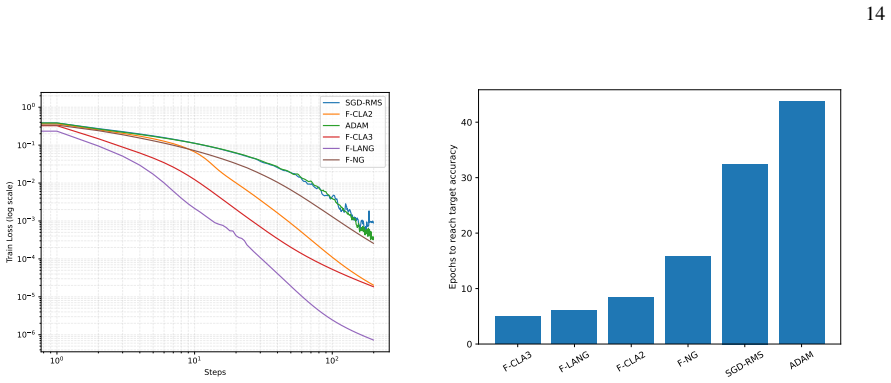
The natural gradient descent optimisation technique is an efficient optimising protocol for broad classes of classical and quantum systems that takes the underlying geometry of the parameter manifold into account by means of using either the Fisher information metric of the classical probability distribution function or the Fubini-Study tensor of the associated parametrised quantum states in the consequent update rules. Even though the natural gradient descent procedure utilises the geometry of the space of probability or states, it is, however, insensitive to the measure of parametrised distance on the space of possible outcomes when the corresponding optimising problem is considered for the expectation value of a classical or quantum observable with respect to the probability distribution or the quantum state. In this work, we introduce a generic optimising principle, where the intrinsic geometry of the space of outcomes has been taken into account suitably, either by using an ambient space construction with a base statistical manifold with the usual Fisher information metric (or the Fubini-Study tensor), where the loss hypersurface is embedded to, or by means of a first-principle construction from the overlap of nearby quantum states on the projective Hilbert space. This construction as well as a family of conformal variants yields a form of loss-aware natural gradient updates that rescale the effective step size while preserving the descent direction. We benchmark the resulting optimisers on variational quantum circuit examples and on a classical neural network task, finding that, while the standard natural gradient remains the most robust on average, the proposed conformal schemes can improve best-case convergence in favourable regimes.
Editorial analysis
A structured set of objections, weighed in public.
Referee Report
Summary. The manuscript proposes a loss-aware extension of natural gradient descent for variational quantum algorithms and classical optimization tasks. By either embedding the loss hypersurface into a base manifold equipped with the Fisher information metric (or Fubini-Study tensor) or constructing a metric directly from overlaps of nearby states on projective Hilbert space, the authors derive updates that incorporate outcome-space geometry. These constructions, together with a family of conformal rescalings, produce loss-aware natural gradients that rescale the effective step size while preserving the descent direction in the tangent space. Numerical benchmarks on variational quantum circuits and a classical neural network are reported, with the finding that standard natural gradient remains most robust on average while the conformal variants can improve best-case convergence in favorable regimes.
Significance. If the central geometric construction holds, the work supplies a first-principles, parameter-free route to making natural-gradient methods sensitive to the loss landscape without altering the optimization direction or introducing new hyperparameters. This is a direct consequence of the conformal invariance of the descent direction under positive scalar rescaling of the metric, a standard fact of Riemannian geometry. The inclusion of both quantum and classical benchmarks, even if qualitative, adds practical relevance for variational quantum algorithms.
major comments (1)
- [Numerical experiments section] Numerical experiments section: The abstract and main text state that benchmarks were performed and that conformal schemes can improve best-case convergence, yet no quantitative results, error bars, number of independent runs, or data-exclusion criteria are supplied. This absence prevents verification of the magnitude and statistical reliability of the claimed improvement over standard natural gradient.
minor comments (2)
- [Abstract] The abstract would be clearer if it briefly indicated the specific VQC ansatze and classical NN architecture used in the benchmarks.
- [Main text] Notation for the conformal factor and the overlap-based metric should be introduced with an explicit equation number in the main text to aid readability.
Simulated Author's Rebuttal
We thank the referee for their careful reading of the manuscript and for recommending minor revision. We address the single major comment below.
read point-by-point responses
-
Referee: [Numerical experiments section] Numerical experiments section: The abstract and main text state that benchmarks were performed and that conformal schemes can improve best-case convergence, yet no quantitative results, error bars, number of independent runs, or data-exclusion criteria are supplied. This absence prevents verification of the magnitude and statistical reliability of the claimed improvement over standard natural gradient.
Authors: We agree that additional quantitative information would strengthen the presentation of the benchmarks. The manuscript currently emphasizes qualitative observations of convergence behavior, consistent with the referee's summary. In the revised version we will expand the numerical experiments section to include error bars derived from multiple independent runs, the precise number of runs performed for each variational quantum circuit and neural-network task, and any data-exclusion or averaging criteria employed. These additions will permit direct assessment of the statistical reliability of the reported best-case improvements under the conformal schemes. revision: yes
Circularity Check
No significant circularity in derivation chain
full rationale
The paper derives loss-aware natural gradient updates via an ambient embedding of the loss hypersurface into the statistical manifold (with Fisher/Fubini-Study metric) or a direct overlap-based construction on projective Hilbert space. These produce a conformal rescaling of the metric, which by standard Riemannian geometry multiplies the natural-gradient vector by a position-dependent positive scalar while preserving its tangent-space direction. The central claim is therefore a direct geometric consequence of the stated constructions and does not reduce to any fitted parameter, self-citation, or renamed empirical pattern. Benchmarks are presented only as empirical checks, not as part of the derivation. No load-bearing step collapses to its own inputs.
Axiom & Free-Parameter Ledger
axioms (2)
- standard math The Fubini-Study metric or Fisher information metric correctly captures the geometry of the parameter manifold for quantum states or probability distributions.
- domain assumption Nearby quantum states on the projective Hilbert space have an overlap that can be used to define a loss-aware metric.
Lean theorems connected to this paper
-
IndisputableMonolith/Cost/FunctionalEquation.leanwashburn_uniqueness_aczel unclear?
unclearRelation between the paper passage and the cited Recognition theorem.
g_LA_ij(θ) = g_FIM_ij(θ) + ∂_i L(θ) ∂_j L(θ); conformal class g_CLA = Ω² g_LA with Ω² = (1 + g^{FS} ∂L ∂L)^{-γ} etc.; effective step η_CLA-3-NG_eff = (1 + σ)^γ η_LA-NG_eff
-
IndisputableMonolith/Foundation/RealityFromDistinction.leanreality_from_one_distinction unclear?
unclearRelation between the paper passage and the cited Recognition theorem.
Biorthogonal LA-AFS tensor FS_LA(α)_ij and non-metric ±α-connections Γ_LA-1(α), Γ_LA-2(-α) from overlap expansion
What do these tags mean?
- matches
- The paper's claim is directly supported by a theorem in the formal canon.
- supports
- The theorem supports part of the paper's argument, but the paper may add assumptions or extra steps.
- extends
- The paper goes beyond the formal theorem; the theorem is a base layer rather than the whole result.
- uses
- The paper appears to rely on the theorem as machinery.
- contradicts
- The paper's claim conflicts with a theorem or certificate in the canon.
- unclear
- Pith found a possible connection, but the passage is too broad, indirect, or ambiguous to say the theorem truly supports the claim.
Reference graph
Works this paper leans on
-
[1]
Mind the gaps: The fraught road to quantum advantage
J. Eisert and J. Preskill, arXiv preprint arXiv:2510.19928 (2025)
-
[2]
Peruzzo, J
A. Peruzzo, J. McClean, P. Shadbolt, M.-H. Yung, X.-Q. Zhou, P. J. Love, A. Aspuru-Guzik, and J. L. O brien, Nature communications5, 4213 (2014)
2014
-
[3]
Tilly, H
J. Tilly, H. Chen, S. Cao, D. Picozzi, K. Setia, Y . Li, E. Grant, L. Wossnig, I. Rungger, G. H. Booth, et al., Physics Reports 986, 1 (2022)
2022
-
[4]
J. R. McClean, J. Romero, R. Babbush, and A. Aspuru-Guzik, New Journal of Physics18, 023023 (2016). 23 FIM LA RCLA1 RCLA2 RCLA3 0 1 2 3 4 5 -1.3 -1.2 -1.1 -1.0 -0.9 -0.8 -0.7 -0.6 κ R Ricci Scalar Curvature (γ= 0.7, θ²= - 0.2) FIG. 9: Variation of the Ricci scalar curvatures with the width of the Gaussian kernelκ, withγ≤1 for the five families of metrics ...
2016
-
[5]
Variational quantum algorithms for nonlinear problems
M. Lubasch, J. Joo, P. Moinier, M. Kiffner, and D. Jaksch, Phys. Rev. A101, 010301 (2020), URLhttps://link.aps. org/doi/10.1103/PhysRevA.101.010301
- [6]
-
[7]
E. Fontana, M. S. Rudolph, R. Duncan, I. Rungger, and C. Cˆırstoiu, npj Quantum Inf.11, 84 (2025), 2306.05400
-
[8]
Y . Shao, F. Wei, S. Cheng, and Z. Liu, Phys. Rev. Lett.133, 120603 (2024), URLhttps://link.aps.org/doi/10.1103/ PhysRevLett.133.120603
2024
- [9]
-
[10]
M. Carrasco-Codina, E. Costa, A. M. Romero, J. Men ´endez, and A. Rios, Phys. Rev. C113, 024332 (2026), 2507.13819
- [11]
-
[12]
M. Consiglio, W. J. Chetcuti, C. Bravo-Prieto, S. Ramos-Calderer, A. Minguzzi, J. I. Latorre, L. Amico, and T. J. G. Apollaro, J. Phys. A55, 265301 (2022), 2106.15552
- [13]
-
[14]
J. Wu and T. H. Hsieh, Phys. Rev. Lett.123, 220502 (2019), URLhttps://link.aps.org/doi/10.1103/PhysRevLett. 123.220502
-
[15]
J. Selisko, M. Amsler, T. Hammerschmidt, R. Drautz, and T. Eckl, Quantum Sci. Technol.9, 015026 (2024), 2208.07621
-
[16]
P. Chawla, Shweta, K. R. Swain, T. Patel, R. Bala, D. Shetty, K. Sugisaki, S. B. Mandal, J. Riu, J. Nogu ´e, et al., Phys. Rev. A111, 022817 (2025), URLhttps://link.aps.org/doi/10.1103/PhysRevA.111.022817
- [17]
- [18]
- [19]
-
[20]
J. Gidi, B. Candia, A. Mu ˜noz-Moller, A. Rojas, L. Pereira, M. Mu ˜noz, L. Zambrano, and A. Delgado, Physical Review A 108, 032409 (2023)
2023
-
[21]
S. E. Smart and P. Narang, Physical Review A110, 052430 (2024)
2024
-
[22]
Miura, Quantum Information Processing25, 34 (2026)
R. Miura, Quantum Information Processing25, 34 (2026)
2026
- [23]
-
[24]
E. Malvetti, C. Arenz, G. Dirr, and T. Schulte-Herbr ¨uggen, arXiv preprint arXiv:2405.12039 (2024)
-
[25]
V ogl, The European Physical Journal Plus140, 848 (2025)
M. V ogl, The European Physical Journal Plus140, 848 (2025)
2025
-
[26]
M. Wiedmann, D. Burgarth, G. Dirr, T. Schulte-Herbr ¨uggen, E. Malvetti, and C. Arenz, arXiv preprint arXiv:2509.05295 (2025)
-
[27]
Z.-L. Li and S.-X. Zhang, Phys. Rev. Res.8, 013266 (2026), 2508.06358
- [28]
-
[29]
A. K. Patra, V . D. Ghevade, R. Bhat, R. Maitra, et al., arXiv preprint arXiv:2512.01605 (2025)
work page internal anchor Pith review Pith/arXiv arXiv 2025
-
[30]
A. Choudhury, S. Halder, R. Maitra, and D. Ghosh, arXiv preprint arXiv:2510.15678 (2025)
-
[31]
G. Clemente, A. Crippa, K. Jansen, S. Ram´ırez-Uribe, A. E. Renter´ıa-Olivo, G. Rodrigo, G. F. R. Sborlini, and L. Vale Silva, Phys. Rev. D108, 096035 (2023), URLhttps://link.aps.org/doi/10.1103/PhysRevD.108.096035
-
[32]
B ¨arligea, B
A. B ¨arligea, B. Poggel, and J. M. Lorenz, Phys. Rev. A112, 032407 (2025), URLhttps://link.aps.org/doi/10. 1103/rgyh-8xw8
2025
-
[33]
K. M. Sherbert, H. Amer, S. E. Economou, E. Barnes, and N. J. Mayhall, Phys. Rev. Appl.23, 024036 (2025), URL https://link.aps.org/doi/10.1103/PhysRevApplied.23.024036
- [34]
-
[35]
K. N. Okada, K. Osaki, K. Mitarai, and K. Fujii, Phys. Rev. Res.5, 043217 (2023), URLhttps://link.aps.org/doi/ 10.1103/PhysRevResearch.5.043217
-
[36]
M. S. Jattana, F. Jin, H. De Raedt, and K. Michielsen, Phys. Rev. Appl.19, 024047 (2023), URLhttps://link.aps.org/ doi/10.1103/PhysRevApplied.19.024047
-
[37]
T. J. Sewell, N. Bao, and S. P. Jordan, Phys. Rev. A107, 042620 (2023), URLhttps://link.aps.org/doi/10.1103/ PhysRevA.107.042620. 24
2023
-
[38]
Kim, K.-M
B. Kim, K.-M. Hu, M.-H. Sohn, Y . Kim, Y .-S. Kim, S.-W. Lee, and H.-T. Lim, Science Advances10, eado3472 (2024)
2024
-
[39]
D. Lee, B. Bilash, J. Lee, H.-T. Lim, Y . Kim, S.-W. Lee, and Y .-S. Kim, npj Quantum Information (2026)
2026
-
[40]
Y . Sato, H. C. Watanabe, R. Raymond, R. Kondo, K. Wada, K. Endo, M. Sugawara, and N. Yamamoto, Phys. Rev. A108, 022429 (2023), URLhttps://link.aps.org/doi/10.1103/PhysRevA.108.022429
-
[41]
A. Nakayama, K. Mitarai, L. Placidi, T. Sugimoto, and K. Fujii, Phys. Rev. Res.7, 033048 (2025), URLhttps://link. aps.org/doi/10.1103/c43x-9866
-
[42]
M. da Silva Fonseca, C. Moraes Porto, N. Armando Cabrera Carpio, G. de Souza Tavares de Morais, N. Henrique Morgon, R. Alfonso Nome, and C. Jorge Villas-Boas, Braz. J. Phys.56, 8 (2026), 2505.04768
-
[43]
A. Callison and N. Chancellor, Phys. Rev. A106, 010101 (2022), 2207.06850
- [44]
- [45]
- [46]
-
[48]
Watanabe, K
R. Watanabe, K. Fujii, and H. Ueda, Phys. Rev. Res.6, 023009 (2024), URLhttps://link.aps.org/doi/10.1103/ PhysRevResearch.6.023009
2024
-
[49]
Amari, Neural computation10, 251 (1998)
S.-I. Amari, Neural computation10, 251 (1998)
1998
-
[50]
K. N. Quinn, M. C. Abbott, M. K. Transtrum, B. B. Machta, and J. P. Sethna, Reports on Progress in Physics86, 035901 (2023)
2023
-
[51]
Nagaoka,Methods of information geometry, vol
S.-i Amari, and H. Nagaoka,Methods of information geometry, vol. 191 (American Mathematical Soc., 2000)
2000
-
[52]
Amari, Advances in neural information processing systems9(1996)
S.-i. Amari, Advances in neural information processing systems9(1996)
1996
-
[53]
Rattray, D
M. Rattray, D. Saad, and S.-i. Amari, Physical review letters81, 5461 (1998)
1998
-
[54]
Amari, R
S.-i. Amari, R. Karakida, and M. Oizumi, inThe 22nd International Conference on Artificial Intelligence and Statistics (PMLR, 2019), pp. 694–702
2019
-
[55]
J. Liu, Y . Tang, and P. Zhang, Physical Review E111, 025304 (2025)
2025
-
[56]
Patel and M
D. Patel and M. M. Wilde, Physical Review A112, 052421 (2025)
2025
-
[57]
Miyahara, Quantum Machine Intelligence7, 98 (2025)
H. Miyahara, Quantum Machine Intelligence7, 98 (2025)
2025
-
[58]
J. Stokes, J. Izaac, N. Killoran, and G. Carleo, Quantum4, 269 (2020), 1909.02108
-
[59]
Yamamoto, arXiv e-prints arXiv:1909.05074 (2019), 1909.05074
N. Yamamoto, arXiv e-prints arXiv:1909.05074 (2019), 1909.05074
-
[60]
Kolotouros and P
I. Kolotouros and P. Wallden, Quantum8, 1503 (2024)
2024
-
[61]
C. Shi, V . Dunjko, and H. Wang, Quantum Science and Technology11, 015060 (2026)
2026
-
[62]
Dell’Anna, R
F. Dell’Anna, R. G´omez-Lurbe, A. P´erez, and E. Ercolessi, Physical Review A112, 022612 (2025)
2025
-
[63]
A. Roy, S. Erramilli, and R. M. Konik, Physical Review Research6, 043083 (2024)
2024
-
[64]
Minervini, D
M. Minervini, D. Patel, and M. M. Wilde, Physical Review A112, 022424 (2025)
2025
-
[65]
Koczor and S
B. Koczor and S. C. Benjamin, Phys. Rev. A106, 062416 (2022), URLhttps://link.aps.org/doi/10.1103/ PhysRevA.106.062416
2022
-
[66]
Haug and M
T. Haug and M. Kim, Physical Review A106, 052611 (2022)
2022
- [67]
-
[68]
Eguchi, Hiroshima Mathematical Journal22, 631 (1992)
S. Eguchi, Hiroshima Mathematical Journal22, 631 (1992)
1992
-
[69]
Kullback and R
S. Kullback and R. A. Leibler, The annals of mathematical statistics22, 79 (1951)
1951
-
[70]
Amari, The Annals of Statistics pp
S.-I. Amari, The Annals of Statistics pp. 357–385 (1982)
1982
-
[71]
Zhu and R
H. Zhu and R. Rohwer, Neural Processing Letters2, 28 (1995)
1995
-
[72]
Provost and G
J. Provost and G. Vallee, Communications in Mathematical Physics76, 289 (1980)
1980
-
[73]
Facchi, R
P. Facchi, R. Kulkarni, V . Man’Ko, G. Marmo, E. Sudarshan, and F. Ventriglia, Physics Letters A374, 4801 (2010)
2010
- [74]
-
[75]
Geometrical formulation of quantum mechanics,
A. Ashtekar and T. A. Schilling, arXiv e-prints gr-qc/9706069 (1997), gr-qc/9706069
work page internal anchor Pith review arXiv 1997
-
[76]
T. W. Kibble, Communications in Mathematical Physics65, 189 (1979)
1979
-
[77]
S. L. Braunstein and C. M. Caves, Phys. Rev. Lett.72, 3439 (1994), URLhttps://link.aps.org/doi/10.1103/ PhysRevLett.72.3439
1994
-
[78]
T. R. Field and L. P. Hughston, Journal of Mathematical Physics40, 2568 (1999)
1999
-
[79]
Anandan, Foundations of Physics21, 1265 (1991)
J. Anandan, Foundations of Physics21, 1265 (1991)
1991
-
[80]
P. Zanardi and N. Paunkovi ´c, Phys. Rev. E74, 031123 (2006), URLhttps://link.aps.org/doi/10.1103/PhysRevE. 74.031123
-
[81]
Zanardi, P
P. Zanardi, P. Giorda, and M. Cozzini, Physical Review Letters99, 100603 (2007)
2007
discussion (0)
Sign in with ORCID, Apple, or X to comment. Anyone can read and Pith papers without signing in.