Recognition: 2 theorem links
· Lean TheoremStellar Population Characterisations in nearby, dusty Early-Type Galaxies
Pith reviewed 2026-05-10 18:38 UTC · model grok-4.3
The pith
Dusty early-type galaxies often contain young stellar populations suggesting recent star formation.
A machine-rendered reading of the paper's core claim, the machinery that carries it, and where it could break.
Core claim
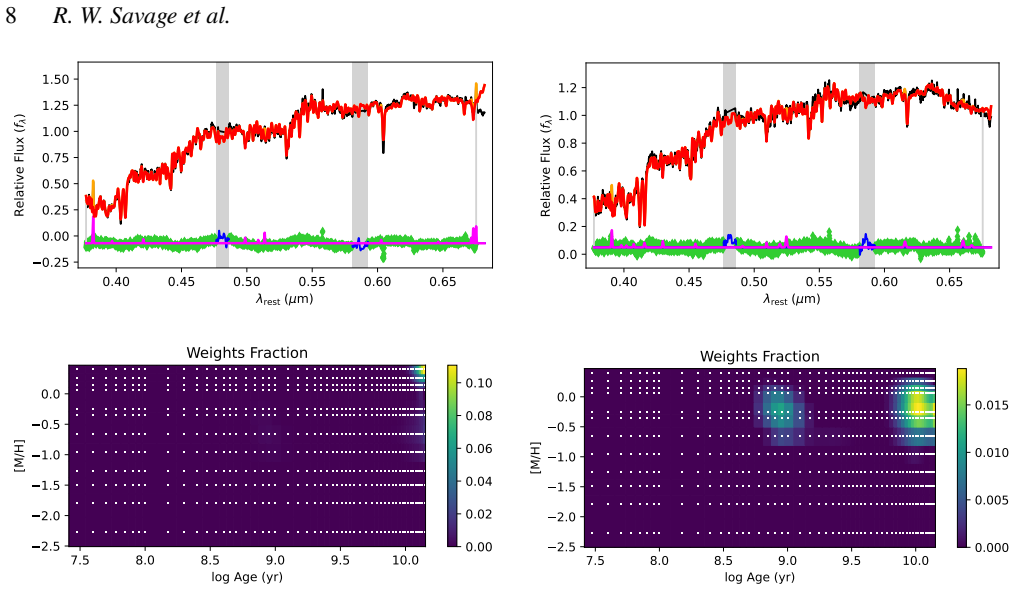
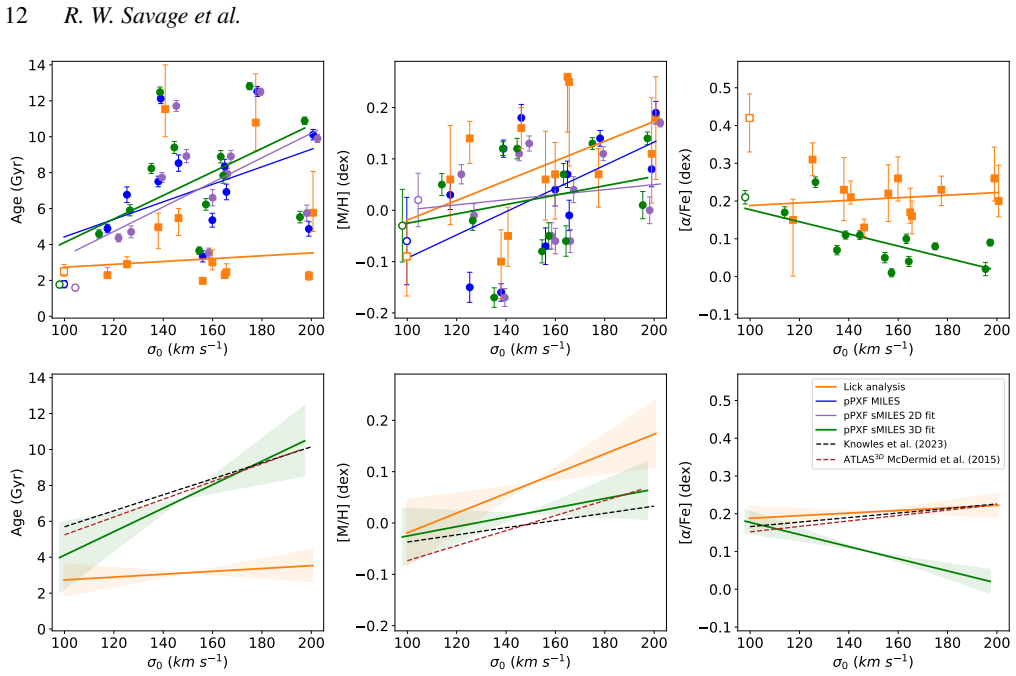
Twelve of fifteen dusty early-type galaxies display young or intermediate-age stellar population components indicating ongoing or recent star formation. These approximately 1 Gyr populations are verified as real through simulations rather than fitting artifacts. The sample galaxies are mostly rotationally supported without detectable kinematic discontinuities. Stacked SDSS spectra confirm the presence of intermediate-age components only in dusty ETGs and not in non-dusty counterparts. Age, metallicity, and alpha-element abundance ratios increase with central velocity dispersion, though with larger scatter than in prior ETG studies.
What carries the argument
Full spectrum fitting and Lick index fitting using the sMILES and MILES stellar population libraries applied to long-slit spectra to extract ages, metallicities, alpha abundances, and kinematics within the effective radius.
If this is right
- Recent star formation may supply or result from the observed high dust and molecular gas content through internal processes or external accretion.
- Kinematic continuity implies that any dust-acquiring events did not strongly disrupt the rotational support of these galaxies.
- The increased scatter in age-metallicity-velocity dispersion relations may reflect the influence of recent star formation episodes mixed with older populations.
- Formation models must account for both dust retention and the observed young stellar components to explain the properties of these ETGs.
Where Pith is reading between the lines
- Dust levels could be used as a selection criterion to identify ETGs with recent star formation in larger surveys.
- Multi-wavelength data might help isolate dust reddening effects from true age signals in future analyses.
- Comparing these findings to simulations of galaxy mergers or gas inflows could test specific dust origin scenarios.
Load-bearing premise
That full spectrum fitting and Lick index methods with sMILES and MILES libraries can reliably separate young stellar components from older populations despite the presence of dust and without significant systematic biases in the selected sample.
What would settle it
Independent age dating of a larger sample of dusty ETGs using UV photometry or resolved stellar populations that finds no young components in most cases.
Figures




read the original abstract
Dust in Early-Type galaxies (ETGs) may originate from internal or external sources. In this paper we study the stellar populations of particularly dusty ETGs to search for evidence of the dust's origin. Using the Southern African Large Telescope (SALT), we obtained long-slit optical spectra within the effective radius (R_e), along the major axis of 15 nearby ETGs, selected from the GAMA and Herschel-ATLAS surveys for their high levels of interstellar dust. Using full spectrum fitting and Lick index fitting we analysed their major axis kinematics and stellar population characteristics. We used stellar population models from the newly developed sMILES library and from the empirical MILES library. Kinematic results show that most of our sample of dusty ETGs are rotationally supported and there are no detectable kinematic discontinuities. 12 of our sample of 15 dusty ETGs show evidence of young/intermediate age stellar population components suggesting ongoing/recent star formation. Using simulations, we show that these recent ($\approx$1~Gyr) populations are not artefacts of the fitting process or data. As a check with a control sample we use stacked SDSS spectra and find that dusty ETGs show a component with intermediate age, whereas non-dusty ETGs do not. Age, metallicity and $\alpha$-element abundance ratio increase with increasing central velocity dispersion in the SALT spectra, as seen in previous studies of ETGs, but with larger scatter in our sample. Given our stellar population findings, we discuss formation scenarios that might cause or rule out a high dust/molecular gas content.
Editorial analysis
A structured set of objections, weighed in public.
Referee Report
Summary. The manuscript presents long-slit optical spectra of 15 nearby dusty ETGs selected from GAMA and Herschel-ATLAS, observed with SALT along the major axis within R_e. Full-spectrum fitting with the sMILES library and Lick-index analysis with MILES are used to derive kinematics and stellar population parameters (age, metallicity, alpha-enhancement). The central result is that 12/15 galaxies exhibit young-to-intermediate age (~1 Gyr) components, interpreted as evidence of recent star formation; simulations are cited to rule out fitting artefacts, a stacked SDSS control sample shows intermediate-age populations only in dusty ETGs, and scaling relations with central velocity dispersion follow literature trends but exhibit larger scatter.
Significance. If the young stellar components are robustly separated from dust effects, the result would constrain dust origins in ETGs (internal from recent SF versus external) and support formation scenarios involving gas accretion or minor mergers. Credit is due for the use of the new sMILES library, the inclusion of simulations to test fitting artefacts, the independent SDSS control sample, and the kinematic continuity check. The larger scatter in scaling relations, if quantified, could also highlight sample-specific effects.
major comments (2)
- [Spectral fitting and stellar population analysis] Spectral fitting procedure: the description does not specify whether dust attenuation (e.g., a Calzetti screen or similar) is included as a free parameter fitted simultaneously with the stellar templates or applied only post-hoc. This is load-bearing for the headline claim, because differential reddening along the slit can steepen the continuum and mimic a young population while leaving metal lines relatively unchanged—the exact degeneracy the simulations are intended to address.
- [Simulations validating young populations] Validation simulations: although the abstract states that simulations demonstrate the ~1 Gyr populations are not artefacts of the fitting process or data, no details are given on the simulation design (e.g., whether realistic dust geometries, attenuation curves, or the precise age-metallicity-extinction grid used in the real fits are included). Without this, it is not possible to confirm that the simulations adequately test the dust-age separation central to the result.
minor comments (3)
- [Scaling relations with velocity dispersion] The statement that scaling relations show 'larger scatter' is not supported by any quantitative metric (rms, standard deviation, or statistical comparison to literature samples) or reference to a specific table or figure.
- [SDSS control sample] The control-sample comparison would benefit from explicit details on how the SDSS stacks were constructed (mass matching, dust selection criteria, number of galaxies per stack) to allow assessment of whether the absence of intermediate-age components in non-dusty ETGs is statistically robust.
- [Abstract] Minor typographical inconsistencies appear in the abstract (e.g., inconsistent use of '≈1 Gyr' versus 'recent (≈1 Gyr) populations') and should be harmonized with the main text.
Simulated Author's Rebuttal
We thank the referee for their careful and constructive review of our manuscript. We address the two major comments below and will revise the paper to provide the requested clarifications and details.
read point-by-point responses
-
Referee: [Spectral fitting and stellar population analysis] Spectral fitting procedure: the description does not specify whether dust attenuation (e.g., a Calzetti screen or similar) is included as a free parameter fitted simultaneously with the stellar templates or applied only post-hoc. This is load-bearing for the headline claim, because differential reddening along the slit can steepen the continuum and mimic a young population while leaving metal lines relatively unchanged—the exact degeneracy the simulations are intended to address.
Authors: We agree that the manuscript does not provide a sufficiently explicit description of how dust attenuation is treated during the full-spectrum fitting with the sMILES library. We will revise the methods section to state clearly whether dust attenuation was included as a free parameter in the fits or handled separately (e.g., post-hoc or via the Lick-index analysis), and we will add a discussion of the implications for continuum shape and the age-dust degeneracy. This will directly address the concern and strengthen the interpretation of the young stellar components. revision: yes
-
Referee: [Simulations validating young populations] Validation simulations: although the abstract states that simulations demonstrate the ~1 Gyr populations are not artefacts of the fitting process or data, no details are given on the simulation design (e.g., whether realistic dust geometries, attenuation curves, or the precise age-metallicity-extinction grid used in the real fits are included). Without this, it is not possible to confirm that the simulations adequately test the dust-age separation central to the result.
Authors: We accept that the current description of the validation simulations lacks the necessary detail on their design. We will expand the relevant section (and any associated appendix) to fully specify the simulation setup, including the age-metallicity grid, noise model, whether dust attenuation curves or geometries were incorporated, and how the mock spectra were fitted using the same procedure as the real data. These additions will allow readers to evaluate the robustness of the ~1 Gyr population detections against fitting artefacts and dust-related degeneracies. revision: yes
Circularity Check
No significant circularity; results from external model fits and control sample
full rationale
The paper derives its central claim (young/intermediate-age components in 12/15 dusty ETGs) from direct long-slit spectra fitted via full-spectrum and Lick-index methods to independent external libraries (sMILES and MILES). Simulations serve as an independent validation against artefacts, while the SDSS stacked control sample provides external contrast showing the intermediate-age component is absent in non-dusty ETGs. Kinematic continuity and velocity-dispersion trends are reported as observed patterns without reduction to self-defined quantities. No self-citations, ansatzes, or fitted inputs are invoked as load-bearing for the result; the derivation chain remains self-contained against external benchmarks.
Axiom & Free-Parameter Ledger
free parameters (1)
- multiple age and metallicity components in spectral fitting
axioms (2)
- domain assumption sMILES and MILES stellar population libraries provide unbiased representations of the spectra of dusty ETGs
- domain assumption Dust extinction does not systematically bias the detection of young stellar components in the fitting process
Lean theorems connected to this paper
-
IndisputableMonolith/Cost/FunctionalEquation.leanwashburn_uniqueness_aczel unclear?
unclearRelation between the paper passage and the cited Recognition theorem.
Using full spectrum fitting and Lick index fitting we analysed their major axis kinematics and stellar population characteristics. We used stellar population models from the newly developed sMILES library and from the empirical MILES library.
-
IndisputableMonolith/Foundation/AbsoluteFloorClosure.leanabsolute_floor_iff_bare_distinguishability unclear?
unclearRelation between the paper passage and the cited Recognition theorem.
12 of our sample of 15 dusty ETGs show evidence of young/intermediate age stellar population components suggesting ongoing/recent star formation.
What do these tags mean?
- matches
- The paper's claim is directly supported by a theorem in the formal canon.
- supports
- The theorem supports part of the paper's argument, but the paper may add assumptions or extra steps.
- extends
- The paper goes beyond the formal theorem; the theorem is a base layer rather than the whole result.
- uses
- The paper appears to rely on the theorem as machinery.
- contradicts
- The paper's claim conflicts with a theorem or certificate in the canon.
- unclear
- Pith found a possible connection, but the passage is too broad, indirect, or ambiguous to say the theorem truly supports the claim.
Reference graph
Works this paper leans on
-
[1]
write newline
" write newline "" before.all 'output.state := FUNCTION fin.entry write newline FUNCTION new.block output.state before.all = 'skip after.block 'output.state := if FUNCTION new.sentence output.state after.block = 'skip output.state before.all = 'skip after.sentence 'output.state := if if FUNCTION not #0 #1 if FUNCTION and 'skip pop #0 if FUNCTION or pop #1...
-
[2]
Agius N. K., et al., 2013, @doi [ ] 10.1093/mnras/stt310 , https://ui.adsabs.harvard.edu/abs/2013MNRAS.431.1929A 431, 1929
-
[3]
Agius N. K., et al., 2015, @doi [ ] 10.1093/mnras/stv1191 , https://ui.adsabs.harvard.edu/abs/2015MNRAS.451.3815A 451, 3815
-
[4]
Bassett R., et al., 2017, @doi [ ] 10.1093/mnras/stx1000 , https://ui.adsabs.harvard.edu/abs/2017MNRAS.470.1991B 470, 1991
-
[5]
Boardman N. F., et al., 2017, @doi [ ] 10.1093/mnras/stx1835 , https://ui.adsabs.harvard.edu/abs/2017MNRAS.471.4005B 471, 4005
-
[6]
Bournaud F., Jog C. J., Combes F., 2005, @doi [ ] 10.1051/0004-6361:20042036 , https://ui.adsabs.harvard.edu/abs/2005A&A...437...69B 437, 69
-
[7]
Bournaud F., Jog C. J., Combes F., 2007, @doi [ ] 10.1051/0004-6361:20078010 , https://ui.adsabs.harvard.edu/abs/2007A&A...476.1179B 476, 1179
-
[8]
Buckley D. A. H., Swart G. P., Meiring J. G., 2006, in Stepp L. M., ed., Society of Photo-Optical Instrumentation Engineers (SPIE) Conference Series Vol. 6267, Society of Photo-Optical Instrumentation Engineers (SPIE) Conference Series. p. 62670Z, @doi 10.1117/12.673750
-
[9]
Buckley D. A. H., et al., 2008, in McLean I. S., Casali M. M., eds, Society of Photo-Optical Instrumentation Engineers (SPIE) Conference Series Vol. 7014, Ground-based and Airborne Instrumentation for Astronomy II. p. 701407, @doi 10.1117/12.789438
-
[10]
Bundy K., et al., 2015, @doi [ ] 10.1088/0004-637X/798/1/7 , https://ui.adsabs.harvard.edu/abs/2015ApJ...798....7B 798, 7
-
[11]
Burgh E. B., Nordsieck K. H., Kobulnicky H. A., Williams T. B., O'Donoghue D., Smith M. P., Percival J. W., 2003, in Iye M., Moorwood A. F. M., eds, Society of Photo-Optical Instrumentation Engineers (SPIE) Conference Series Vol. 4841, Instrument Design and Performance for Optical/Infrared Ground-based Telescopes. pp 1463--1471, @doi 10.1117/12.460312
-
[12]
Burkert A., Naab T., 2003, Major Mergers and the Origin of Elliptical Galaxies. Springer Berlin Heidelberg, Berlin, Heidelberg, pp 327--339, @doi 10.1007/978-3-540-45040-5_27 , https://doi.org/10.1007/978-3-540-45040-5_27
-
[13]
Cappellari M., 2016, @doi [ ] 10.1146/annurev-astro-082214-122432 , https://ui.adsabs.harvard.edu/abs/2016ARA&A..54..597C 54, 597
-
[14]
Cappellari M., 2017, @doi [ ] 10.1093/mnras/stw3020 , https://ui.adsabs.harvard.edu/abs/2017MNRAS.466..798C 466, 798
work page internal anchor Pith review doi:10.1093/mnras/stw3020 2017
-
[15]
Cappellari M., 2023, @doi [ ] 10.1093/mnras/stad2597 , https://ui.adsabs.harvard.edu/abs/2023MNRAS.526.3273C 526, 3273
-
[16]
Cappellari M., Emsellem E., 2004, @doi [ ] 10.1086/381875 , https://ui.adsabs.harvard.edu/abs/2004PASP..116..138C 116, 138
-
[17]
Cappellari M., et al., 2011, @doi [ ] 10.1111/j.1365-2966.2010.18174.x , https://ui.adsabs.harvard.edu/abs/2011MNRAS.413..813C 413, 813
-
[18]
Catala L., et al., 2013, @doi [ ] 10.1093/mnras/stt1602 , https://ui.adsabs.harvard.edu/abs/2013MNRAS.436..590C 436, 590
-
[19]
doi:10.1111/j.1365-2966.2009.15598.x , archivePrefix =
Cid Fernandes R., Stasi \'n ska G., Schlickmann M. S., Mateus A., Vale Asari N., Schoenell W., Sodr \'e L., 2010, @doi [ ] 10.1111/j.1365-2966.2009.16185.x , https://ui.adsabs.harvard.edu/abs/2010MNRAS.403.1036C 403, 1036
-
[20]
Cid Fernandes R., Stasi \'n ska G., Mateus A., Vale Asari N., 2011, @doi [ ] 10.1111/j.1365-2966.2011.18244.x , https://ui.adsabs.harvard.edu/abs/2011MNRAS.413.1687C 413, 1687
-
[21]
Clemens M. S., et al., 2010, @doi [ ] 10.1051/0004-6361/201014533 , https://ui.adsabs.harvard.edu/abs/2010A&A...518L..50C 518, L50
-
[22]
Conroy C., 2013, @doi [ ] 10.1146/annurev-astro-082812-141017 , https://ui.adsabs.harvard.edu/abs/2013ARA&A..51..393C 51, 393
work page Pith review doi:10.1146/annurev-astro-082812-141017 2013
-
[23]
Conroy C., Graves G. J., van Dokkum P. G., 2014, @doi [ ] 10.1088/0004-637X/780/1/33 , https://ui.adsabs.harvard.edu/abs/2014ApJ...780...33C 780, 33
-
[24]
Conselice C. J., 2014, @doi [ ] 10.1146/annurev-astro-081913-040037 , https://ui.adsabs.harvard.edu/abs/2014ARA&A..52..291C 52, 291
-
[25]
Cortese L., et al., 2012, @doi [ ] 10.1051/0004-6361/201118499 , https://ui.adsabs.harvard.edu/abs/2012A&A...540A..52C 540, A52
-
[26]
7737, Observatory Operations: Strategies, Processes, and Systems III, ed
Crawford S. M., et al., 2010, in Silva D. R., Peck A. B., Soifer B. T., eds, Society of Photo-Optical Instrumentation Engineers (SPIE) Conference Series Vol. 7737, Observatory Operations: Strategies, Processes, and Systems III. p. 773725, @doi 10.1117/12.857000
-
[27]
The Merger Rates and Mass Assembly Histories of Dark Matter Haloes in the Two
Crocker A. F., Bureau M., Young L. M., Combes F., 2011, @doi [ ] 10.1111/j.1365-2966.2010.17537.x , https://ui.adsabs.harvard.edu/abs/2011MNRAS.410.1197C 410, 1197
-
[28]
I., Nersesian, A., Baes, M., et al
Davies J. I., et al., 2019, @doi [ ] 10.1051/0004-6361/201935547 , https://ui.adsabs.harvard.edu/abs/2019A&A...626A..63D 626, A63
-
[29]
, archivePrefix = "arXiv", eprint =
Davis T. A., et al., 2011, @doi [ ] 10.1111/j.1365-2966.2011.19355.x , https://ui.adsabs.harvard.edu/abs/2011MNRAS.417..882D 417, 882
-
[30]
A., et al., 2015, , 449, 3503
Davis T. A., et al., 2015, , 449, 3503
2015
-
[31]
Draine B. T., Salpeter E. E., 1979, @doi [ ] 10.1086/157206 , https://ui.adsabs.harvard.edu/abs/1979ApJ...231..438D 231, 438
-
[32]
Driver S. P., et al., 2009, @doi [Astronomy and Geophysics] 10.1111/j.1468-4004.2009.50512.x , https://ui.adsabs.harvard.edu/abs/2009A&G....50e..12D 50, 5.12
-
[33]
Driver S. P., et al., 2022, @doi [ ] 10.1093/mnras/stac472 , https://ui.adsabs.harvard.edu/abs/2022MNRAS.513..439D 513, 439
-
[34]
Eales S., et al., 2010, @doi [ ] 10.1086/653086 , https://ui.adsabs.harvard.edu/abs/2010PASP..122..499E 122, 499
-
[35]
Eales S., et al., 2015, @doi [ ] 10.1093/mnras/stv1300 , https://ui.adsabs.harvard.edu/abs/2015MNRAS.452.3489E 452, 3489
-
[36]
Falc \'o n-Barroso J., S \'a nchez-Bl \'a zquez P., Vazdekis A., Ricciardelli E., Cardiel N., Cenarro A. J., Gorgas J., Peletier R. F., 2011, @doi [ ] 10.1051/0004-6361/201116842 , https://ui.adsabs.harvard.edu/abs/2011A&A...532A..95F 532, A95
-
[37]
Ferreras I., et al., 2019, @doi [ ] 10.1093/mnras/stz2095 , https://ui.adsabs.harvard.edu/abs/2019MNRAS.489..608F 489, 608
-
[38]
French K. D., et al., 2023, @doi [ ] 10.3847/1538-4357/aca46e , https://ui.adsabs.harvard.edu/abs/2023ApJ...942...25F 942, 25
-
[39]
Gallazzi A., Charlot S., Brinchmann J., White S. D. M., 2006, @doi [ ] 10.1111/j.1365-2966.2006.10548.x , https://ui.adsabs.harvard.edu/abs/2006MNRAS.370.1106G 370, 1106
-
[40]
Ge J., Yan R., Cappellari M., Mao S., Li H., Lu Y., 2018, @doi [ ] 10.1093/mnras/sty1245 , https://ui.adsabs.harvard.edu/abs/2018MNRAS.478.2633G 478, 2633
-
[41]
Glass D. H. W., 2024, Ph D thesis, University of Central Lancashire, Preston, UK, http://doi.org/10.17030/uclan.thesis.00042515
-
[42]
Glass D. H. W., Sansom A. E., Davis T. A., Popescu C. C., 2022, @doi [ ] 10.1093/mnras/stac3001 , https://ui.adsabs.harvard.edu/abs/2022MNRAS.517.5524G 517, 5524
-
[43]
Spatially resolved stellar population properties in galaxies
Gonz \'a lez Delgado R. M., et al., 2015, @doi [ ] 10.1051/0004-6361/201525938 , https://ui.adsabs.harvard.edu/abs/2015A&A...581A.103G 581, A103
-
[44]
Goudfrooij P., de Jong T., 1995, @doi [ ] 10.48550/arXiv.astro-ph/9504011 , https://ui.adsabs.harvard.edu/abs/1995A&A...298..784G 298, 784
-
[45]
Griffith E., Martini P., Conroy C., 2019, @doi [ ] 10.1093/mnras/sty3405 , https://ui.adsabs.harvard.edu/abs/2019MNRAS.484..562G 484, 562
-
[46]
Holwerda B. W., et al., 2024, @doi [ ] 10.1017/pasa.2024.109 , https://ui.adsabs.harvard.edu/abs/2024PASA...41..115H 41, e115
-
[47]
Jegatheesan K., Johnston E. J., H \"a u ler B., Nedkova K. V., 2024, @doi [ ] 10.1051/0004-6361/202347372 , https://ui.adsabs.harvard.edu/abs/2024A&A...684A..32J 684, A32
-
[48]
Jegatheesan K., Johnston E. J., H \"a u ler B., Lassen A. E., Riffel R., Chies-Santos A. L., 2025, @doi [ ] 10.1051/0004-6361/202452137 , https://ui.adsabs.harvard.edu/abs/2025A&A...694A.224J 694, A224
-
[49]
Johansson J., Thomas D., Maraston C., 2012, @doi [ ] 10.1111/j.1365-2966.2011.20316.x , https://ui.adsabs.harvard.edu/abs/2012MNRAS.421.1908J 421, 1908
-
[50]
Johnston E. J., et al., 2022, @doi [Monthly Notices of the Royal Astronomical Society] 10.1093/mnras/stac1447 , 514, 6141
-
[51]
Katkov I. Y., Kniazev A. Y., Sil'chenko O. K., 2015, @doi [ ] 10.1088/0004-6256/150/1/24 , https://ui.adsabs.harvard.edu/abs/2015AJ....150...24K 150, 24
-
[52]
Katkov I. Y., Kniazev A. Y., Kasparova A. V., Sil'chenko O. K., 2019, @doi [ ] 10.1093/mnras/sty3268 , https://ui.adsabs.harvard.edu/abs/2019MNRAS.483.2413K 483, 2413
-
[53]
Kaviraj S., et al., 2012, @doi [ ] 10.1111/j.1365-2966.2012.20957.x , https://ui.adsabs.harvard.edu/abs/2012MNRAS.423...49K 423, 49
-
[54]
, archivePrefix = "arXiv", eprint =
Kelvin L. S., et al., 2014, @doi [ ] 10.1093/mnras/stu1507 , https://ui.adsabs.harvard.edu/abs/2014MNRAS.444.1647K 444, 1647
-
[55]
Knowles A. T., Sansom A. E., Allende Prieto C., Vazdekis A., 2021, @doi [ ] 10.1093/mnras/stab1001 , https://ui.adsabs.harvard.edu/abs/2021MNRAS.504.2286K 504, 2286
-
[56]
Knowles A. T., Sansom A. E., Vazdekis A., Allende Prieto C., 2023, @doi [ ] 10.1093/mnras/stad1647 , https://ui.adsabs.harvard.edu/abs/2023MNRAS.523.3450K 523, 3450
-
[57]
Kokusho T., Kaneda H., Bureau M., Suzuki T., Murata K., Kondo A., Yamagishi M., 2017, @doi [ ] 10.1051/0004-6361/201630158 , https://ui.adsabs.harvard.edu/abs/2017A&A...605A..74K 605, A74
-
[58]
Kokusho T., et al., 2019, @doi [ ] 10.1051/0004-6361/201833911 , https://ui.adsabs.harvard.edu/abs/2019A&A...622A..87K 622, A87
-
[59]
Kuntschner H., et al., 2010, @doi [ ] 10.1111/j.1365-2966.2010.17161.x , https://ui.adsabs.harvard.edu/abs/2010MNRAS.408...97K 408, 97
-
[60]
La Barbera F., Ferreras I., Vazdekis A., de la Rosa I. G., de Carvalho R. R., Trevisan M., Falc \'o n-Barroso J., Ricciardelli E., 2013, @doi [ ] 10.1093/mnras/stt943 , https://ui.adsabs.harvard.edu/abs/2013MNRAS.433.3017L 433, 3017
-
[61]
La Barbera F., Pasquali A., Ferreras I., Gallazzi A., de Carvalho R. R., de la Rosa I. G., 2014, @doi [ ] 10.1093/mnras/stu1626 , https://ui.adsabs.harvard.edu/abs/2014MNRAS.445.1977L 445, 1977
-
[62]
La Barbera F., Ferreras I., Vazdekis A., 2015, @doi [ ] 10.1093/mnrasl/slv029 , https://ui.adsabs.harvard.edu/abs/2015MNRAS.449L.137L 449, L137
-
[63]
Lee Y. H., Hwang H. S., Hwang N., Lee J. C., Kim K.-B., 2023, @doi [ ] 10.3847/1538-4357/ace1ea , https://ui.adsabs.harvard.edu/abs/2023ApJ...953...88L 953, 88
-
[64]
Le \'s niewska A., Micha owski M. J., Gall C., Hjorth J., Nadolny J., Ryzhov O., Solar M., 2023, @doi [ ] 10.3847/1538-4357/acdcfc , https://ui.adsabs.harvard.edu/abs/2023ApJ...953...27L 953, 27
-
[65]
Liske J., et al., 2015, @doi [ ] 10.1093/mnras/stv1436 , https://ui.adsabs.harvard.edu/abs/2015MNRAS.452.2087L 452, 2087
-
[66]
Liu Y., 2020, @doi [ ] 10.1093/mnras/staa2012 , https://ui.adsabs.harvard.edu/abs/2020MNRAS.497.3011L 497, 3011
-
[67]
W., Zirm A
Man A. W., Zirm A. W., Toft S., 2016, , 830, 89
2016
-
[68]
Martin G., Kaviraj S., Devriendt J. E. G., Dubois Y., Pichon C., 2018, @doi [ ] 10.1093/mnras/sty1936 , https://ui.adsabs.harvard.edu/abs/2018MNRAS.480.2266M 480, 2266
-
[69]
Martini P., Dicken D., Storchi-Bergmann T., 2013, @doi [ ] 10.1088/0004-637X/766/2/121 , https://ui.adsabs.harvard.edu/abs/2013ApJ...766..121M 766, 121
-
[70]
McDermid R. M., et al., 2015, @doi [ ] 10.1093/mnras/stv105 , https://ui.adsabs.harvard.edu/abs/2015MNRAS.448.3484M 448, 3484
-
[71]
Micha owski M. J., et al., 2019, @doi [ ] 10.1051/0004-6361/201936055 , https://ui.adsabs.harvard.edu/abs/2019A&A...632A..43M 632, A43
-
[72]
Micha owski M. J., et al., 2024, @doi [ ] 10.3847/1538-4357/ad1b52 , https://ui.adsabs.harvard.edu/abs/2024ApJ...964..129M 964, 129
-
[73]
J., Driver S
Moffett A. J., Driver S. P., Lange R., Robotham A., Kelvin L., GAMA Team 2016, in American Astronomical Society Meeting Abstracts \#227. p. 408.01
2016
-
[74]
Pernet E., Boecker A., Mart \' n-Navarro I., 2024, @doi [ ] 10.1051/0004-6361/202449308 , https://ui.adsabs.harvard.edu/abs/2024A&A...687L..14P 687, L14
-
[75]
Porter-Temple R., et al., 2022, @doi [ ] 10.1093/mnras/stac1936 , https://ui.adsabs.harvard.edu/abs/2022MNRAS.515.3875P 515, 3875
-
[76]
H., Teukolsky S
Press W. H., Teukolsky S. A., Vetterling W. T., Flannery B. P., 1992, Numerical recipes in FORTRAN. The art of scientific computing . Cambridge University Press
1992
-
[77]
Robotham A. S. G., et al., 2011, @doi [ ] 10.1111/j.1365-2966.2011.19217.x , https://ui.adsabs.harvard.edu/abs/2011MNRAS.416.2640R 416, 2640
-
[78]
Rowlands K., et al., 2012, @doi [ ] 10.1111/j.1365-2966.2011.19905.x , https://ui.adsabs.harvard.edu/abs/2012MNRAS.419.2545R 419, 2545
-
[79]
Saintonge A., et al., 2016, @doi [ ] 10.1093/mnras/stw1715 , https://ui.adsabs.harvard.edu/abs/2016MNRAS.462.1749S 462, 1749
-
[80]
Sansom A. E., et al., 2019, @doi [ ] 10.1093/mnras/sty3021 , https://ui.adsabs.harvard.edu/abs/2019MNRAS.482.4617S 482, 4617
discussion (0)
Sign in with ORCID, Apple, or X to comment. Anyone can read and Pith papers without signing in.