Recognition: no theorem link
Terahertz and Optical Acceleration Techniques
Pith reviewed 2026-05-10 18:52 UTC · model grok-4.3
The pith
Terahertz and optical radiation have advanced enough over the last decade to enable practical devices for electron acceleration and bunch manipulation.
A machine-rendered reading of the paper's core claim, the machinery that carries it, and where it could break.
Core claim
The use of terahertz (THz) and optical radiation for electron acceleration and manipulation of electron bunches has progressed over the last decade to a level where practical devices for THz guns, THz and optical acceleration modules and a wide range of beam manipulations have become possible. The advantages of using shorter wavelength radiation for acceleration are in overcoming breakdown phenomena, therefore enabling higher acceleration gradients than in conventional RF-accelerators albeit with lower bunch charge. The lower pulse energies needed to power the smaller cross section of the accelerating structures is also advantageous. In addition, the shorter wavelengths enable tighter timing
What carries the argument
Shorter-wavelength THz and optical radiation used to drive compact dielectric accelerating structures, enabling higher gradients with lower pulse energies.
Where Pith is reading between the lines
- These compact devices could reduce the overall size and cost of accelerator facilities for targeted research applications.
- The emphasis on low bunch charge may orient the technology toward precision experiments rather than high-intensity beams.
- Successful scaling would likely depend on continued advances in laser timing stability to support cascaded stages.
Load-bearing premise
The advantages of shorter wavelengths in overcoming breakdown, achieving higher gradients, and providing tighter timing will hold in scalable practical devices without being limited by bunch charge or synchronization demands.
What would settle it
An experiment demonstrating that multi-stage THz or optical accelerators fail to deliver net energy gains beyond single-stage performance due to timing jitter or achievable bunch charge limits would falsify the practicality of these devices.
Figures


read the original abstract
The use of terahertz (THz) and optical radiation for electron acceleration and manipulation of electron bunches has progressed over the last decade to a level where practical devices for THz guns, THz and optical acceleration modules and a wide range of beam manipulations have become possible. Here, we discuss recent progress in optical driven Terahertz generation and its use in charged particle acceleration and beam manipulation devices. The advantages of using shorter wavelength radiation for acceleration are in overcoming breakdown phenomena, therefore enabling higher acceleration gradients than in conventional RF-accelerators albeit with lower bunch charge. The lower pulse energies needed to power the smaller cross section of the accelerating structures is also advantageous. In addition, the shorter wavelengths enable tighter timing control of the generated electron bunches but in return also need more precise timing when multiple stage interactions are required. Early results on THz guns, beam manipulation devices and accelerator structures are discussed as well as basic working principles of dielectric laser accelerators.
Editorial analysis
A structured set of objections, weighed in public.
Referee Report
Summary. The manuscript reviews progress over the last decade in using terahertz (THz) and optical radiation for electron acceleration and bunch manipulation. It asserts that these techniques have now reached a level where practical devices—including THz guns, THz/optical acceleration modules, and various beam-manipulation structures—are feasible. Advantages of shorter wavelengths (higher gradients by overcoming breakdown, lower required pulse energies, tighter timing) are discussed alongside the corresponding requirement for precise synchronization in multi-stage systems; early experimental results on THz guns, dielectric laser accelerators, and related structures are summarized along with basic operating principles.
Significance. If the practicality assessment holds, the work is significant for accelerator physics as it consolidates a promising route to compact, high-gradient devices that could enable new applications where conventional RF technology is limited by size or gradient. The review usefully highlights both the benefits and the synchronization challenges of shorter-wavelength approaches, providing a consolidated reference for the field.
major comments (1)
- [Abstract] Abstract (opening claim): the assertion that 'practical devices for THz guns, THz and optical acceleration modules and a wide range of beam manipulations have become possible' is not supported by any scaling analysis or data addressing bunch charge. Early results cited operate at fC-level charges where space-charge and wakefield limits are minimal; no section quantifies how the stated advantages (gradient, pulse energy, timing) survive at pC charges relevant to applications, which is load-bearing for the central practicality claim.
Simulated Author's Rebuttal
We thank the referee for the careful and constructive review of our manuscript. We address the major comment below.
read point-by-point responses
-
Referee: [Abstract] Abstract (opening claim): the assertion that 'practical devices for THz guns, THz and optical acceleration modules and a wide range of beam manipulations have become possible' is not supported by any scaling analysis or data addressing bunch charge. Early results cited operate at fC-level charges where space-charge and wakefield limits are minimal; no section quantifies how the stated advantages (gradient, pulse energy, timing) survive at pC charges relevant to applications, which is load-bearing for the central practicality claim.
Authors: We agree that the abstract's practicality claim would benefit from greater precision on bunch charge. The manuscript already notes the trade-off of 'albeit with lower bunch charge' when discussing advantages of shorter wavelengths, and the review summarizes early experimental demonstrations that operate at fC charges. However, the referee is correct that no explicit scaling analysis for pC charges (including space-charge and wakefield limits) is provided. We will revise the abstract to qualify the claim as applying to emerging practical devices for low-charge applications, and add a concise paragraph in the introduction discussing the challenges of scaling to higher charges. This will better contextualize the current state of the field without overstating demonstrated capabilities. revision: yes
Circularity Check
No circularity: purely descriptive review with no derivations or fitted predictions
full rationale
The manuscript is a high-level progress report on THz and optical acceleration techniques. It contains no equations, no parameter fits, no predictions derived from internal models, and no load-bearing self-citations that close a logical loop. All claims are supported by external citations to prior experimental work rather than by any internal reduction to the paper's own inputs. The central assertion that practical devices have become possible is presented as a summary of the literature, not as a derived result.
Axiom & Free-Parameter Ledger
Reference graph
Works this paper leans on
-
[1]
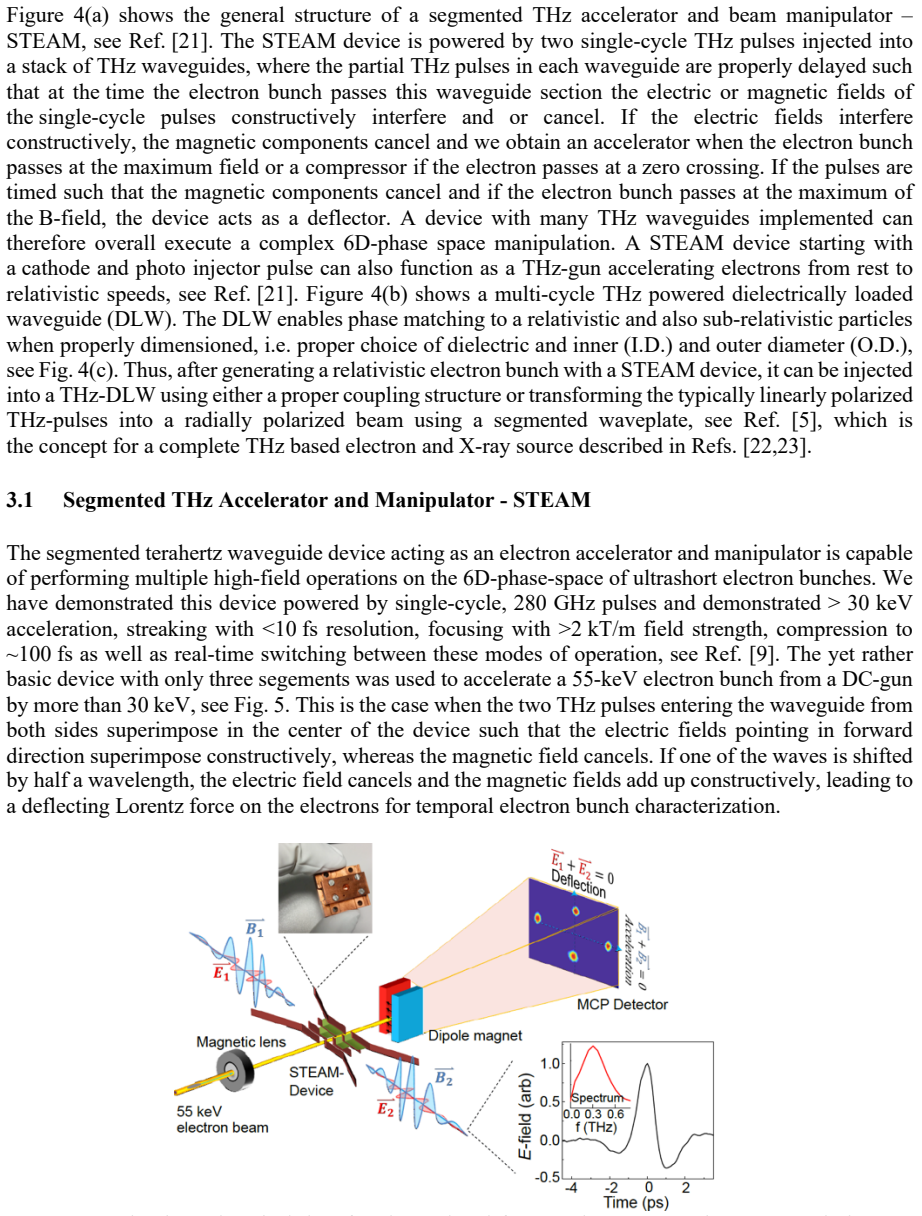
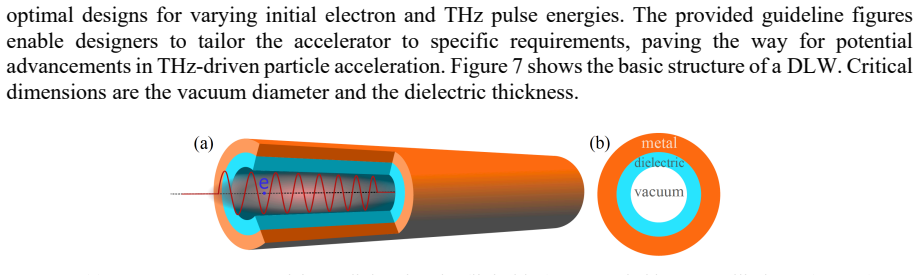
CERN Accelerator School Proceedings ̶ RF for Accelerators ̶ Berlin, Germany, 2023 Available online at https://cas.web.cern.ch/previous-schools 1 Terahertz and Optical Acceleration Techniques Franz X. Kärtner Center for Free-Electron Laser Science – CFEL, Deutsches Elektronen-Synchrotron – DESY, Hamburg, Germany Abstract The use of terahertz (THz) and opti...
2023
-
[2]
Frontiers in Attosecond x-ray Science: Imaging and Spectroscopy
APF-DLAs are designed to act as alternating phase focusing lattices, where electrons, depending on the electron-laser interaction phase, will alternate between opposing longitudinal and transverse focusing and defocusing forces. By incorporating fractional period drift sections that alter the synchronous phase between ±60∘ off crest, electrons captured in...
2007
-
[3]
Criterion for vacuum sparking designed to include both rf and dc,
W. Kilpatrick, “Criterion for vacuum sparking designed to include both rf and dc,” Review of Scientific Instruments 28, 824–826 (1957)
1957
-
[4]
Accelerator Science and Technology, Proceedings of the 1989 IEEE 1989, 1137–1139 (IEEE, 1989)
1989
-
[5]
Observations about RF Breakdown from the CLIC High-Gradient Testing Program,
W. Wünsch, “Observations about RF Breakdown from the CLIC High-Gradient Testing Program,” AIP Conf. Proc. 877 (2006)
2006
-
[6]
M. Dal Forno et al., “Experimental measurements of rf breakdowns and deflecting gradients in mm-wave metallic accelerating structures,” Physical Review Accelerators and Beams, vol. 19, no. 5, pp. 1–6, 2016, doi: 10.1103/PhysRevAccelBeams.19.051302
-
[7]
Terahertz-driven Linear Electron Acceleration,
E. A. Nanni, W. R. Huang, K. Ravi, A. Fallahi, G. Moriena, R. J. Miller, and F. X. Kärtner, “Terahertz-driven Linear Electron Acceleration,” Nat. Com. 6, p. 8486 (2015)
2015
-
[8]
Demonstration of electron acceleration in a laser-driven dielectric microstructure
E. A. Peralta et al., “Demonstration of electron acceleration in a laser-driven dielectric microstructure.” Nature 503, 91–94 (2013) 13
2013
-
[9]
Laser-based acceleration of nonrelativistic electrons at a dielectric structure
J. Breuer and P. Hommelhoff, “Laser-based acceleration of nonrelativistic electrons at a dielectric structure.” Physical Review Letters 111, 134803 (2013)
2013
-
[10]
Dielectric laser accelerators,
R. J. England et al., “Dielectric laser accelerators,” Reviews of Modern Physics 86, 1337 (2014)
2014
-
[11]
Segmented THz electron accelerator and manipulator (STEAM),
D. Zhang, A. Fallahi, M. Hemmer, X. Wu, M. Fakhari, Y. Hua, H. Cankaya, A.-L. Calendron, L. Zapata, N. H. Matlis, and F. X. Kärtner, “Segmented THz electron accelerator and manipulator (STEAM),” Nat. Photonics 12: (6) 336 (2018)
2018
-
[12]
Dielectric Loaded Waveguide Terahertz LINACs,
M. Vahdani, M. Fakhari, and F. X. Kaertner, “Dielectric Loaded Waveguide Terahertz LINACs,” arXiv preprint arXiv:2412.03202,
-
[13]
Hebling, G
J. Hebling, G. Almási, I.Z. Kozma, J. Kuhl, Velocity matching by pulse front tilting or large-area THz-pulse generation, Opt. Express 10, 1161–1166 (2002)
2002
-
[14]
Parameter sensitivities in tilted-pulse-front based terahertz setups and their implications for high-energy terahertz source design and optimization,
T. Kroh et al., “Parameter sensitivities in tilted-pulse-front based terahertz setups and their implications for high-energy terahertz source design and optimization,” Opt. Exp. 30:(14), pp. 24186-24206 (2022)
2022
-
[15]
T. Kroh et al., „High-Energy Single-Cycle Terahertz Sources for Compact Particle Accelerators and Manipulators,“ TUPA045, IPAC 2023, doi: https://doi.org/10.18429/JACoW-IPAC-23-TUPA045
-
[16]
Cascaded Parametric Amplification for Highly Efficient Terahertz Generation,
K. Ravi et al., “Cascaded Parametric Amplification for Highly Efficient Terahertz Generation,” Opt. Lett. 41: (16) pp 3806-3809 (2016)
2016
-
[17]
Efficient narrowband terahertz generation in cryogenically cooled periodically poled lithium niobate,
S. Carbajo et al., “Efficient narrowband terahertz generation in cryogenically cooled periodically poled lithium niobate,” Opt. Lett. 40, 5762–5765 (2015)
2015
-
[18]
Narrowband terahertz generation with chirped-and-delayed laser pulses in periodically poled lithium niobate
F. Ahr et al., “Narrowband terahertz generation with chirped-and-delayed laser pulses in periodically poled lithium niobate”, Opt. Lett. 42, 2118–2121 (2017)
2017
-
[19]
Spectral phase control of interfering chirped pulses for high-energy narrowband terahertz generation ,
S. W. Jolly, N. H. Matlis, F. Ahr, V. Leroux, T. Eichner, Al. Calendron, H. Ishizuki, T. Taira, F. X. Kärtner and A. R. Maier, “Spectral phase control of interfering chirped pulses for high-energy narrowband terahertz generation ,” Nat. Commun. 10, pp. 872-877 (2019)
2019
-
[20]
Precise parameter control of multicycle terahertz generation in PPLN using flexible pulse trains,
N.H. Matlis, Z. Zhang, U. Demirbas, C. Rentschler, K. Ravi, M. Youssef, G. Cirmi, M. Pergament, M. Edelmann, S.M. Mohamadi, S. Reuter, and F.X. Kärtner “Precise parameter control of multicycle terahertz generation in PPLN using flexible pulse trains,” Opt. Express 31:(26), 44424-44443 (2023)
2023
-
[21]
High-energy electron emission from metallic nano-tips driven by intense single-cycle terahertz pulses,
S. Li and R. R. Jones, “High-energy electron emission from metallic nano-tips driven by intense single-cycle terahertz pulses,” Nat. Com. 7, p. 13405 (2016)
2016
-
[22]
Terahertz-driven, all-optical electron gun,
W. R. Huang, et al, “Terahertz-driven, all-optical electron gun,” Optica 3, p. 1209 (2016)
2016
-
[23]
Short electron bunch generation using single-cycle ultrafast electron guns,
A. Fallahi, M. Fakhari, A. Yahaghi, M. Arrieta, and F. X. Kärtner, “Short electron bunch generation using single-cycle ultrafast electron guns,” Phys. Rev. Accelerators and Beams 19, 081302 (2016)
2016
-
[24]
F. X. Kärtner et al. AXSIS: Exploring the frontiers in attosecond X-ray science, imaging and spectroscopy, Nucl. Instrum. Methods Phys. Res. A 829, 24–29 (2016)
2016
-
[25]
Acceleration of electrons in THz driven structures for AXSIS,
N. Matlis, et al., “Acceleration of electrons in THz driven structures for AXSIS,” NIMA A 909, 27–32 (2018)
2018
-
[26]
All-optical control and metrology of electron pulses,
C. Kealhofer et al., “All-optical control and metrology of electron pulses,” Science 352, 429–433 (2016)
2016
-
[27]
THz-Enhanced DC Ultrafast Electron Diffractometer,
D. Zhang et al., “THz-Enhanced DC Ultrafast Electron Diffractometer,” Ultrafast Science (2021); https://doi.org/10.34133/2021/9848526
-
[28]
Electron source concept for single-shot sub-100 fs electron diffraction in the 100 keV range,
T. van Oudheusden et al., "Electron source concept for single-shot sub-100 fs electron diffraction in the 100 keV range," J. Appl. Phys. 102, 093501 (2007)
2007
-
[29]
Full characterization of RF compressed femtosecond electron pulses using ponderomotive scattering,
M. Gao et al., “Full characterization of RF compressed femtosecond electron pulses using ponderomotive scattering,” Opt. Express 20, 12048 (2012)
2012
-
[30]
Electron phase-space control in photonic chip-based particle acceleration,
R. Shiloh, et al., “Electron phase-space control in photonic chip-based particle acceleration,” Nature 597, 498 (2021)
2021
discussion (0)
Sign in with ORCID, Apple, or X to comment. Anyone can read and Pith papers without signing in.