Recognition: 1 theorem link
· Lean TheoremUntargeted analysis of volatile markers of post-exercise fat oxidation in exhaled breath
Pith reviewed 2026-05-10 19:00 UTC · model grok-4.3
The pith
Breath acetone signals measured at exercise end predict later fat oxidation changes with accuracy 0.89.
A machine-rendered reading of the paper's core claim, the machinery that carries it, and where it could break.
Core claim
An untargeted PTR-TOF-MS screening of exhaled breath during and after exercise found no novel volatile markers of fat oxidation. Only acetone and its isotopologues or fragments showed strong correlations with blood BOHB levels, and measurements of these signals taken at the end of exercise predicted participants with substantial post-exercise BOHB increases at F1 score at least 0.83 and accuracy 0.89.
What carries the argument
Untargeted PTR-TOF-MS screening of breath volatile organic compounds, referenced against blood beta-hydroxybutyrate as the marker of fat oxidation.
If this is right
- Acetone remains the dominant breath-based indicator of fat oxidation.
- Breath readings collected at the conclusion of exercise can forecast delayed metabolic changes without waiting hours for concentration shifts.
- Basic prediction of post-exercise fat oxidation becomes feasible from data acquired during the activity itself.
- No additional volatile markers of fat oxidation were detected in the untargeted scan.
Where Pith is reading between the lines
- Acetone-focused sensors might support real-time metabolic feedback for athletes or individuals on ketogenic diets.
- Repeating the protocol across different exercise durations or participant groups would test whether the prediction performance remains stable.
- Combining breath acetone readings with other non-invasive signals could improve tracking of fat oxidation in everyday conditions.
Load-bearing premise
Results observed in a small group of 19 participants under controlled cycling conditions will apply to other people, diets, fitness levels, and metabolic variations.
What would settle it
A larger study in which other breath compounds correlate with BOHB or in which the reported prediction accuracy falls substantially below 0.8.
Figures




read the original abstract
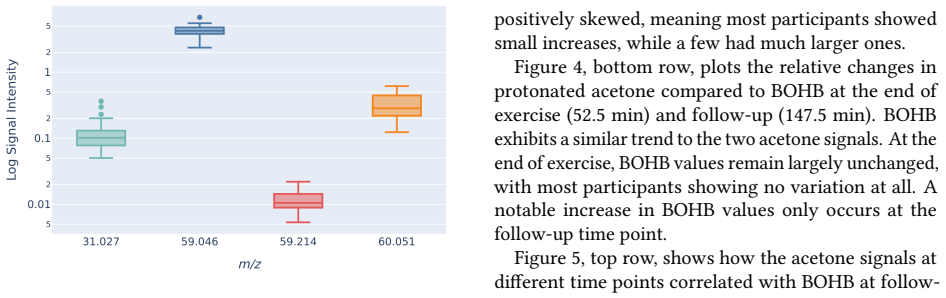
Breath acetone represents a promising non-invasive biomarker for monitoring fat oxidation during exercise. However, its utility is limited by confounding factors, as well as by the fact that significant changes in concentration occur only hours post-exercise, which makes real-time assessment difficult. We performed an untargeted screening for volatile organic compounds (VOCs) that could serve as markers of fat oxidation beyond acetone, and investigated whether breath measurements taken during exercise could predict post-exercise changes in fat oxidation. Nineteen participants completed two 25-min cycling sessions separated by a brief 5-min rest period. VOC emissions were analysed using proton-transfer-reaction time-of-flight mass spectrometry (PTR-TOF-MS) during exercise and after a 90-min recovery period. Blood $\beta$-hydroxybutyrate (BOHB) concentrations served as the reference marker for fat oxidation. Among 773 relevant analytical features detected in the PTR-TOF-MS measurements, only four signals exhibited strong correlations with BOHB ($\rho$ $\geq$ 0.82, p = 0.0002)-all attributable to acetone or its isotopologues or fragments. End-of-exercise measurements of these signals enabled accurate prediction of participants with substantial post-exercise BOHB changes (F1 score $\geq$ 0.83, accuracy = 0.89). Our study did not reveal any novel breath-based biomarkers of fat oxidation, but it confirmed acetone as the key marker. Moreover, our findings suggest that breath acetone measurements during exercise may already enable basic predictions of post-exercise fat oxidation.
Editorial analysis
A structured set of objections, weighed in public.
Referee Report
Summary. The manuscript reports results from an untargeted PTR-TOF-MS screen of exhaled breath VOCs in 19 participants performing two 25-min cycling bouts. Among 773 detected analytical features, only four (attributed to acetone and its isotopologues/fragments) showed strong Spearman correlations (ρ ≥ 0.82, p = 0.0002) with post-exercise blood β-hydroxybutyrate (BOHB) levels. End-of-exercise measurements of these signals were used to classify participants with substantial post-exercise BOHB increases, yielding F1 ≥ 0.83 and accuracy = 0.89. The authors conclude that no novel breath biomarkers of fat oxidation were identified beyond acetone and that breath acetone during exercise may enable basic prediction of post-exercise fat oxidation.
Significance. If the reported correlations and prediction metrics hold after proper validation, the work would reinforce acetone as the dominant breath marker for fat oxidation while demonstrating that end-of-exercise breath data can anticipate delayed post-exercise changes measured by an independent blood reference (BOHB). The untargeted design and direct comparison to BOHB provide empirical grounding rather than parameter-fitted derivations. However, the small cohort size limits claims of generalizability and predictive utility for non-invasive monitoring.
major comments (3)
- [Results (prediction analysis)] Results section describing the binary classifier: the F1 ≥ 0.83 and accuracy = 0.89 for predicting 'substantial' post-exercise BOHB change from end-of-exercise signals are reported without specifying the classification model, the numerical threshold used to define 'substantial' BOHB change, whether feature selection was performed on the full 773-feature set, or any cross-validation procedure. With n = 19 this leaves open the possibility that the metrics reflect resubstitution or chance rather than robust performance.
- [Methods/Results (correlation analysis)] Methods and Results (correlation screening): the claim that only four of 773 features exhibit strong correlations (ρ ≥ 0.82, p = 0.0002) with BOHB does not mention correction for multiple testing. In a screen of this size, uncorrected p-values are expected to produce false positives; the absence of Bonferroni, FDR, or permutation-based adjustment undermines the assertion that acetone signals are the sole relevant markers.
- [Methods (study design)] Methods (participant and data collection): no description is given of how diet, fitness level, baseline metabolic state, or session order were controlled, stratified, or regressed out. These factors are known to influence both breath VOCs and BOHB and could act as unmeasured confounders for both the reported correlations and the downstream classifier.
minor comments (2)
- [Abstract/Results] The abstract and results refer to 'relevant analytical features' and 'signals' without providing the exact m/z values or fragmentation patterns used to attribute the four correlated features to acetone; this attribution should be shown explicitly (e.g., in a table or supplementary figure) for reproducibility.
- [Statistical analysis] The manuscript should clarify whether the two cycling sessions per participant were treated as independent observations or whether within-subject correlation was accounted for in the statistical tests.
Simulated Author's Rebuttal
Thank you for your insightful comments on our manuscript. We believe they will help improve the clarity and robustness of our findings. We address each major comment below and indicate the revisions we plan to make.
read point-by-point responses
-
Referee: Results section describing the binary classifier: the F1 ≥ 0.83 and accuracy = 0.89 for predicting 'substantial' post-exercise BOHB change from end-of-exercise signals are reported without specifying the classification model, the numerical threshold used to define 'substantial' BOHB change, whether feature selection was performed on the full 773-feature set, or any cross-validation procedure. With n = 19 this leaves open the possibility that the metrics reflect resubstitution or chance rather than robust performance.
Authors: We agree that the description of the classification analysis was incomplete. In the revised manuscript we will explicitly state that a threshold-based classifier was applied solely to the four acetone-related features identified in the correlation screen (no selection or modeling was performed on the full 773-feature set). The threshold defining 'substantial' post-exercise BOHB change will be given as an increase >0.25 mmol/L. Because of the modest sample size we employed leave-one-out cross-validation; the reported F1 and accuracy values will be updated to reflect this procedure, and a confusion matrix will be added. We will also add a sentence noting the inherent limitations of n=19 for generalizability. revision: yes
-
Referee: Methods and Results (correlation screening): the claim that only four of 773 features exhibit strong correlations (ρ ≥ 0.82, p = 0.0002) with BOHB does not mention correction for multiple testing. In a screen of this size, uncorrected p-values are expected to produce false positives; the absence of Bonferroni, FDR, or permutation-based adjustment undermines the assertion that acetone signals are the sole relevant markers.
Authors: The referee is correct that multiple-testing correction was not reported. Although the p-value threshold is stringent and the four features are chemically related (acetone and its isotopologues/fragments), we accept that an untargeted screen of 773 features requires formal adjustment. In the revision we will apply the Benjamini-Hochberg FDR procedure, confirm that the acetone signals remain significant after correction, and state that the ρ ≥ 0.82 filter was used as an additional conservative screen. These additions will be placed in both Methods and Results. revision: yes
-
Referee: Methods (participant and data collection): no description is given of how diet, fitness level, baseline metabolic state, or session order were controlled, stratified, or regressed out. These factors are known to influence both breath VOCs and BOHB and could act as unmeasured confounders for both the reported correlations and the downstream classifier.
Authors: We thank the referee for highlighting this omission. The protocol required participants to fast for at least two hours before each session and to refrain from vigorous exercise the preceding day; session order was counter-balanced. However, no detailed dietary records, fitness-level stratification, or regression adjustment for baseline metabolic state were performed. In the revised Methods we will add a concise description of the controls that were applied. In the Discussion we will explicitly list diet, fitness, and baseline state as potential unmeasured confounders and recommend that future studies incorporate these factors. revision: yes
Circularity Check
No significant circularity in empirical analysis
full rationale
The paper's central claims rest on direct experimental measurements: PTR-TOF-MS detection of 773 VOC features during exercise, independent blood BOHB quantification as reference, and standard statistical correlation plus binary classification on the observed data from 19 participants. No mathematical derivation chain exists; the reported correlations (ρ ≥ 0.82) and prediction metrics (F1 ≥ 0.83) are computed from measured values without self-definitional loops, fitted parameters renamed as predictions, or load-bearing self-citations. The analysis is self-contained against the external BOHB benchmark and does not reduce any result to its inputs by construction.
Axiom & Free-Parameter Ledger
free parameters (2)
- correlation threshold rho >= 0.82 =
0.82
- significance threshold p = 0.0002 =
0.0002
Lean theorems connected to this paper
-
IndisputableMonolith/Cost/FunctionalEquation.leanwashburn_uniqueness_aczel unclearAmong 773 relevant analytical features, only four signals exhibited strong correlations with BOHB (ρ ≥ 0.82, p = 0.0002)—all attributable to acetone or its isotopologues or fragments.
Reference graph
Works this paper leans on
-
[1]
WHO European Regional Obesity Report 2022
Nutrition, Physical Activity & Obesity, Office for Prevention & Control of NCDs. WHO European Regional Obesity Report 2022. World Health Organization; 2022. Available from: https://iris.who.int/bitstream/handle/10665/ 353747/9789289057738-eng.pdf
2022
-
[2]
Long- term health benefits of physical activity – a sys- tematic review of longitudinal studies
Reiner M, Niermann C, Jekauc D, Woll A. Long- term health benefits of physical activity – a sys- tematic review of longitudinal studies. BMC Pub- lic Health. 2013 Sep;13(1). Available from: http: //dx.doi.org/10.1186/1471-2458-13-813
-
[3]
Un- derstanding the factors that effect maximal fat ox- idation
Purdom T, Kravitz L, Dokladny K, Mermier C. Un- derstanding the factors that effect maximal fat ox- idation. Journal of the International Society of Sports Nutrition. 2018 Jan;15(1). Available from: http://dx.doi.org/10.1186/s12970-018-0207-1
-
[4]
Assessment of maximal fat oxidation during ex- ercise: A systematic review
Amaro-Gahete FJ, Sanchez-Delgado G, Jurado- Fasoli L, De-la-O A, Castillo MJ, Helge JW, et al. Assessment of maximal fat oxidation during ex- ercise: A systematic review. Scandinavian Journal of Medicine & Science in Sports. 2019 Apr;29(7):910–921. Available from: http://dx.doi. org/10.1111/sms.13424
-
[5]
Optimizing fat oxida- tion through exercise and diet
Achten J, Jeukendrup AE. Optimizing fat oxida- tion through exercise and diet. Nutrition. 2004 Jul;20(7–8):716–727. Available from: http://dx.doi. org/10.1016/j.nut.2004.04.005
-
[6]
Caloric Expenditure Estimation Differences between an Elliptical Machine and Indirect Calorimetry
Glave AP, Didier JJ, Oden GL, Wagner MC. Caloric Expenditure Estimation Differences between an Elliptical Machine and Indirect Calorimetry. Ex- ercise Medicine. 2018 Apr;2:8. Available from: http://dx.doi.org/10.26644/em.2018.008
-
[7]
Shcherbina A, Mattsson C, Waggott D, Salisbury H, Christle J, Hastie T, et al. Accuracy in Wrist-Worn, Sensor-Based Measurements of Heart Rate and Energy Expenditure in a Diverse Cohort. Journal of Personalized Medicine. 2017 May;7(2):3. Available from: http://dx.doi.org/10.3390/jpm7020003
-
[8]
Measuring breath acetone for monitoring fat loss: Review
Anderson JC. Measuring breath acetone for monitoring fat loss: Review. Obesity. 2015 Nov;23(12):2327–2334. Available from: http://dx. doi.org/10.1002/oby.21242
-
[9]
Ketone bodies: a review of physiology, pathophysiology and application of monitoring to diabetes
Laffel L. Ketone bodies: a review of physiology, pathophysiology and application of monitoring to diabetes. Diabetes/Metabolism Research and 10 Reviews. 1999 Nov;15(6):412–426. Available from: http://dx.doi.org/10.1002/(SICI)1520- 7560(199911/12)15:6<412::AID-DMRR72>3.0.CO; 2-8
-
[10]
Breath analyzer for person- alized monitoring of exercise-induced metabolic fat burning
Del Orbe DV, Park HJ, Kwack MJ, Lee HK, Kim DY, Lim JG, et al. Breath analyzer for person- alized monitoring of exercise-induced metabolic fat burning. Sensors and Actuators B: Chemi- cal. 2022 Oct;369:132192. Available from: http: //dx.doi.org/10.1016/j.snb.2022.132192
-
[11]
Characterization of a high-resolution breath ace- tone meter for ketosis monitoring
Suntrup III DJ, Ratto TV, Ratto M, McCarter JP. Characterization of a high-resolution breath ace- tone meter for ketosis monitoring. PeerJ. 2020 Sep;8:e9969. Available from: http://dx.doi.org/10. 7717/peerj.9969
2020
-
[12]
Abegg S, Güntner AT. 23. In: Lifestyle applications. Elsevier; 2020. p. 363–375. Available from: http:// dx.doi.org/10.1016/B978-0-12-819967-1.00023-2
-
[13]
Noninvasive Body Fat Burn Monitoring from Exhaled Acetone with Si-doped WO3-sensing Nanoparticles
Güntner AT, Sievi NA, Theodore SJ, Gulich T, Kohler M, Pratsinis SE. Noninvasive Body Fat Burn Monitoring from Exhaled Acetone with Si-doped WO3-sensing Nanoparticles. Analytical Chem- istry. 2017 Sep;89(19):10578–10584. Available from: http://dx.doi.org/10.1021/acs.analchem.7b02843
-
[14]
Lee B, Lee J, Lee HK, Park H, Kwack MJ, Kim DY, et al. Breath Analyzer for Real-Time Exer- cise Fat Burning Prediction: Oral and Alveolar Breath Insights with CNN. ACS Sensors. 2024 Dec;10(4):2510–2519. Available from: http://dx.doi. org/10.1021/acssensors.4c02502
-
[15]
Monitoring Lipolysis by Sensing Breath Acetone down to Parts-per- Billion
Weber IC, Derron N, Königstein K, Gerber PA, Güntner AT, Pratsinis SE. Monitoring Lipolysis by Sensing Breath Acetone down to Parts-per- Billion. Small Science. 2021 Mar;1(4). Available from: http://dx.doi.org/10.1002/smsc.202100004
-
[16]
Breath Acetone Measurement-Based Pre- diction of Exercise-Induced Energy and Substrate Expenditure
Kim MJ, Hong SH, Cho W, Park DH, Lee EB, Song Y, et al. Breath Acetone Measurement-Based Pre- diction of Exercise-Induced Energy and Substrate Expenditure. Sensors. 2020 Dec;20(23):6878. Avail- able from: http://dx.doi.org/10.3390/s20236878
-
[17]
Drabińska N, Flynn C, Ratcliffe N, Belluomo I, Myridakis A, Gould O, et al. A literature survey of all volatiles from healthy human breath and bodily fluids: the human volatilome. Journal of Breath Research. 2021 Apr;15(3):034001. Available from: http://dx.doi.org/10.1088/1752-7163/abf1d0
-
[18]
Breath acetone as a potential marker in clinical practice
Ruzsányi V, Péter Kalapos M. Breath acetone as a potential marker in clinical practice. Journal of Breath Research. 2017 Jun;11(2):024002. Available from: http://dx.doi.org/10.1088/1752-7163/aa66d3
-
[19]
Španěl P, Smith D. Quantification of volatile metabolites in exhaled breath by selected ion flow tube mass spectrometry, SIFT-MS. Clinical Mass Spectrometry. 2020 Apr;16:18–24. Available from: http://dx.doi.org/10.1016/j.clinms.2020.02.001
-
[20]
On the mammalian acetone metabolism: from chemistry to clinical impli- cations
Kalapos MP. On the mammalian acetone metabolism: from chemistry to clinical impli- cations. Biochimica et Biophysica Acta (BBA) - General Subjects. 2003 May;1621(2):122–139. Available from: http://dx.doi.org/10.1016/S0304- 4165(03)00051-5
-
[21]
Breath acetone concentration; bio- logical variability and the influence of diet
Španěl P, Dryahina K, Rejšková A, Chippendale TWE, Smith D. Breath acetone concentration; bio- logical variability and the influence of diet. Phys- iological Measurement. 2011 Jul;32(8):N23–N31. Available from: http://dx.doi.org/10.1088/0967- 3334/32/8/N01
-
[22]
Turner C, Španěl P, Smith D. A longitudinal study of ammonia, acetone and propanol in the exhaled breath of 30 subjects using selected ion flow tube mass spectrometry, SIFT-MS. Physiological Mea- surement. 2006 Feb;27(4):321–337. Available from: http://dx.doi.org/10.1088/0967-3334/27/4/001
-
[23]
Is breath acetone a biomarker of diabetes? A historical review on breath acetone measurements
Wang Z, Wang C. Is breath acetone a biomarker of diabetes? A historical review on breath acetone measurements. Journal of Breath Research. 2013 Aug;7(3):037109. Available from: http://dx.doi.org/ 10.1088/1752-7155/7/3/037109
-
[24]
Biological moni- toring of workers exposed to acetone in acetate fibre plants
Fujino A, Satoh T, Takebayashi T, Nakashima H, Sakurai H, Higashi T, et al. Biological moni- toring of workers exposed to acetone in acetate fibre plants. Occupational and Environmental Medicine. 1992 Sep;49(9):654–657. Available from: http://dx.doi.org/10.1136/oem.49.9.654
-
[25]
On the importance of accurate quantification of individual volatile metabolites in exhaled breath
Smith D, Španěl P. On the importance of accurate quantification of individual volatile metabolites in exhaled breath. Journal of Breath Research. 2017 Nov;11(4):047106. Available from: http://dx.doi. org/10.1088/1752-7163/aa7ab5
-
[26]
Isoprene and ace- tone concentration profiles during exercise on an ergometer
King J, Kupferthaler A, Unterkofler K, Koc H, Teschl S, Teschl G, et al. Isoprene and ace- tone concentration profiles during exercise on an ergometer. Journal of Breath Research. 2009 11 Jun;3(2):027006. Available from: http://dx.doi.org/ 10.1088/1752-7155/3/2/027006
-
[27]
The Impact of a Graded Maxi- mal Exercise Protocol on Exhaled Volatile Or- ganic Compounds: A Pilot Study
Heaney LM, Kang S, Turner MA, Lindley MR, Thomas CLP. The Impact of a Graded Maxi- mal Exercise Protocol on Exhaled Volatile Or- ganic Compounds: A Pilot Study. Molecules. 2022 Jan;27(2):370. Available from: http://dx.doi.org/10. 3390/molecules27020370
2022
-
[28]
Bell LR, Myers MA, Harvey JT, Hennessy D, Worn RL, Wallen MP, et al. Reliability of Exhaled Ace- tone and Isoprene in Healthy Active Adult Re- sponses to Sub-maximal Treadmill Exercise: A Pilot Study. Journal of Science in Sport and Exer- cise. 2025 Apr. Available from: http://dx.doi.org/ 10.1007/s42978-025-00327-x
-
[29]
Origin of breath isoprene in humans is revealed via multi-omic investigations
Sukul P, Richter A, Junghanss C, Schubert JK, Miekisch W. Origin of breath isoprene in humans is revealed via multi-omic investigations. Commu- nications Biology. 2023 Sep;6(1). Available from: http://dx.doi.org/10.1038/s42003-023-05384-y
-
[30]
Unravelling the origin of isoprene in the human body—a forty year Odyssey
Mochalski P, King J, Unterkofler K, Mayhew CA. Unravelling the origin of isoprene in the human body—a forty year Odyssey. Journal of Breath Research. 2024 May;18(3):032001. Available from: http://dx.doi.org/10.1088/1752-7163/ad4388
-
[31]
Mixed effects of moderate exer- cise and subsequent various food ingestion on breath acetone
Nagamine K, Mineta D, Ishida K, Katayama K, Kondo T. Mixed effects of moderate exer- cise and subsequent various food ingestion on breath acetone. Journal of Breath Research. 2022 Nov;17(1):016004. Available from: http://dx.doi. org/10.1088/1752-7163/ac9ed4
-
[32]
Breath acetone change dur- ing aerobic exercise is moderated by cardiorespi- ratory fitness
Königstein K, Abegg S, Schorn AN, Weber IC, Der- ron N, Krebs A, et al. Breath acetone change dur- ing aerobic exercise is moderated by cardiorespi- ratory fitness. Journal of Breath Research. 2020 Oct;15(1):016006. Available from: http://dx.doi. org/10.1088/1752-7163/abba6c
-
[33]
Proton Transfer Reaction Mass Spectrometry: Principles and Applications
Ellis AM, Mayhew CA. Proton Transfer Reaction Mass Spectrometry: Principles and Applications. Wiley; 2013. Available from: http://dx.doi.org/10. 1002/9781118682883
2013
-
[34]
Buffered end-tidal (BET) sampling—a novel method for real-time breath-gas analysis
Herbig J, Titzmann T, Beauchamp J, Kohl I, Hansel A. Buffered end-tidal (BET) sampling—a novel method for real-time breath-gas analysis. Journal of Breath Research. 2008 Sep;2(3):037008. Avail- able from: http://dx.doi.org/10.1088/1752-7155/2/ 3/037008
-
[35]
Liu D, Yu J. Otsu Method and K-means. In: 2009 Ninth International Conference on Hybrid Intel- ligent Systems. IEEE; 2009. p. 344–349. Available from: http://dx.doi.org/10.1109/HIS.2009.74
-
[36]
Principles of Digital Image Processing: Fundamental Techniques
Burger W, Burge MJ. Principles of Digital Image Processing: Fundamental Techniques. Springer London; 2009. Available from: http://dx.doi.org/ 10.1007/978-1-84800-191-6
-
[37]
A new software tool for the analysis of high resolution PTR-TOF mass spectra
Müller M, Mikoviny T, Jud W, D’Anna B, Wisthaler A. A new software tool for the analysis of high resolution PTR-TOF mass spectra. Chemo- metrics and Intelligent Laboratory Systems. 2013 Aug;127:158–165. Available from: http://dx.doi. org/10.1016/j.chemolab.2013.06.011
-
[38]
Schubert E, Sander J, Ester M, Kriegel HP, Xu X. DBSCAN Revisited, Revisited: Why and How You Should (Still) Use DBSCAN. ACM Transactions on Database Systems. 2017 Jul;42(3):1–21. Available from: http://dx.doi.org/10.1145/3068335
-
[39]
On data analysis in PTR-TOF-MS: From raw spectra to data min- ing
Cappellin L, Biasioli F, Granitto PM, Schuhfried E, Soukoulis C, Costa F, et al. On data analysis in PTR-TOF-MS: From raw spectra to data min- ing. Sensors and Actuators B: Chemical. 2011 Jul;155(1):183–190. Available from: http://dx.doi. org/10.1016/j.snb.2010.11.044
-
[40]
Inomata S, Tanimoto H, Kameyama S, Tsunogai U, Irie H, Kanaya Y, et al. Technical Note: Determi- nation of formaldehyde mixing ratios in air with PTR-MS: laboratory experiments and field mea- surements. Atmospheric Chemistry and Physics. 2008 Jan;8(2):273–284. Available from: http://dx. doi.org/10.5194/acp-8-273-2008
-
[41]
Energy dependencies of the proton transfer reactions
Hansel A, Singer W, Wisthaler A, Schwarzmann M, Lindinger W. Energy dependencies of the proton transfer reactions. International Journal of Mass Spectrometry and Ion Processes. 1997 Nov;167–168:697–703. Available from: http://dx. doi.org/10.1016/S0168-1176(97)00128-6
-
[42]
Rapid Communi- cations in Mass Spectrometry39(S1), 9153 (2025) https://doi.org/10.1002/rcm
Prazeller P, Palmer PT, Boscaini E, Jobson T, Alexander M. Proton transfer reaction ion trap mass spectrometer. Rapid Communications in Mass Spectrometry. 2003 Jun;17(14):1593–1599. Available from: http://dx.doi.org/10.1002/rcm. 1088
work page doi:10.1002/rcm 2003
-
[43]
Warneke C, de Gouw JA, Lovejoy ER, Murphy PC, Kuster WC, Fall R. Development of proton-transfer ion trap-mass spectrometry: on-line detection and 12 identification of volatile organic compounds in air. Journal of the American Society for Mass Spectrometry. 2005 Aug;16(8):1316–1324. Avail- able from: http://dx.doi.org/10.1016/j.jasms.2005. 03.025
-
[44]
Handheld device quantifies breath acetone for real-life metabolic health monitoring
Bastide GMGBH, Remund AL, Oosthuizen DN, Derron N, Gerber PA, Weber IC. Handheld device quantifies breath acetone for real-life metabolic health monitoring. Sensors & Diag- nostics. 2023;2(4):918–928. Available from: http: //dx.doi.org/10.1039/d3sd00079f. 13
discussion (0)
Sign in with ORCID, Apple, or X to comment. Anyone can read and Pith papers without signing in.