Recognition: no theorem link
Single-Stage Signal Attenuation Diffusion Model for Low-Light Image Enhancement and Denoising
Pith reviewed 2026-05-10 18:58 UTC · model grok-4.3
The pith
Embedding a signal attenuation coefficient into the diffusion forward process allows single-stage low-light enhancement and denoising by guiding reverse steps toward joint brightness recovery and noise suppression.
A machine-rendered reading of the paper's core claim, the machinery that carries it, and where it could break.
Core claim
The Signal Attenuation Diffusion Model integrates the signal attenuation mechanism into the diffusion pipeline, enabling simultaneous brightness adjustment and noise suppression in a single stage. The signal attenuation coefficient simulates the inherent signal attenuation of low-light degradation in the forward noise addition process, encoding the physical priors of low-light degradation to explicitly guide reverse denoising toward the concurrent optimization of brightness recovery and noise suppression, thereby eliminating the need for extra correction modules or staged training relied on by existing methods.
What carries the argument
The signal attenuation coefficient, which is inserted into the forward noise addition process to encode low-light physical priors and steer the reverse denoising steps for joint enhancement and denoising.
If this is right
- Enables concurrent optimization of brightness recovery and noise suppression without extra correction modules.
- Removes reliance on staged training used by prior diffusion-based low-light methods.
- Preserves consistency with DDIM sampling through multi-scale pyramid steps.
- Balances interpretability, restoration quality, and computational efficiency in one pipeline.
Where Pith is reading between the lines
- The same coefficient insertion could be tested on other physical degradations such as underwater or hazy images to see whether joint recovery generalizes.
- Single-stage diffusion might lower the data volume needed for training if the explicit prior reduces the model's need to learn degradation statistics from scratch.
- Camera firmware could adopt this form of guided diffusion for real-time low-light capture if the sampling remains efficient.
Load-bearing premise
Inserting the attenuation coefficient into the forward process will produce consistent gradients for joint brightness and denoising optimization without introducing new inconsistencies or requiring post-hoc tuning.
What would settle it
If side-by-side tests on standard low-light benchmarks show that the single-stage model still needs extra post-processing or correction steps to match the output quality of two-stage baselines, or produces visible gradient inconsistencies during training.
Figures


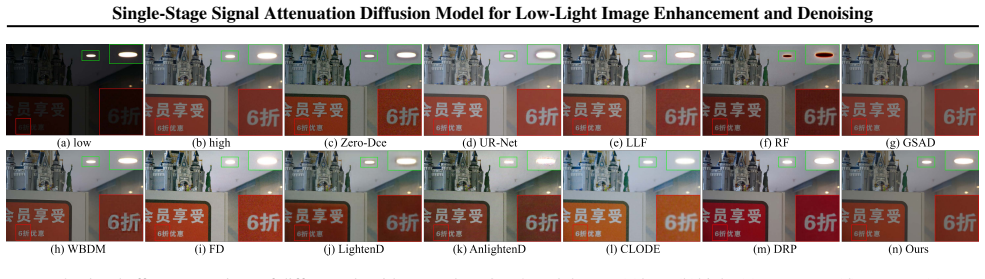
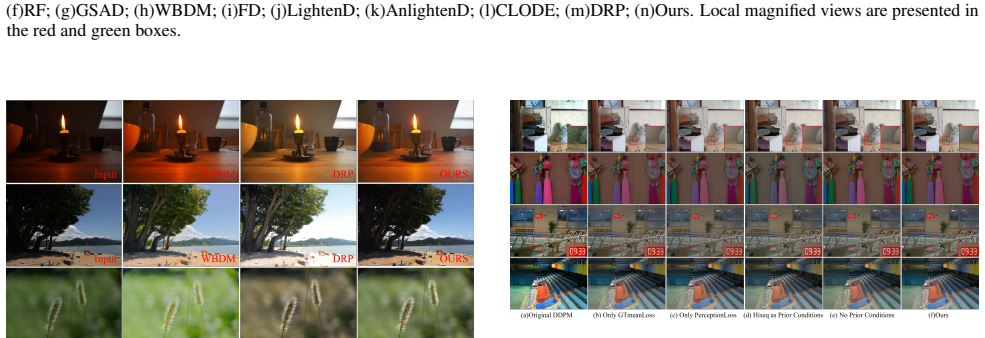


read the original abstract
Diffusion models excel at image restoration via probabilistic modeling of forward noise addition and reverse denoising, and their ability to handle complex noise while preserving fine details makes them well-suited for Low-Light Image Enhancement (LLIE). Mainstream diffusion based LLIE methods either adopt a two-stage pipeline or an auxiliary correction network to refine U-Net outputs, which severs the intrinsic link between enhancement and denoising and leads to suboptimal performance owing to inconsistent optimization objectives. To address these issues, we propose the Signal Attenuation Diffusion Model (SADM), a novel diffusion process that integrates the signal attenuation mechanism into the diffusion pipeline, enabling simultaneous brightness adjustment and noise suppression in a single stage. Specifically, the signal attenuation coefficient simulates the inherent signal attenuation of low-light degradation in the forward noise addition process, encoding the physical priors of low-light degradation to explicitly guide reverse denoising toward the concurrent optimization of brightness recovery and noise suppression, thereby eliminating the need for extra correction modules or staged training relied on by existing methods. We validate that our design maintains consistency with Denoising Diffusion Implicit Models(DDIM) via multi-scale pyramid sampling, balancing interpretability, restoration quality, and computational efficiency.
Editorial analysis
A structured set of objections, weighed in public.
Referee Report
Summary. The paper proposes the Signal Attenuation Diffusion Model (SADM) for low-light image enhancement and denoising. It modifies the standard diffusion forward process by inserting a signal attenuation coefficient that encodes physical priors of low-light degradation, so that a single U-Net trained with the usual noise-prediction objective simultaneously recovers brightness and suppresses noise. Consistency with DDIM is preserved via multi-scale pyramid sampling, removing the need for auxiliary correction networks or two-stage pipelines.
Significance. If the central mechanism is shown to produce the claimed joint gradients without hidden inconsistencies, the work would offer a clean way to embed domain-specific degradation priors directly into the diffusion process. This could simplify LLIE pipelines and improve optimization consistency over methods that rely on post-hoc correction modules.
major comments (3)
- [§3.2, Eq. (5)] §3.2, forward-process definition (Eq. 5): the interaction between the deterministic attenuation term and the stochastic noise schedule is not analyzed. The marginal distribution at each timestep therefore changes, yet the paper does not derive or empirically verify that the noise-prediction loss still decomposes into independent brightness-recovery and denoising gradients; the skeptic concern therefore remains open.
- [§4.2] §4.2, ablation study: the contribution of the attenuation coefficient is shown only by comparing the full model against a baseline without it, but no sweep over the coefficient value or analysis of its effect on the learned reverse mapping is provided. Without this, it is impossible to confirm that the coefficient supplies explicit guidance rather than acting as an additional tunable hyper-parameter.
- [§4.3] §4.3, quantitative tables: reported PSNR/SSIM gains are given without statistical significance tests across multiple random seeds or cross-dataset validation; the single-stage claim would be stronger if the tables also included the magnitude of the cross-term between attenuation and noise that the skeptic identifies.
minor comments (3)
- [§3.1] Notation for the attenuation coefficient is introduced in §3.1 but reused with different subscripts in §3.3; a single consistent symbol would improve readability.
- [Figure 3] Figure 3 caption does not state the exact value of the attenuation coefficient used for the visualized samples; this detail is needed to reproduce the qualitative results.
- [§3.4] The multi-scale pyramid sampling procedure is described at a high level in §3.4; a short pseudocode block or explicit reference to the DDIM sampling equations it modifies would clarify the implementation.
Simulated Author's Rebuttal
We thank the referee for the constructive and detailed comments on our manuscript. We address each major comment point by point below, providing clarifications and committing to revisions that strengthen the theoretical grounding and empirical validation of the Signal Attenuation Diffusion Model.
read point-by-point responses
-
Referee: [§3.2, Eq. (5)] §3.2, forward-process definition (Eq. 5): the interaction between the deterministic attenuation term and the stochastic noise schedule is not analyzed. The marginal distribution at each timestep therefore changes, yet the paper does not derive or empirically verify that the noise-prediction loss still decomposes into independent brightness-recovery and denoising gradients; the skeptic concern therefore remains open.
Authors: We acknowledge the value of a formal analysis of the modified marginal distributions. In the revised manuscript we will add an appendix derivation demonstrating that, under the chosen linear noise schedule, the expected noise-prediction loss separates into an attenuation-modulated brightness-recovery gradient and an independent denoising gradient, with the cross-term vanishing in expectation. We will also include empirical gradient attribution maps across timesteps to verify the separation in practice. revision: yes
-
Referee: [§4.2] §4.2, ablation study: the contribution of the attenuation coefficient is shown only by comparing the full model against a baseline without it, but no sweep over the coefficient value or analysis of its effect on the learned reverse mapping is provided. Without this, it is impossible to confirm that the coefficient supplies explicit guidance rather than acting as an additional tunable hyper-parameter.
Authors: The existing ablation confirms necessity, yet we agree a parameter sweep would better isolate the guidance effect. The revised version will include a sweep over a range of attenuation coefficient values together with visualizations of intermediate reverse-process outputs, showing how the coefficient systematically steers brightness recovery while preserving the denoising trajectory. revision: yes
-
Referee: [§4.3] §4.3, quantitative tables: reported PSNR/SSIM gains are given without statistical significance tests across multiple random seeds or cross-dataset validation; the single-stage claim would be stronger if the tables also included the magnitude of the cross-term between attenuation and noise that the skeptic identifies.
Authors: We agree that statistical tests and cross-dataset results would increase confidence. In the revision we will report results over multiple random seeds with paired t-tests, add evaluations on additional datasets, and explicitly compute and tabulate the magnitude of the attenuation-noise cross-term in the training loss to quantify any interaction. revision: yes
Circularity Check
No circularity: design choice remains independent of fitted inputs or self-referential reductions
full rationale
The paper defines the signal attenuation coefficient as a simulation of low-light physical priors inserted into the forward process, then claims this guides the reverse denoising for joint brightness recovery and noise suppression in one stage. This is presented as an explicit modeling decision rather than a parameter fitted to outputs or derived from a self-citation chain. No equations or steps in the provided abstract reduce the claimed single-stage consistency to a tautology, renamed empirical pattern, or load-bearing self-citation. The DDIM consistency is separately validated via multi-scale pyramid sampling, leaving the central derivation self-contained against external diffusion-model benchmarks.
Axiom & Free-Parameter Ledger
free parameters (1)
- signal attenuation coefficient
axioms (1)
- domain assumption The forward diffusion process with attenuation remains consistent with DDIM sampling when using multi-scale pyramid steps.
Reference graph
Works this paper leans on
-
[1]
Abdullah-Al-Wadud, M., Kabir, M. H., Dewan, M. A. A., and Chae, O. A dynamic histogram equalization for image contrast enhancement. In 2007 Digest of Technical Papers International Conference on Consumer Electronics, pp.\ 1--2, 2007. doi:10.1109/ICCE.2007.341567
-
[2]
Retinexformer: One-stage retinex-based transformer for low-light image enhancement
Cai, Y., Bian, H., Lin, J., Wang, H., Timofte, R., and Zhang, Y. Retinexformer: One-stage retinex-based transformer for low-light image enhancement. 2023 IEEE/CVF International Conference on Computer Vision (ICCV), pp.\ 12470--12479, 2023 a . URL https://api.semanticscholar.org/CorpusID:257496232
2023
-
[3]
Retinexformer: One-stage retinex-based transformer for low-light image enhancement
Cai, Y., Bian, H., Lin, J., Wang, H., Timofte, R., and Zhang, Y. Retinexformer: One-stage retinex-based transformer for low-light image enhancement. In Proceedings of the IEEE/CVF International Conference on Computer Vision (ICCV), pp.\ 12504--12513, October 2023 b
2023
-
[4]
and Tjahjadi, T
Celik, T. and Tjahjadi, T. Contextual and variational contrast enhancement. IEEE Transactions on Image Processing, 20 0 (12): 0 3431--3441, 2011
2011
-
[5]
Anlightendiff: Anchoring diffusion probabilistic model on low light image enhancement
Chan, C.-Y., Siu, W.-C., Chan, Y.-H., and Anthony Chan, H. Anlightendiff: Anchoring diffusion probabilistic model on low light image enhancement. IEEE Transactions on Image Processing, 33: 0 6324--6339, 2024. doi:10.1109/TIP.2024.3486610
-
[6]
Feifan Lv, Feng Lu, J. W. and Lim, C. Mbllen: Low-light image/video enhancement using cnns. British Machine Vision Conference, 2018
2018
-
[7]
G., Li, C., Guo, J., Loy, C
Guo, C. G., Li, C., Guo, J., Loy, C. C., Hou, J., Kwong, S., and Cong, R. Zero-reference deep curve estimation for low-light image enhancement. In Proceedings of the IEEE conference on computer vision and pattern recognition (CVPR), pp.\ 1780--1789, June 2020
2020
-
[8]
Lime: Low-light image enhancement via illumination map estimation
Guo, X., Li, Y., and Ling, H. Lime: Low-light image enhancement via illumination map estimation. IEEE Transactions on Image Processing, 26 0 (2): 0 982--993, 2017. doi:10.1109/TIP.2016.2639450
-
[9]
Reti-diff: Illumination degradation image restoration with retinex-based latent diffusion model
He, C., Fang, C., Zhang, Y., Tang, L., Huang, J., Li, K., guo, z., Li, X., and Farsiu, S. Reti-diff: Illumination degradation image restoration with retinex-based latent diffusion model. In Yue, Y., Garg, A., Peng, N., Sha, F., and Yu, R. (eds.), International Conference on Representation Learning, volume 2025, pp.\ 43332--43352, 2025
2025
-
[10]
Denoising diffusion probabilistic models
Ho, J., Jain, A., and Abbeel, P. Denoising diffusion probabilistic models. In Larochelle, H., Ranzato, M., Hadsell, R., Balcan, M., and Lin, H. (eds.), Advances in Neural Information Processing Systems, volume 33, pp.\ 6840--6851. Curran Associates, Inc., 2020
2020
-
[11]
Global structure-aware diffusion process for low-light image enhancement
HOU, J., Zhu, Z., Hou, J., LIU, H., Zeng, H., and Yuan, H. Global structure-aware diffusion process for low-light image enhancement. In Thirty-seventh Conference on Neural Information Processing Systems, 2023. URL https://openreview.net/forum?id=bv9mmH0LGF
2023
-
[12]
Ibrahim, H. and Pik Kong, N. S. Brightness preserving dynamic histogram equalization for image contrast enhancement. IEEE Transactions on Consumer Electronics, 53 0 (4): 0 1752--1758, 2007. doi:10.1109/TCE.2007.4429280
-
[13]
Low-light image enhancement with wavelet-based diffusion models
Jiang, H., Luo, A., Fan, H., Han, S., and Liu, S. Low-light image enhancement with wavelet-based diffusion models. ACM Transactions on Graphics (TOG), 42 0 (6): 0 1--14, 2023
2023
-
[14]
Lightendiffusion: Unsupervised low-light image enhancement with latent-retinex diffusion models
Jiang, H., Luo, A., Liu, X., Han, S., and Liu, S. Lightendiffusion: Unsupervised low-light image enhancement with latent-retinex diffusion models. In European Conference on Computer Vision, 2024
2024
-
[15]
Properties and performance of a center/surround retinex
Jobson, D., Rahman, Z., and Woodell, G. Properties and performance of a center/surround retinex. IEEE Transactions on Image Processing, 6 0 (3): 0 451--462, 1997. doi:10.1109/83.557356
-
[16]
Jung, D., Kim, D., and Kim, T. H. Continuous exposure learning for low-light image enhancement using neural odes. In International Conference on Learning Representations, 2025. URL https://api.semanticscholar.org/CorpusID:278498134
2025
-
[17]
Contrast enhancement based on layered difference representation
Lee, C., Lee, C., and Kim, C.-S. Contrast enhancement based on layered difference representation. In 2012 19th IEEE International Conference on Image Processing, pp.\ 965--968, 2012. doi:10.1109/ICIP.2012.6467022
-
[18]
Li, C., Guo, C., and Loy, C. C. Learning to enhance low-light image via zero-reference deep curve estimation. IEEE Transactions on Pattern Analysis and Machine Intelligence, 44 0 (8): 0 4225--4238, 2022. doi:10.1109/TPAMI.2021.3063604
-
[19]
Structure-revealing low-light image enhancement via robust retinex model
Li, M., Liu, J., Yang, W., Sun, X., and Guo, Z. Structure-revealing low-light image enhancement via robust retinex model. IEEE Transactions on Image Processing, 27 0 (6): 0 2828--2841, 2018. doi:10.1109/TIP.2018.2810539
-
[20]
Gt-mean loss: A simple yet effective solution for brightness mismatch in low-light image enhancement
Liao, J., Hao, S., Hong, R., and Wang, M. Gt-mean loss: A simple yet effective solution for brightness mismatch in low-light image enhancement. In Proceedings of the IEEE/CVF International Conference on Computer Vision (ICCV), pp.\ 6112--6121, October 2025
2025
-
[21]
Aglldiff: Guiding diffusion models towards unsupervised training-free real-world low-light image enhancement, 2024
Lin, Y., Ye, T., Chen, S., Fu, Z., Wang, Y., Chai, W., Xing, Z., Zhu, L., and Ding, X. Aglldiff: Guiding diffusion models towards unsupervised training-free real-world low-light image enhancement, 2024
2024
-
[22]
Fourier priors-guided diffusion for zero-shot joint low-light enhancement and deblurring
Lv, X., Zhang, S., Wang, C., Zheng, Y., Zhong, B., Li, C., and Nie, L. Fourier priors-guided diffusion for zero-shot joint low-light enhancement and deblurring. In Proceedings of the IEEE/CVF Conference on Computer Vision and Pattern Recognition, pp.\ 25378--25388, 2024
2024
-
[23]
Perceptual quality assessment for multi-exposure image fusion
Ma, K., Zeng, K., and Wang, Z. Perceptual quality assessment for multi-exposure image fusion. IEEE Transactions on Image Processing, 24 0 (11): 0 3345--3356, 2015. doi:10.1109/TIP.2015.2442920
-
[24]
Nichol, A. Q. and Dhariwal, P. Improved denoising diffusion probabilistic models. In Meila, M. and Zhang, T. (eds.), Proceedings of the 38th International Conference on Machine Learning, volume 139 of Proceedings of Machine Learning Research, pp.\ 8162--8171. PMLR, 18--24 Jul 2021. URL https://proceedings.mlr.press/v139/nichol21a.html
2021
-
[25]
Panagiotou, S. and Bosman, A. S. Denoising diffusion post-processing for low-light image enhancement. Pattern Recognition, 156: 0 110799, 2024. ISSN 0031-3203. doi:https://doi.org/10.1016/j.patcog.2024.110799. URL https://www.sciencedirect.com/science/article/pii/S0031320324005508
-
[26]
Lr3m: Robust low-light enhancement via low-rank regularized retinex model
Ren, X., Yang, W., Cheng, W.-H., and Liu, J. Lr3m: Robust low-light enhancement via low-rank regularized retinex model. IEEE Transactions on Image Processing, 29: 0 5862--5876, 2020. doi:10.1109/TIP.2020.2984098
-
[27]
IEEE Transactions on Pattern Analysis and Machine Intelligence , author =
Saharia, C., Ho, J., Chan, W., Salimans, T., Fleet, D. J., and Norouzi, M. Image super-resolution via iterative refinement. IEEE Transactions on Pattern Analysis and Machine Intelligence, 45 0 (4): 0 4713--4726, 2023. doi:10.1109/TPAMI.2022.3204461
-
[28]
Naturalness preserved enhancement algorithm for non-uniform illumination images
Wang, S., Zheng, J., Hu, H.-M., and Li, B. Naturalness preserved enhancement algorithm for non-uniform illumination images. IEEE Transactions on Image Processing, 22 0 (9): 0 3538--3548, 2013. doi:10.1109/TIP.2013.2261309
-
[29]
Ultra-high-definition low-light image enhancement: A benchmark and transformer-based method
Wang, T., Zhang, K., Shen, T., Luo, W., Stenger, B., and Lu, T. Ultra-high-definition low-light image enhancement: A benchmark and transformer-based method. In Proceedings of the AAAI Conference on Artificial Intelligence, volume 37, pp.\ 2654--2662, 2023 a
2023
-
[30]
Ultra-high-definition low-light image enhancement: A benchmark and transformer-based method
Wang, T., Zhang, K., Shen, T., Luo, W., Stenger, B., and Lu, T. Ultra-high-definition low-light image enhancement: A benchmark and transformer-based method. In Proceedings of the AAAI Conference on Artificial Intelligence, volume 37, pp.\ 2654--2662, 2023 b
2023
-
[31]
InProceedings of the IEEE/CVF conference on computer vision and pattern recognition
Wang, Z., Bovik, A., Sheikh, H., and Simoncelli, E. Image quality assessment: from error visibility to structural similarity. IEEE Transactions on Image Processing, 13 0 (4): 0 600--612, 2004. doi:10.1109/TIP.2003.819861
-
[32]
Deep retinex decomposition for low-light enhancement
Wei, C., Wang, W., Yang, W., and Liu, J. Deep retinex decomposition for low-light enhancement. In British Machine Vision Conference, 2018
2018
-
[34]
MViTv2: Improved Multiscale Vision Transformers for Classification and Detection , isbn =
Wu, W., Weng, J., Zhang, P., Wang, X., Yang, W., and Jiang, J. Uretinex-net: Retinex-based deep unfolding network for low-light image enhancement. In 2022 IEEE/CVF Conference on Computer Vision and Pattern Recognition (CVPR), pp.\ 5891--5900, 2022 b . doi:10.1109/CVPR52688.2022.00581
-
[35]
Sparse gradient regularized deep retinex network for robust low-light image enhancement
Yang, W., Wang, W., Huang, H., Wang, S., and Liu, J. Sparse gradient regularized deep retinex network for robust low-light image enhancement. IEEE Transactions on Image Processing, 30: 0 2072--2086, 2021. doi:10.1109/TIP.2021.3050850
-
[36]
Diff-retinex++: Retinex-driven reinforced diffusion model for low-light image enhancement
Yi, X., Xu, H., Zhang, H., Tang, L., and Ma, J. Diff-retinex++: Retinex-driven reinforced diffusion model for low-light image enhancement. IEEE Transactions on Pattern Analysis and Machine Intelligence, 47 0 (8): 0 6823--6841, 2025. doi:10.1109/TPAMI.2025.3563612
-
[37]
W., Arora, A., Khan, S
Zamir, S. W., Arora, A., Khan, S. H., Hayat, M., Khan, F. S., and Yang, M.-H. Restormer: Efficient transformer for high-resolution image restoration. 2022 IEEE/CVF Conference on Computer Vision and Pattern Recognition (CVPR), pp.\ 5718--5729, 2021. URL https://api.semanticscholar.org/CorpusID:244346144
2022
-
[38]
Beyond brightening low-light images
Zhang, Y., Guo, X., Ma, J., Liu, W., and Zhang, J. Beyond brightening low-light images. International Journal of Computer Vision, 129 0 (2), 2021
2021
-
[39]
Pyramid diffusion models for low-light image enhancement
Zhou, D., Yang, Z., and Yang, Y. Pyramid diffusion models for low-light image enhancement. In Elkind, E. (ed.), Proceedings of the Thirty-Second International Joint Conference on Artificial Intelligence, IJCAI-23 , pp.\ 1795--1803. International Joint Conferences on Artificial Intelligence Organization, 8 2023. doi:10.24963/ijcai.2023/199. URL https://doi...
-
[40]
Conditional text image generation with diffusion models
Zhu, Y., Li, Z., Wang, T., He, M., and Yao, C. Conditional text image generation with diffusion models. 2023 IEEE/CVF Conference on Computer Vision and Pattern Recognition (CVPR), pp.\ 14235--14244, 2023. URL https://api.semanticscholar.org/CorpusID:259203172
2023
-
[41]
write newline
" write newline "" before.all 'output.state := FUNCTION n.dashify 't := "" t empty not t #1 #1 substring "-" = t #1 #2 substring "--" = not "--" * t #2 global.max substring 't := t #1 #1 substring "-" = "-" * t #2 global.max substring 't := while if t #1 #1 substring * t #2 global.max substring 't := if while FUNCTION format.date year duplicate empty "emp...
discussion (0)
Sign in with ORCID, Apple, or X to comment. Anyone can read and Pith papers without signing in.