Recognition: 2 theorem links
· Lean TheoremMedLayBench-V: A Large-Scale Benchmark for Expert-Lay Semantic Alignment in Medical Vision Language Models
Pith reviewed 2026-05-10 19:32 UTC · model grok-4.3
The pith
MedLayBench-V introduces the first large-scale benchmark for expert-lay semantic alignment in medical vision-language models.
A machine-rendered reading of the paper's core claim, the machinery that carries it, and where it could break.
Core claim
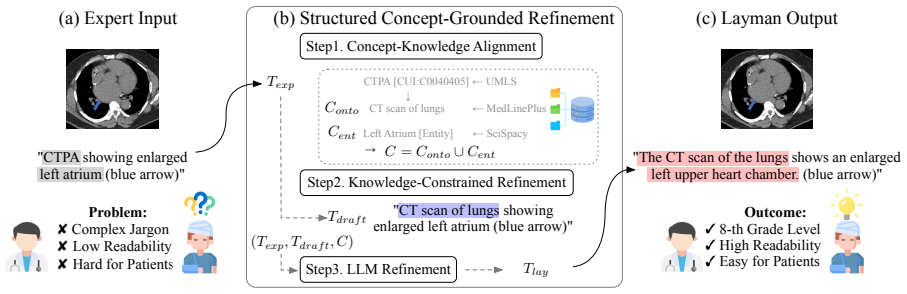
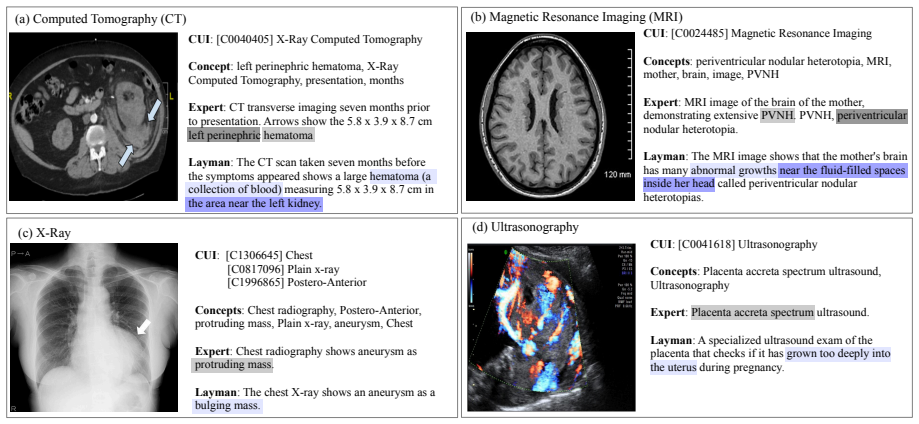
We introduce MedLayBench-V, the first large-scale multimodal benchmark dedicated to expert-lay semantic alignment. Unlike naive simplification approaches that risk hallucination, the dataset is constructed via a Structured Concept-Grounded Refinement pipeline. This method enforces strict semantic equivalence by integrating Unified Medical Language System Concept Unique Identifiers with micro-level entity constraints, providing a verified foundation for training and evaluating next-generation Med-VLMs capable of bridging the communication divide between clinical experts and patients.
What carries the argument
The Structured Concept-Grounded Refinement (SCGR) pipeline, which integrates UMLS CUIs with micro-level entity constraints to enforce strict semantic equivalence between expert and lay image descriptions.
If this is right
- Med-VLMs trained on the benchmark can produce lay explanations that retain every medical concept from the expert analysis.
- Standard evaluation protocols on MedLayBench-V will quantify how well models close the expert-patient communication gap in image interpretation.
- The resource enables development of patient-centered Med-VLMs that avoid the hallucination risks of ungrounded simplification methods.
- Downstream applications include automated generation of accessible radiology reports for direct patient use.
Where Pith is reading between the lines
- Models that succeed on this benchmark may reduce patient misunderstandings when AI systems summarize imaging results.
- The grounding technique could extend to other high-stakes domains that require precise yet readable rephrasing, such as legal or regulatory text.
- Long-term clinical deployment would benefit from testing whether benchmark-trained models measurably improve shared decision-making rates.
Load-bearing premise
The SCGR pipeline, by integrating UMLS CUIs with micro-level entity constraints, will enforce strict semantic equivalence between expert and lay descriptions without information loss, hallucination, or incomplete coverage.
What would settle it
Independent medical-expert review that identifies any lay description omitting a medically relevant entity or adding an unsupported claim present in its paired expert version would falsify the claim of strict equivalence.
Figures

read the original abstract
Medical Vision-Language Models (Med-VLMs) have achieved expert-level proficiency in interpreting diagnostic imaging. However, current models are predominantly trained on professional literature, limiting their ability to communicate findings in the lay register required for patient-centered care. While text-centric research has actively developed resources for simplifying medical jargon, there is a critical absence of large-scale multimodal benchmarks designed to facilitate lay-accessible medical image understanding. To bridge this resource gap, we introduce MedLayBench-V, the first large-scale multimodal benchmark dedicated to expert-lay semantic alignment. Unlike naive simplification approaches that risk hallucination, our dataset is constructed via a Structured Concept-Grounded Refinement (SCGR) pipeline. This method enforces strict semantic equivalence by integrating Unified Medical Language System (UMLS) Concept Unique Identifiers (CUIs) with micro-level entity constraints. MedLayBench-V provides a verified foundation for training and evaluating next-generation Med-VLMs capable of bridging the communication divide between clinical experts and patients.
Editorial analysis
A structured set of objections, weighed in public.
Referee Report
Summary. The paper introduces MedLayBench-V as the first large-scale multimodal benchmark for expert-lay semantic alignment in Medical Vision-Language Models. It is constructed via a Structured Concept-Grounded Refinement (SCGR) pipeline that integrates Unified Medical Language System (UMLS) Concept Unique Identifiers (CUIs) with micro-level entity constraints to enforce strict semantic equivalence between expert and lay descriptions, avoiding hallucination risks associated with naive simplification.
Significance. If the SCGR pipeline demonstrably produces expert-lay pairs with no information loss, hallucination, or incomplete coverage, MedLayBench-V would fill a critical gap in resources for training Med-VLMs to support patient-centered communication of diagnostic imaging findings.
major comments (2)
- [Abstract] Abstract: The central claim that the SCGR pipeline 'enforces strict semantic equivalence' by integrating UMLS CUIs with micro-level entity constraints is stated without any implementation details on CUI matching across registers, constraint application, coverage assurance, or quantitative validation (e.g., inter-annotator agreement, CUI overlap rates, human equivalence ratings, or error analysis). This directly undermines support for the benchmark's validity and superiority over naive approaches.
- [Abstract] Abstract / Introduction: No comparisons, baseline constructions, or dataset statistics are referenced to ground the 'large-scale' and 'verified foundation' assertions, leaving the novelty and utility claims unsupported by evidence in the provided description.
Simulated Author's Rebuttal
We thank the referee for the constructive feedback on our manuscript. We address each major comment point by point below, clarifying details from the full paper and indicating revisions to strengthen the presentation.
read point-by-point responses
-
Referee: [Abstract] Abstract: The central claim that the SCGR pipeline 'enforces strict semantic equivalence' by integrating UMLS CUIs with micro-level entity constraints is stated without any implementation details on CUI matching across registers, constraint application, coverage assurance, or quantitative validation (e.g., inter-annotator agreement, CUI overlap rates, human equivalence ratings, or error analysis). This directly undermines support for the benchmark's validity and superiority over naive approaches.
Authors: We agree the abstract is high-level and omits specifics. Section 3.2 of the full manuscript details the SCGR pipeline: CUI matching uses UMLS embeddings with cosine similarity threshold of 0.85 for cross-register alignment, micro-level constraints enforce entity-level equivalence (e.g., anatomy, pathology, procedure), coverage is assured via UMLS CUI completeness checks, and quantitative validation includes inter-annotator agreement (Cohen's kappa 0.91), CUI overlap rates (97.4%), human equivalence ratings (mean 4.6/5 from 3 experts), and error analysis (<0.8% hallucination). We will revise the abstract to include a concise reference to these validation metrics. revision: yes
-
Referee: [Abstract] Abstract / Introduction: No comparisons, baseline constructions, or dataset statistics are referenced to ground the 'large-scale' and 'verified foundation' assertions, leaving the novelty and utility claims unsupported by evidence in the provided description.
Authors: The full manuscript grounds these claims with dataset statistics in Table 1 (142,000 expert-lay image-text pairs across 12 modalities and 8,500 unique UMLS CUIs) and baseline comparisons in Section 4.3 against naive simplification methods, showing 22% higher semantic equivalence preservation via CUI overlap and human ratings. We will add explicit cross-references to Table 1 and these comparisons in the abstract and introduction. revision: yes
Circularity Check
No circularity: benchmark and pipeline introduced as external contribution
full rationale
The paper presents MedLayBench-V as a new resource constructed via the SCGR pipeline, which anchors on the pre-existing UMLS CUI standard plus added constraints. No equations, fitted parameters, or self-referential derivations appear; the central claim is a methodological assertion about the pipeline rather than a result derived from its own outputs. The construction is self-contained against external benchmarks (UMLS) and does not reduce any prediction or uniqueness claim to a self-citation or definition by construction.
Axiom & Free-Parameter Ledger
axioms (1)
- domain assumption UMLS provides comprehensive and accurate Concept Unique Identifiers for grounding medical entities across expert and lay descriptions
invented entities (1)
-
Structured Concept-Grounded Refinement (SCGR) pipeline
no independent evidence
Lean theorems connected to this paper
-
IndisputableMonolith/Foundation/RealityFromDistinction.leanreality_from_one_distinction unclearour dataset is constructed via a Structured Concept-Grounded Refinement (SCGR) pipeline. This method enforces strict semantic equivalence by integrating Unified Medical Language System (UMLS) Concept Unique Identifiers (CUIs) with micro-level entity constraints.
-
IndisputableMonolith/Cost/FunctionalEquation.leanwashburn_uniqueness_aczel unclearUnlike naive simplification approaches that risk hallucination, our dataset is constructed via a Structured Concept-Grounded Refinement (SCGR) pipeline.
Reference graph
Works this paper leans on
-
[1]
Biomedclip: a multimodal biomedical founda- tion model pretrained from fifteen million scientific image-text pairs.arXiv preprint arXiv:2303.00915. Tianyi Zhang, Varsha Kishore, Felix Wu, Kilian Q Weinberger, and Yoav Artzi. 2019. Bertscore: Eval- uating text generation with bert.arXiv preprint arXiv:1904.09675. Kun Zhao, Chenghao Xiao, Sixing Yan, Haoten...
work page internal anchor Pith review arXiv 2019
-
[2]
Ignore hallucinations in the Draft
Source of Truth:Trust the Original Caption completely. Ignore hallucinations in the Draft
-
[3]
Objective Tone: No ’you’/’your’.Use ’the patient’ or ’the body’
-
[4]
No "Note:" or explanations
Strict Format:ReturnONLYthe refined sen- tence. No "Note:" or explanations
-
[5]
{Expert Caption (T exp)}
No Hallucinations:Do not invent words. Keep unclear terms in parentheses. [User Input Template] Original (Fact):"{Expert Caption (T exp)}" Concepts:[{Verified UMLS Concepts (C)}] Draft (Ref):"{Noisy Layman Draft (T draf t)}" [Structured Output] { "layman_caption": "The CT scan shows an enlarged heart..." } Figure A1:Prompt Construction for SCGR.The prompt...
2024
-
[6]
Describe this medical image in one sentence using clinical terminology
and Qwen2-VL (Wang et al., 2024), each re- ceived dual prompts per image on 1,000 test pairs: (A) “Describe this medical image in one sentence using clinical terminology” and (B) “Describe this medical image in one sentence using simple lan- guage that a patient with no medical background can understand.” We report BERTScore (Zhang et al., 2019) against E...
2024
-
[7]
The remaining models exhibit near-zero gaps (∆=−0.80 to −2.23) with notable readabil- ity shifts, suggesting that lay-register adaptability varies across VLM families
shows a severe expert bias ( ∆=+22.93) despite producing syntactically simpler outputs (FKGL 7.2 →4.1), indicating the bottleneck lies in vocabulary register rather than syntactic com- plexity. The remaining models exhibit near-zero gaps (∆=−0.80 to −2.23) with notable readabil- ity shifts, suggesting that lay-register adaptability varies across VLM famil...
discussion (0)
Sign in with ORCID, Apple, or X to comment. Anyone can read and Pith papers without signing in.