Recognition: no theorem link
Introduction to Mechanics and Structures
Pith reviewed 2026-05-10 18:25 UTC · model grok-4.3
The pith
Continuum mechanics separates elastic recovery from plastic flow in materials, then applies shell theory to simplify stress analysis in thin axisymmetric pressure vessels.
A machine-rendered reading of the paper's core claim, the machinery that carries it, and where it could break.
Core claim
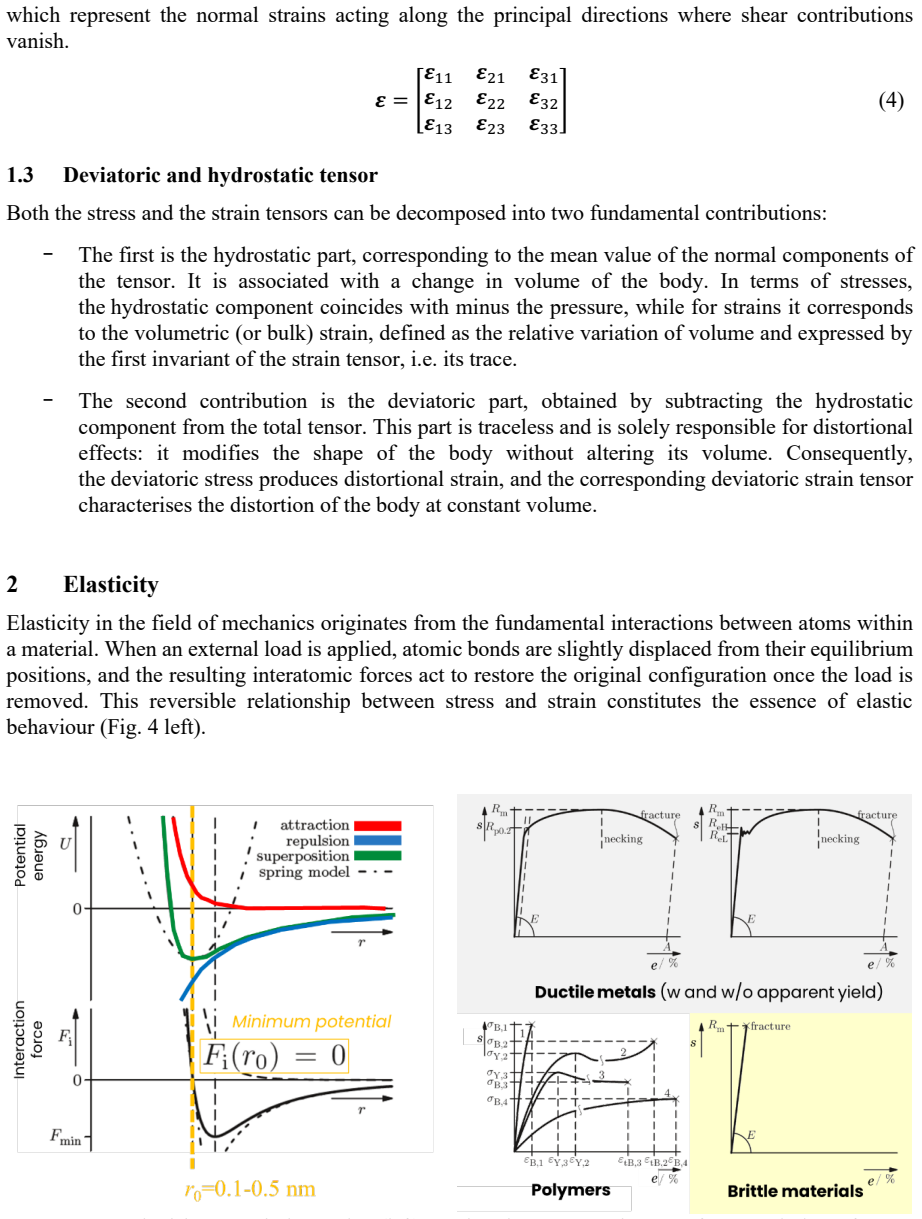
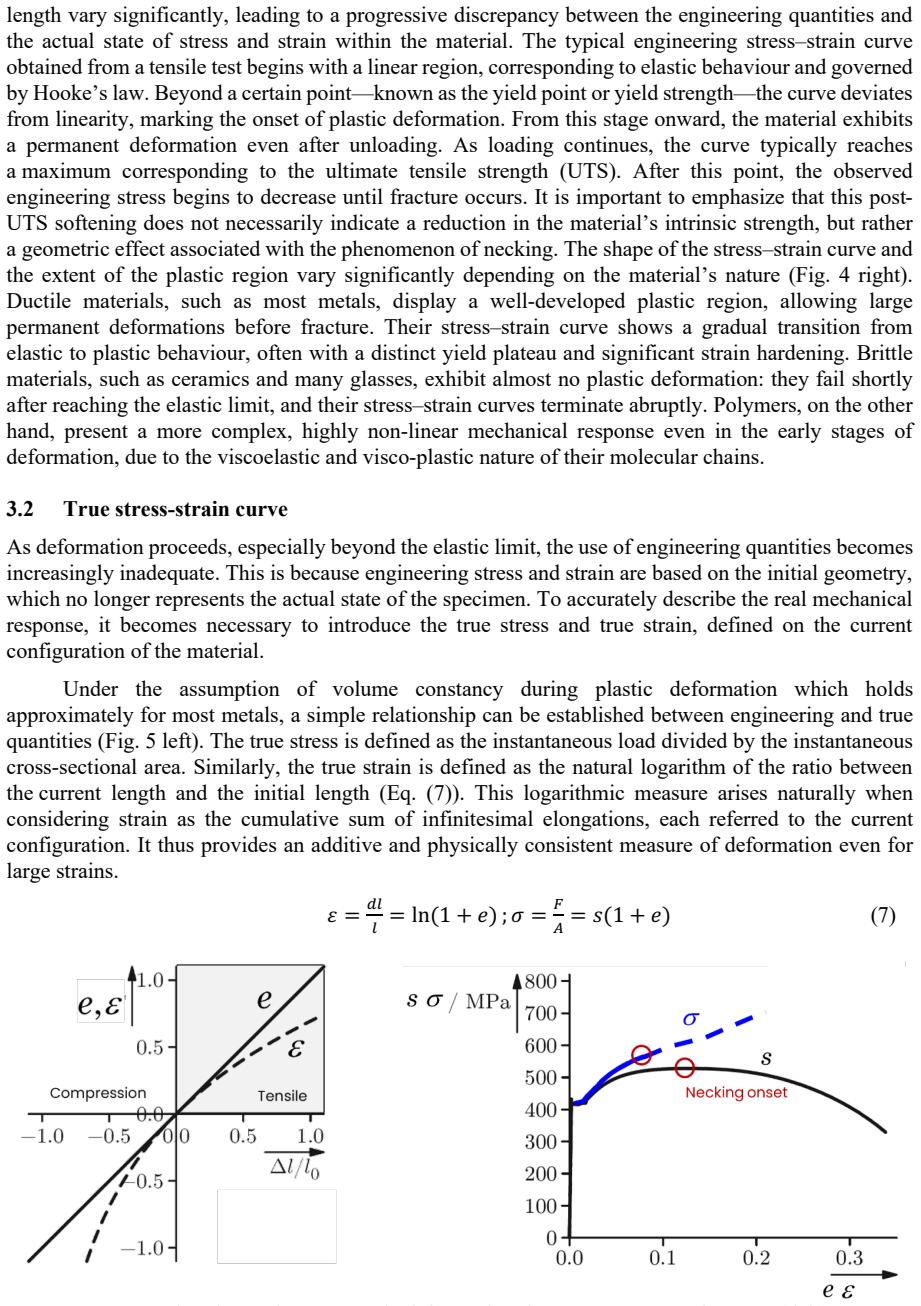
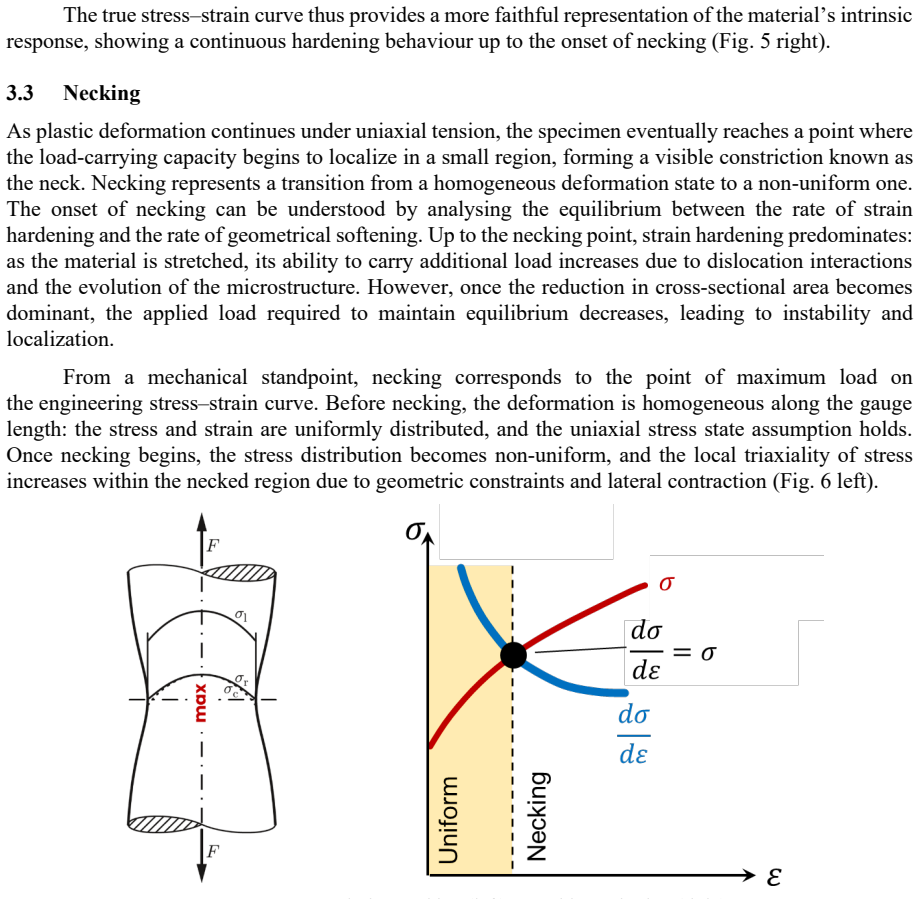
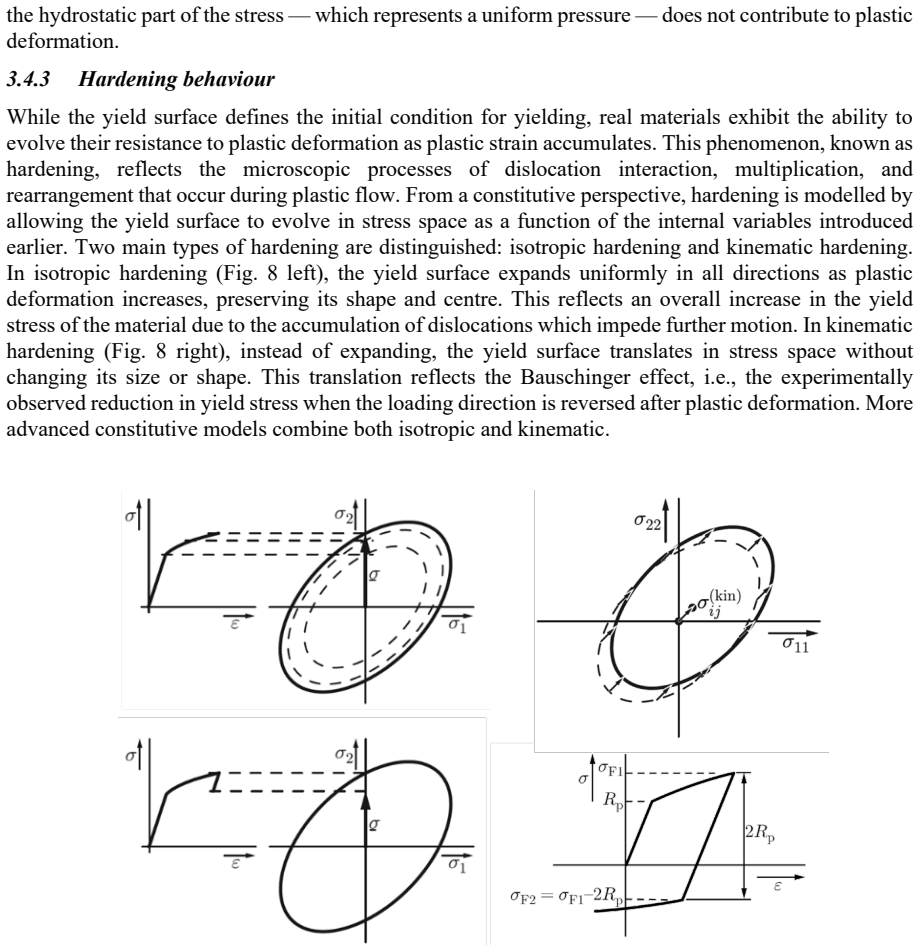
The work presents the theoretical foundations of elastic and plastic behavior in materials under mechanical loads, with elasticity governed by Hooke's law and constitutive matrices and plasticity described by yield surfaces, flow rules, and isotropic or kinematic hardening. It applies these foundations to the mechanical behavior of pressure vessels and thin axisymmetric shells, where shell theory simplifies the stress distribution to membrane stresses under internal or external pressure, while also treating buckling phenomena, secondary stresses at geometric discontinuities, and design provisions from the EN 13445 standard.
What carries the argument
Shell theory for thin axisymmetric shells, which reduces the full three-dimensional stress state to membrane stresses by assuming thin walls and rotational symmetry that eliminate significant bending moments.
If this is right
- Hooke's law and the associated constitutive matrix allow prediction of linear elastic strains from applied stresses up to the yield point.
- Yield surfaces combined with associated flow rules determine the onset of plastic deformation and the direction of plastic strain increments.
- Membrane stress formulas give explicit hoop and longitudinal stresses in a thin pressurized cylinder or sphere without integration through the wall thickness.
- Critical external pressure for buckling of a thin shell follows from geometry and material modulus once membrane equilibrium is established.
- Secondary stresses at nozzles or other discontinuities can be superposed on the membrane field to check local design limits per the EN 13445 rules.
Where Pith is reading between the lines
- The membrane-stress approach supplies analytical benchmark cases that finite-element codes for thicker or asymmetric shells must recover in the thin-wall limit.
- Atomic origins of elasticity and plasticity suggest that microstructural changes such as grain size or phase composition could be used to shift the yield surface for a given alloy.
- The same shell-theory reduction might be tested on spherical or conical shells to confirm whether the membrane simplification remains accurate under combined internal pressure and thermal loads.
- Buckling predictions could be extended by adding small initial geometric imperfections to quantify sensitivity of the critical pressure to manufacturing tolerances.
Load-bearing premise
The analysis assumes thin walls and axisymmetric geometry for shells so that stresses reduce to membrane components without needing to account for bending or asymmetry effects.
What would settle it
Direct measurement of strain or stress on a thick-walled or non-axisymmetric cylindrical vessel under known internal pressure that shows large deviations from the membrane-stress predictions would indicate the simplification does not hold.
Figures



read the original abstract
This work provides a comprehensive overview of the fundamental concepts in continuum mechanics, focusing on the behaviour of materials under mechanical loads. It discusses the distinction between elastic and plastic, highlighting their atomic origins and macroscopic implications. Elastic behaviour is examined via Hooke's law and constitutive matrices, while plasticity is treated through yield surfaces, flow rules, and hardening laws, including isotropic and kinematic hardening. In addition, the theoretical foundations and design principles of pressure vessels and thin axisymmetric shells, focusing on their mechanical behaviour under internal or external pressure, is discussed. The analysis is based on shell theory, assuming thin walls and axisymmetric geometry, which simplifies the stress distribution into membrane stresses. The work also addresses buckling phenomena under external pressure, secondary stresses at geometric discontinuities, and design provisions from the EN 13445 standard.
Editorial analysis
A structured set of objections, weighed in public.
Referee Report
Summary. The manuscript provides a comprehensive overview of continuum mechanics fundamentals, distinguishing elastic and plastic material behavior with atomic origins and macroscopic implications. It covers elastic response via Hooke's law and constitutive matrices, and plasticity through yield surfaces, flow rules, and isotropic/kinematic hardening. The work then examines the theoretical foundations and design of pressure vessels and thin axisymmetric shells under internal/external pressure, employing shell theory under explicit assumptions of thin walls and axisymmetric geometry that reduce stresses to membrane components. It further addresses buckling under external pressure, secondary stresses at geometric discontinuities, and relevant provisions from the EN 13445 standard.
Significance. If the presented summaries of standard models are accurate, the paper could function as a useful introductory synthesis or reference for engineers and students working on pressure vessel design and thin-shell applications, particularly where integration of continuum mechanics with design codes is needed. The explicit statement of modeling assumptions (thin walls, axisymmetric geometry, membrane-stress simplification) is a strength that enhances reliability for readers. However, as a compilation of established material without new derivations, data, or falsifiable predictions, its significance for advancing the field remains limited.
minor comments (2)
- [Abstract] The abstract is lengthy and repetitive in places; condensing it to emphasize the linkage between continuum mechanics concepts and the specific EN 13445 applications would improve focus and readability.
- [Shell analysis section] In the shell theory discussion, while the thin-wall and axisymmetric assumptions are stated, the reduction to membrane stresses would benefit from a short reference to the relevant equilibrium equations or a citation to a standard text (e.g., Timoshenko or Flügge) to support readers without prior shell-theory background.
Simulated Author's Rebuttal
We thank the referee for their review and recommendation of minor revision. The manuscript is explicitly positioned as an introductory synthesis of established concepts in continuum mechanics and their application to pressure vessel design. We address the assessment of its scope and significance below.
read point-by-point responses
-
Referee: If the presented summaries of standard models are accurate, the paper could function as a useful introductory synthesis or reference for engineers and students working on pressure vessel design and thin-shell applications, particularly where integration of continuum mechanics with design codes is needed. The explicit statement of modeling assumptions (thin walls, axisymmetric geometry, membrane-stress simplification) is a strength that enhances reliability for readers.
Authors: We are pleased that the referee recognizes the manuscript's potential utility as an introductory reference, particularly for integrating theoretical models with design standards. The explicit discussion of assumptions such as thin-wall and axisymmetric approximations is intentional to help readers assess applicability, and we have endeavored to maintain clarity on these points throughout. revision: no
-
Referee: However, as a compilation of established material without new derivations, data, or falsifiable predictions, its significance for advancing the field remains limited.
Authors: We agree that the work compiles and synthesizes established results from continuum mechanics, elasticity, plasticity, and shell theory without introducing new derivations, data, or predictions. This aligns with the manuscript's title and abstract, which frame it as an introduction rather than original research. We maintain that such syntheses can still provide value by clarifying connections between atomic-scale behavior, macroscopic constitutive models, and engineering standards like EN 13445 for students and practitioners. revision: no
Circularity Check
No significant circularity in introductory overview of standard models
full rationale
The paper is an explicit overview of established continuum mechanics, elastic/plastic constitutive laws, and thin-shell theory for pressure vessels. It states modeling assumptions (thin walls, axisymmetric geometry, membrane-stress simplification) upfront and presents Hooke's law, yield surfaces, and EN 13445 provisions as standard references without claiming novel derivations, data fits, or predictions. No load-bearing step reduces by construction to a self-definition, fitted input, or self-citation chain; the work contains no original derivation chain to inspect.
Axiom & Free-Parameter Ledger
Reference graph
Works this paper leans on
-
[1]
!𝜎#!𝜎!"𝜎
Mechanical & Materials Engineering for Particle Accelerators and Detectors CERN Accelerator School Proceedings ̶ ̶ Sint-Michielsgestel, Netherlands, 2024 Available online at https://cas.web.cern.ch/previous-schools 1 Introduction to Mechanics and Structures M. Scapin Politecnico di Torino, Department of Mechanical and Aerospace Engineering, Corso Duca deg...
2024
-
[2]
Rösler, J., Harders, H., & Baeker, M. (2007). Mechanical Behaviour of Engineering Materials: Metals, Ceramics, Polymers, and Composites. Springer
2007
-
[3]
D., & Rethwisch, D
Callister, W. D., & Rethwisch, D. G. (2020). Materials Science and Engineering: An Introduction. Wiley
2020
-
[4]
P., & Goodier, J
Timoshenko, S. P., & Goodier, J. N. (1970). Theory of Elasticity. McGraw-Hill
1970
-
[5]
Hill, R. (1950). The Mathematical Theory of Plasticity. Oxford University Press
1950
-
[6]
F., & Han, D
Chen, W. F., & Han, D. J. (1988). Plasticity for Structural Engineers. Springer
1988
-
[7]
Timoshenko, S., and Woinowsky-Krieger, S. (1959). Theory of Plates and Shells. McGraw-Hill
1959
-
[8]
Ugural, A. C. (1981). Stresses in Plates and Shells. McGraw-Hill
1981
discussion (0)
Sign in with ORCID, Apple, or X to comment. Anyone can read and Pith papers without signing in.