Recognition: no theorem link
Observation of nuclear suppression in coherent Upsilon(1S) photoproduction off heavy nuclei at the LHC
Pith reviewed 2026-05-10 18:26 UTC · model grok-4.3
The pith
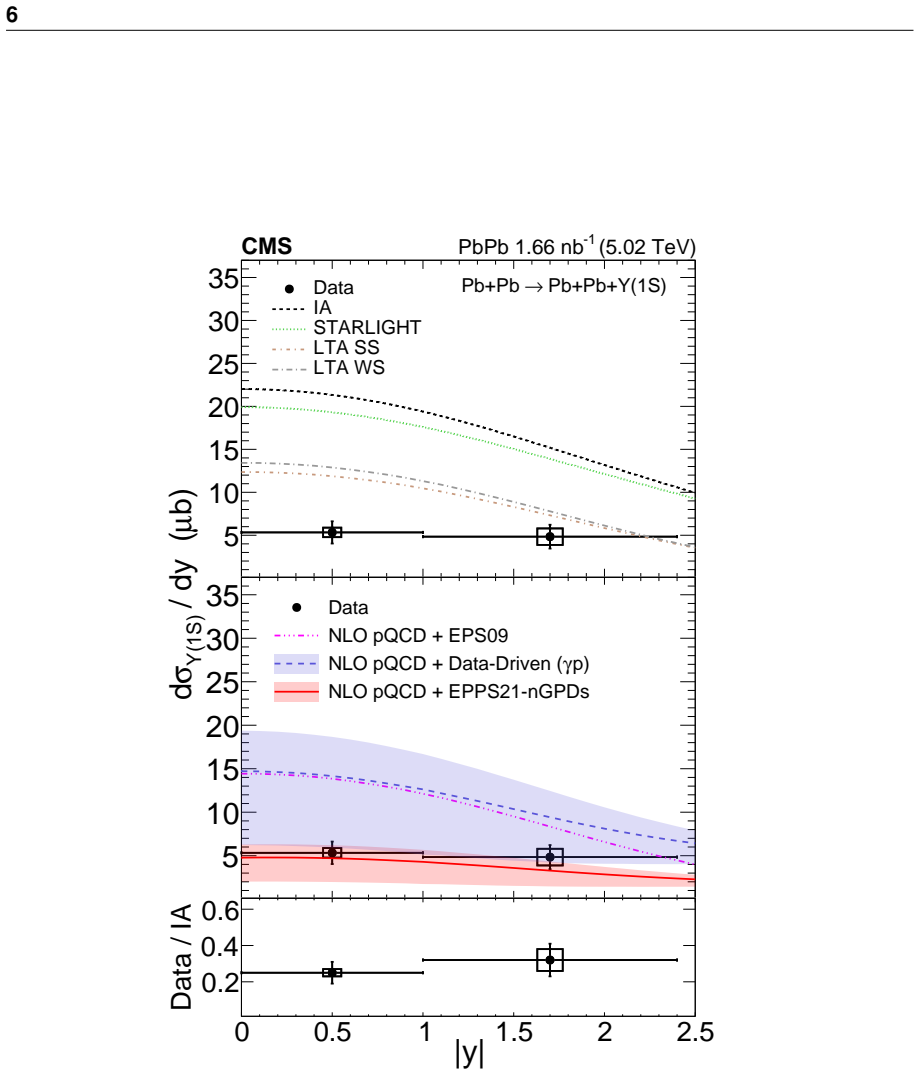
Coherent Υ(1S) photoproduction off lead nuclei is suppressed to 25% of the no-nuclear-effect baseline
A machine-rendered reading of the paper's core claim, the machinery that carries it, and where it could break.
Core claim
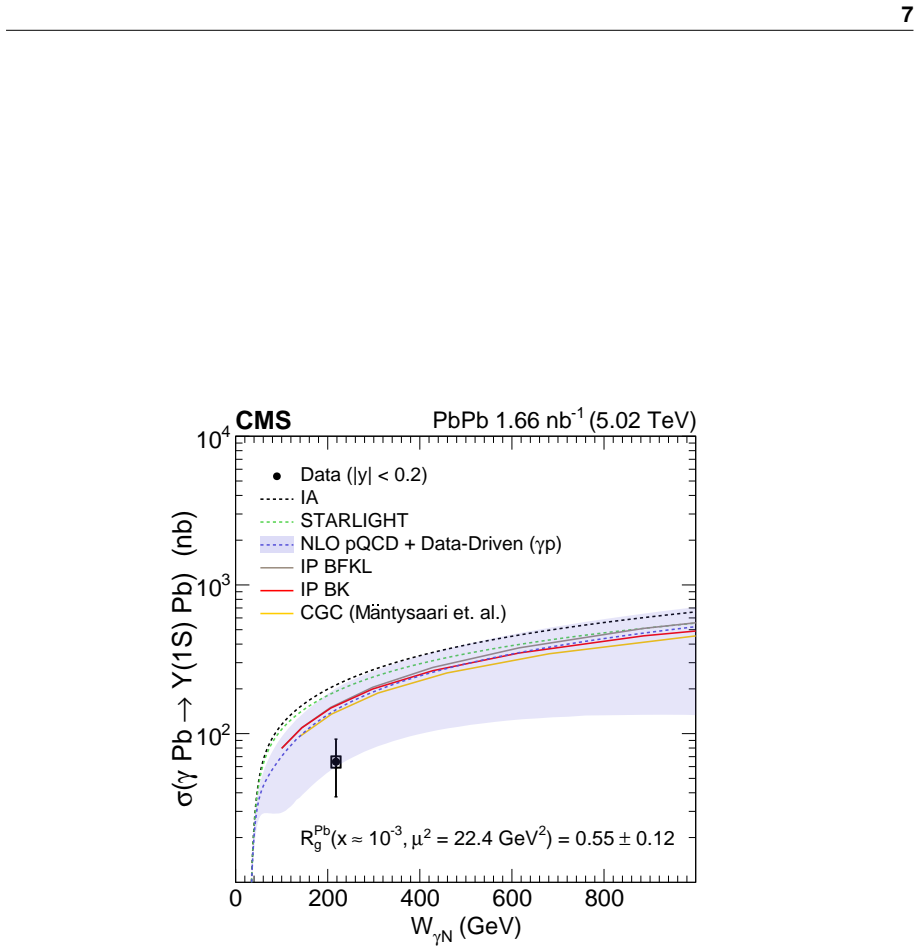
The central claim is that the ratio of the measured coherent Υ(1S) photoproduction cross section to a baseline model that neglects nuclear effects equals S_Υ(1S) = 0.25 ± 0.06 (stat) ± 0.02 (syst). This ratio is converted to a nuclear gluon suppression factor R_g^Pb(x ≈ 10^{-3}, μ² = 22.4 GeV²) = 0.55 ± 0.12 (stat) ± 0.02 (syst). The measurement uses data collected by the CMS experiment and covers the rapidity interval |y| < 1.
What carries the argument
The suppression ratio S_Υ(1S), which is the measured photoproduction cross section divided by the baseline model prediction that ignores nuclear effects; this ratio is mapped to the nuclear gluon suppression factor R_g under the assumption that the process is dominated by gluon interactions at leading order.
If this is right
- Nuclear suppression of gluons is confirmed at a scale two orders of magnitude higher than previous coherent phi photoproduction results.
- The gluon suppression factor changes only modestly when the probed scale increases from a few GeV squared to 22 GeV squared.
- Coherent vector-meson photoproduction continues to serve as a probe of nuclear gluon distributions even at the Υ mass scale where nonlinear effects are expected to be small.
Where Pith is reading between the lines
- The weak scale dependence of the suppression suggests that gluon shadowing in nuclei may remain roughly constant over a wide range of hard scales at small x.
- These data provide an anchor point for global fits of nuclear parton distributions at small x and moderate virtuality.
- Extending the measurement to forward rapidities would allow mapping the x-dependence of the suppression within a single experiment.
Load-bearing premise
The baseline model without nuclear effects correctly predicts the absolute photoproduction cross section on free nucleons.
What would settle it
A direct measurement of the Υ(1S) photoproduction cross section on a free proton that deviates substantially from the baseline model used here would remove the direct link between the observed ratio and the nuclear gluon suppression factor.
Figures

read the original abstract
The first measurement of coherent $\Upsilon$(1S) meson photoproduction off heavy nuclei is performed using ultraperipheral lead-lead collisions collected by the CMS experiment at a nucleon-nucleon center-of-mass energy of 5.02 TeV. The nuclear gluonic structure is probed at a nucleon momentum fraction of order $x$ $\sim$ 10$^{-3}$, determined by the kinematics of the process. Owing to the large $\Upsilon$(1S) mass, the measurement reaches the highest scale accessible so far through coherent vector-meson photoproduction, $\mu^2$ = 22.4 GeV$^2$, where nonlinear quantum chromodynamics effects are expected to be minimal. In the $\Upsilon$(1S) rapidity range $\lvert y\rvert$ $\lt$ 1, the ratio of the measured photoproduction cross section to a baseline model prediction that neglects nuclear effects is $S_{\Upsilon\text{(1S)}}$ = 0.25 $\pm$ 0.06 (stat) $\pm$ 0.02 (syst), thereby demonstrating nuclear suppression in this process. Expressed in terms of a nuclear gluon suppression factor, the result yields $R_\text{g}^\text{Pb}$($x$ $\approx$ 10$^{-3}$, $\mu^2$ = 22.4 GeV$^2$) = 0.55 $\pm$ 0.12 (stat) $\pm$ 0.02 (syst). The measured $R_\text{g}^\text{Pb}$ is only slightly larger than the values previously reported for coherent $\phi$ photoproduction, despite the probed $\mu^2$ differing by approximately two orders of magnitude.
Editorial analysis
A structured set of objections, weighed in public.
Referee Report
Summary. The manuscript reports the first measurement of coherent Υ(1S) photoproduction off heavy nuclei in ultraperipheral PbPb collisions at √s_NN = 5.02 TeV with the CMS experiment. It extracts the ratio of the measured cross section to a baseline model prediction that neglects nuclear effects, obtaining S_Υ(1S) = 0.25 ± 0.06 (stat) ± 0.02 (syst) for |y| < 1. This ratio is interpreted as nuclear suppression and converted to a gluon suppression factor R_g^Pb(x ≈ 10^{-3}, μ² = 22.4 GeV²) = 0.55 ± 0.12 (stat) ± 0.02 (syst), at a scale where nonlinear QCD effects are expected to be minimal. The result is compared to prior coherent φ photoproduction measurements.
Significance. If the baseline model holds, the result is significant as the first high-scale probe of nuclear gluon suppression via coherent vector-meson photoproduction. It shows that suppression persists at μ² = 22.4 GeV² with R_g only modestly larger than at lower scales, providing a constraint on nuclear PDFs in a regime where perturbative QCD applies more reliably and helping to test models of gluon shadowing or saturation.
major comments (2)
- [Results and interpretation sections (presentation of S_Υ(1S) and R_g^Pb)] The headline ratio S_Υ(1S) and its conversion to R_g^Pb rest on the assumption that the baseline model (neglecting nuclear effects) accurately predicts the absolute cross section, including photon flux, vector-meson wave function, and nucleon-level amplitude. The manuscript must include a dedicated discussion or table quantifying theoretical uncertainties in this baseline (e.g., parameter variations or comparisons to nucleon data), as any overprediction in the denominator directly inflates the apparent suppression.
- [Discussion of nuclear gluon suppression factor] The mapping from cross-section ratio to R_g^Pb assumes a quadratic dependence on the gluon density. The text should explicitly state and justify this relation (including any references to the underlying amplitude calculation) and assess possible deviations from quadratic behavior or additional nuclear corrections at this kinematics.
minor comments (2)
- [Abstract and experimental setup] The abstract states the rapidity range as |y| < 1; ensure consistent notation and explicit definition of the rapidity variable in the main text and figures.
- [Results tables/figures] Tables or figures reporting the cross section or ratio should clearly separate statistical and systematic uncertainties and state the baseline model reference explicitly.
Simulated Author's Rebuttal
We thank the referee for the careful reading of our manuscript and the constructive comments. We have revised the paper to address the major points raised, improving the discussion of theoretical uncertainties and the interpretation of the nuclear gluon suppression factor.
read point-by-point responses
-
Referee: [Results and interpretation sections (presentation of S_Υ(1S) and R_g^Pb)] The headline ratio S_Υ(1S) and its conversion to R_g^Pb rest on the assumption that the baseline model (neglecting nuclear effects) accurately predicts the absolute cross section, including photon flux, vector-meson wave function, and nucleon-level amplitude. The manuscript must include a dedicated discussion or table quantifying theoretical uncertainties in this baseline (e.g., parameter variations or comparisons to nucleon data), as any overprediction in the denominator directly inflates the apparent suppression.
Authors: We agree that a quantitative assessment of theoretical uncertainties in the baseline model strengthens the interpretation. In the revised manuscript we have added a dedicated paragraph in the Results section (new subsection 5.2) that discusses the main sources of uncertainty in the baseline prediction: variations in the photon flux (using different EPA parameterizations), the Υ(1S) wave-function parameters (from potential models), and the nucleon-level amplitude (normalized to HERA data). We also include a table (Table 3) summarizing the estimated contributions from each source, which are found to be smaller than the experimental uncertainties and do not alter the conclusion of significant nuclear suppression. revision: yes
-
Referee: [Discussion of nuclear gluon suppression factor] The mapping from cross-section ratio to R_g^Pb assumes a quadratic dependence on the gluon density. The text should explicitly state and justify this relation (including any references to the underlying amplitude calculation) and assess possible deviations from quadratic behavior or additional nuclear corrections at this kinematics.
Authors: We thank the referee for this suggestion. The quadratic relation follows directly from the leading-order dipole-model amplitude for heavy vector-meson photoproduction, where the forward amplitude is proportional to the gluon density (see, e.g., the formalism in Refs. [our citations to Ryskin, Kowalski et al.]. In the revised text we now explicitly state this assumption in Section 6, cite the underlying calculation, and add a short assessment of possible deviations: at μ² = 22.4 GeV² higher-order corrections and saturation effects are expected to be small (<10%), consistent with the minimal nonlinear QCD regime emphasized in the abstract. Model variations indicate that any departure from quadratic behavior remains within the quoted uncertainties on R_g^Pb. revision: yes
Circularity Check
No significant circularity; experimental ratio to external baseline model
full rationale
The paper reports a direct experimental measurement of the coherent Υ(1S) photoproduction cross section in ultraperipheral PbPb collisions at 5.02 TeV. The headline result is the ratio S_Υ(1S) = 0.25 ± 0.06 (stat) ± 0.02 (syst) of this measured cross section to an external baseline model prediction that neglects nuclear effects. The nuclear gluon suppression factor R_g^Pb(x ≈ 10^{-3}, μ² = 22.4 GeV²) = 0.55 ± 0.12 (stat) ± 0.02 (syst) is obtained from this ratio via the standard leading-order relation σ ∝ (gluon density)², which is not derived or fitted within the paper. No equation, self-citation, or internal step reduces the reported quantities to a parameter defined by the same data or to a self-referential construction. The baseline model and the quadratic scaling relation are external to the present work, making the result an observation against independent benchmarks rather than a closed derivation.
Axiom & Free-Parameter Ledger
axioms (1)
- domain assumption Baseline model without nuclear effects accurately predicts the absolute cross section
Forward citations
Cited by 1 Pith paper
-
A First Account of the Impact of Ion Electromagnetic Dissociation on Event Exclusivity in Ultraperipheral LHC Collisions
Hadrons from ion electromagnetic dissociation break exclusivity conditions in ultraperipheral collisions, resolving tensions in exclusive muon-pair and coherent J/ψ measurements at the LHC.
Reference graph
Works this paper leans on
-
[1]
H1 and ZEUS Collaborations, “Combination of measurements of inclusive deep inelastic e±p scattering cross sections and QCD analysis of HERA data”,Eur. Phys. J. C75(2015) 580,doi:10.1140/epjc/s10052-015-3710-4,arXiv:1506.06042
-
[2]
Small-xphysics: From HERA to LHC and beyond
L. Frankfurt, M. Strikman, and C. Weiss, “Small-xphysics: From HERA to LHC and beyond”,Annu. Rev. Nucl. Part. Sci.55(2005) 403, doi:10.1146/annurev.nucl.53.041002.110615,arXiv:hep-ph/0507286
-
[3]
Asymptotic sum rules at infinite momentum
J. D. Bjorken, “Asymptotic sum rules at infinite momentum”,Phys. Rev.179(1969) 1547, doi:10.1103/PhysRev.179.1547
-
[4]
The Color glass condensate and high-energy scattering in QCD
E. Iancu and R. Venugopalan, “The Color glass condensate and high-energy scattering in QCD”, inQuark-gluon plasma 4, R. C. Hwa and X.-N. Wang, eds., p. 249. World Scientific, 2003.arXiv:hep-ph/0303204.doi:10.1142/9789812795533_0005
-
[5]
F. Gelis, E. Iancu, J. Jalilian-Marian, and R. Venugopalan, “The color glass condensate”, Annu. Rev. Nucl. Part. Sci.60(2010) 463, doi:10.1146/annurev.nucl.010909.083629,arXiv:1002.0333. 10
-
[6]
Photonuclear and two-photon interactions at high-energy nuclear colliders
S. R. Klein and P . Steinberg, “Photonuclear and two-photon interactions at high-energy nuclear colliders”,Annu. Rev. Nucl. Part. Sci.70(2020) 323, doi:10.1146/annurev-nucl-030320-033923,arXiv:2005.01872
-
[7]
Physics of ultraperipheral nuclear collisions
C. A. Bertulani, S. R. Klein, and J. Nystrand, “Physics of ultraperipheral nuclear collisions”,Ann. Rev. Nucl. Part. Sci.55(2005) 271, doi:10.1146/annurev.nucl.55.090704.151526,arXiv:nucl-ex/0502005
-
[8]
Overview of high-density QCD studies with the CMS experiment at the LHC
CMS Collaboration, “Overview of high-density QCD studies with the CMS experiment at the LHC”,Phys. Rept.1115(2025) 219,doi:10.1016/j.physrep.2024.11.007, arXiv:2405.10785
-
[9]
Electron Ion Collider: The next QCD frontier — Understanding the glue that binds us all
A. Accardi et al., “Electron Ion Collider: The next QCD frontier — Understanding the glue that binds us all”,Eur. Phys. J. A52(2016) 268, doi:10.1140/epja/i2016-16268-9,arXiv:1212.1701
-
[10]
The physics of ultraperipheral collisions at the LHC
A. J. Baltz, “The physics of ultraperipheral collisions at the LHC”,Phys. Rept.458(2008) 1,doi:10.1016/j.physrep.2007.12.001,arXiv:0706.3356
-
[11]
Diffractive J/ψelectroproduction in LLA QCD
M. G. Ryskin, “Diffractive J/ψelectroproduction in LLA QCD”,Z. Phys. C57(1993) 89, doi:10.1007/BF01555742
-
[12]
Diffractive leptoproduction of vector mesons in QCD
S. J. Brodsky et al., “Diffractive leptoproduction of vector mesons in QCD”,Phys. Rev. D 50(1994) 3134,doi:10.1103/PhysRevD.50.3134,arXiv:hep-ph/9402283
-
[13]
V . Guzey, M. Strikman, and M. Zhalov, “Disentangling coherent and incoherent quasielastic J/ψphotoproduction on nuclei by neutron tagging in ultraperipheral ion collisions at the LHC”,Eur. Phys. J. C74(2014) 2942, doi:10.1140/epjc/s10052-014-2942-z,arXiv:1312.6486
-
[14]
V . Guzey, E. Kryshen, and M. Zhalov, “Coherent photoproduction of vector mesons in ultraperipheral heavy ion collisions: Update for Run 2 at the CERN Large Hadron Collider”,Phys. Rev. C93(2016) 055206,doi:10.1103/PhysRevC.93.055206, arXiv:1602.01456
-
[15]
Review of proton and nuclear shape fluctuations at high energy
H. M ¨antysaari, “Review of proton and nuclear shape fluctuations at high energy”,Rept. Prog. Phys.83(2020) 082201,doi:10.1088/1361-6633/aba347, arXiv:2001.10705
-
[16]
Probing subnucleon scale fluctuations in ultraperipheral heavy ion collisions
H. M ¨antysaari and B. Schenke, “Probing subnucleon scale fluctuations in ultraperipheral heavy ion collisions”,Phys. Lett. B772(2017) 832, doi:10.1016/j.physletb.2017.07.063,arXiv:1703.09256
-
[17]
Photonuclear J/ψproduction at the LHC: Proton-based versus nuclear dipole scattering amplitudes
D. Bendova, J. Cepila, J. G. Contreras, and M. Matas, “Photonuclear J/ψproduction at the LHC: Proton-based versus nuclear dipole scattering amplitudes”,Phys. Lett. B817(2021) 136306,doi:10.1016/j.physletb.2021.136306,arXiv:2006.12980
-
[18]
Photoproduction of J/ψand of high mass e +e− in ultraperipheral AuAu collisions at √sNN =200 GeV
PHENIX Collaboration, “Photoproduction of J/ψand of high mass e +e− in ultraperipheral AuAu collisions at √sNN =200 GeV”,Phys. Lett. B679(2009) 321, doi:10.1016/j.physletb.2009.07.061,arXiv:0903.2041
-
[19]
STAR Collaboration, “Coherent diffractive photoproduction ofρ 0 mesons on gold nuclei at 200 GeV/nucleon-pair at the Relativistic Heavy Ion Collider”,Phys. Rev. C96(2017) 054904,doi:10.1103/PhysRevC.96.054904,arXiv:1702.07705. References 11
-
[20]
ALICE Collaboration, “Charmonium and e +e− pair photoproduction at midrapidity in ultraperipheral PbPb collisions at √sNN =2.76 TeV”,Eur. Phys. J. C73(2013) 2617, doi:10.1140/epjc/s10052-013-2617-1,arXiv:1305.1467
-
[21]
CMS Collaboration, “Coherent J/ψphotoproduction in ultraperipheral PbPb collisions at√sNN =2.76 TeV with the CMS experiment”,Phys. Lett. B772(2017) 489, doi:10.1016/j.physletb.2017.07.001,arXiv:1605.06966
-
[22]
ALICE Collaboration, “Coherent J/ψandψ ′ photoproduction at midrapidity in ultraperipheral PbPb collisions at √sNN =5.02 TeV”,Eur. Phys. J. C81(2021) 712, doi:10.1140/epjc/s10052-021-09437-6,arXiv:2101.04577
-
[23]
Coherent photoproduction ofρ 0 vector mesons in ultraperipheral PbPb collisions at √sNN =5.02 TeV
ALICE Collaboration, “Coherent photoproduction ofρ 0 vector mesons in ultraperipheral PbPb collisions at √sNN =5.02 TeV”,JHEP06(2020) 035, doi:10.1007/JHEP06(2020)035,arXiv:2002.10897
-
[24]
Study of coherent J/ψproduction in PbPb collisions at√sNN =5 TeV
LHCb Collaboration, “Study of coherent J/ψproduction in PbPb collisions at√sNN =5 TeV”,JHEP07(2022) 117,doi:10.1007/JHEP07(2022)117, arXiv:2107.03223
-
[25]
CMS Collaboration, “Probing small Bjorken-x nuclear gluonic structure via coherent J/ψ photoproduction in ultraperipheral PbPb collisions at √sNN =5.02 TeV”,Phys. Rev. Lett. 131(2023) 262301,doi:10.1103/PhysRevLett.131.262301,arXiv:2303.16984
-
[26]
ALICE Collaboration, “Energy dependence of coherent photonuclear production of J/ψ mesons in ultraperipheral PbPb collisions at √sNN =5.02 TeV”,JHEP10(2023) 119, doi:10.1007/JHEP10(2023)119,arXiv:2305.19060
-
[27]
STAR Collaboration, “Observation of strong nuclear suppression in exclusive J/ψ photoproduction in AuAu ultraperipheral collisions at RHIC”,Phys. Rev. Lett.133(2024) 052301,doi:10.1103/PhysRevLett.133.052301,arXiv:2311.13637
-
[28]
ATLAS Collaboration, “Measurement of coherent exclusive J/ψ→µ +µ− production in ultraperipheral PbPb collisions at √sNN =5.36 TeV with the ATLAS detector”, 2025. arXiv:2509.04135
work page internal anchor Pith review Pith/arXiv arXiv 2025
-
[29]
CMS Collaboration, “Probing gluon fluctuations in nuclei with the first energy-dependent measurement of incoherent J/ψphotoproduction in ultraperipheral PbPb collisions”,Phys. Rev. Lett.135(2025) 112301,doi:10.1103/w9kp-f8xr, arXiv:2503.08903
-
[30]
V . Guzey, E. Kryshen, M. Strikman, and M. Zhalov, “Evidence for nuclear gluon shadowing from the ALICE measurements of PbPb ultraperipheral exclusive J/ψ production”,Phys. Lett. B726(2013) 290,doi:10.1016/j.physletb.2013.08.043, arXiv:1305.1724
-
[31]
V . Guzey, M. Strikman, and M. Zhalov, “Nucleon dissociation and incoherent J/ψ photoproduction on nuclei in ion ultraperipheral collisions at the Large Hadron Collider”,Phys. Rev. C99(2019) 015201,doi:10.1103/PhysRevC.99.015201, arXiv:1808.00740
-
[32]
E. Kryshen, M. Strikman, and M. Zhalov, “Photoproduction of J/ψwith neutron tagging in ultraperipheral collisions of nuclei at RHIC and at the LHC”,Phys. Rev. C108(2023) 024904,doi:10.1103/PhysRevC.108.024904,arXiv:2303.12052. 12
-
[33]
CMS Collaboration, “Observation of coherentϕ(1020) meson photoproduction in ultraperipheral PbPb collisions at √sNN =5.36 TeV”,Phys. Rev. Lett.135(2025) 262301, doi:10.1103/2ssw-wwyy,arXiv:2504.05193
-
[34]
Gluon saturation in the colour dipole model?
J. R. Forshaw and G. Shaw, “Gluon saturation in the colour dipole model?”,JHEP12 (2004) 052,doi:10.1088/1126-6708/2004/12/052,arXiv:hep-ph/0411337
-
[35]
Exclusive diffractive processes at HERA within the dipole picture
H. Kowalski, L. Motyka, and G. Watt, “Exclusive diffractive processes at HERA within the dipole picture”,Phys. Rev. D74(2006) 074016, doi:10.1103/PhysRevD.74.074016,arXiv:hep-ph/0606272
-
[36]
Incoherent diffractive J/ψproduction in high-energy nuclear DIS
T. Lappi and H. M ¨antysaari, “Incoherent diffractive J/ψproduction in high-energy nuclear DIS”,Phys. Rev. C83(2011) 065202,doi:10.1103/PhysRevC.83.065202, arXiv:1011.1988
-
[37]
Energy dependence of dissociative J/ψ photoproduction as a signature of gluon saturation at the LHC
J. Cepila, J. G. Contreras, and J. D. Tapia Takaki, “Energy dependence of dissociative J/ψ photoproduction as a signature of gluon saturation at the LHC”,Phys. Lett. B766(2017) 186,doi:10.1016/j.physletb.2016.12.063,arXiv:1608.07559
-
[38]
Energy dependent nuclear suppression from gluon saturation in exclusive vector meson production
H. M ¨antysaari, F. Salazar, and B. Schenke, “Energy dependent nuclear suppression from gluon saturation in exclusive vector meson production”,Phys. Rev. D109(2024) L071504,doi:10.1103/PhysRevD.109.L071504,arXiv:2312.04194
-
[39]
Nuclear geometry at high energy from exclusive vector meson production
H. M ¨antysaari, F. Salazar, and B. Schenke, “Nuclear geometry at high energy from exclusive vector meson production”,Phys. Rev. D106(2022) 074019, doi:10.1103/PhysRevD.106.074019,arXiv:2207.03712
-
[40]
Coherent photoproduction of light vector mesons off nuclear targets in the dipole picture
C. Henkels, E. G. de Oliveira, R. Pasechnik, and H. Trebien, “Coherent photoproduction of light vector mesons off nuclear targets in the dipole picture”,Nucl. Phys. A1055 (2025) 123018,doi:10.1016/j.nuclphysa.2025.123018,arXiv:2310.06965
-
[41]
Investigating exclusiveρ 0 photoproduction within the Regge phenomenology approach
L. Jenkovszky and M. V . T. Rocha, ´Erison S., “Investigating exclusiveρ 0 photoproduction within the Regge phenomenology approach”,Phys. Lett. B835(2022) 137585, doi:10.1016/j.physletb.2022.137585,arXiv:2210.15749
-
[42]
L. Jenkovszky, ´E. S. Rocha, and M. V . T. Machado, “Light vector meson photoproduction in ultraperipheral heavy ion collisions at the LHC within the Reggeometric Pomeron approach”,Astron. Nachr.344(2023) e220117,doi:10.1002/asna.20220117, arXiv:2301.05136
-
[43]
K. J. Eskola et al., “Exclusive J/ψphotoproduction in ultraperipheral PbPb collisions at the CERN Large Hadron Collider calculated at next-to-leading order perturbative QCD”, Phys. Rev. C106(2022) 035202,doi:10.1103/PhysRevC.106.035202, arXiv:2203.11613
-
[44]
K. J. Eskola et al., “Predictions for exclusiveΥphotoproduction in ultraperipheral PbPb collisions at the LHC at next-to-leading order in perturbative QCD”,Eur. Phys. J. C83 (2023) 758,doi:10.1140/epjc/s10052-023-11927-8,arXiv:2303.03007
-
[45]
Measurement of exclusiveΥphotoproduction from protons in pPb collisions at √sNN =5.02 TeV
CMS Collaboration, “Measurement of exclusiveΥphotoproduction from protons in pPb collisions at √sNN =5.02 TeV”,Eur. Phys. J. C79(2019) 277, doi:10.1140/epjc/s10052-019-6774-8,arXiv:1809.11080. [Erratum: https://doi.org/10.1140/epjc/s10052-022-10276-2]. References 13
-
[46]
Luminosity measurement for lead-lead collisions at√sNN =5.02 TeV in 2015 and 2018 at CMS
CMS Collaboration, “Luminosity measurement for lead-lead collisions at√sNN =5.02 TeV in 2015 and 2018 at CMS”, 2025.arXiv:2503.03946. Submitted to EPJC
-
[47]
HEPData record for this analysis, 2026
CMS Collaboration. HEPData record for this analysis, 2026. doi:10.17182/hepdata.165283
-
[48]
The CMS experiment at the CERN LHC
CMS Collaboration, “The CMS experiment at the CERN LHC”,JINST3(2008) S08004, doi:10.1088/1748-0221/3/08/S08004
-
[49]
Performance of the CMS Level-1 trigger in proton-proton collisions at √s=13 TeV
CMS Collaboration, “Performance of the CMS level-1 trigger in proton-proton collisions at √s=13 TeV”,JINST15(2020) P10017,doi:10.1088/1748-0221/15/10/P10017, arXiv:2006.10165
-
[50]
CMS Collaboration, “The CMS trigger system”,JINST12(2017) P01020, doi:10.1088/1748-0221/12/01/P01020,arXiv:1609.02366
-
[51]
Electron and photon reconstruction and identification with the CMS experiment at the CERN LHC
CMS Collaboration, “Electron and photon reconstruction and identification with the CMS experiment at the CERN LHC”,JINST16(2021) P05014, doi:10.1088/1748-0221/16/05/P05014,arXiv:2012.06888
-
[52]
CMS Collaboration, “Performance of the CMS muon detector and muon reconstruction with proton-proton collisions at √s=13 TeV”,JINST13(2018) P06015, doi:10.1088/1748-0221/13/06/P06015,arXiv:1804.04528
work page internal anchor Pith review Pith/arXiv arXiv doi:10.1088/1748-0221/13/06/p06015 2018
-
[53]
Description and performance of track and primary-vertex reconstruction with the CMS tracker
CMS Collaboration, “Description and performance of track and primary-vertex reconstruction with the CMS tracker”,JINST9(2014) P10009, doi:10.1088/1748-0221/9/10/P10009,arXiv:1405.6569
-
[54]
Particle-flow reconstruction and global event description with the CMS detector
CMS Collaboration, “Particle-flow reconstruction and global event description with the CMS detector”,JINST12(2017) P10003,doi:10.1088/1748-0221/12/10/P10003, arXiv:1706.04965
work page internal anchor Pith review Pith/arXiv arXiv doi:10.1088/1748-0221/12/10/p10003 2017
-
[55]
Design, performance, and calibration of the CMS forward calorimeter wedges
G. Bayatian et al., “Design, performance, and calibration of the CMS forward calorimeter wedges”,Eur. Phys. J. C53(2008) 139,doi:10.1140/epjc/s10052-007-0459-4
-
[56]
Performance of CMS muon reconstruction in pp collision events at√s=7 TeV
CMS Collaboration, “Performance of CMS muon reconstruction in pp collision events at√s=7 TeV”,JINST7(2012) P10002,doi:10.1088/1748-0221/7/10/P10002, arXiv:1206.4071
-
[57]
Coherent J/ψphotoproduction at forward rapidity in ultraperipheral PbPb collisions at √sNN =5.02 TeV
ALICE Collaboration, “Coherent J/ψphotoproduction at forward rapidity in ultraperipheral PbPb collisions at √sNN =5.02 TeV”,Phys. Lett. B798(2019) 134926, doi:10.1016/j.physletb.2019.134926,arXiv:1904.06272
-
[58]
A Study of the Reactionψ ′ →γγJ/ψ
M. Oreglia et al., “A Study of the Reactionψ ′ →γγJ/ψ”,Phys. Rev. D25(1982) 2259, doi:10.1103/PhysRevD.25.2259
-
[59]
STARlight: A Monte Carlo simulation program for ultraperipheral collisions of relativistic ions
S. R. Klein et al., “STARlight: A Monte Carlo simulation program for ultraperipheral collisions of relativistic ions”,Comput. Phys. Commun.212(2017) 258, doi:10.1016/j.cpc.2016.10.016,arXiv:1607.03838
-
[60]
GEANT4 Collaboration, “GEANT4—a simulation toolkit”,Nucl. Instrum. Meth. A506 (2003) 250,doi:10.1016/S0168-9002(03)01368-8. 14
-
[61]
Particle Data Group, S. Navas et al., “Review of particle physics”,Phys. Rev. D110 (2024) 030001,doi:10.1103/PhysRevD.110.030001
-
[62]
Elastic and proton-dissociative photoproduction of J/ψmesons at HERA
H1 Collaboration, “Elastic and proton-dissociative photoproduction of J/ψmesons at HERA”,Eur. Phys. J. C73(2013) 2466,doi:10.1140/epjc/s10052-013-2466-y, arXiv:1304.5162
-
[63]
Measurement of the Inclusive W and Z Production Cross Sections in pp Collisions at √s=7 TeV
CMS Collaboration, “Measurement of the inclusive W and Z production cross sections in pp collisions at √s=7 TeV”,JHEP10(2011) 132,doi:10.1007/JHEP10(2011)132, arXiv:1107.4789
-
[64]
The hadronic properties of the photon in high-energy interactions
T. H. Bauer, R. D. Spital, D. R. Yennie, and F. M. Pipkin, “The hadronic properties of the photon in high-energy interactions”,Rev. Mod. Phys.50(1978) 261, doi:10.1103/RevModPhys.50.261
-
[65]
Glauber corrections and the interaction between high-energy hadrons and nuclei
V . N. Gribov, “Glauber corrections and the interaction between high-energy hadrons and nuclei”,Sov. Phys. JETP29(1969) 483
1969
-
[66]
A. Shuvaev, “Solution of the off forward leading logarithmic evolution equation based on the Gegenbauer moments inversion”,Phys. Rev. D60(1999) 116005, doi:10.1103/PhysRevD.60.116005,arXiv:hep-ph/9902318
-
[67]
Off diagonal distributions fixed by diagonal partons at small x and xi
A. G. Shuvaev, K. J. Golec-Biernat, A. D. Martin, and M. G. Ryskin, “Off diagonal distributions fixed by diagonal partons at small x and xi”,Phys. Rev. D60(1999) 014015, doi:10.1103/PhysRevD.60.014015,arXiv:hep-ph/9902410
-
[68]
Elastic photoproduction of J/ψandΥmesons at HERA
H1 Collaboration, “Elastic photoproduction of J/ψandΥmesons at HERA”,Phys. Lett. B 483(2000) 23,doi:10.1016/S0370-2693(00)00530-X,arXiv:hep-ex/0003020
-
[69]
Measurement of elasticΥphotoproduction at HERA
ZEUS Collaboration, “Measurement of elasticΥphotoproduction at HERA”,Phys. Lett. B 437(1998) 432,doi:10.1016/S0370-2693(98)01081-8,arXiv:hep-ex/9807020
-
[70]
Exclusive photoproduction ofΥmesons at HERA
ZEUS Collaboration, “Exclusive photoproduction ofΥmesons at HERA”,Phys. Lett. B 680(2009) 4,doi:10.1016/j.physletb.2009.07.066,arXiv:0903.4205
-
[71]
Measurement of the exclusiveΥproduction cross-section in pp collisions at √s=7 TeV and 8 TeV
LHCb Collaboration, “Measurement of the exclusiveΥproduction cross-section in pp collisions at √s=7 TeV and 8 TeV”,JHEP09(2015) 084, doi:10.1007/JHEP09(2015)084,arXiv:1505.08139
-
[72]
Progress in the Glauber model at collider energies
D. d’Enterria and C. Loizides, “Progress in the Glauber model at collider energies”,Ann. Rev. Nucl. Part. Sci.71(2021) 315,doi:10.1146/annurev-nucl-102419-060007, arXiv:2011.14909
-
[73]
Gluon saturation effects in exclusive heavy vector meson photoproduction
J. Penttala and C. Royon, “Gluon saturation effects in exclusive heavy vector meson photoproduction”,Phys. Lett. B864(2025) 139394, doi:10.1016/j.physletb.2025.139394,arXiv:2411.14815
-
[74]
The Pomeranchuk singularity in quantum chromodynamics
I. I. Balitsky and L. N. Lipatov, “The Pomeranchuk singularity in quantum chromodynamics”,Sov. J. Nucl. Phys.28(1978) 822
1978
-
[75]
The Pomeranchuk singularity in nonabelian gauge theories
E. A. Kuraev, L. N. Lipatov, and V . S. Fadin, “The Pomeranchuk singularity in nonabelian gauge theories”,Sov. Phys. JETP45(1977) 199
1977
-
[76]
BFKL pomeron in the next-to-leading approximation
V . S. Fadin and L. N. Lipatov, “BFKL pomeron in the next-to-leading approximation”, Phys. Lett. B429(1998) 127,doi:10.1016/S0370-2693(98)00473-0, arXiv:hep-ph/9802290. References 15
-
[77]
Operator expansion for high-energy scattering
I. Balitsky, “Operator expansion for high-energy scattering”,Nucl. Phys. B463(1996) 99, doi:10.1016/0550-3213(95)00638-9,arXiv:hep-ph/9509348
-
[78]
Unitarization of the BFKL pomeron on a nucleus
Y. V . Kovchegov, “Unitarization of the BFKL pomeron on a nucleus”,Phys. Rev. D61 (2000) 074018,doi:10.1103/PhysRevD.61.074018,arXiv:hep-ph/9905214. 16 17 A The CMS Collaboration Yerevan Physics Institute, Yerevan, Armenia A. Belyaev , A. Hayrapetyan, A. Tumasyan1 Institut f ¨ ur Hochenergiephysik, Vienna, Austria W. Adam , J.W. Andrejkovic, L. Benato , T...
discussion (0)
Sign in with ORCID, Apple, or X to comment. Anyone can read and Pith papers without signing in.