Recognition: unknown
A First Account of the Impact of Ion Electromagnetic Dissociation on Event Exclusivity in Ultraperipheral LHC Collisions
Pith reviewed 2026-05-10 01:52 UTC · model grok-4.3
The pith
Accounting for hadron production from electromagnetic ion dissociation resolves tensions between theory and data in exclusive LHC processes.
A machine-rendered reading of the paper's core claim, the machinery that carries it, and where it could break.
Core claim
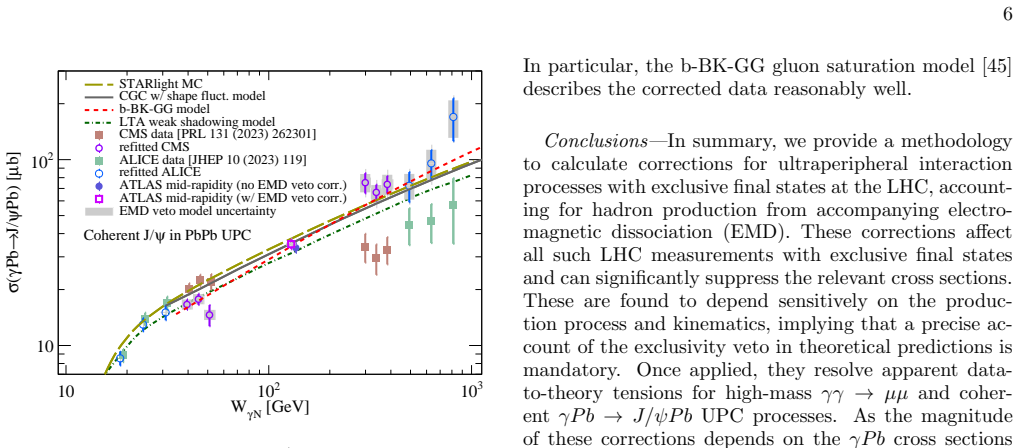
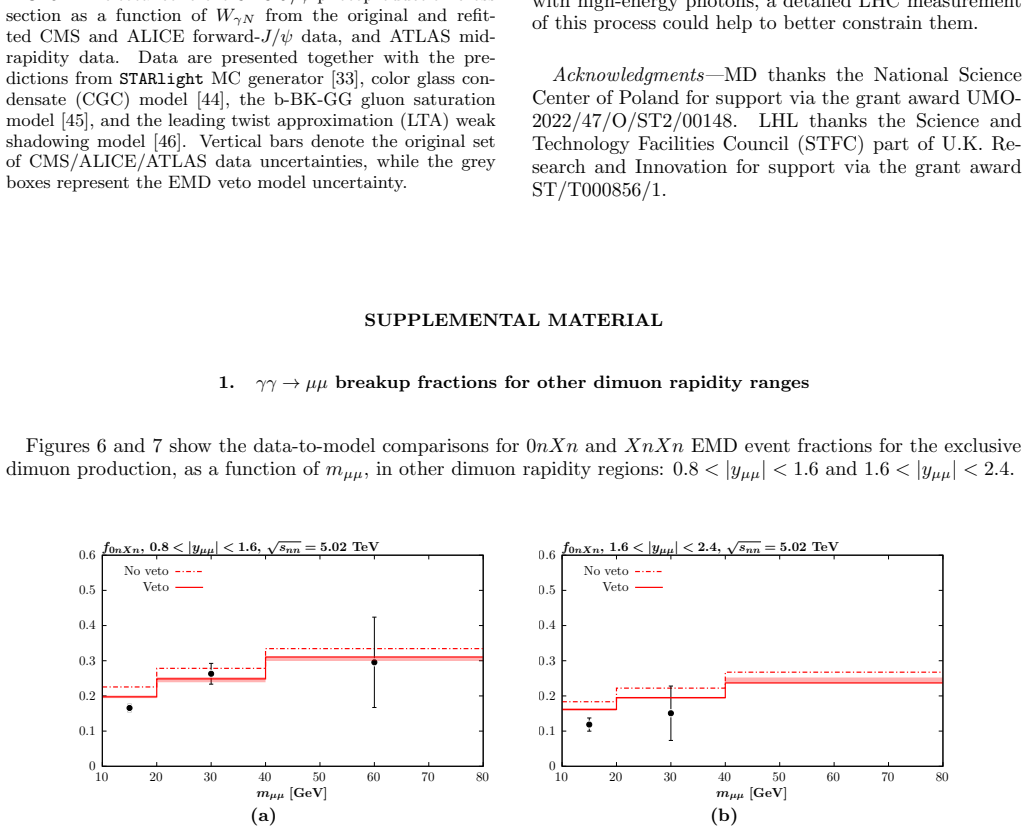
Electromagnetic dissociation of the ions can take place together with exclusive processes in ultraperipheral heavy-ion collisions. The hadrons emitted in the dissociation violate the exclusivity vetos used by experiments, so earlier calculations that ignored them overstated the purity of the selected samples. When the kinematics and production rates of these hadrons are folded into the predictions for gamma-gamma to muon pairs and coherent J/psi production, the long-standing discrepancies with LHC data disappear.
What carries the argument
The model of hadron production accompanying electromagnetic ion dissociation and its kinematic effect on exclusivity selection criteria.
If this is right
- Theoretical predictions for exclusive vector-meson photoproduction must incorporate electromagnetic dissociation contributions to match observed rates.
- The same correction applies to exclusive dilepton production in photon-photon interactions.
- Background estimates for future exclusivity-based analyses in ultraperipheral collisions will need to include this hadron source.
- Cross-section extractions for coherent and incoherent processes will shift once the effect is accounted for.
Where Pith is reading between the lines
- The same mechanism may affect exclusivity selections in other heavy-ion collider programs beyond the LHC.
- Exclusivity vetos could be supplemented with explicit hadron-activity requirements derived from dissociation models.
- Correlations between detected hadrons and exclusivity tags offer a new way to study electromagnetic dissociation in situ.
Load-bearing premise
The model used for hadron production in electromagnetic ion dissociation correctly describes the momenta and rates of those hadrons when they occur alongside exclusive vector-meson or dilepton production.
What would settle it
A direct measurement of the additional hadronic activity in events tagged as exclusive muon-pair or J/psi production that deviates from the predicted distribution and rate from electromagnetic dissociation would show the resolution does not hold.
Figures




read the original abstract
In this Letter we explore the modelling of hadron production in electromagnetic ion dissociation (EMD) processes in high-energy ultraperipheral collisions at LHC energies. Since EMD can accompany exclusive particle production in these interactions, we demonstrate that the resulting hadrons can break the exclusivity vetos typically imposed by experiments. As two representative examples, we calculate the impact on existing LHC measurements of exclusive muon pair production ($\gamma\gamma\to\mu\mu$) and exclusive coherent $J/\psi$ production. We demonstrate that accounting for this effect resolves long-standing tensions between theoretical predictions and experimental measurements.
Editorial analysis
A structured set of objections, weighed in public.
Referee Report
Summary. The paper models hadron production accompanying electromagnetic dissociation (EMD) of ions in ultraperipheral LHC collisions and shows that the resulting hadrons can violate the exclusivity vetoes used in measurements of exclusive γγ→μμ and coherent J/ψ production. It calculates the size of this background and claims that including it removes the long-standing discrepancy between theory and LHC data for these channels.
Significance. If the EMD hadron model is reliable for the low-pT kinematics and detector acceptances relevant to exclusivity vetoes, the result would be important for the interpretation of UPC measurements, as it supplies a conventional background mechanism that reconciles existing data without altering photon fluxes or introducing new physics. The work also underscores the need to treat EMD as a correlated background in future exclusive analyses.
major comments (2)
- [§4.2, Eq. (8)] §4.2 and Eq. (8): the joint probability of EMD with the exclusive process is obtained by multiplying the EMD cross section by the exclusive cross section and an overlap factor; this factorization assumes no correlation between the impact-parameter ranges that produce EMD and those that produce the exclusive final state, yet the paper does not quantify the size of the correction when a more realistic b-dependent treatment is used.
- [§5.1, Table 2] §5.1, Table 2: the reduction in the predicted exclusive μμ yield after applying the EMD veto-breaking correction is stated to be 12–18 %; however, the table reports only the central value with no uncertainty band arising from variations in the EMD hadron multiplicity or pT spectrum, making it impossible to judge whether the correction is large enough to fully resolve the quoted experimental tension.
minor comments (2)
- [Abstract] The abstract refers to 'long-standing tensions' without citing the specific measurements or quoting the size of the discrepancy before and after the correction.
- [Figure 3 caption] Notation for the EMD hadron generator (e.g., the meaning of the parameter set labeled 'default' versus 'tuned') is introduced only in the caption of Figure 3 and should be defined in the text.
Simulated Author's Rebuttal
We thank the referee for their careful reading and constructive comments on our manuscript. We address each major comment below and have revised the paper to improve the presentation and robustness of our results.
read point-by-point responses
-
Referee: [§4.2, Eq. (8)] §4.2 and Eq. (8): the joint probability of EMD with the exclusive process is obtained by multiplying the EMD cross section by the exclusive cross section and an overlap factor; this factorization assumes no correlation between the impact-parameter ranges that produce EMD and those that produce the exclusive final state, yet the paper does not quantify the size of the correction when a more realistic b-dependent treatment is used.
Authors: We acknowledge that Eq. (8) relies on a factorization approximation neglecting possible correlations in the impact-parameter distributions. EMD occurs at significantly larger average impact parameters than the exclusive processes under consideration, so the relevant overlap region is peripheral and correlations are expected to be weak. In the revised manuscript we have added a brief discussion in §4.2 noting this point and estimating the residual correction to be at the few-percent level; a full b-dependent Monte Carlo treatment lies beyond the scope of the present Letter but would not alter the main conclusions. revision: partial
-
Referee: [§5.1, Table 2] §5.1, Table 2: the reduction in the predicted exclusive μμ yield after applying the EMD veto-breaking correction is stated to be 12–18 %; however, the table reports only the central value with no uncertainty band arising from variations in the EMD hadron multiplicity or pT spectrum, making it impossible to judge whether the correction is large enough to fully resolve the quoted experimental tension.
Authors: The 12–18 % range quoted in the text already incorporates the principal variations in EMD hadron multiplicity and pT spectrum. To address the referee’s concern we have updated Table 2 to display explicit uncertainty bands derived from these variations. The revised table shows that the EMD-induced reduction remains sufficient to bring the theoretical predictions into agreement with the LHC data within the reported experimental uncertainties. revision: yes
Circularity Check
No significant circularity; central result follows from applying an external EMD hadron model to exclusivity calculations.
full rationale
The paper introduces a model for hadron production accompanying electromagnetic dissociation in ultraperipheral collisions and computes its effect on breaking experimental exclusivity vetoes for γγ→μμ and coherent J/ψ production. The claimed resolution of theory-experiment tensions is presented as the direct numerical consequence of including this additional process, with the EMD model treated as an independent input whose kinematics and rates are not redefined or fitted using the same exclusive yields under study. No step reduces by construction to a prior fit, self-citation chain, or ansatz that encodes the target result; the derivation chain remains self-contained against external benchmarks for the EMD component.
Axiom & Free-Parameter Ledger
Reference graph
Works this paper leans on
-
[1]
This model is based on a simple scaling of experimental data from exclusiveJ/ψphotoproduction off protons and neglects the nuclear modifications of the gluon density
Study of the nuclear suppression factor with UPC coherentJ/ψ It is often convenient to convert theσ(γP b→J/ψP b) photoproduction cross sections into the nuclear suppression factorS g, which can be defined as: Sg(x) = s σ(γP b→J/ψP b) σIA(γP b→J/ψP b) ,(5) wherex=m 2 J/ψ/W 2 γN andσ IA(γP b→J/ψP b) term denotes the cross sections from the impulse approxima...
-
[2]
Figure 8 presents theS g values extracted from the EMD-veto-corrected CMS, ALICE, and ATLAS coherent exclu- siveJ/ψdata shown in Fig
= gA(x, Q2 0)/[Agp(x, Q2 0)] representing the ratio of the nuclear to the proton gluon density, whereQ 2 0 = 3 GeV 2 is the resolution scale set by the charm quark mass, which allows to interpret the UPCJ/ψdata in terms of nuclear PDFs [46–48]. Figure 8 presents theS g values extracted from the EMD-veto-corrected CMS, ALICE, and ATLAS coherent exclu- sive...
- [3]
-
[4]
S. Klein and P. Steinberg, Photonuclear and Two-photon Interactions at High-Energy Nuclear Colliders, Ann. Rev. Nucl. Part. Sci.70, 323 (2020), arXiv:2005.01872 [nucl- ex]
- [5]
- [6]
- [7]
- [8]
- [9]
-
[10]
CMS Collaboration, Measurement of light-by-light scat- tering and the Breit-Wheeler process, and search for axion-like particles in ultraperipheral PbPb collisions at 8 5 −104 −103 −102 −10 x 0.2 0.4 0.6 0.8 1 1.2 (x) g S nCTEQ15HQ EPPS21 nNNPDF3.0 refitted CMS data refitted ALICE data ATLAS mid-rapidity (w/ EMD veto corr.) EMD veto model uncertainty 2 =3...
- [11]
- [12]
- [13]
- [14]
- [15]
- [16]
- [17]
- [18]
- [19]
- [20]
- [21]
- [22]
-
[23]
ATLAS Collaboration, Measurement of coherent exclu- siveJ/ψ→µ +µ− production in ultraperipheral Pb+Pb collisions at √sNN = 5.36 TeV with the ATLAS detector, JHEP04, 020, arXiv:2509.04135 [nucl-ex]
work page internal anchor Pith review Pith/arXiv arXiv
- [24]
-
[25]
CMS Collaboration, Observation of nuclear suppression in coherent Υ(1S) photoproduction off heavy nuclei at the LHC, (2026), arXiv:2604.05814 [nucl-ex]
work page internal anchor Pith review Pith/arXiv arXiv 2026
- [26]
- [27]
- [28]
-
[29]
B. L. Berman and S. C. Fultz, Measurements of the giant dipole resonance with monoenergetic photons, Rev. Mod. Phys.47, 713 (1975)
1975
- [30]
-
[31]
A comprehensive guide to the physics and usage of PYTHIA 8.3
C. Bierlichet al., A comprehensive guide to the physics and usage of PYTHIA 8.3, SciPost Phys. Codeb.2022, 8 (2022), arXiv:2203.11601 [hep-ph]
work page internal anchor Pith review arXiv 2022
-
[32]
C. Bierlich, G. Gustafson, L. L¨ onnblad, and H. Shah, The Angantyr model for Heavy-Ion Collisions in PYTHIA8, JHEP10, 134, arXiv:1806.10820 [hep-ph]
-
[33]
I. Helenius and M. Utheim, Hadron-ion collisions in Pythia and the vector-meson dominance model for photoproduction, Eur. Phys. J. C84, 1155 (2024), arXiv:2406.10403 [hep-ph]
- [34]
- [35]
- [36]
-
[37]
H.-S. Shao and D. d’Enterria, gamma-UPC: automated generation of exclusive photon-photon processes in ul- traperipheral proton and nuclear collisions with varying form factors, JHEP09, 248, arXiv:2207.03012 [hep-ph]
- [38]
-
[39]
P. Duwent¨ aster, T. Jeˇ zo, M. Klasen, K. Kovaˇ r´ ık, A. Kusina, K. F. Muzakka, F. I. Olness, R. Ruiz, I. Schienbein, and J. Y. Yu, Impact of heavy quark and quarkonium data on nuclear gluon PDFs, Phys. Rev. D 105, 114043 (2022), arXiv:2204.09982 [hep-ph]
- [40]
- [41]
- [42]
-
[43]
Sidoti, Minimum Bias Trigger Scintillators in ATLAS Run II, JINST9(10), C10020
A. Sidoti, Minimum Bias Trigger Scintillators in ATLAS Run II, JINST9(10), C10020
-
[44]
H.-S. Shao and D. d’Enterria, Dimuon and ditau produc- tion in photon-photon collisions at next-to-leading order in QED, JHEP02, 023, arXiv:2407.13610 [hep-ph]
-
[45]
M. Brozet al., Performance of ALICE AD modules in the CERN PS test beam, JINST16(01), P01017, arXiv:2006.14982 [physics.ins-det]
-
[46]
H. M¨ antysaari, F. Salazar, and B. Schenke, Energy de- pendent nuclear suppression from gluon saturation in exclusive vector meson production, Phys. Rev. D109, L071504 (2024), arXiv:2312.04194 [hep-ph]
-
[47]
D. Bendova, J. Cepila, J. G. Contreras, and M. Matas, PhotonuclearJ/ψproduction at the LHC: Proton-based versus nuclear dipole scattering amplitudes, Phys. Lett. B817, 136306 (2021), arXiv:2006.12980 [hep-ph]
-
[48]
V. Guzey and M. Strikman, Nuclear suppression of co- herent J/ψphotoproduction in heavy-ion ultraperiph- eral collisions and leading twist nuclear shadowing, Phys. Rev. C110, 045201 (2024), arXiv:2404.17476 [hep-ph]
- [49]
-
[50]
V. Guzey and M. Zhalov, ExclusiveJ/ψproduction in ultraperipheral collisions at the LHC: constrains on the gluon distributions in the proton and nuclei, JHEP10, 207, arXiv:1307.4526 [hep-ph]
- [51]
-
[52]
R. Abdul Khalek, R. Gauld, T. Giani, E. R. Nocera, T. R. Rabemananjara, and J. Rojo, nNNPDF3.0: evidence for a modified partonic structure in heavy nuclei, Eur. Phys. J. C82, 507 (2022), arXiv:2201.12363 [hep-ph]
discussion (0)
Sign in with ORCID, Apple, or X to comment. Anyone can read and Pith papers without signing in.