Recognition: 2 theorem links
· Lean TheoremEfficient High-order Mass-conserving and Energy-balancing Schemes for Schr\"odinger-Poisson Equations
Pith reviewed 2026-05-10 18:31 UTC · model grok-4.3
The pith
Relaxation post-processing applied after time stepping conserves mass and energy in discrete Schrödinger-Poisson systems up to rounding errors.
A machine-rendered reading of the paper's core claim, the machinery that carries it, and where it could break.
Core claim
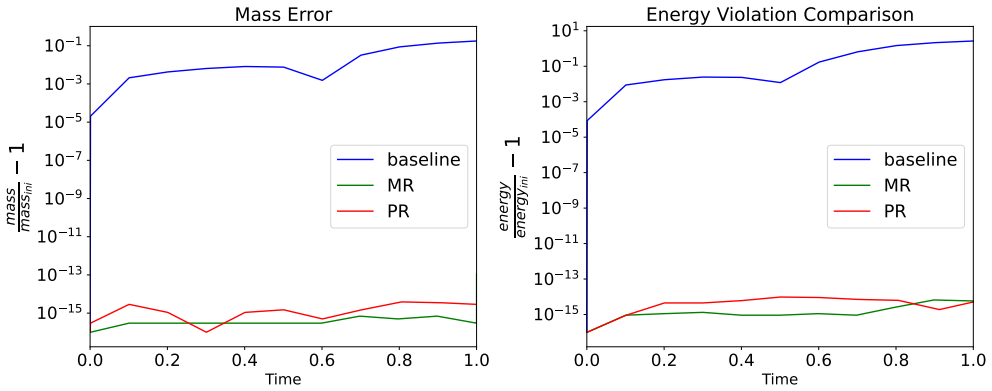
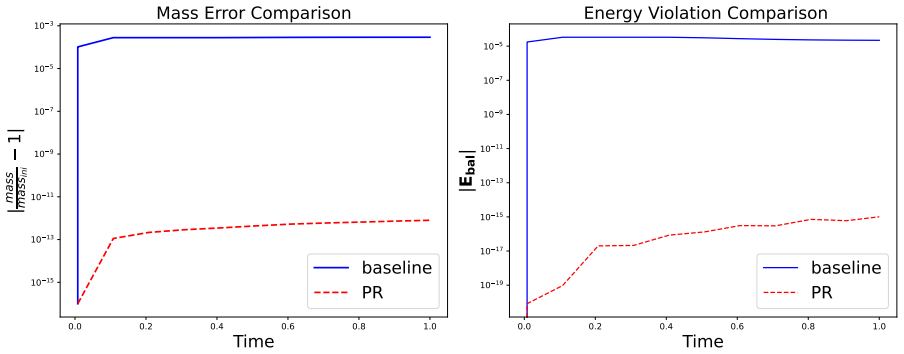
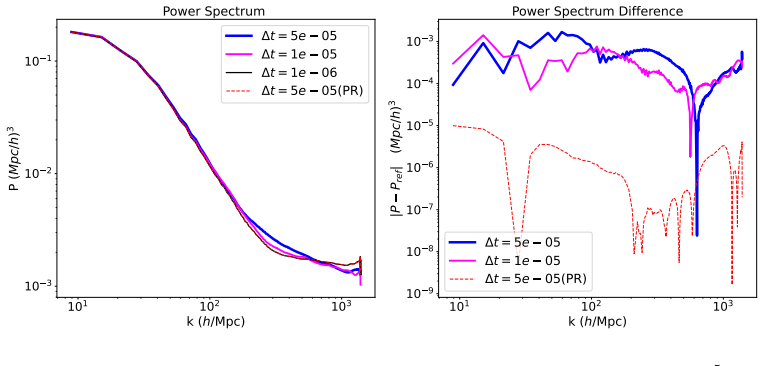
The fully discrete scheme obtained by combining Fourier collocation, an implicit-explicit Runge-Kutta integrator, and a relaxation post-processing step conserves total mass and satisfies the discrete energy balance equation exactly, up to machine rounding, for both constant and time-varying coefficients.
What carries the argument
Relaxation-based post-processing applied after each implicit-explicit Runge-Kutta step to enforce the mass and energy invariants while preserving the integrator's accuracy order.
If this is right
- The conservation property holds for the fully discrete system even when the potential coefficients vary explicitly in time.
- The underlying Runge-Kutta scheme retains its designed order of accuracy after the relaxation step is added.
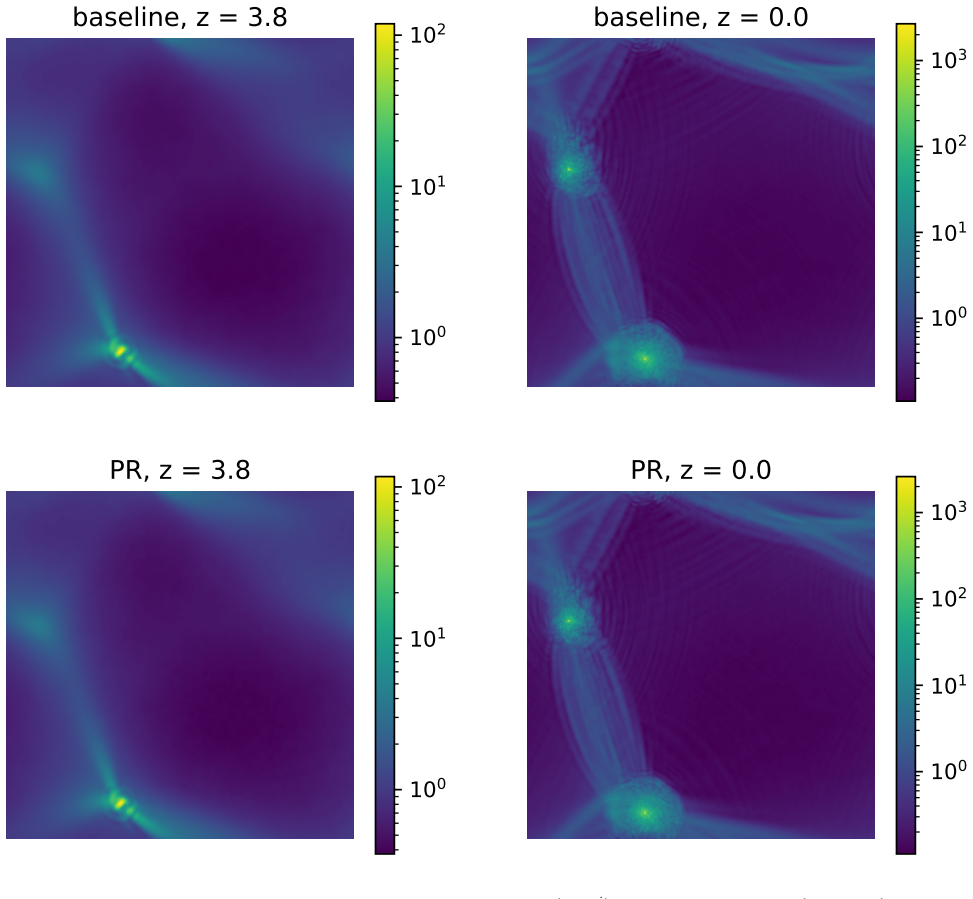
- The same framework applies equally to energy-conserving and energy-balance cases, as demonstrated by three-dimensional cosmological test problems.
- Fourier collocation in space is compatible with the relaxation step, yielding spectral accuracy in space while maintaining the invariants.
Where Pith is reading between the lines
- The same post-processing idea could be tested on other spatial discretizations such as finite elements or discontinuous Galerkin methods to check whether conservation survives without Fourier structure.
- Long-time cosmological simulations that already use Runge-Kutta integrators could adopt the relaxation step to reduce secular drift in mass and energy without changing the time-stepper.
- Because the correction is inexpensive, it may allow larger time steps in stiff regimes while still respecting the invariants, an effect not explored in the reported experiments.
Load-bearing premise
The relaxation correction can be applied to arbitrary implicit-explicit Runge-Kutta schemes without degrading their order of accuracy or introducing uncontrolled additional errors.
What would settle it
A single run of the scheme on a smooth, periodic Schrödinger-Poisson problem in which the computed mass or energy deviates from its initial value by more than a few units of machine epsilon after many time steps.
Figures





read the original abstract
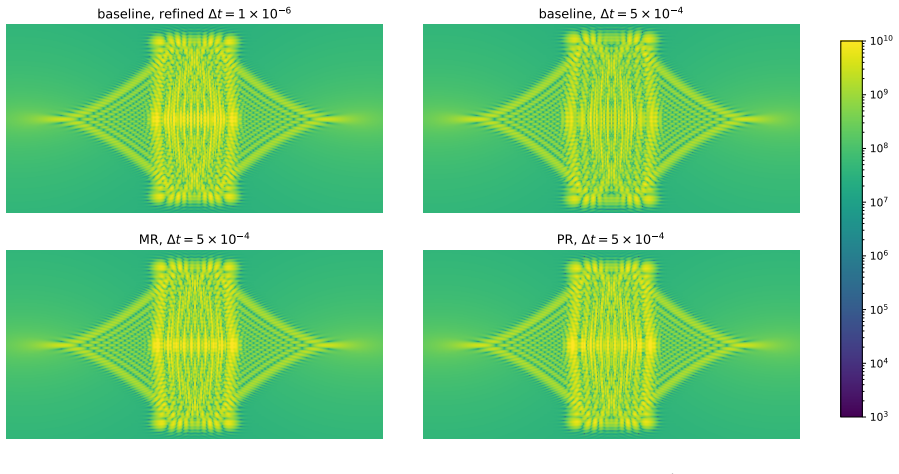
We study relaxation-based approaches for conserving mass and energy in the numerical solution of Schr\"odinger-Poisson (SP) type systems. Relaxation-based methods offer a general approach that can be applied as post-time step processing to achieve conservation with any time-stepping scheme. Here we study two types of relaxation techniques applied to implicit-explicit Runge-Kutta schemes, with Fourier collocation in space. We also study SP equations with time-varying coefficients (which appear naturally in cosmology) where energy is not conserved but satisfies a balance equation. We show that the fully-discrete system conserves both mass and energy (or satisfies the balance equation in case of time-varying coefficients), up to rounding errors. The effectiveness of these methods is demonstrated via numerical examples, including a three-dimensional cosmological simulation.
Editorial analysis
A structured set of objections, weighed in public.
Referee Report
Summary. This paper develops relaxation-based post-processing techniques applied to implicit-explicit Runge-Kutta time integrators combined with Fourier collocation spatial discretization for the Schrödinger-Poisson system. The central claim is that the resulting fully discrete schemes conserve mass and energy exactly (up to rounding errors) or satisfy the appropriate energy balance equation when coefficients vary in time, as relevant to cosmological applications. The authors provide algebraic arguments showing that the scalar relaxation correction preserves the underlying scheme's temporal order, and they demonstrate the methods on numerical examples including a three-dimensional cosmological simulation.
Significance. If the conservation properties hold as stated, the work supplies a general, efficient framework for high-order accurate simulations of nonlinear Schrödinger-Poisson equations that exactly respects key invariants without custom time-stepping schemes. This is valuable for long-time integrations where conservation errors can otherwise accumulate. The algebraic verification that the relaxation term is O(Δt^{p+1}) for any consistent IMEX RK of order p, together with the exact discrete L2 inner-product preservation under Fourier collocation, and the reproducible 3D cosmological test, constitute clear technical strengths.
minor comments (3)
- [Abstract] Abstract: the claim of conservation 'up to rounding errors' for the fully discrete system would be clearer if the abstract briefly indicated the temporal orders tested and the precise form of the relaxation parameter.
- [§3] The manuscript would benefit from an explicit statement (perhaps in §3 or §4) confirming that the Poisson nonlinearity does not introduce additional commutator terms that could affect the exact balance identity beyond what is shown for the linear Schrödinger part.
- [Numerical results] Numerical examples: a compact table summarizing mass and energy errors versus Δt for both standard IMEX RK and the relaxed versions would make the order-preservation claim easier to verify at a glance.
Simulated Author's Rebuttal
We thank the referee for the positive assessment of our work and for recommending minor revision. The report correctly identifies the core contribution: relaxation post-processing applied to IMEX Runge-Kutta schemes with Fourier collocation that enforces exact (up to round-off) mass conservation and the appropriate energy balance for time-dependent coefficients. We address the report below.
Circularity Check
No significant circularity
full rationale
The paper establishes that the fully discrete scheme (IMEX Runge-Kutta + Fourier collocation + relaxation) conserves mass and satisfies the energy balance (or balance equation) exactly up to rounding errors. These statements are proven via direct algebraic identities that follow from the scheme's structure and the exact preservation of the discrete L2 inner product under Fourier collocation; the relaxation correction is shown separately to be O(Δt^{p+1}) for any consistent order-p IMEX RK method. No step reduces by construction to a fitted input, a self-referential definition, or a load-bearing self-citation whose validity is assumed rather than independently verified. The derivation is therefore self-contained.
Axiom & Free-Parameter Ledger
Lean theorems connected to this paper
-
IndisputableMonolith/Cost/FunctionalEquation.leanwashburn_uniqueness_aczel unclear?
unclearRelation between the paper passage and the cited Recognition theorem.
We show that the fully-discrete system conserves both mass and energy (or satisfies the balance equation in case of time-varying coefficients), up to rounding errors.
-
IndisputableMonolith/Foundation/ArithmeticFromLogic.leanLogicNat recovery of Peano arithmetic unclear?
unclearRelation between the paper passage and the cited Recognition theorem.
relaxation-based approaches for conserving mass and energy... applied as post-time step processing
What do these tags mean?
- matches
- The paper's claim is directly supported by a theorem in the formal canon.
- supports
- The theorem supports part of the paper's argument, but the paper may add assumptions or extra steps.
- extends
- The paper goes beyond the formal theorem; the theorem is a base layer rather than the whole result.
- uses
- The paper appears to rely on the theorem as machinery.
- contradicts
- The paper's claim conflicts with a theorem or certificate in the canon.
- unclear
- Pith found a possible connection, but the passage is too broad, indirect, or ambiguous to say the theorem truly supports the claim.
Reference graph
Works this paper leans on
-
[1]
A novel, structure-preserving, second-order-in-time relaxation scheme for Schr¨ odinger-Poisson systems.Jour- nal of Computational Physics, 490:112307, 2023
Agissilaos Athanassoulis, Theodoros Katsaounis, Irene Kyza, and Stephen Metcalfe. A novel, structure-preserving, second-order-in-time relaxation scheme for Schr¨ odinger-Poisson systems.Jour- nal of Computational Physics, 490:112307, 2023
2023
-
[2]
Convergence of a Strang splitting finite element discretization for the Schr¨ odinger–Poisson equation.ESAIM: Mathematical Modelling and Numerical Analysis, 51(4):1245–1278, 2017
Winfried Auzinger, Thomas Kassebacher, Othmar Koch, and Mechthild Thalhammer. Convergence of a Strang splitting finite element discretization for the Schr¨ odinger–Poisson equation.ESAIM: Mathematical Modelling and Numerical Analysis, 51(4):1245–1278, 2017
2017
-
[3]
Mauser, and H.P
Weizhu Bao, N.J. Mauser, and H.P. Stimming. Effective one particle quantum dynamics of elec- trons:: A numerical study of the Schr¨ odinger-Poisson-Xαmodel.Communications in Mathematical Sciences, 1(4):809 – 828, 2003. Cited by: 54; All Open Access, Bronze Open Access
2003
-
[4]
Energy- preserving methods for nonlinear Schr¨ odinger equations.IMA Journal of Numerical Analysis, 41(1):618–653, 06 2020
Christophe Besse, St´ ephane Descombes, Guillaume Dujardin, and Ingrid Lacroix-Violet. Energy- preserving methods for nonlinear Schr¨ odinger equations.IMA Journal of Numerical Analysis, 41(1):618–653, 06 2020
2020
-
[5]
Busaleh, David I
Abhijit Biswas, Laila S. Busaleh, David I. Ketcheson, Carlos Mu˜ noz-Moncayo, and Manvendra Rajvanshi. A hyperbolic approximation of the nonlinear Schr¨ odinger equation.Studies in Applied Mathematics, 155(4):e70129, 2025
2025
-
[6]
Ketcheson
Abhijit Biswas and David I. Ketcheson. Accurate solution of the nonlinear Schr¨ odinger equa- tion via conservative multiple-relaxation ImEx methods.SIAM Journal on Scientific Computing, 46(6):A3827–A3848, 2024
2024
-
[7]
Society for Industrial and Applied Mathematics, Philadel- phia, PA, 2024
Sebastiano Boscarino, Lorenzo Pareschi, and Giovanni Russo.Implicit-Explicit Methods for Evolu- tionary Partial Differential Equations. Society for Industrial and Applied Mathematics, Philadel- phia, PA, 2024
2024
-
[8]
Mass-radius relation of Newtonian self-gravitating Bose-Einstein condensates with short-range interactions
Pierre-Henri Chavanis. Mass-radius relation of Newtonian self-gravitating Bose-Einstein condensates with short-range interactions. i. Analytical results.Phys. Rev. D, 84:043531, Aug 2011
2011
-
[9]
A Fourier collocation method for Schr¨ odinger-Poisson system with perfectly matched layer.Communications in Mathematical Sciences, 20(2):523 – 542, 2022
Ronghua Cheng, Liping Wu, Chunping Pang, and Hanquan Wang. A Fourier collocation method for Schr¨ odinger-Poisson system with perfectly matched layer.Communications in Mathematical Sciences, 20(2):523 – 542, 2022. Cited by: 6
2022
-
[10]
Effective mass and energy recovery by conserved compact finite difference schemes.IEEE Access, 6:52336–52344, 2018
Xiujun Cheng, Xiaoli Chen, and Dongfang Li. Effective mass and energy recovery by conserved compact finite difference schemes.IEEE Access, 6:52336–52344, 2018
2018
-
[11]
W. J. G. de Blok. The core-cusp problem.Advances in Astronomy, 2010(1), November 2009
2010
-
[12]
PyUltraLight: a pseudo- spectral solver for ultralight dark matter dynamics.Journal of Cosmology and Astroparticle Physics, 2018(10):027–027, October 2018
Faber Edwards, Emily Kendall, Shaun Hotchkiss, and Richard Easther. PyUltraLight: a pseudo- spectral solver for ultralight dark matter dynamics.Journal of Cosmology and Astroparticle Physics, 2018(10):027–027, October 2018
2018
-
[13]
Fast calculation of energy and mass preserving solutions of Schr¨ odinger–Poisson systems on unbounded domains.Journal of computational and applied mathematics, 187(1):1–28, 2006
Matthias Ehrhardt and Andrea Zisowsky. Fast calculation of energy and mass preserving solutions of Schr¨ odinger–Poisson systems on unbounded domains.Journal of computational and applied mathematics, 187(1):1–28, 2006
2006
-
[14]
SAV Galerkin-Legendre spectral method for the nonlinear Schr¨ odinger-Poisson equations.Electronic Research Archive, 30(3):943–960, 2022
Chunye Gong, Mianfu She, Wanqiu Yuan, and Dan Zhao. SAV Galerkin-Legendre spectral method for the nonlinear Schr¨ odinger-Poisson equations.Electronic Research Archive, 30(3):943–960, 2022
2022
-
[15]
Fuzzy cold dark matter: The wave properties of ultralight particles.Phys
Wayne Hu, Rennan Barkana, and Andrei Gruzinov. Fuzzy cold dark matter: The wave properties of ultralight particles.Phys. Rev. Lett., 85:1158–1161, Aug 2000
2000
-
[16]
K. Husimi. Some formal properties of the density matrix.Proceedings of the Physico-Mathematical Society of Japan. 3rd Series, 22(4):264–314, 1940
1940
-
[17]
PhD thesis, Harvard University, Massachusetts, January 1961
William Michael Irvine.Local Irregularities in a Universe Satisfying the Cosmological Principle. PhD thesis, Harvard University, Massachusetts, January 1961
1961
-
[18]
C. A. Kennedy and M. H. Carpenter. Additive Runge-Kutta schemes for convection-diffusion- reaction equations.Applied Numerical Mathematics, 44:139–181, 2003. 18
2003
-
[19]
Ketcheson
David I. Ketcheson. Relaxation Runge-Kutta methods: Conservation and stability for inner-product norms, 2019
2019
-
[20]
Solving the Vlasov equation in two spatial dimensions with the Schr¨ odinger method.Physical Review D, 96(12), December 2017
Michael Kopp, Kyriakos Vattis, and Constantinos Skordis. Solving the Vlasov equation in two spatial dimensions with the Schr¨ odinger method.Physical Review D, 96(12), December 2017
2017
-
[21]
A preface to cosmogony
David Layzer. A preface to cosmogony. I. the energy equation and the virial theorem for cosmic distributions. ApJ, 138:174, July 1963
1963
-
[22]
D. G. Levkov, A. G. Panin, and I. I. Tkachev. Gravitational Bose-Einstein condensation in the kinetic regime.Phys. Rev. Lett., 121:151301, Oct 2018
2018
-
[23]
Markowich, Christian A
Peter A. Markowich, Christian A. Ringhofer, and Christian Schmeiser.Semiconductor equations. Springer-Verlag, Berlin, Heidelberg, 1990
1990
-
[24]
David J. E. Marsh and Ana-Roxana Pop. Axion dark matter, solitons and the cusp–core problem. Monthly Notices of the Royal Astronomical Society, 451(3):2479–2492, 06 2015
2015
-
[25]
David J.E. Marsh. Axion cosmology.Physics Reports, 643:1–79, 2016. Axion Cosmology
2016
-
[26]
Simon May and Volker Springel. Structure formation in large-volume cosmological simulations of fuzzy dark matter: impact of the non-linear dynamics.Monthly Notices of the Royal Astronomical Society, 506(2):2603–2618, 06 2021
2021
-
[27]
Mota, and Hans A
Mattia Mina, David F. Mota, and Hans A. Winther. SCALAR: an AMR code to simulate axion-like dark matter models. A&A, 641:A107, September 2020
2020
-
[28]
Schr¨ odinger-Poisson–Vlasov-Poisson correspondence.Phys
Philip Mocz, Lachlan Lancaster, Anastasia Fialkov, Fernando Becerra, and Pierre-Henri Chavanis. Schr¨ odinger-Poisson–Vlasov-Poisson correspondence.Phys. Rev. D, 97:083519, Apr 2018
2018
-
[29]
Robles, Jes´ us Zavala, Michael Boylan-Kolchin, Anastasia Fialkov, and Lars Hernquist
Philip Mocz, Mark Vogelsberger, Victor H. Robles, Jes´ us Zavala, Michael Boylan-Kolchin, Anastasia Fialkov, and Lars Hernquist. Galaxy formation with BECDM – I. Turbulence and relaxation of idealized haloes.Monthly Notices of the Royal Astronomical Society, 471(4):4559–4570, July 2017
2017
-
[30]
High-order numerical solution for solving multi-dimensional Schr¨ odinger-Poisson equation.Applied Numerical Mathematics, 2025
Maedeh Nemati, Mostafa Abbaszadeh, and Mehdi Dehghan. High-order numerical solution for solving multi-dimensional Schr¨ odinger-Poisson equation.Applied Numerical Mathematics, 2025
2025
-
[31]
Olivieri, and Humberto Michinel
Angel Paredes, David N. Olivieri, and Humberto Michinel. From optics to dark matter: A review on nonlinear Schr¨ odinger–Poisson systems.Physica D: Nonlinear Phenomena, 403:132301, 2020
2020
-
[32]
Optimistix: modular optimisation in JAX and Equinox.arXiv:2402.09983, 2024
Jason Rader, Terry Lyons, and Patrick Kidger. Optimistix: modular optimisation in JAX and Equinox.arXiv:2402.09983, 2024
-
[33]
Ketcheson
Hendrik Ranocha and David I. Ketcheson. High-order mass- and energy-conserving methods for the nonlinear Schr¨ odinger equation and its hyperbolization, 2025
2025
-
[34]
Ketcheson
Hendrik Ranocha, Lajos L´ oczi, and David I. Ketcheson. General relaxation methods for initial-value problems with application to multistep schemes.Numerische Mathematik, 146(4):875–906, October 2020
2020
-
[35]
Discrete Schr¨ odinger-Poisson systems preserving energy and mass.Applied Mathematics Letters, 13(7):27–32, 2000
Christian Ringhofer and Juan Soler. Discrete Schr¨ odinger-Poisson systems preserving energy and mass.Applied Mathematics Letters, 13(7):27–32, 2000
2000
-
[36]
Systems of self-gravitating particles in General Relativity and the concept of an equation of state.Phys
Remo Ruffini and Silvano Bonazzola. Systems of self-gravitating particles in General Relativity and the concept of an equation of state.Phys. Rev., 187:1767–1783, Nov 1969
1969
-
[37]
An explicit finite-difference scheme with exact conservation properties.Journal of Computational Physics, 47(2):199–210, 1982
J.M Sanz-Serna. An explicit finite-difference scheme with exact conservation properties.Journal of Computational Physics, 47(2):199–210, 1982
1982
-
[38]
A method for the integration in time of certain partial differential equations.Journal of Computational Physics, 52(2):273–289, 1983
J.M Sanz-Serna and V.S Manoranjan. A method for the integration in time of certain partial differential equations.Journal of Computational Physics, 52(2):273–289, 1983
1983
-
[39]
Fuzzy dark matter simulations, 2025
Hsi-Yu Schive. Fuzzy dark matter simulations, 2025
2025
-
[40]
Cosmic structure as the quantum interference of a coherent dark wave.Nature Physics, 10(7):496–499, June 2014
Hsi-Yu Schive, Tzihong Chiueh, and Tom Broadhurst. Cosmic structure as the quantum interference of a coherent dark wave.Nature Physics, 10(7):496–499, June 2014. 19
2014
-
[41]
Pauchy Hwang
Hsi-Yu Schive, Ming-Hsuan Liao, Tak-Pong Woo, Shing-Kwong Wong, Tzihong Chiueh, Tom Broad- hurst, and W-Y. Pauchy Hwang. Understanding the core-halo relation of quantum wave dark matter from 3d simulations.Phys. Rev. Lett., 113:261302, Dec 2014
2014
-
[42]
Stability of self-gravitating Bose-Einstein con- densates.Phys
Kris Schroven, Meike List, and Claus L¨ ammerzahl. Stability of self-gravitating Bose-Einstein con- densates.Phys. Rev. D, 92:124008, Dec 2015
2015
-
[43]
Niemeyer, and Richard Easther
Bodo Schwabe, Mateja Gosenca, Christoph Behrens, Jens C. Niemeyer, and Richard Easther. Sim- ulating mixed fuzzy and cold dark matter.Phys. Rev. D, 102:083518, Oct 2020
2020
-
[44]
ColDICE: A parallel Vlasov–Poisson solver using moving adaptive simplicial tessellation.Journal of Computational Physics, 321:644–697, September 2016
Thierry Sousbie and St´ ephane Colombi. ColDICE: A parallel Vlasov–Poisson solver using moving adaptive simplicial tessellation.Journal of Computational Physics, 321:644–697, September 2016
2016
-
[45]
Simulating cosmic struc- ture formation with the GADGET-4 code.Monthly Notices of the Royal Astronomical Society, 506(2):2871–2949, July 2021
Volker Springel, R¨ udiger Pakmor, Oliver Zier, and Martin Reinecke. Simulating cosmic struc- ture formation with the GADGET-4 code.Monthly Notices of the Royal Astronomical Society, 506(2):2871–2949, July 2021
2021
-
[46]
Point-wise error estimates of two mass- and energy-preserving schemes for two-dimensional Schr¨ odinger-Poisson equations.Applied Numerical Mathematics, 2025
Jialing Wang, Anxin Kong, Tingchun Wang, and Wenjun Cai. Point-wise error estimates of two mass- and energy-preserving schemes for two-dimensional Schr¨ odinger-Poisson equations.Applied Numerical Mathematics, 2025
2025
-
[47]
Widrow and Nick Kaiser
Lawrence M. Widrow and Nick Kaiser. Using the Schr¨ odinger equation to simulate collisionless matter. ApJ, 416:L71, October 1993
1993
-
[48]
High-resolution simulation on structure formation with ex- tremely light bosonic dark matter.The Astrophysical Journal, 697(1):850, may 2009
Tak-Pong Woo and Tzihong Chiueh. High-resolution simulation on structure formation with ex- tremely light bosonic dark matter.The Astrophysical Journal, 697(1):850, may 2009
2009
-
[49]
Cosmological simulation for fuzzy dark matter model.Frontiers in Astronomy and Space Sciences, 5, January 2019
Jiajun Zhang, Hantao Liu, and Ming-Chung Chu. Cosmological simulation for fuzzy dark matter model.Frontiers in Astronomy and Space Sciences, 5, January 2019. 20
2019
discussion (0)
Sign in with ORCID, Apple, or X to comment. Anyone can read and Pith papers without signing in.