Recognition: no theorem link
Self-gravitating thin shells are dynamically unstable on all angular scales
Pith reviewed 2026-05-10 19:28 UTC · model grok-4.3
The pith
Thin shells of perfect fluid separating Minkowski and Schwarzschild spacetimes are dynamically unstable on all angular scales.
A machine-rendered reading of the paper's core claim, the machinery that carries it, and where it could break.
Core claim
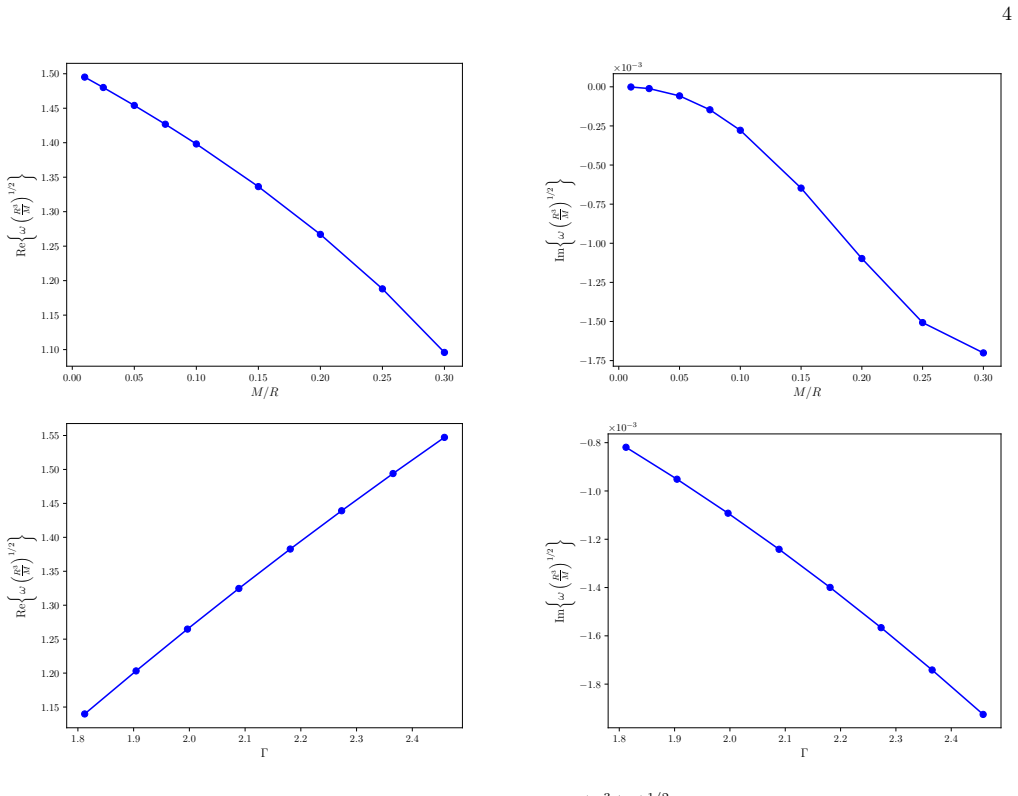
We reveal the existence of two modes with a purely imaginary frequency, one negative (which describes stable oscillations), the other positive (which describes an exponential growth); these modes occur for all sampled values of the shell's compactness and adiabatic index, and all sampled values of the multipolar order ℓ ≥ 2, in the even-parity sector of the perturbation. All other quasinormal modes describe damped oscillations.
What carries the argument
The eigenvalue problem for even-parity perturbation frequencies obtained by solving the linearized Einstein equations inside and outside the shell and enforcing Israel's junction conditions with a source term from the perturbed barotropic fluid.
If this is right
- Thin-shell configurations are ruled out as stable models of black-hole mimickers.
- The same instability appears in the Newtonian limit for a self-gravitating thin shell.
- All other quasinormal modes are damped, so the unstable mode determines the long-term behavior.
- The instability is present at every angular scale, not only in the eikonal limit of large ℓ.
Where Pith is reading between the lines
- The result suggests that any compact object whose surface is modeled by an abrupt density jump may inherit a similar instability.
- Numerical initial-value evolutions of thin-shell data could directly confirm the growth rate extracted from the frequency spectrum.
- The nonrelativistic instability indicates that the effect survives when gravitational field strengths are weak.
Load-bearing premise
The shell is infinitesimally thin, composed of a perfect fluid with a barotropic equation of state, and separates exactly Minkowski spacetime inside from Schwarzschild spacetime outside.
What would settle it
An analytic demonstration that the positive imaginary frequency mode vanishes for some value of compactness or adiabatic index, or a numerical evolution in which an initial perturbation of a thin shell fails to grow.
Figures



read the original abstract
We establish the dynamical instability of a static, spherically symmetric, and infinitesimally thin shell in general relativity. The shell is made up of a perfect fluid with a barotropic equation of state, and it produces a Schwarzschild spacetime in its exterior and a Minkowski spacetime in its interior. We reveal the existence of two modes with a purely imaginary frequency, one negative (which describes stable oscillations), the other positive (which describes an exponential growth); these modes occur for all sampled values of the shell's compactness and adiabatic index, and all sampled values of the multipolar order $\ell \geq 2$, in the even-parity sector of the perturbation. All other quasinormal modes describe damped oscillations. This study complements a recent analysis by Yang, Bonga, and Pen, which also concluded in a dynamical instability, but was limited by an eikonal approximation to small angular scales ($\ell \gg 1$); our treatment applies to all angular scales. The eigenvalue problem for the mode frequencies is formulated by introducing a perturbation of Minkowski spacetime, a perturbation of Schwarzschild spacetime, and a perturbation of the shell matter. The metric perturbations are governed by the Einstein field equations, and they are matched across the shell with the help of Israel's junction conditions. The matter perturbation is governed by the equations of fluid mechanics, and it produces a source term in the junction conditions. All calculations are carried out in full general relativity, but we also examine a nonrelativistic formulation of the problem; we show that a Newtonian shell also is necessarily unstable to a time-dependent perturbation. Our conclusion suggests that a compact object that features a thin shell at its surface will be dynamically unstable; this makes it nonviable as a model of black-hole mimicker.
Editorial analysis
A structured set of objections, weighed in public.
Referee Report
Summary. The manuscript claims that static, spherically symmetric, infinitesimally thin shells of perfect fluid (barotropic EOS) with Minkowski interior and Schwarzschild exterior are dynamically unstable in GR. Linearized even-parity metric perturbations are matched to fluid perturbations via Israel's junction conditions, yielding an eigenvalue problem whose numerical solutions exhibit a positive-imaginary-frequency mode (exponential growth) for all sampled compactness, adiabatic index, and multipolar order ℓ ≥ 2; a negative-imaginary-frequency mode (stable oscillations) is also found, while all other quasinormal modes are damped. The work includes a parallel Newtonian analysis showing instability and extends prior eikonal results to all angular scales.
Significance. If the numerical result holds, the paper would establish that thin-shell models are nonviable as black-hole mimickers because they are unstable on all angular scales, complementing the small-scale eikonal analysis of Yang, Bonga, and Pen. The explicit demonstration of instability in the Newtonian limit supplies independent, non-GR support. The formulation via standard linearized Einstein equations, Israel's conditions, and fluid equations is a methodological strength.
major comments (2)
- [Abstract and §4 (Numerical Results)] Abstract and §4 (Numerical Results): The central claim of instability 'for all sampled values' of compactness, adiabatic index, and ℓ ≥ 2 (and thus 'on all angular scales' in the title) rests on discrete numerical sampling of the eigenvalue problem without reported grid density, sampling ranges, number of points, or convergence tests for the mode finder. This is load-bearing, as gaps or missed roots in the characteristic equation could falsify the generality asserted.
- [§3 (Formulation of the eigenvalue problem)] §3 (Formulation of the eigenvalue problem): While the setup using Minkowski/Schwarzschild perturbations and Israel's junction conditions is standard, no analytic proof, root-counting argument, or exhaustive coverage of the parameter space is provided to guarantee the positive-imaginary-frequency root exists for every value rather than the sampled points; the conclusion therefore depends entirely on the numerical survey.
minor comments (2)
- [Abstract] The abstract and results section do not specify the numerical ranges or number of sampled points for compactness, adiabatic index, and ℓ, which would improve reproducibility and allow readers to assess coverage.
- [Figures] Figures displaying the imaginary parts of the frequencies versus parameters lack error bars, numerical tolerances, or indications of solver precision, making it harder to judge the robustness of the reported positive imaginary values.
Simulated Author's Rebuttal
We thank the referee for their careful reading and constructive comments on our manuscript. We appreciate the positive assessment of the work's significance and address the major comments point by point below, with plans to revise the manuscript to improve transparency.
read point-by-point responses
-
Referee: [Abstract and §4 (Numerical Results)] Abstract and §4 (Numerical Results): The central claim of instability 'for all sampled values' of compactness, adiabatic index, and ℓ ≥ 2 (and thus 'on all angular scales' in the title) rests on discrete numerical sampling of the eigenvalue problem without reported grid density, sampling ranges, number of points, or convergence tests for the mode finder. This is load-bearing, as gaps or missed roots in the characteristic equation could falsify the generality asserted.
Authors: We agree that additional details on the numerical procedure are required to support the claims. In the revised manuscript we will expand §4 to report the specific sampling ranges and densities used for compactness, adiabatic index, and multipole order ℓ, the total number of points evaluated, and the convergence tests applied to the eigenvalue solver, including variations in search intervals and numerical tolerances to check for missed roots. This will make the survey reproducible and address concerns about potential gaps. revision: yes
-
Referee: [§3 (Formulation of the eigenvalue problem)] §3 (Formulation of the eigenvalue problem): While the setup using Minkowski/Schwarzschild perturbations and Israel's junction conditions is standard, no analytic proof, root-counting argument, or exhaustive coverage of the parameter space is provided to guarantee the positive-imaginary-frequency root exists for every value rather than the sampled points; the conclusion therefore depends entirely on the numerical survey.
Authors: We acknowledge that the analysis is purely numerical and that no analytic proof or root-counting argument is available. The characteristic equation obtained from the linearized Einstein equations, Israel's conditions, and fluid perturbations is transcendental and does not admit a simple analytic treatment. In the revision we will clarify in §3 and the conclusions that the instability is demonstrated for all sampled parameter values, qualify the title's reference to 'all angular scales' by specifying the investigated range of ℓ, and add a short discussion of the limitations of the numerical approach. revision: partial
- Absence of an analytic proof or root-counting argument guaranteeing the unstable mode for every possible parameter value rather than the numerically sampled points.
Circularity Check
No circularity: derivation follows directly from linearized Einstein equations and junction conditions
full rationale
The paper formulates the eigenvalue problem for quasinormal modes by perturbing the Minkowski interior, Schwarzschild exterior, and thin-shell fluid, then enforces the Einstein field equations together with Israel's junction conditions and the barotropic fluid equations. The positive imaginary frequency (indicating instability) emerges as a numerical root of this characteristic equation for each sampled compactness, adiabatic index, and ℓ ≥ 2. This is a direct forward computation, not a self-definitional loop, not a fitted parameter renamed as a prediction, and not dependent on any self-citation chain. The Newtonian limit is treated separately as an independent check. No ansatz is smuggled via citation, and no known result is merely relabeled. The derivation chain is therefore self-contained and non-circular.
Axiom & Free-Parameter Ledger
axioms (3)
- standard math Einstein field equations govern the metric perturbations
- domain assumption Israel's junction conditions match the metric and matter perturbations across the thin shell
- domain assumption Perfect fluid with barotropic equation of state obeys the equations of fluid mechanics
Forward citations
Cited by 1 Pith paper
-
Unifying the Regge-Wheeler-Zerilli and Bardeen-Press-Teukolsky formalisms on spherical backgrounds
A self-dual curvature formulation unifies the Regge-Wheeler-Zerilli and Bardeen-Press-Teukolsky equations on spherical backgrounds as components of one tensorial curvature equation.
Reference graph
Works this paper leans on
-
[1]
The Cartesian description of the deformed shell is then x=Rsinϑcosφ+O(h 2 1), x=Rsinϑsinφ+O(h 2 1), z=Rcosϑ+Rh 1 +O(h 2 1),(10.59) and we see that the perturbation describes a translation byRh 1(t) in thez-direction. 42 I. Static tides When the tidal field is idealized as static, so thate ℓm does not depend on time, the solution to Eq. (10.51) is simply x...
-
[2]
(8.11d) after simplification
We arrive at Eq. (8.11d) after simplification. We get Eq. (8.11c) directly from Eq. (8.11d) after making use of Eq. (B6), in which we now inserta=b=ℓand c= 2ℓ+ 2
-
[3]
B. P. Abbott et al. (LIGO Scientific Collaboration and Virgo Collaboration), Observation of Gravitational Waves from a Binary Black Hole Merger, Phys. Rev. Lett.116, 061102 (2016)
2016
-
[4]
B. P. Abbott et al. and Abbott. (LIGO Scientific Collaboration and Virgo Collaboration), GWTC-1: A Gravitational-Wave Transient Catalog of Compact Binary Mergers Observed by LIGO and Virgo during the First and Second Observing Runs, Phys. Rev. X9, 031040 (2019)
2019
-
[5]
Abbott et al
R. Abbott et al. (LIGO Scientific Collaboration and Virgo Collaboration), GWTC-2: Compact Binary Coalescences Observed by LIGO and Virgo during the First Half of the Third Observing Run, Phys. Rev. X11, 021053 (2021)
2021
-
[6]
Abbott et al
R. Abbott et al. (LIGO Scientific Collaboration, Virgo Collaboration, and KAGRA Collaboration), GWTC-3: Compact Binary Coalescences Observed by LIGO and Virgo during the Second Part of the Third Observing Run, Phys. Rev. X13, 041039 (2023)
2023
-
[7]
A. G. Abac et al. (LIGO Scientific Collaboration, Virgo Collaboration, and KAGRA Collaboration), GWTC-4.0: Updating the Gravitational-Wave Transient Catalog with Observations from the First Part of the Fourth LIGO-Virgo-KAGRA Observing Run (2025), arXiv:2508.18082 [gr-qc]
work page internal anchor Pith review Pith/arXiv arXiv 2025
-
[8]
S. Doeleman et al., Imaging an Event Horizon: submm-VLBI of a Super Massive Black Hole (2009), arXiv:0906.3899 [astro-ph.CO]
-
[9]
Akiyama et al., First M87 Event Horizon Telescope Results
K. Akiyama et al., First M87 Event Horizon Telescope Results. I. The Shadow of the Supermassive Black Hole, Astrophys. J. Lett.875, L1 (2019)
2019
-
[10]
Sch¨ odel et al., A star in a 15.2-year orbit around the supermassive black hole at the centre of the Milky Way, Nature 419, 694–696 (2002)
R. Sch¨ odel et al., A star in a 15.2-year orbit around the supermassive black hole at the centre of the Milky Way, Nature 419, 694–696 (2002)
2002
-
[11]
Cardoso and P
V. Cardoso and P. Pani, Testing the nature of dark compact objects: a status report, Living Reviews in Relativity22 (2019)
2019
-
[12]
Small, dark, and heavy: But is it a black hole?,
M. Visser, C. Barcelo, S. Liberati, and S. Sonego, Small, dark, and heavy: But is it a black hole? (2009), arXiv:0902.0346 [gr-qc]
-
[13]
N. K. Johnson-McDaniel, A. Mukherjee, R. Kashyap, P. Ajith, W. Del Pozzo, and S. Vitale, Constraining black hole mimickers with gravitational wave observations, Phys. Rev. D102, 123010 (2020)
2020
-
[14]
H. Yang, K. Yagi, J. Blackman, L. Lehner, V. Paschalidis, F. Pretorius, and N. Yunes, Black Hole Spectroscopy with Coherent Mode Stacking, Phys. Rev. Lett.118, 161101 (2017)
2017
-
[15]
Berti, A
E. Berti, A. Sesana, E. Barausse, V. Cardoso, and K. Belczynski, Spectroscopy of Kerr Black Holes with Earth- and Space-Based Interferometers, Phys. Rev. Lett.117, 101102 (2016)
2016
-
[16]
Cosmic Explorer: The U.S. Contribution to Gravitational-Wave Astronomy beyond LIGO
D. Reitze et al., Cosmic Explorer: The U.S. Contribution to Gravitational-Wave Astronomy beyond LIGO (2019), arXiv:1907.04833 [astro-ph.IM]
work page internal anchor Pith review arXiv 2019
-
[17]
Punturo et al., The Einstein Telescope: a third-generation gravitational wave observatory, Class
M. Punturo et al., The Einstein Telescope: a third-generation gravitational wave observatory, Class. Quantum Grav.27, 194002 (2010)
2010
-
[18]
Laser Interferometer Space Antenna
P. Amaro-Seoane et al., Laser Interferometer Space Antenna (2017), arXiv:1702.00786 [astro-ph.IM]
work page internal anchor Pith review Pith/arXiv arXiv 2017
-
[19]
P. O. Mazur and E. Mottola, Gravitational condensate stars: An alternative to black holes, Universe9, 88 (2023)
2023
-
[20]
Cardoso, E
V. Cardoso, E. Franzin, and P. Pani, Is the Gravitational-Wave Ringdown a Probe of the Event Horizon?, Phys. Rev. Lett. 116, 171101 (2016)
2016
-
[21]
Chirenti and L
C. Chirenti and L. Rezzolla, Did GW150914 produce a rotating gravastar?, Phys. Rev. D94, 084016 (2016)
2016
-
[22]
H. Yang, B. Bonga, and Z. Pan, Dynamical Instability of Self-Gravitating Membranes, Phys. Rev. Lett.130, 011402 (2023)
2023
-
[23]
P. Pani, E. Berti, V. Cardoso, Y. Chen, and R. Norte, Gravitational wave signatures of the absence of an event horizon: Nonradial oscillations of a thin-shell gravastar, Phys. Rev. D80, 124047 (2009). 47
2009
-
[24]
Israel, Singular hypersurfaces and thin shells in general relativity, Nuovo Cimento44, 1 (1966)
W. Israel, Singular hypersurfaces and thin shells in general relativity, Nuovo Cimento44, 1 (1966)
1966
-
[25]
Pound and B
A. Pound and B. Wardell, Black hole perturbation theory and gravitational self-force, inHandbook of Gravitational Wave Astronomy, edited by C. Bambi, S. Katsanevas, and K. D. Kokkotas (Springer Singapore, Singapore, 2020) pp. 1–119
2020
-
[26]
Chandrasekhar,The Mathematical Theory of Black Holes(Oxford University Press, 1998)
S. Chandrasekhar,The Mathematical Theory of Black Holes(Oxford University Press, 1998)
1998
-
[27]
Nollert, Quasinormal modes: the characteristic ‘sound’ of black holes and neutron stars, Class
H.-P. Nollert, Quasinormal modes: the characteristic ‘sound’ of black holes and neutron stars, Class. Quantum Grav.16, R159 (1999)
1999
-
[28]
Zengino˘ glu, A geometric framework for black hole perturbations, Phys
A. Zengino˘ glu, A geometric framework for black hole perturbations, Phys. Rev. D83, 127502 (2011)
2011
-
[29]
J. L. Jaramillo, R. P. Macedo, and L. A. Sheikh, Pseudospectrum and Black Hole Quasinormal Mode Instability, Phys. Rev. X11, 031003 (2021)
2021
-
[30]
J. L. Ripley, Computing the quasinormal modes and eigenfunctions for the Teukolsky equation using horizon penetrating, hyperboloidally compactified coordinates, Class. Quantum Grav.39, 145009 (2022)
2022
-
[31]
Regge and J
T. Regge and J. A. Wheeler, Stability of a Schwarzschild singularity, Phys. Rev.108, 1063 (1957)
1957
-
[32]
Martel and E
K. Martel and E. Poisson, Gravitational perturbations of the Schwarzschild spacetime: A practical covariant and gauge- invariant formalism, Phys. Rev. D71, 104003 (2005)
2005
-
[33]
G. R. Mukkamala and D. Pere˜ niguez, Decoupled gravitational wave equations in spherical symmetry from curvature wave equations, J. Cosmol. Astropart. Phys.2025(01), 122
2025
-
[34]
Poisson, Mukkamala-Pere˜ niguez master function for even-parity perturbations of the Schwarzschild spacetime, Gen
E. Poisson, Mukkamala-Pere˜ niguez master function for even-parity perturbations of the Schwarzschild spacetime, Gen. Relativ. Gravit.57, 51 (2025)
2025
-
[35]
Pitre and E
T. Pitre and E. Poisson, General relativistic dynamical tides in binary inspirals without modes, Phys. Rev. D109, 064004 (2024)
2024
-
[36]
LeMaitre and E
P. LeMaitre and E. Poisson, Equilibrium and stability of thin spherical shells in Newtonian and relativistic gravity, Am. J. Phys.87, 961 (2019)
2019
-
[37]
C. T. Cunningham, R. H. Price, and V. Moncrief, Radiation from collapsing relativistic stars. I. Linearized odd-parity radiation, Astrophys. J.224, 643 (1978)
1978
-
[38]
F. W. J. Olver, D. W. Lozier, R. F. Boisvert, and C. W. Clark,NIST Handbook of Mathematical Functions(Cambridge University Press, Cambridge, England, 2010)
2010
-
[39]
S. Mano, H. Suzuki, and E. Takasugi, Analytic solutions of the Regge-Wheeler equation and the post-Minkowskian expan- sion, Prog. Theor. Phys.96, 549 (1996)
1996
-
[40]
Black Hole Perturbation Toolkit, (bhptoolkit.org)
-
[41]
Poisson and M
E. Poisson and M. Sasaki, Gravitational radiation from a particle in circular orbit around a black hole. V. Black-hole absorption and tail corrections, Phys. Rev. D51, 5753 (1995)
1995
-
[42]
Corless, G
R. Corless, G. Gonnet, D. Hare,et al., On the Lambert-W function, Adv. Comput. Math.5, 329 (1996)
1996
-
[43]
Andersson, Two simple models for gravitational-wave modes of compact star, Gen
N. Andersson, Two simple models for gravitational-wave modes of compact star, Gen. Relativ. Gravit.28, 1433 (1996)
1996
-
[44]
Binnington and E
T. Binnington and E. Poisson, Relativistic theory of tidal Love numbers, Phys. Rev. D80, 084018 (2009)
2009
-
[45]
Cadogan and E
T. Cadogan and E. Poisson, Self-gravitating anisotropic fluids. II: Newtonian theory, Gen. Relativ. Gravit.56, 119 (2024)
2024
-
[46]
Abramowitz and I
M. Abramowitz and I. A. Stegun,Handbook of Mathematical Functions(Dover, New York, 1972)
1972
discussion (0)
Sign in with ORCID, Apple, or X to comment. Anyone can read and Pith papers without signing in.