Recognition: no theorem link
Designing Around Stigma: Human-Centered LLMs for Menstrual Health
Pith reviewed 2026-05-10 19:08 UTC · model grok-4.3
The pith
A co-designed WhatsApp LLM chatbot lets Pakistani women challenge menstrual taboos and validate health concerns.
A machine-rendered reading of the paper's core claim, the machinery that carries it, and where it could break.
Core claim
Through workshops and live deployment, an LLM chatbot using retrieval-augmented generation on WhatsApp enables users to contest cultural restrictions on menstrual talk, treat dismissed symptoms as legitimate medical issues, and accumulate reproductive health knowledge via repeated queries, while exposing limits tied to cultural explanatory models, verification needs, and chatbot persona.
What carries the argument
A stigma-aware design framework that combines user co-design, expert-curated RAG knowledge, language and platform choices, and explicit validation steps to make conversational AI usable in domains shaped by strong cultural taboos.
If this is right
- Accessible platforms such as WhatsApp with local-language support can carry iterative health learning where formal education is blocked.
- Expert-curated content helps users treat culturally dismissed symptoms as real medical concerns.
- Design processes must explicitly handle trust, cultural explanatory models, and chatbot persona when addressing intimate health topics.
- Expert validation steps become a necessary methodological safeguard for AI tools in stigmatized health areas.
Where Pith is reading between the lines
- The same co-design and expert-curation steps could be tested on other taboo-linked topics such as mental health or sexual health to check transferability.
- Balancing scientific information with users' existing cultural models without eroding trust may require new dialogue strategies not yet explored here.
- Deployment on subsidized messaging apps points toward low-cost scaling paths for health information in low-resource settings.
Load-bearing premise
That the patterns seen with a small number of college-educated women in one Pakistani setting will hold for other groups and that the observed gains in knowledge and agency outweigh risks of reinforcing existing cultural beliefs or creating new trust problems.
What would settle it
A larger study across varied ages, education levels, and regions in which participants show no measurable rise in menstrual health knowledge or continue to express strong distrust in the chatbot's replies would falsify the core effectiveness claim.
Figures



read the original abstract
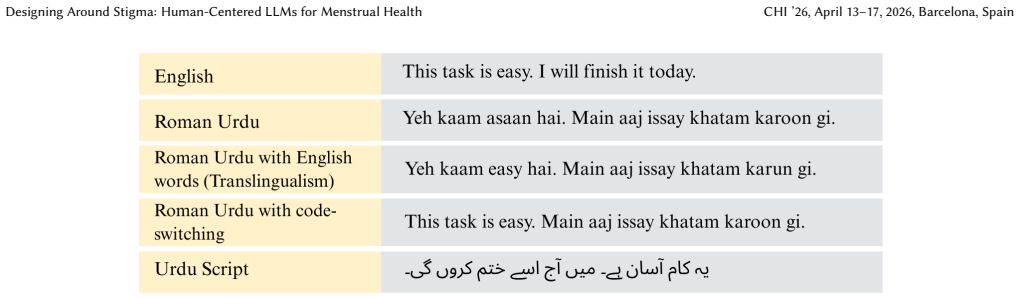
Menstrual health education (MHE) in Pakistan is constrained by cultural taboos and inadequate formal curricula, leaving women with few trusted resources to lean on. In response to these challenges, we introduce a WhatsApp-based chatbot powered by a large language model (LLM) and Retrieval Augmented Generation (RAG), co-designed with Pakistani college women. Workshops (N=30) revealed key design requirements -- support for Roman Urdu, use of subsidized platforms, and an expert -- curated knowledge base. We then deployed the chatbot with 13 participants for two weeks (403 messages and interviews). Women used it to challenge cultural taboos, legitimize health concerns often dismissed as normal, and build reproductive health knowledge through iterative questioning. Yet, interactions also exposed tensions: reliance on cultural explanatory models, questions of trust and validation, and gendered persona of the chatbot itself. We contribute empirical insights, a stigma-aware design framework for culturally sensitive conversational AI, and a methodological lens foregrounding expert validation in intimate health domains.
Editorial analysis
A structured set of objections, weighed in public.
Referee Report
Summary. The paper introduces a WhatsApp-based LLM chatbot with RAG for menstrual health education in Pakistan, co-designed via workshops with 30 college women identifying requirements such as Roman Urdu support and expert-curated knowledge bases. Deployment with 13 participants over two weeks (403 messages) showed uses in challenging taboos and building knowledge, but also tensions around cultural explanatory models, trust, and chatbot persona. Contributions are empirical insights, a stigma-aware design framework for culturally sensitive conversational AI, and a methodological lens emphasizing expert validation in intimate health domains.
Significance. If the reported patterns and framework hold, this work offers timely empirical grounding for designing LLMs in culturally sensitive health domains, particularly where stigma limits access to information. The co-design approach and real-world deployment provide concrete examples of addressing taboos through technology, which could influence HCI practices in global health contexts. However, the significance is tempered by the narrow demographic and geographic scope.
major comments (2)
- [Abstract / Deployment study] Abstract and deployment description: the transferable 'stigma-aware design framework' is presented as a core contribution, yet it derives from a single urban Pakistani college context with 13 self-selected deployment users and no cross-validation or replication; this makes generalizability load-bearing for the framework claim and requires explicit scoping or additional evidence.
- [Workshops and deployment] Workshops (N=30) and deployment (13 participants): qualitative patterns are supported by user feedback, but the absence of quantitative outcome measures, control conditions, or pre/post assessments limits the strength of effectiveness claims about challenging taboos or building knowledge, as these are central to justifying the design requirements and framework.
minor comments (2)
- [Abstract] Abstract: the summary of deployment results (403 messages and interviews) could more precisely state the participant count and duration to improve clarity for readers.
- [Methodology] Methodology: expand on the process of expert curation for the knowledge base and how it integrates with RAG to better foreground the 'methodological lens' contribution.
Simulated Author's Rebuttal
We thank the referee for the detailed and constructive feedback. We have addressed the concerns about the scope of the stigma-aware design framework and the qualitative nature of our evidence by revising the manuscript to explicitly scope claims, clarify the exploratory focus, and strengthen limitations discussions. Point-by-point responses follow.
read point-by-point responses
-
Referee: [Abstract / Deployment study] Abstract and deployment description: the transferable 'stigma-aware design framework' is presented as a core contribution, yet it derives from a single urban Pakistani college context with 13 self-selected deployment users and no cross-validation or replication; this makes generalizability load-bearing for the framework claim and requires explicit scoping or additional evidence.
Authors: We agree that the framework's transferability is constrained by the single urban Pakistani college context and small deployment sample. In the revised manuscript, we have explicitly scoped the framework as emerging from this specific setting in the abstract, introduction, contributions, and dedicated limitations section. We now emphasize that it serves as an initial empirical grounding rather than a universally validated model, and we outline directions for cross-context validation. While replication is beyond the scope of this study, the detailed co-design and deployment methodology provides a replicable template for similar domains. revision: yes
-
Referee: [Workshops and deployment] Workshops (N=30) and deployment (13 participants): qualitative patterns are supported by user feedback, but the absence of quantitative outcome measures, control conditions, or pre/post assessments limits the strength of effectiveness claims about challenging taboos or building knowledge, as these are central to justifying the design requirements and framework.
Authors: Our work is intentionally qualitative and exploratory, focused on generating rich insights from co-design workshops and real-world deployment rather than establishing causal effectiveness. We have revised the abstract, results, and discussion to frame findings as observed patterns of use, tensions, and participant-reported experiences, removing any language implying measured outcomes or general effectiveness. Design requirements are justified through workshop synthesis, and the framework through integration with deployment data. We have added explicit discussion of this methodological choice and limitations, including recommendations for future quantitative evaluations with controls and pre/post measures. revision: partial
Circularity Check
No circularity: empirical HCI study with no derivations or self-referential reductions
full rationale
The paper is a qualitative design study reporting workshops (N=30) and a two-week deployment (N=13) to derive design requirements and a stigma-aware framework for an LLM chatbot. No equations, fitted parameters, or mathematical predictions appear. Claims rest on participant feedback and standard HCI methods rather than any reduction of outputs to inputs by construction. Self-citations are absent from the provided text, and the framework is presented as an inductive contribution from the specific sample rather than a universal theorem. This matches the default expectation of no significant circularity for non-mathematical empirical work.
Axiom & Free-Parameter Ledger
axioms (1)
- domain assumption Co-design workshops and short-term deployment with interviews can produce reliable insights into user needs and chatbot effectiveness in sensitive domains.
Reference graph
Works this paper leans on
-
[1]
M. Abbasian, E. Khatibi, I. Azimi, et al. 2024. Foundation metrics for evaluating effectiveness of healthcare conversations powered by generative AI.npj Digital Medicine7, 1 (2024), 82. doi:10.1038/s41746-024-01074-z
-
[2]
Adhikary, I
P. Adhikary, I. Motiyani, G. Oke, M. Joshi, K. Pathak, S. Singh, and T. Chakraborty
-
[3]
Menstrual Health Education Using a Specialized Large Language Model in India: Development and Evaluation Study of MenstLLaMA.Journal of Medical Internet Research27, 1 (2025), e71977. doi:10.2196/71977
-
[4]
Muhammad Farid Adilazuarda, Sagnik Mukherjee, Pradhyumna Lavania, Sid- dhant Shivdutt Singh, Alham Fikri Aji, Jacki O’Neill, Ashutosh Modi, and Mono- jit Choudhury. 2024. Towards Measuring and Modeling “Culture” in LLMs: A Survey. InProceedings of the 2024 Conference on Empirical Methods in Natural Language Processing, Yaser Al-Onaizan, Mohit Bansal, and ...
-
[5]
Leah Hope Ajmani, Jasmine C Foriest, Jordan Taylor, Kyle Pittman, Sarah Gilbert, and Michael Ann Devito. 2024. Whose Knowledge is Valued? Epistemic Injustice in CSCW Applications.Proceedings of the ACM on Human-Computer Interaction 8, CSCW2 (2024), 1–28
2024
-
[6]
Tazeen S Ali, Parveen Azam Ali, Humaira Waheed, and Azam Ali Memon
-
[7]
Understanding of puberty and related health problems among female adolescents in Karachi, Pakistan.Journal of Pakistan medical association56, 2 (2006), 68
2006
-
[8]
Mike Armour, Kelly Parry, Christina Curry, Tania Ferfolja, Melissa A Parker, Toobah Farooqi, Freya MacMillan, Caroline A Smith, and Kathryn Holmes. 2022. Evaluation of a web-based resource to improve menstrual health literacy and self-management in young women.Journal of Psychosomatic Research162 (2022), 111038
2022
-
[9]
Joshua Au Yeung, Zeljko Kraljevic, Akish Luintel, Alfred Balston, Esther Idowu, Richard J. Dobson, and James T. Teo. 2023. AI chatbots not yet ready for clinical use.Frontiers in Digital Health5 (12 April 2023), 1161098. doi:10.3389/fdgth. 2023.1161098
-
[10]
Shaowen Bardzell. 2010. Feminist HCI: taking stock and outlining an agenda for design. InProceedings of the SIGCHI Conference on Human Factors in Com- puting Systems(Atlanta, Georgia, USA)(CHI ’10). Association for Computing Machinery, New York, NY, USA, 1301–1310. doi:10.1145/1753326.1753521
-
[11]
Abul Barkat and Murtaza Majid. 2003. Adolescent reproductive health in Bangladesh: Status, policies, programs and issues
2003
-
[12]
Gul Mehar Javaid Bukhari, Maimoona Nazar, Laiba Sultan, Janita Azeem, Mariam Jamil, Hajr-e-Aswad Khan Khattak, and Farah Rashid. 2023. Myths and Chal- lenges Regarding Menstrual Hygiene among Adolescent Girls of Islamabad. Pakistan Journal of Public Health13, 4 (2023), 168–171
2023
-
[13]
Chandra and E
D. Chandra and E. Gomez. 2019. Dignified Menstruation Southeast Asia Regional Overview. InDignified Menstruation: (The Dignity of Menstruators Through- out Their Life Cycle): A Practical Handbook, Radha Paudel (Ed.). Kathmandu Publication, Kathmandu, 11–21
2019
-
[14]
Vikas Chothe, Jagdish Khubchandani, Denise Seabert, Mahesh Asalkar, Sarika Rakshe, Arti Firke, Inuka Midha, and Robert Simmons. 2014. Students’ percep- tions and doubts about menstruation in developing countries: a case study from India.Health promotion practice15, 3 (2014), 319–326
2014
-
[15]
Hafsah Mahzabin Chowdhury and Sharifa Sultana. 2025. From Literature to ReWA: Discussing Reproductive Well-being in HCI. arXiv:2507.01121 [cs.HC] https://arxiv.org/abs/2507.01121 CHI ’26, April 13–17, 2026, Barcelona, Spain Shahnawaz et al. Design Commitment Relevance to Designing around Stigma Implications for Design Trade-offs D1. Infrastructural fit & ...
-
[16]
J.S. Corrêa, A.P.d.A. Neto, G.R. Pinto, L.D.B. Lima, and A.S. Teles. 2023. Lhia: A Smart Chatbot for Breastfeeding Education and Recruitment of Human Milk Donors.Applied Sciences13, 12 (2023), 6923. doi:10.3390/app13126923
-
[17]
Wang, Chinmay Kulkarni, Lauren Wilcox, Michael Terry, and Michael Madaio
Andrea Cuadra, Maria Wang, Lynn Andrea Stein, Malte F. Jung, Nicola Dell, Deborah Estrin, and James A. Landay. 2024. The Illusion of Empathy? Notes on Displays of Emotion in Human-Computer Interaction. InProceedings of the 2024 CHI Conference on Human Factors in Computing Systems(Honolulu, HI, USA) (CHI ’24). Association for Computing Machinery, New York,...
-
[18]
Dung Dao, Jun Yi Claire Teo, Wenru Wang, and Hoang D. Nguyen. 2024. LLM- Powered Multimodal AI Conversations for Diabetes Prevention. InProceedings of the 1st ACM Workshop on AI-Powered Q&A Systems for Multimedia(Phuket, Thailand)(AIQAM ’24). Association for Computing Machinery, New York, NY, USA, 1–6. doi:10.1145/3643479.3662049
-
[19]
Kya family planning after marriage hoti hai?
Roshini Deva, Dhruv Ramani, Tanvi Divate, Suhani Jalota, and Azra Ismail. 2025. "Kya family planning after marriage hoti hai?": Integrating Cultural Sensitivity in an LLM Chatbot for Reproductive Health. InProceedings of the 2025 CHI Conference on Human Factors in Computing Systems (CHI ’25). Association for Computing Machinery, New York, NY, USA, Article...
-
[20]
Catherine D’ignazio and Lauren F. Klein. 2020. Seven intersectional feminist principles for equitable and actionable COVID-19 data.Big data & society7, 2 (2020), 2053951720942544
2020
-
[21]
Catherine D’Ignazio and Lauren F. Klein. 2020.Data Feminism. The MIT Press, Cambridge, Massachusetts
2020
-
[22]
Epstein, Nicole B
Daniel A. Epstein, Nicole B. Lee, Jennifer H. Kang, Elena Agapie, Jessica Schroeder, Laura R. Pina, James Fogarty, Julie A. Kientz, and Sean Munson
-
[23]
Examining Menstrual Tracking to Inform the Design of Personal Infor- matics Tools. InProceedings of the 2017 CHI Conference on Human Factors in Computing Systems(Denver, Colorado, USA)(CHI ’17). Association for Comput- ing Machinery, New York, NY, USA, 6876–6888. doi:10.1145/3025453.3025635
-
[24]
Cristina Espinosa-Heywood and Richa Karki. 2019. Breaking Taboos: Menstru- ation, Female Subordination and Reproductive Health, the Case of India
2019
-
[25]
Liu Feng, Muhammad Jawad Sajid, Zhu Lian, and Li Shuqin. 2018. Female gyne- cologist preference: A viewpoint based on two scenario survey from Pakistan. International Journal of Research05 (05 2018)
2018
-
[26]
Law, Manfred Tscheligi, and Ewa A
Asbjørn Følstad, Petter Bae Brandtzaeg, Tom Feltwell, Effie L-C. Law, Manfred Tscheligi, and Ewa A. Luger. 2018. SIG: Chatbots for Social Good. InExtended Abstracts of the 2018 CHI Conference on Human Factors in Computing Systems (Montreal QC, Canada)(CHI EA ’18). Association for Computing Machinery, New York, NY, USA, 1–4. doi:10.1145/3170427.3185372
-
[27]
2021.Gallup Pakistan: WhatsApp’s Widespread Usage in Pak- istan
Gallup Pakistan. 2021.Gallup Pakistan: WhatsApp’s Widespread Usage in Pak- istan. https://gallup.com.pk/post/33823 Gallup Pakistan Report
2021
-
[28]
Sato, Simo Hosio, and Koji Yatani
Shixian Geng, Remi Inayoshi, Chi-Lan Yang, Zefan Sramek, Yuya Umeda, Chiaki Kasahara, Arissa J. Sato, Simo Hosio, and Koji Yatani. 2025. Beyond the Dialogue: Multi-chatbot Group Motivational Interviewing for Premenstrual Syndrome (PMS) Management. InProceedings of the 2025 CHI Conference on Human Factors in Computing Systems (CHI ’25). Association for Com...
-
[29]
Johanna Habicht et al. 2024. Closing the Accessibility Gap to Mental Health Treatment with a Personalized Self-Referral Chatbot.Nature Medicine30, 2 (2024), 595–602
2024
-
[30]
Yuexing Hao, Jason Holmes, Mark R Waddle, Brian J Davis, Nathan Y Yu, Kristin S Vickers, Heather Preston, Drew Margolin, Corinna E Löckenhoff, Aditya Vashistha, et al. 2025. Personalizing prostate cancer education for pa- tients using an EHR-Integrated LLM agent.npj Digital Medicine8, 1 (2025), 770
2025
-
[31]
Christina N. Harrington and Lisa Egede. 2023. Trust, Comfort and Relatability: Understanding Black Older Adults’ Perceptions of Chatbot Design for Health Information Seeking. InProceedings of the 2023 CHI Conference on Human Factors in Computing Systems. Association for Computing Machinery, New York, NY, USA, 1–18. doi:10.1145/3544548.3580719 Designing Ar...
-
[32]
Zhiqiang Hu, Lei Wang, Yihuai Lan, Wanyu Xu, Ee-Peng Lim, Lidong Bing, Xing Xu, Soujanya Poria, and Roy Lee. 2023. LLM-Adapters: An Adapter Family for Parameter-Efficient Fine-Tuning of Large Language Models. InProceedings of the 2023 Conference on Empirical Methods in Natural Language Processing, Houda Bouamor, Juan Pino, and Kalika Bali (Eds.). Associat...
-
[33]
Gilhwan Hwang, Jeewon Lee, Cindy Yoonjung Oh, and Joonhwan Lee. 2019. It Sounds Like A Woman: Exploring Gender Stereotypes in South Korean Voice Assistants. InExtended Abstracts of the 2019 CHI Conference on Human Factors in Computing Systems(Glasgow, Scotland Uk)(CHI EA ’19). Association for Computing Machinery, New York, NY, USA, 1–6. doi:10.1145/329060...
-
[34]
Zaidat Ibrahim, Novia Nurain, and James Clawson. 2024. Tracking During Ramadan: Examining the Intersection of Menstrual and Religious Tracking Practices Among Muslim Women in the United States. InProceedings of the 2024 CHI Conference on Human Factors in Computing Systems(Honolulu, HI, USA) (CHI ’24). Association for Computing Machinery, New York, NY, USA...
-
[35]
Zaidat Ibrahim, Pallavi Panchpor, Novia Nurain, and James Clawson. 2024. "Islamically, I am not on my period": A Study of Menstrual Tracking in Muslim Women in the US. InProceedings of the 2024 CHI Conference on Human Factors in Computing Systems(Honolulu, HI, USA)(CHI ’24). Association for Computing Machinery, New York, NY, USA, Article 686, 16 pages. do...
-
[36]
Samia Ibtasam. 2021. For God’s sake! Considering Religious Beliefs in HCI Research: A Case of Islamic HCI. InExtended Abstracts of the 2021 CHI Confer- ence on Human Factors in Computing Systems(Yokohama, Japan)(CHI EA ’21). Association for Computing Machinery, New York, NY, USA, Article 9, 8 pages. doi:10.1145/3411763.3450383
-
[37]
My cousin bought the phone for me. I never go to mobile shops
Samia Ibtasam, Lubna Razaq, Maryam Ayub, Jennifer R Webster, Syed Ishtiaque Ahmed, and Richard Anderson. 2019. " My cousin bought the phone for me. I never go to mobile shops. " The Role of Family in Women’s Technological Inclusion in Islamic Culture.Proceedings of the ACM on Human-Computer Interaction3, CSCW (2019), 1–33
2019
-
[38]
Lilly Irani, Janet Vertesi, Paul Dourish, Kavita Philip, and Rebecca E. Grinter
-
[39]
InProceedings of the SIGCHI Conference on Human Factors in Computing Systems (CHI ’10)
Postcolonial computing: a lens on design and development. InProceedings of the SIGCHI Conference on Human Factors in Computing Systems(Atlanta, Georgia, USA)(CHI ’10). Association for Computing Machinery, New York, NY, USA, 1311–1320. doi:10.1145/1753326.1753522
-
[40]
Ann Irvine, Jonathan Weese, and Chris Callison-Burch. 2012. Processing infor- mal, romanized Pakistani text messages. InProceedings of the Second Workshop on Language in Social Media(Montreal, Canada)(LSM ’12). Association for Computational Linguistics, USA, 75–78
2012
-
[41]
Rabeea Jabbar, Noor Us Sama, and Ayesha Ihtisham Khattak. 2025. Integrating menstrual hygiene management (MHM) in disaster health response: lessons from 2022 Pakistan floods.Environmental Research: Health3, 3 (2025), 035001. doi:10.1088/2752-5309/add364 Open access
-
[42]
Minal Jain and Pradeep Yammiyavar. 2015. Game based learning tool seeking peer support for empowering adolescent girls in rural Assam. InProceedings of the 14th International Conference on Interaction Design and Children(Boston, Massachusetts)(IDC ’15). Association for Computing Machinery, New York, NY, USA, 275–278. doi:10.1145/2771839.2771895
-
[43]
Because AI is 100% right and safe
Shivani Kapania, Oliver Siy, Gabe Clapper, Azhagu Meena SP, and Nithya Sambasivan. 2022. "Because AI is 100% right and safe": User Attitudes and Sources of AI Authority in India. InProceedings of the 2022 CHI Conference on Human Factors in Computing Systems(New Orleans, LA, USA)(CHI ’22). Association for Computing Machinery, New York, NY, USA, Article 158...
-
[44]
Naveena Karusala, Victoria G, Shirley Yan, and Richard Anderson. 2023. Unset- tling Care Infrastructures: From the Individual to the Structural in a Digital Ma- ternal and Child Health Intervention. InProceedings of the 2023 CHI Conference on Human Factors in Computing Systems (CHI ’23). Association for Computing Ma- chinery, New York, NY, USA, Article 42...
-
[45]
Jasmeet Kaur, Preetika Sharma, Vijay Kumar, Mona Duggal, Nadia Griffin Diamond-Smith, Alison El Ayadi, Kathryn Vosburg, and Pushpendra Singh
-
[46]
Exploring the Role of Chatbots in Tackling COVID-19 Vaccine Hesitancy among Pregnant and Breastfeeding Women in Rural Northern India.Proceedings of the ACM on Human-Computer Interaction8, CSCW1 (2024), 1–29
2024
-
[47]
Jasmeet Kaur, Asra Sakeen Wani, and Pushpendra Singh. 2019. Engagement of Pregnant Women and Mothers over WhatsApp: Challenges and Opportu- nities Involved. InCompanion Publication of the 2019 Conference on Computer Supported Cooperative Work and Social Computing(Austin, TX, USA)(CSCW ’19 Companion). Association for Computing Machinery, New York, NY, USA,...
-
[48]
2023.FemTech and Taboo Topics: Raaji as a Tool for Educating Women in Pakistan
Khawar Latif Khan and Farah Azhar. 2023.FemTech and Taboo Topics: Raaji as a Tool for Educating Women in Pakistan. Springer Nature Singapore, Singapore, 185–210. doi:10.1007/978-981-99-5605-0_9
-
[49]
Shahedul Huq Khandkar. 2009. Open coding.University of Calgary23, 2009 (2009), 2009
2009
-
[50]
Lauren Klein and Catherine D’Ignazio. 2024. Data Feminism for AI. InProceed- ings of the 2024 ACM Conference on Fairness, Accountability, and Transparency (Rio de Janeiro, Brazil)(FAccT ’24). Association for Computing Machinery, New York, NY, USA, 100–112. doi:10.1145/3630106.3658543
-
[51]
Quiroz, Liliana Laranjo, Huong Ly Tong, Dana Rezazadegan, Agustina Briatore, and Enrico Coiera
Ahmet Baki Kocaballi, Shlomo Berkovsky, Juan C. Quiroz, Liliana Laranjo, Huong Ly Tong, Dana Rezazadegan, Agustina Briatore, and Enrico Coiera. 2019. The Personalization of Conversational Agents in Health Care: Systematic Review. Journal of Medical Internet Research21, 11 (2019), e15360. doi:10.2196/15360
-
[52]
Ha-Kyung Kong, Rachel Lowy, Youjin Choi, and Jennifer G Kim. 2025. Working Together Toward Interdependence: Chatbot-Based Support for Balanced Social Interactions Between Neurodivergent and Neurotypical Individuals. InProceed- ings of the 2025 CHI Conference on Human Factors in Computing Systems (CHI ’25). Association for Computing Machinery, New York, NY...
-
[53]
Anant Kumar and Kamiya Srivastava. 2011. Cultural and social practices re- garding menstruation among adolescent girls.Social Work in Public Health26, 6 (2011), 594–604
2011
-
[54]
Jyoti Kumar and Surbhi Pratap. 2020. Detriments to Cultural Sensitivity in HCI Design Processes: Insights from Practitioners’ Experiences in India. In HCI International 2020 - Late Breaking Papers: User Experience Design and Case Studies: 22nd HCI International Conference, HCII 2020, Copenhagen, Denmark, July 19–24, 2020, Proceedings(Copenhagen, Denmark)....
-
[55]
Neha Kumar, Trevor Perrier, Michelle Desmond, Kiersten Israel-Ballard, Vikrant Kumar, Sudip Mahapatra, Anil Mishra, Shreya Agarwal, Rikin Gandhi, Pallavi Lal, and Richard Anderson. 2015. Projecting health: community-led video edu- cation for maternal health. InProceedings of the Seventh International Conference on Information and Communication Technologie...
-
[56]
Yi-Chieh Lee, Naomi Yamashita, and Yun Huang. 2020. Designing a chatbot as a mediator for promoting deep self-disclosure to a real mental health professional. Proceedings of the ACM on Human-Computer Interaction4, CSCW1 (2020), 1–27
2020
-
[57]
Patrick Lewis, Ethan Perez, Aleksandra Piktus, Fabio Petroni, Vladimir Karpukhin, Naman Goyal, Heinrich Küttler, Mike Lewis, Wen-tau Yih, Tim Rock- täschel, et al. 2020. Retrieval-augmented generation for knowledge-intensive nlp tasks.Advances in Neural Information Processing Systems33 (2020), 9459–9474
2020
-
[58]
Brenna Li, Ofek Gross, Noah Crampton, Mamta Kapoor, Saba Tauseef, Mohit Jain, Khai N. Truong, and Alex Mariakakis. 2024. Beyond the Waiting Room: Patient’s Perspectives on the Conversational Nuances of Pre-Consultation Chatbots. In Proceedings of the 2024 CHI Conference on Human Factors in Computing Systems (Honolulu, HI, USA)(CHI ’24). Association for Co...
-
[59]
Cheng Li, Mengzhuo Chen, Jindong Wang, Sunayana Sitaram, and Xing Xie
-
[60]
InAdvances in Neural Information Processing Systems, A
CultureLLM: Incorporating Cultural Differences into Large Language Models. InAdvances in Neural Information Processing Systems, A. Globerson, L. Mackey, D. Belgrave, A. Fan, U. Paquet, J. Tomczak, and C. Zhang (Eds.), Vol. 37. Curran Associates, Inc., Red Hook, NY, USA, 84799–84838. doi:10.52202/079017- 2693
-
[61]
Lei Li, Yongfeng Zhang, and Li Chen. 2023. Prompt Distillation for Efficient LLM-based Recommendation. InProceedings of the 32nd ACM International Conference on Information and Knowledge Management(Birmingham, United Kingdom)(CIKM ’23). Association for Computing Machinery, New York, NY, USA, 1348–1357. doi:10.1145/3583780.3615017
-
[62]
Xiubo Liang, Jing Zhang, Jiayi Ma, Jiayu Yao, Weijia Lin, Zheliang Zhu, Yingy- ing Ma, Fangtian Ying, Cheng Yao, Leijing Zhou, Preben Hansen, Yijun Zhao, and Guanyun Wang. 2022. Menstrual Monster: A Tangible Interactive Co- educational Game Designed for Teenagers. InExtended Abstracts of the 2022 CHI Conference on Human Factors in Computing Systems(New Or...
-
[63]
Georgianna Lin, Pierre-William Lessard, Minh Ngoc Le, Brenna Li, Fanny Cheva- lier, Khai N. Truong, and Alex Mariakakis. 2024. Functional Design Requirements to Facilitate Menstrual Health Data Exploration. InProceedings of the 2024 CHI Conference on Human Factors in Computing Systems(Honolulu, HI, USA)(CHI ’24). Association for Computing Machinery, New Y...
-
[64]
Georgianna E Lin, Elizabeth D Mynatt, and Neha Kumar. 2022. Investigating Culturally Responsive Design for Menstrual Tracking and Sharing Practices Among Individuals with Minimal Sexual Education. InProceedings of the 2022 CHI Conference on Human Factors in Computing Systems(New Orleans, LA, USA) (CHI ’22). Association for Computing Machinery, New York, N...
-
[65]
Zilin Ma, Yiyang Mei, Yinru Long, Zhaoyuan Su, and Krzysztof Z. Gajos. 2024. Evaluating the Experience of LGBTQ+ People Using Large Language Model Based Chatbots for Mental Health Support. InProceedings of the 2024 CHI Conference on Human Factors in Computing Systems(Honolulu, HI, USA)(CHI ’24). Association for Computing Machinery, New York, NY, USA, Arti...
-
[66]
Neeraj Jain, Elmy Sebastain, Shinoy Shaji, and Anandhu Ajayakumar
Divya Madhu, C.J. Neeraj Jain, Elmy Sebastain, Shinoy Shaji, and Anandhu Ajayakumar. 2017. A novel approach for medical assistance using trained chatbot. In2017 International Conference on Inventive Communication and Com- putational Technologies (ICICCT). 243–246. doi:10.1109/ICICCT.2017.7975195
-
[67]
Sanam Maher. 2023. The Activists Confronting Period Taboos in Pak- istan. https://www.aljazeera.com/features/2023/5/28/the-activists-confronting- period-taboos-in-pakistan Accessed: 2024-08-17
2023
-
[68]
Amama Mahmood, Shiye Cao, Maia Stiber, Victor Nikhil Antony, and Chien- Ming Huang. 2025. Voice Assistants for Health Self-Management: Designing for and with Older Adults. InProceedings of the 2025 CHI Conference on Human Factors in Computing Systems (CHI ’25). Association for Computing Machinery, New York, NY, USA, Article 511, 22 pages. doi:10.1145/3706...
-
[69]
Judy Michael, Qaiser Iqbal, Sajjad Haider, Adnan Khalid, Naheed Haque, Rabia Ishaq, Fahad Saleem, Mohamed Azmi Hassali, and Mohammad Bashaar. 2020. Knowledge and practice of adolescent females about menstruation and menstru- ation hygiene visiting a public healthcare institute of Quetta, Pakistan.BMC women’s health20 (2020), 1–8
2020
-
[70]
Ministry of Federal Education and Professional Training, Pakistan
-
[71]
Government of Pak- istan
Draft National Education Policy 2017. Government of Pak- istan. https://www.mofept.gov.pk/SiteImage/Policy/Draft%20National% 20Educaiton%20Policy%202017.pdf
2017
-
[72]
2007.Reach- ing The Age of Adolescence
Ministry of Human Resource Development (Government of India). 2007.Reach- ing The Age of Adolescence. National Council of Educational Research and Training (NCERT). 113–126 pages
2007
-
[73]
Wen Mo, Aneesha Singh, and Catherine Holloway. 2024. From Information Seeking to Empowerment: Using Large Language Model Chatbot in Supporting Wheelchair Life in Low Resource Settings. InProceedings of the 26th International ACM SIGACCESS Conference on Computers and Accessibility(St. John’s, NL, Canada)(ASSETS ’24). Association for Computing Machinery, Ne...
-
[74]
Shafaq Fatima Mughal, Shayan Aamir, Abdul Samad, Umema Zehra, and Ayesha Asif Syed. 2025. Mai: A Transformer Based Domain Specific Chat- bot for Menstrual Health.ACM Journal on Responsible Computing2, 1 (2025), 1–32
2025
-
[75]
Manideepa Mukherjee, Abhay Sheel Anand, Varnika Kairon, and Aman Parnami
-
[76]
MenstruWear: In-The-Wild Study For Characterizing The Effect Of User Activities On Sanitary Napkin-Based Bodily Fluid Monitoring. InProceedings of the 15th Biannual Conference of the Italian SIGCHI Chapter(Torino, Italy) (CHItaly ’23). Association for Computing Machinery, New York, NY, USA, Article 7, 12 pages. doi:10.1145/3605390.3605404
-
[77]
How can we leave the traditions of our Baab Daada
Zubia Mumtaz, Priya Sivananthajothy, Afshan Bhatti, and Marni Sommer. 2019. “How can we leave the traditions of our Baab Daada”: socio-cultural structures and values driving menstrual hygiene management challenges in schools in Pakistan.Journal of Adolescence76 (2019), 152–161
2019
-
[78]
Michelle Murphy. 2015. Unsettling care: Troubling transnational itineraries of care in feminist health practices.Social studies of science45, 5 (2015), 717–737
2015
-
[79]
Maryam Mustafa, Abdul Moeed Asad, Shehrbano Hassan, Urooj Haider, Zainab Durrani, and Katharina Krombholz. 2023. Pakistani Teens and Privacy - How Gender Disparities, Religion and Family Values Impact the Privacy Design Space. InProceedings of the 2023 ACM SIGSAC Conference on Computer and Communications Security(Copenhagen, Denmark)(CCS ’23). Association...
-
[80]
Maryam Mustafa, Shaimaa Lazem, Ebtisam Alabdulqader, Kentaro Toyama, Sharifa Sultana, Samia Ibtasam, Richard Anderson, and Syed Ishtiaque Ahmed
discussion (0)
Sign in with ORCID, Apple, or X to comment. Anyone can read and Pith papers without signing in.