Recognition: no theorem link
Late Breaking Results: Hardware-Efficient Quantum Reservoir Computing via Quantized Readout
Pith reviewed 2026-05-10 18:18 UTC · model grok-4.3
The pith
Quantized readout in a fixed quantum reservoir preserves short-term load forecasting accuracy within 1% while cutting memory by up to 81%.
A machine-rendered reading of the paper's core claim, the machinery that carries it, and where it could break.
Core claim
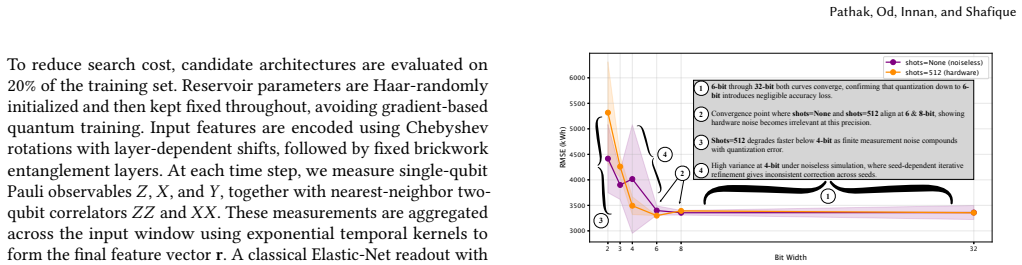
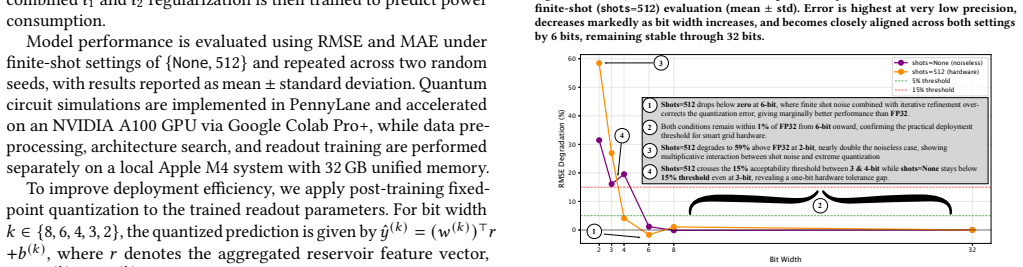
A fixed, untrained quantum reservoir circuit with Chebyshev feature encoding, brickwork entanglement, and Pauli measurements, followed by post-training quantization of the classical readout to 6 or 8 bits, maintains forecasting accuracy within 1% of the 32-bit floating-point baseline on the Tetouan City Power Consumption dataset while reducing readout memory by 81% and 75%, respectively.
What carries the argument
The post-training fixed-point quantized readout layer that maps features from a fixed, untrained quantum reservoir circuit selected by genetic search.
If this is right
- QRC models become feasible for memory-constrained edge devices performing real-time energy forecasting.
- Training reduces to classical linear regression on the readout, eliminating any need for quantum backpropagation.
- Low-bit fixed-point arithmetic is compatible with quantum-generated feature vectors for time-series tasks.
- Hardware cost reductions may encourage wider use of quantum-inspired reservoirs in power-grid applications.
Where Pith is reading between the lines
- The same fixed-reservoir-plus-quantized-readout pattern could be tried on other forecasting domains without redesigning the quantum layer.
- If the limited genetic search already suffices, further architecture search may yield only marginal gains once quantization is applied.
- Real-device noise on actual quantum hardware might interact differently with the quantized readout than the finite-shot simulation used here.
Load-bearing premise
The reservoir architecture found by searching only 18 candidates produces quantum features stable and rich enough that quantizing the readout does not degrade short-term load forecasts on this particular dataset.
What would settle it
Testing the same 6-bit quantized readout on an independent power-consumption time series from another city and observing accuracy loss larger than 1% relative to FP32 would show the result does not generalize.
Figures


read the original abstract
Due to rising electricity demand, accurate short-term load forecasting is increasingly important for grid stability and efficient energy management, particularly in resource-constrained edge settings. We present a hardware-efficient Quantum Reservoir Computing (QRC) framework based on a fixed, untrained quantum circuit with Chebyshev feature encoding, brickwork entanglement, and single- and two-qubit Pauli measurements, avoiding quantum backpropagation entirely. Using the Tetouan City Power Consumption dataset, we examine the effect of post-training fixed-point quantization on the classical readout layer, with the reservoir architecture selected through a genetic search over 18 candidate configurations. Under finite-shot evaluation, 8-bit and 6-bit quantization maintain forecasting accuracy within 1% of the FP32 baseline while reducing readout memory by 75% and 81%, respectively. These results suggest that quantized readout can improve the hardware efficiency and deployment practicality of QRC for memory-constrained energy forecasting.
Editorial analysis
A structured set of objections, weighed in public.
Referee Report
Summary. The manuscript claims to introduce a hardware-efficient Quantum Reservoir Computing (QRC) framework for short-term electricity load forecasting on the Tetouan City Power Consumption dataset. It employs a fixed, untrained quantum circuit with Chebyshev feature encoding, brickwork entanglement, and single-/two-qubit Pauli measurements, selecting the reservoir via genetic search over 18 candidate configurations. Under finite-shot evaluation, post-training 8-bit and 6-bit fixed-point quantization of the classical linear readout is reported to retain forecasting accuracy within 1% of the FP32 baseline while reducing readout memory by 75% and 81%, respectively, without requiring quantum backpropagation.
Significance. If the empirical results are robust, the work would show that quantized readouts can deliver substantial memory savings for QRC with negligible accuracy loss, supporting deployment on memory-constrained edge hardware for energy applications. The fixed-circuit design and direct comparison of quantization levels add practical value to quantum ML literature. The limited reservoir search and missing statistical details, however, constrain the strength of the central claim.
major comments (2)
- [Experimental Results] Experimental Results section: The claim that 8-bit and 6-bit quantization maintains accuracy 'within 1%' of the FP32 baseline provides no error bars, standard deviations, number of runs, or statistical significance tests. Without these, it is impossible to assess whether the tolerance holds beyond a single trial or is distinguishable from finite-shot noise.
- [Methods] Methods section on architecture selection: The genetic search is confined to 18 reservoir configurations. No ablation across multiple high-performing reservoirs or stability metrics (feature variance across shots or time windows) is reported. This leaves open the possibility that the chosen architecture is under-expressive for the load series, such that the linear readout operates near a noise floor where quantization error appears artificially small.
minor comments (2)
- [Abstract] The abstract and results text should explicitly state the forecasting metric (RMSE, MAE, or other) used to define the '1% within baseline' tolerance.
- [Results] Figure captions and tables reporting memory savings should include the precise bit-width definitions and any assumptions about weight storage formats.
Simulated Author's Rebuttal
We thank the referee for the constructive feedback on our late-breaking results manuscript. The comments highlight important aspects of statistical rigor and methodological transparency that we will address to strengthen the presentation of our quantized QRC framework. Below we respond point by point to the major comments.
read point-by-point responses
-
Referee: Experimental Results section: The claim that 8-bit and 6-bit quantization maintains accuracy 'within 1%' of the FP32 baseline provides no error bars, standard deviations, number of runs, or statistical significance tests. Without these, it is impossible to assess whether the tolerance holds beyond a single trial or is distinguishable from finite-shot noise.
Authors: We agree that the absence of error bars, run counts, and statistical tests limits the ability to evaluate robustness against finite-shot noise. In the revised version we will rerun the experiments over at least 10 independent trials (varying the random seed for shot sampling while keeping the reservoir and readout training fixed) and report mean RMSE/MAE values together with standard deviations. We will also include a statistical significance test (paired t-test or Wilcoxon signed-rank) between the FP32 baseline and each quantized variant to confirm that the observed differences remain within the stated 1% tolerance and are not attributable to shot noise alone. revision: yes
-
Referee: Methods section on architecture selection: The genetic search is confined to 18 reservoir configurations. No ablation across multiple high-performing reservoirs or stability metrics (feature variance across shots or time windows) is reported. This leaves open the possibility that the chosen architecture is under-expressive for the load series, such that the linear readout operates near a noise floor where quantization error appears artificially small.
Authors: The genetic search was deliberately restricted to 18 configurations to keep the late-breaking results paper concise while still identifying a competitive reservoir for the Tetouan dataset. We acknowledge that a broader ablation would be desirable. In the revision we will add (i) a short table listing the top three configurations returned by the search together with their FP32 accuracies, demonstrating that the selected circuit is not an outlier, and (ii) a stability analysis reporting the per-feature variance of the reservoir states across 1000 shots and across sliding time windows. A full ablation study over all 18 candidates exceeds the scope and length constraints of this late-breaking format; we will therefore note the limited search space as a limitation and a direction for future work. revision: partial
Circularity Check
No circularity: results are direct empirical measurements on fixed architecture
full rationale
The paper reports forecasting accuracy and memory reduction from post-training fixed-point quantization applied to a classically trained linear readout on top of a genetically selected fixed quantum reservoir (Chebyshev encoding + brickwork + Pauli measurements). No equations, fitted parameters, or self-citations are shown that would make the reported 1% accuracy tolerance or memory savings equivalent to the inputs by construction; the genetic search is used only for architecture selection, not as a predictive derivation that loops back into the quantization claim. The evaluation is performed on an external public dataset under finite-shot conditions, rendering the central comparison self-contained and falsifiable without internal redefinition.
Axiom & Free-Parameter Ledger
free parameters (1)
- Quantization bit widths
Reference graph
Works this paper leans on
-
[1]
AH Abbas et al. 2024. Classical and quantum physical reservoir computing for onboard artificial intelligence systems: A perspective.Dynamics(2024)
2024
-
[2]
Mashael M Asiri et al . 2024. Short-term load forecasting in smart grids using hybrid deep learning.IEEE access(2024)
2024
-
[3]
Keisuke Fujii and Kohei Nakajima. 2017. Harnessing disordered-ensemble quan- tum dynamics for machine learning.Physical Review Applied(2017)
2017
-
[4]
Imane Moustati and Noreddine Gherabi. 2025. Unveiling the Potential of Transformer-Based Models for Efficient Time-Series Energy Forecasting.Journal of Advances in Information Technology(2025)
2025
-
[5]
Abdulwahed Salam and Abdelaaziz El Hibaoui. 2018. Power Consumption of Tetouan City. UCI Machine Learning Repository
2018
discussion (0)
Sign in with ORCID, Apple, or X to comment. Anyone can read and Pith papers without signing in.