Signature Placement in Post-Quantum TLS Certificate Hierarchies: An Experimental Study of ML-DSA and SLH-DSA in TLS 1.3 Authentication
Pith reviewed 2026-05-21 10:28 UTC · model grok-4.3
The pith
Placing SLH-DSA in the server leaf certificate of a post-quantum TLS hierarchy increases handshake latency and server compute by orders of magnitude.
A machine-rendered reading of the paper's core claim, the machinery that carries it, and where it could break.
Core claim
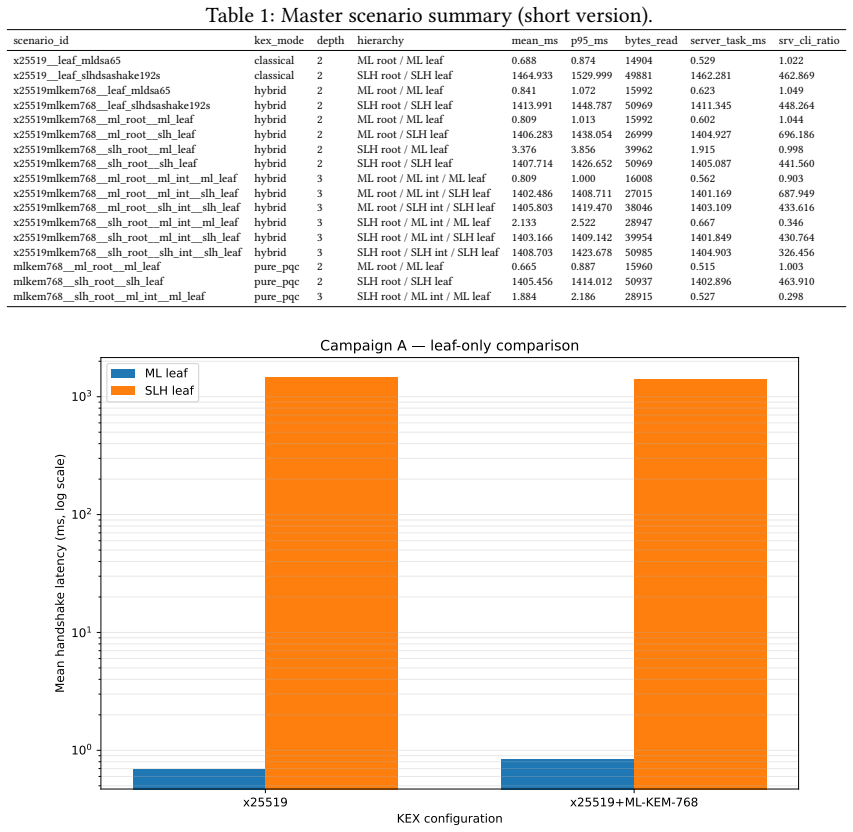
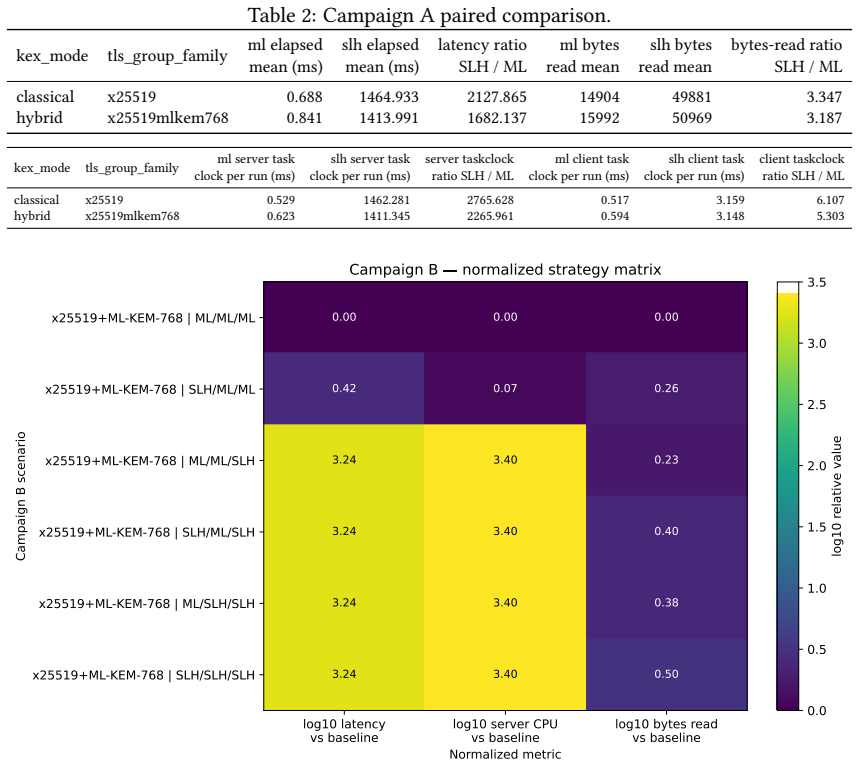
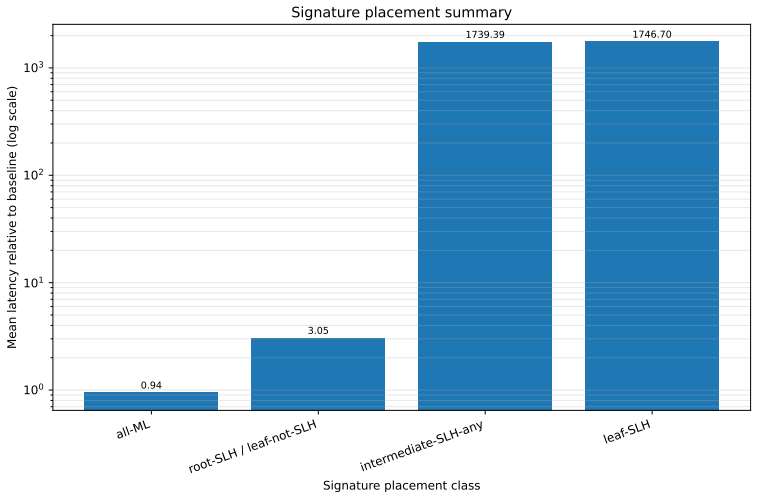
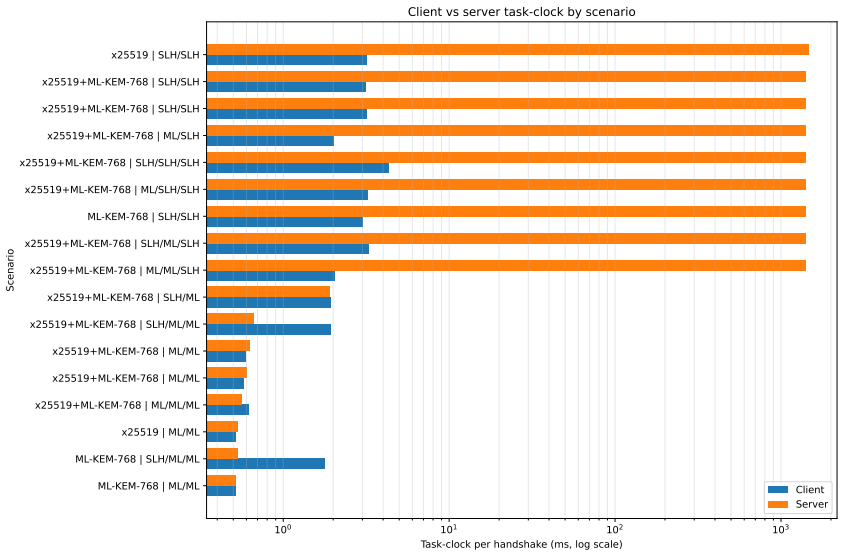
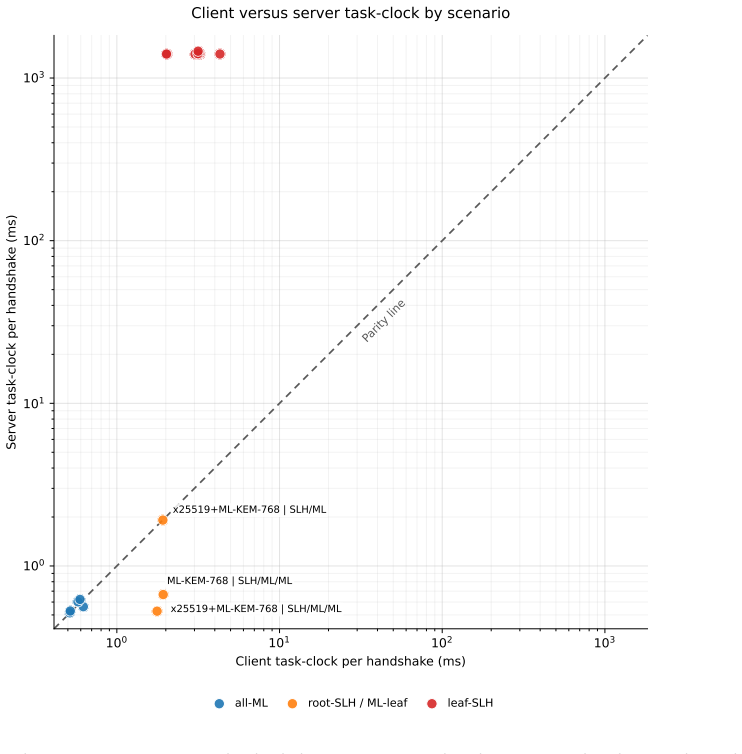
When SLH-DSA appears in the server leaf certificate, handshake latency and server-side cryptographic cost rise by orders of magnitude; confining SLH-DSA to intermediate or root certificates and retaining ML-DSA at the leaf keeps performance in a usable range. Transport size alone does not explain the difference: outside leaf-SLH cases, byte counts track latency, but leaf-SLH cases are dominated by server computation rather than data transfer.
What carries the argument
The placement of ML-DSA and SLH-DSA within the certificate hierarchy, which controls both the portion of the chain sent during the TLS handshake and the split of signing versus verification work between server and client.
If this is right
- Strategies that keep SLH-DSA out of the leaf certificate avoid the heavy performance regime.
- Chain size and transferred bytes predict latency only when the leaf uses the lighter algorithm.
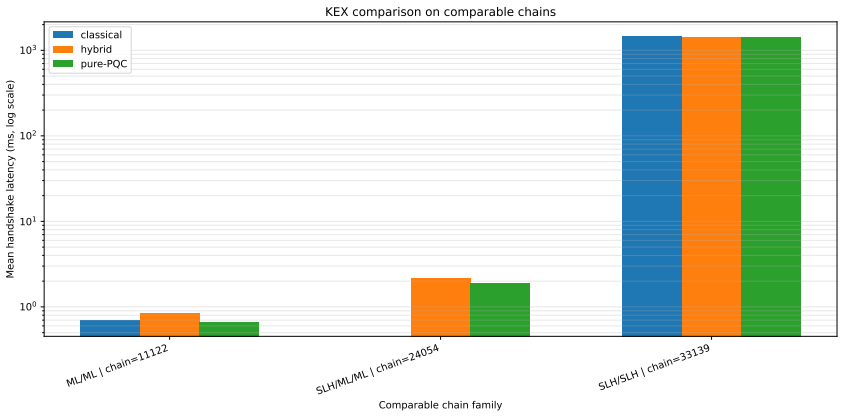
- Hybrid key exchanges do not remove the discontinuity created by a leaf SLH-DSA certificate.
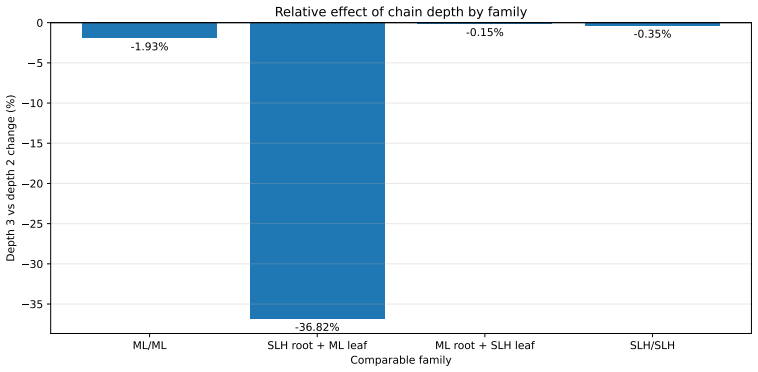
- Deeper hierarchies amplify the cost difference when the leaf signature is expensive.
Where Pith is reading between the lines
- Operators may standardize on ML-DSA for all server leaf certificates and reserve SLH-DSA for long-lived root or intermediate certificates.
- The same placement logic could guide selection among other fast versus slow post-quantum signature families.
- Load-testing under concurrent connections would show whether the leaf-SLH penalty limits server scalability.
Load-bearing premise
Measurements taken in a local lab with OpenSSL 3 and oqsprovider reflect the costs that would appear in production TLS deployments under realistic network and load conditions.
What would settle it
Repeating the TLS 1.3 handshakes on production hardware and networks with SLH-DSA forced into the leaf certificate and measuring whether server CPU time and latency still jump by orders of magnitude.
Figures








read the original abstract
Post-quantum migration in TLS 1.3 couples signature-algorithm choice with certificate-hierarchy structure, chain exposure during the handshake, and role-dependent cryptographic cost. In certificate-based authentication, the practical effect of a signature family depends on where it appears in the certification hierarchy, how much of that hierarchy is exposed during the handshake, and how the resulting cryptographic cost is distributed across client and server roles. Post-quantum TLS migration must therefore be evaluated as cryptographic design within authenticated key establishment, with algorithm selection assessed in its deployment context. This paper presents a local experimental study of TLS 1.3 authentication strategies implemented with OpenSSL 3 and oqsprovider. Using a reproducible laboratory setting, it compares ML-DSA and SLH-DSA across multiple certificate placements, hierarchy depths, and key-exchange modes, including classical, hybrid, and pure post-quantum configurations. The analysis is organized into four complementary campaigns: a leaf-only comparison, a full hierarchy strategy matrix, a depth comparison, and a key-exchange exploration. Across the experimental matrix, the main discontinuity appears when SLH-DSA is placed in the server leaf certificate. In that configuration, handshake latency and server-side compute cost increase by orders of magnitude, whereas strategies that confine SLH-DSA to upper trust layers and preserve ML-DSA in the interactive leaf remain within a more plausible operational range. The results also show that transport size alone does not explain the heavy regime: outside leaf-SLH scenarios, transferred bytes and observed chain size track latency closely, but once SLH-DSA reaches the leaf, server-side cryptographic cost becomes dominant.
Editorial analysis
A structured set of objections, weighed in public.
Referee Report
Summary. The paper conducts a local experimental study of TLS 1.3 certificate hierarchies using OpenSSL 3 and oqsprovider, comparing ML-DSA and SLH-DSA placements across four campaigns (leaf-only, full hierarchy strategy matrix, depth comparison, and key-exchange exploration). It reports that placing SLH-DSA in the server leaf certificate produces orders-of-magnitude increases in handshake latency and server-side compute cost, while confining SLH-DSA to upper layers and retaining ML-DSA at the leaf keeps costs in a plausible range; transport size alone does not explain the heavy regime.
Significance. If the observed discontinuity holds, the work supplies concrete, actionable guidance for post-quantum TLS migration by showing that hybrid hierarchy designs can avoid prohibitive leaf costs. The reproducible laboratory setup and systematic coverage of four complementary campaigns are strengths that allow direct replication and extension.
major comments (2)
- [§4.2 and §5] §4.2 (full hierarchy strategy matrix) and §5 (results): the central operational claim—that leaf-SLH-DSA placements are impractical while upper-layer SLH-DSA with ML-DSA leaf remains viable—rests on a zero-latency local loopback or low-RTT LAN configuration. No experiments with added RTT, packet loss, or concurrent-connection load are reported, leaving open whether the fixed cryptographic penalty would remain dominant once network and queuing delays are convolved with the measurements.
- [§3 and §5] §3 (experimental methodology) and §5: the four campaigns report clear qualitative discontinuities but supply neither per-configuration repetition counts, error bars, nor statistical tests for the latency and server-compute figures. Without these, it is impossible to judge whether the reported orders-of-magnitude gap is robust to measurement variability or post-hoc selection of representative runs.
minor comments (2)
- [Figures 3–7] Figure captions and axis labels in the latency and byte-transfer plots could explicitly note the number of handshake repetitions and the exact timing points measured (e.g., from ClientHello to ServerFinished).
- [§4.4] The key-exchange exploration campaign (§4.4) mixes classical, hybrid, and pure-PQ KEMs; a short table summarizing which KEM was paired with each signature placement would improve readability.
Simulated Author's Rebuttal
We are grateful to the referee for the detailed and constructive feedback on our paper. We address each of the major comments below and describe the planned revisions.
read point-by-point responses
-
Referee: [§4.2 and §5] §4.2 (full hierarchy strategy matrix) and §5 (results): the central operational claim—that leaf-SLH-DSA placements are impractical while upper-layer SLH-DSA with ML-DSA leaf remains viable—rests on a zero-latency local loopback or low-RTT LAN configuration. No experiments with added RTT, packet loss, or concurrent-connection load are reported, leaving open whether the fixed cryptographic penalty would remain dominant once network and queuing delays are convolved with the measurements.
Authors: We appreciate this observation. The experiments were designed as a controlled laboratory study to isolate and quantify the pure cryptographic costs of different certificate hierarchy strategies without confounding network effects. This local setup (using loopback or low-RTT LAN) allows us to clearly demonstrate the orders-of-magnitude increase in server compute time for leaf-SLH-DSA placements. We agree that real-world scenarios include network delays, and the absolute handshake times would be higher. Nevertheless, the relative cost difference is large enough that leaf-SLH-DSA would likely remain impractical. We will add a paragraph in the discussion section (§5) acknowledging this limitation of the experimental environment and noting that future studies should incorporate network emulation tools to validate the findings under varied RTT and load conditions. This constitutes a partial revision. revision: partial
-
Referee: [§3 and §5] §3 (experimental methodology) and §5: the four campaigns report clear qualitative discontinuities but supply neither per-configuration repetition counts, error bars, nor statistical tests for the latency and server-compute figures. Without these, it is impossible to judge whether the reported orders-of-magnitude gap is robust to measurement variability or post-hoc selection of representative runs.
Authors: This is a fair critique. To ensure reproducibility, we conducted multiple independent runs for each configuration in our laboratory setup. However, we omitted the specific counts, variability measures, and any statistical analysis from the manuscript. In the revised version, we will expand §3 to detail the repetition counts (we performed 10 runs per configuration) and include error bars on the figures in §5 to represent the standard deviation across runs. Given the magnitude of the observed differences, formal statistical tests were not necessary, but we will add a note confirming the consistency of the results across repetitions. revision: yes
Circularity Check
No significant circularity; experimental measurements are direct
full rationale
The paper conducts a laboratory experimental study of TLS 1.3 authentication using OpenSSL 3 and oqsprovider, directly measuring handshake latency, server compute cost, and transport sizes across certificate hierarchy placements, depths, and key-exchange modes for ML-DSA and SLH-DSA. The reported discontinuity when SLH-DSA occupies the server leaf certificate is presented as an observed outcome of these measurements rather than any derived prediction, fitted parameter, or equation. No self-citations, ansatzes, uniqueness theorems, or renamings of known results are invoked to support the central claims; the findings rest on reproducible empirical data collection in a controlled setting. The derivation chain is therefore self-contained and does not reduce any result to its inputs by construction.
Axiom & Free-Parameter Ledger
axioms (1)
- domain assumption OpenSSL 3 with oqsprovider correctly implements the tested post-quantum signature algorithms and TLS 1.3 handshake logic.
Reference graph
Works this paper leans on
-
[1]
Internet X.509 Public Key Infrastructure Certificate and Certificate Revocation List (CRL) Profile
David Cooper et al. Internet X.509 Public Key Infrastructure Certificate and Certificate Revocation List (CRL) Profile. RFC 5280. May 2008. doi: 10.17487/RFC5280. url: https: //www.rfc-editor.org/rfc/rfc5280.html
-
[2]
P. Kampanakis, S. Fluhrer, et al. Post-Quantum Cryptography Recommendations for Ap- plication Services. IETF Internet-Draft, draft-ietf-uta-pqc-app. Feb. 2026. url: https:// datatracker.ietf.org/doc/draft-ietf-uta-pqc-app/
work page 2026
-
[3]
J. A. Montenegro et al. A Performance Evaluation Framework for Post-Quantum TLS . Uni- versity of Málaga technical paper / preprint. 2025. url: https://www.nics.uma.es/wp- content/papers/Monte2025pqc.pdf
work page 2025
-
[4]
Module-Lattice-Based Digital Signature Standard
National Institute of Standards and Technology. Module-Lattice-Based Digital Signature Standard. Tech. rep. FIPS 204. U.S. Department of Commerce, Aug. 2024. url: https : //nvlpubs.nist.gov/nistpubs/fips/nist.fips.204.pdf
work page 2024
-
[5]
Module-Lattice-Based Key-Encapsulation Mechanism Standard
National Institute of Standards and Technology. Module-Lattice-Based Key-Encapsulation Mechanism Standard. Tech. rep. FIPS 203. U.S. Department of Commerce, Aug. 2024.url: https://nvlpubs.nist.gov/nistpubs/fips/nist.fips.203.pdf
work page 2024
-
[6]
Stateless Hash-Based Digital Signature Standard
National Institute of Standards and Technology. Stateless Hash-Based Digital Signature Standard. Tech. rep. FIPS 205. U.S. Department of Commerce, Aug. 2024. url: https : //nvlpubs.nist.gov/nistpubs/fips/nist.fips.205.pdf
work page 2024
-
[7]
Open Quantum Safe Project. liboqs. https://openquantumsafe.org/liboqs/. Accessed 2026-03-23. 2026
work page 2026
-
[8]
Open Quantum Safe Project.OpenSSL 3 Provider (OQS Provider). https://openquantumsafe. org/applications/tls.html. Accessed 2026-03-23. 2026
work page 2026
-
[9]
Mixed Certificate Chains for the Transition to Post-Quantum Au- thentication in TLS 1.3
Sebastian Paul et al. Mixed Certificate Chains for the Transition to Post-Quantum Au- thentication in TLS 1.3 . Cryptology ePrint Archive, Paper 2021/1447. 2021. url: https: //eprint.iacr.org/2021/1447
work page 2021
-
[10]
Eric Rescorla. The Transport Layer Security (TLS) Protocol Version 1.3 . RFC 8446. Aug. 2018. doi: 10.17487/RFC8446. url: https://www.rfc-editor.org/rfc/rfc8446.html
-
[11]
Post-Quantum Authen- tication in TLS 1.3: A Performance Study
Dimitrios Sikeridis, Panos Kampanakis, and Michael Devetsikiotis. “Post-Quantum Authen- tication in TLS 1.3: A Performance Study”. In: Proceedings of the Network and Distributed System Security Symposium (NDSS) . 2020. url: https://www.ndss-symposium.org/wp- content/uploads/2020/02/24203.pdf
work page 2020
-
[12]
D. Stebila et al. ML-KEM Post-Quantum Key Agreement for TLS 1.3 . IETF Internet-Draft, draft-ietf-tls-mlkem-07. Feb. 2026. url: https://datatracker.ietf.org/doc/draft- ietf-tls-mlkem/
work page 2026
-
[13]
Hybrid Key Exchange in TLS 1.3
Sean Turner, Deirdre Connolly, et al. Hybrid Key Exchange in TLS 1.3 . IETF Internet-Draft, draft-ietf-tls-hybrid-design-16. Feb. 2026. url: https://datatracker.ietf.org/doc/ html/draft-ietf-tls-hybrid-design-16 . 43 A Scenario Inventory This appendix provides the full experimental inventory used in the study. The main text discusses only those scenario d...
work page 2026
discussion (0)
Sign in with ORCID, Apple, or X to comment. Anyone can read and Pith papers without signing in.