Recognition: no theorem link
QAFE²: Quantum Accelerated Multiscale Finite Element Analysis
Pith reviewed 2026-05-10 18:10 UTC · model grok-4.3
The pith
Quantum superposition solves the full ensemble of RVE problems in one execution for multiscale finite element analysis.
A machine-rendered reading of the paper's core claim, the machinery that carries it, and where it could break.
Core claim
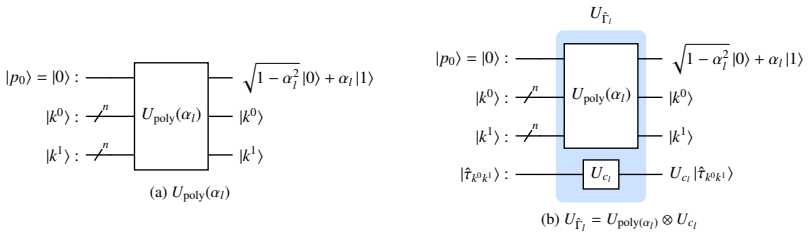
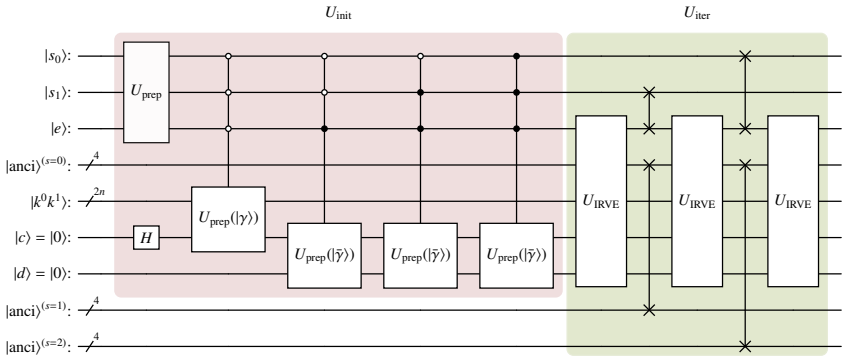
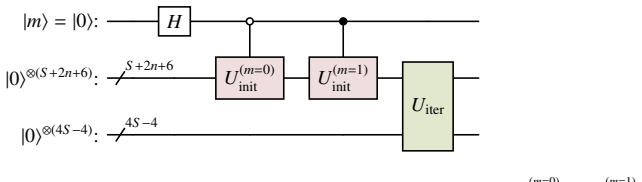
QAFE² attains polylogarithmic complexity with respect to microscopic discretization size for each RVE and exploits quantum superposition and entanglement to evaluate the entire ensemble of RVE problems associated with all macroscopic quadrature points in a single quantum execution. This form of intrinsic quantum concurrency is verified by numerical experiments on one- and two-dimensional model problems with known analytical solutions that confirm both accuracy and the theoretical scaling.
What carries the argument
Quantum superposition and entanglement that encode the ensemble of all RVE problems at macroscopic quadrature points for simultaneous solution in one circuit execution.
If this is right
- The runtime of the multiscale analysis becomes independent of the number of macroscopic quadrature points.
- Exponential asymptotic speedup is realized over classical solvers for the microscopic problems.
- The accuracy of the overall finite element solution remains equivalent to classical multiscale methods.
- Problems with very large numbers of quadrature points, common in three-dimensional applications, become tractable without proportional computational cost.
Where Pith is reading between the lines
- Similar quantum ensemble techniques could accelerate other computational mechanics tasks that involve repeated independent solves.
- Realization would require quantum hardware with sufficient qubit count and coherence to handle the encoded ensemble size.
- The method suggests exploring hybrid quantum-classical solvers for related homogenization problems in materials science.
Load-bearing premise
The framework requires a quantum computer that preserves superposition and entanglement over the complete collection of RVE problems without decoherence erasing the concurrency benefit.
What would settle it
Execution of the quantum circuit on a simulator or device where the total gate count or depth remains constant as the number of quadrature points increases from one to many; linear growth in resources with the number of points would falsify the single-execution claim.
Figures







read the original abstract
The computational cost of concurrent multiscale finite element methods is dominated by the repeated solution of microscopic representative volume element (RVE) problems at macroscopic quadrature points. In this work, we introduce a quantum-classical framework for multiscale finite element analysis (QAFE$^2$) that leverages quantum parallelism to fundamentally alter the scaling of RVE-based homogenisation. At the single-RVE level, the proposed quantum solver attains polylogarithmic complexity with respect to the microscopic discretisation size, yielding an exponential asymptotic speedup over the best available classical solvers. More importantly, QAFE$^2$ exploits quantum superposition and entanglement to evaluate, in a single quantum execution, the entire ensemble of RVE problems associated with all macroscopic quadrature points. This capability is a form of intrinsic quantum concurrency with no classical analogue. Numerical experiments on one- and two-dimensional model problems with known analytical solutions confirm the accuracy of the proposed formulation and verify the theoretical computational scaling and parallel performance.
Editorial analysis
A structured set of objections, weighed in public.
Referee Report
Summary. The paper introduces QAFE², a quantum-classical hybrid framework for concurrent multiscale finite element analysis. It claims that a quantum linear solver applied to individual representative volume element (RVE) problems achieves polylogarithmic complexity in the microscopic discretization size N, yielding exponential asymptotic speedup over classical solvers. More centrally, it asserts that quantum superposition and entanglement enable the entire ensemble of RVE problems (one per macroscopic quadrature point) to be solved in a single quantum execution, providing intrinsic concurrency with no classical counterpart. Accuracy and scaling are reported to be confirmed by numerical experiments on one- and two-dimensional analytic model problems.
Significance. If the central claims on complexity and ensemble concurrency hold, the work would represent a substantial advance in quantum-accelerated multiscale modeling, potentially enabling simulations at scales inaccessible to classical methods. The explicit use of quantum superposition across an ensemble of independent RVEs is a genuine strength with no direct classical analogue, and the grounding in standard FEM discretization is a positive. The paper also supplies numerical verification on analytic problems, which is a credit. However, the practical significance remains conditional on fault-tolerant quantum hardware and on whether the claimed polylog scaling survives standard condition-number analysis.
major comments (3)
- [§4, Theorem 2] §4 (Complexity Analysis), Theorem 2 and surrounding discussion: The claim that the single-RVE quantum solver attains polylogarithmic complexity in the microscopic discretization size N is not supported by the cited HHL-style algorithm. Standard quantum linear-system solvers incur an additional poly(κ) factor where κ is the condition number of the FEM stiffness matrix; for elliptic problems discretized on quasi-uniform meshes, κ scales as O(N^{2/d}) in d spatial dimensions. In the 1-D and 2-D cases used for verification this yields at best polynomial scaling, undermining the stated exponential asymptotic speedup. The ensemble-superposition construction inherits the same per-system κ dependence.
- [§5] §5 (Numerical Experiments): The reported experiments on 1-D and 2-D analytic problems confirm pointwise accuracy but provide no error bars, no quantitative comparison against state-of-the-art classical multiscale FE codes (e.g., FE² or MsFEM implementations), and no measured or estimated quantum circuit depth or gate count as a function of mesh size or number of quadrature points. Without these, the verification of “theoretical computational scaling” remains incomplete.
- [§3.1] §3.1 (Quantum RVE Solver): The block-encoding and ensemble embedding construction is presented without an explicit quantum preconditioner or alternative algorithm that removes the κ dependence. If the manuscript intends to rely on future improvements to quantum linear-system solvers, this assumption must be stated clearly and its impact on the overall complexity bound quantified.
minor comments (2)
- [§2–3] Notation for the macroscopic quadrature points and the associated RVE ensemble is introduced inconsistently between the abstract, §2, and §3; a single consolidated definition would improve readability.
- [Abstract and §5] The abstract states that experiments “verify the theoretical computational scaling,” yet the main text does not tabulate or plot measured runtimes or circuit depths against N; this mismatch should be resolved.
Simulated Author's Rebuttal
We thank the referee for the thorough review and constructive feedback on our manuscript. We address each of the major comments point by point below, providing clarifications and indicating the revisions we intend to implement.
read point-by-point responses
-
Referee: [§4, Theorem 2] §4 (Complexity Analysis), Theorem 2 and surrounding discussion: The claim that the single-RVE quantum solver attains polylogarithmic complexity in the microscopic discretization size N is not supported by the cited HHL-style algorithm. Standard quantum linear-system solvers incur an additional poly(κ) factor where κ is the condition number of the FEM stiffness matrix; for elliptic problems discretized on quasi-uniform meshes, κ scales as O(N^{2/d}) in d spatial dimensions. In the 1-D and 2-D cases used for verification this yields at best polynomial scaling, undermining the stated exponential asymptotic speedup. The ensemble-superposition construction inherits the same per-system κ dependence.
Authors: We appreciate the referee highlighting this important aspect of the complexity analysis. The Theorem 2 in the manuscript is based on the complexity of quantum linear system solvers such as HHL, which does include a poly(κ) factor. Our original statement of polylogarithmic complexity in N assumed that κ is independent of N or grows slowly, which is not generally true for standard FEM discretizations of elliptic problems. We agree that the claim needs qualification. In the revised manuscript, we will update the complexity statement to O(poly(κ) polylog(N)) per RVE, discuss the typical scaling of κ ≈ O(N^{2/d}), and explain that the exponential speedup holds relative to classical methods when κ is polylogarithmic, for example through the use of appropriate preconditioners. The ensemble construction will be similarly adjusted. This revision clarifies the conditions under which the claimed speedup is realized. revision: partial
-
Referee: [§5] §5 (Numerical Experiments): The reported experiments on 1-D and 2-D analytic problems confirm pointwise accuracy but provide no error bars, no quantitative comparison against state-of-the-art classical multiscale FE codes (e.g., FE² or MsFEM implementations), and no measured or estimated quantum circuit depth or gate count as a function of mesh size or number of quadrature points. Without these, the verification of “theoretical computational scaling” remains incomplete.
Authors: We concur that the numerical experiments section would benefit from additional quantitative support. We will revise §5 to include error bars on all reported accuracy metrics to indicate the reliability of the results across multiple runs or realizations. Additionally, we will incorporate scaling comparisons with classical multiscale methods such as FE², showing the number of operations or time as a function of microscopic mesh size N and number of quadrature points Q. For the quantum aspects, we will provide analytical estimates of the circuit depth and total gate count derived from the block-encoding and the quantum linear solver, plotted against N and Q to verify the theoretical polylog scaling under the stated assumptions. These enhancements will provide a more complete verification of the computational claims. revision: yes
-
Referee: [§3.1] §3.1 (Quantum RVE Solver): The block-encoding and ensemble embedding construction is presented without an explicit quantum preconditioner or alternative algorithm that removes the κ dependence. If the manuscript intends to rely on future improvements to quantum linear-system solvers, this assumption must be stated clearly and its impact on the overall complexity bound quantified.
Authors: The referee is correct that the current presentation in §3.1 does not explicitly address the condition number dependence. The framework is designed to be compatible with any quantum linear solver, including those with improved κ dependence. In the revised manuscript, we will add a clear statement in §3.1 that the complexity analysis assumes a quantum linear solver with polylogarithmic dependence on κ (or that such a solver is used), and we will quantify the overall complexity as including the poly(κ) factor. We will also briefly discuss ongoing research on quantum preconditioners for FEM matrices and how they could be integrated into the QAFE² framework to achieve the full polylog scaling in N. revision: yes
Circularity Check
No significant circularity; claims rest on external quantum algorithm assumptions
full rationale
The paper's central claims concern the application of standard quantum linear-system solvers (with polylog(N) scaling under known assumptions) to RVE problems and a proposed superposition-based ensemble evaluation. No step reduces a prediction to a fitted parameter from the same data, redefines a quantity in terms of itself, or relies on a self-citation chain for uniqueness or ansatz. The derivation chain is self-contained and draws on externally established quantum complexity results rather than internal redefinitions.
Axiom & Free-Parameter Ledger
axioms (2)
- standard math Quantum linear-system solvers (HHL or successors) achieve polylog complexity in the dimension of the RVE system when the matrix is sparse and well-conditioned.
- domain assumption Superposition and entanglement can be maintained across a number of qubits proportional to the total degrees of freedom of all RVEs simultaneously.
Reference graph
Works this paper leans on
-
[1]
R. P. Feynman, Simulating physics with computers, International Journal of Theoretical Physics 21 (1982) 467–488
1982
-
[2]
Y . I. Manin, Computable and Noncomputable, Soviet Radio, 1980
1980
-
[3]
Benioff, Quantum mechanical Hamiltonian models of Turing machines, Journal of Statistical Physics 29 (1982) 515–546
P. Benioff, Quantum mechanical Hamiltonian models of Turing machines, Journal of Statistical Physics 29 (1982) 515–546
1982
-
[4]
Deutsch, Quantum theory, the Church–Turing principle and the universal quantum computer, Proceedings of the Royal Society of London A 400 (1985) 97–117
D. Deutsch, Quantum theory, the Church–Turing principle and the universal quantum computer, Proceedings of the Royal Society of London A 400 (1985) 97–117
1985
-
[5]
P. W. Shor, Polynomial-time algorithms for prime factorization and discrete logarithms on a quantum computer, SIAM Journal on Computing 26 (1997) 1484–1509
1997
-
[6]
L. K. Grover, A fast quantum mechanical algorithm for database search, Proceedings of the 28th Annual ACM Symposium on Theory of Computing (1996) 212–219
1996
-
[7]
A. W. Harrow, A. Hassidim, S. Lloyd, Quantum algorithm for linear systems of equations, Physical Review Letters 103 (2009) 150502
2009
-
[8]
A. M. Childs, R. Kothari, R. D. Somma, Quantum algorithms for systems of linear equations, SIAM Journal on Computing 46 (2017) 1920–1950
2017
-
[9]
Gily ´en, Y
A. Gily ´en, Y . Su, G. H. Low, N. Wiebe, Quantum singular value transformation and beyond: exponential improvements for quantum matrix arithmetics, in: Proceedings of the 51st Annual ACM SIGACT Symposium on Theory of Computing, 193–204, 2019
2019
- [10]
-
[11]
Aaronson, Read the fine print, Nature Physics 11 (2015) 291–293
S. Aaronson, Read the fine print, Nature Physics 11 (2015) 291–293
2015
-
[12]
Montanaro, S
A. Montanaro, S. Pallister, Quantum algorithms and the finite element method, Physical Review A 93 (2016) 032324
2016
-
[13]
Ortiz, R
M. Ortiz, R. Phillips, Nanomechanics of defects in solids, Advances in Applied Mechanics 36 (1999) 1–79
1999
-
[14]
Ortiz, A
M. Ortiz, A. M. Cuiti ˜no, J. Knap, M. Koslowski, Mixed atomistic–continuum models of material behavior: The art of transcending atomistics and informing continua, MRS Bulletin 26 (2001) 216–221
2001
-
[15]
Conti, P
S. Conti, P. Hauret, M. Ortiz, Concurrent multiscale computing of deformation microstructure by relaxation and local enrichment with application to single-crystal plasticity, Multiscale Modeling & Simulation 6 (2007) 135–157
2007
-
[16]
Terada, N
K. Terada, N. Kikuchi, A method of two-scale analysis in solid mechanics, Computer Methods in Applied Mechanics and Engineering 138 (1997) 1–22
1997
-
[17]
V . G. Kouznetsova, W. A. M. Brekelmans, F. P. T. Baaijens, An approach to micro–macro modeling of heterogeneous materials, Computa- tional Mechanics 27 (2001) 37–48
2001
-
[18]
Miehe, J
C. Miehe, J. Schr ¨oder, M. Becker, Computational micro-to-macro transitions for discretized micro-structures of heterogeneous materials at finite strains, Computer Methods in Applied Mechanics and Engineering 191 (2002) 559–583
2002
-
[19]
Suquet, Elements of homogenization for inelastic solid mechanics, Lecture Notes in Physics 272 (1987) 193–278
P. Suquet, Elements of homogenization for inelastic solid mechanics, Lecture Notes in Physics 272 (1987) 193–278
1987
-
[20]
M. G. D. Geers, V . G. Kouznetsova, W. A. M. Brekelmans, Multiscale computational homogenization: Trends and challenges, Journal of Computational and Applied Mathematics 234 (2010) 2175–2182
2010
-
[22]
D. J. Eyre, G. W. Milton, A fast numerical scheme for computing the response of composites using grid refinement, The European Physical Journal Applied Physics 6 (1999) 41–47
1999
-
[23]
Willot, Fourier-based schemes for computing the mechanical response of composites with accurate local fields, Comptes Rendus M´ecanique 343 (2015) 232–245
F. Willot, Fourier-based schemes for computing the mechanical response of composites with accurate local fields, Comptes Rendus M´ecanique 343 (2015) 232–245
2015
-
[24]
Schneider, A review of nonlinear FFT-based computational homogenization methods: M
M. Schneider, A review of nonlinear FFT-based computational homogenization methods: M. Schneider, Acta Mechanica 232 (2021) 2051– 2100
2021
-
[25]
Lucarini, M
S. Lucarini, M. V . Upadhyay, J. Segurado, FFT based approaches in micromechanics: fundamentals, methods and applications, Modelling and Simulation in Materials Science and Engineering 30 (2022) 023002
2022
-
[26]
B. Liu, M. Ortiz, F. Cirak, Towards quantum computational mechanics, Computer Methods in Applied Mechanics and Engineering 432 (2024) 117403
2024
-
[27]
Coppersmith, An approximate Fourier transform useful in quantum factoring, IBM Research Report
D. Coppersmith, An approximate Fourier transform useful in quantum factoring, IBM Research Report
-
[28]
M. A. Nielsen, I. L. Chuang, Quantum Computation and Quantum Information, Cambridge University Press, 10th anniversary edn., 2010
2010
-
[29]
Woerner, D
S. Woerner, D. J. Egger, Quantum risk analysis, npj Quantum Information 5 (2019) 1–15
2019
-
[30]
A. C. Vazquez, R. Hiptmair, S. Woerner, Enhancing the quantum linear systems algorithm using Richardson extrapolation, ACM Transactions on Quantum Computing 3 (2022) 1–37
2022
-
[31]
Febrianto, Y
E. Febrianto, Y . Wang, B. Liu, M. Ortiz, F. Cirak, A Quantum Spectral Method for Non-Periodic Boundary Value Problems, Computer Methods in Applied Mechanics and Engineering In Press
-
[32]
A. M. Childs, N. Wiebe, Hamiltonian simulation using linear combinations of unitary operations, Quantum Information & Computation 12 (2012) 901?924
2012
-
[33]
Herbert, Quantum Computing: Foundations and Practice, Oxford University Press, 2026
S. Herbert, Quantum Computing: Foundations and Practice, Oxford University Press, 2026
2026
-
[34]
Moulinec, P
H. Moulinec, P. Suquet, A numerical method for computing the overall response of nonlinear composites with complex microstructure, Computer Methods in Applied Mechanics and Engineering 157 (1998) 69–94
1998
-
[35]
A. Javadi-Abhari, M. Treinish, K. Krsulich, C. J. Wood, J. Lishman, J. Gacon, S. Martiel, P. D. Nation, L. S. Bishop, A. W. Cross, B. R. Johnson, J. M. Gambetta, Quantum computing with Qiskit, arXiv preprint arXiv:2405.08810 (2024)
work page internal anchor Pith review arXiv 2024
-
[36]
Rosenkranz, E
M. Rosenkranz, E. Brunner, G. Marin-Sanchez, N. Fitzpatrick, S. Dilkes, Y . Tang, Y . Kikuchi, M. Benedetti, Quantum state preparation for multivariate functions, Quantum 9 (2025) 1703. 23
2025
discussion (0)
Sign in with ORCID, Apple, or X to comment. Anyone can read and Pith papers without signing in.