Recognition: 2 theorem links
· Lean TheoremDelta6: A Low-Cost, 6-DOF Force-Sensing Flexible End-Effector
Pith reviewed 2026-05-10 18:42 UTC · model grok-4.3
The pith
Delta6 achieves 6-DOF wrench sensing to 7 percent full-scale error without calibration using antagonistic springs and magnetic encoders.
A machine-rendered reading of the paper's core claim, the machinery that carries it, and where it could break.
Core claim
Delta6 attains accurate 6-DOF force and torque sensing through a combination of antagonistic springs and magnetic encoders in a simple 3D-printed structure. Without calibration it achieves 7 percent full-scale 99th-percentile error, reduced to 3.8 percent full-scale by the best lightweight sequence model. The design withstands peak loads of plus or minus 14.4 newtons force and plus or minus 0.33 newton-meters torque per axis, with the parametric analytical model allowing extension of these limits, and the sensor has been integrated with a robot arm to perform contact-rich tasks.
What carries the argument
The antagonistic spring and magnetic encoder arrangement, together with a parametric analytical model and lightweight sequence models that convert encoder readings into wrench estimates.
If this is right
- The sensor can be assembled from 3D-printed and commodity parts like flat-pack furniture.
- Bandwidth can be traded against accuracy and compute cost across different hardware platforms.
- The parametric model directly supports scaling force and torque ranges by changing spring stiffness.
- Integration with force-impedance control enables contact-rich tasks such as curved-surface buffing and precision assembly.
- Durability and thermal-drift tests indicate the device remains usable over extended operation without recalibration.
Where Pith is reading between the lines
- The approach lowers the hardware barrier for force-controlled robots in education and small laboratories.
- Similar spring-plus-encoder mechanisms could be adapted to other low-cost sensing problems if comparable linearity can be achieved.
- On-device sequence models may compensate for unit-to-unit manufacturing variation, reducing the need for individual calibration.
- The open-source release allows direct replication and further extension of the force range through spring substitution.
Load-bearing premise
The combination of antagonistic springs and magnetic encoders produces sufficiently linear, repeatable, and low-hysteresis signals across the operating range so that the parametric model and sequence models can reach the stated accuracy without per-unit calibration.
What would settle it
Repeated loading cycles that produce hysteresis exceeding the modeled correction, or thermal changes that shift the zero point beyond 3.8 percent full scale, would falsify the accuracy claims.
Figures

read the original abstract
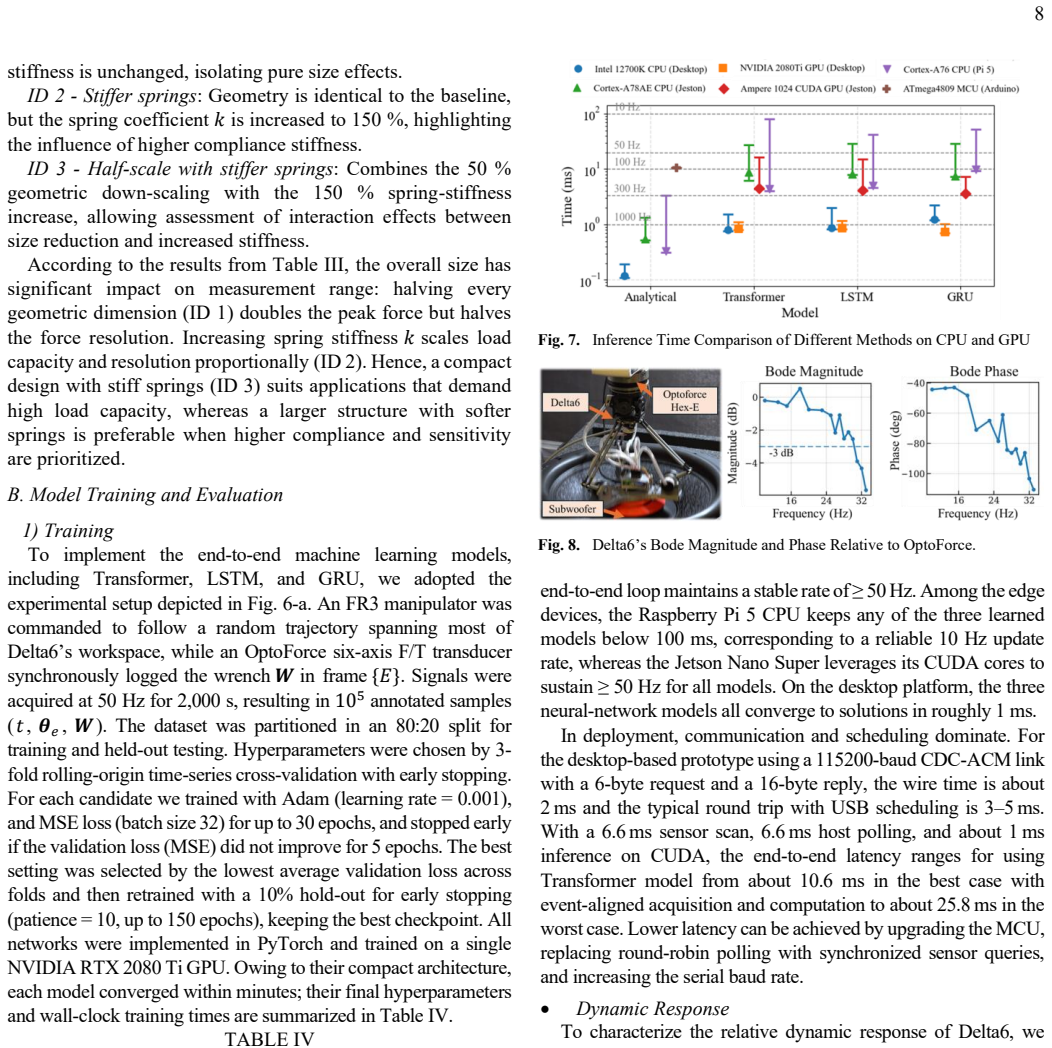
This paper presents Delta6, a low-cost, six-degree-of-freedom (6-DOF) force/torque end-effector that combines antagonistic springs with magnetic encoders to deliver accurate wrench sensing while remaining as simple to assemble as flat-pack furniture. A fully 3D-printed prototype, assembled entirely from off-the-shelf parts, withstands peak forces above +/-14.4 N and torques of +/-0.33 N.m per axis; these limits can be further extended by leveraging the proposed parametric analytical model. Without calibration, Delta6 attains a 99th-percentile error of 7% full scale (FS). With lightweight sequence models, the error is reduced to 3.8% FS by the best-performing network. Benchmarks on multiple computing platforms confirm that the device's bandwidth is adjustable, enabling balanced trade-offs among update rate, accuracy, and cost, while durability, thermal drift, and zero-calibration tests confirm its robustness. With Delta6 mounted on a robot arm governed by a force-impedance controller, the system successfully performs two contact-rich tasks: buffing curved surfaces and tight assemblies. Experiments validate the design, showing that Delta6 is a robust, low-cost alternative to existing 6-DOF force sensing solutions. Open-source site: https://wings-robotics.github.io/delta6 .
Editorial analysis
A structured set of objections, weighed in public.
Referee Report
Summary. The manuscript introduces Delta6, a low-cost 6-DOF force/torque end-effector fabricated entirely from 3D-printed parts and off-the-shelf components. It employs antagonistic springs paired with magnetic encoders, presents a parametric analytical model for wrench estimation, reports peak load capacities of +/-14.4 N force and +/-0.33 Nm torque per axis, claims a 99th-percentile error of 7% full scale without calibration (reduced to 3.8% FS by the best lightweight sequence model), and demonstrates successful integration with a force-impedance controller for contact-rich tasks including curved-surface buffing and tight assembly. The work emphasizes adjustable bandwidth, robustness via durability/thermal/zero-calibration tests, and open-source release.
Significance. If the accuracy and linearity claims hold under full 6-DOF loading, Delta6 would constitute a meaningful contribution to accessible robotics hardware by providing a parametric, fully 3D-printable 6-DOF sensor at far lower cost than commercial alternatives. The open-source repository, parametric model, and demonstrated task performance are clear strengths that could facilitate adoption in education and low-budget research settings.
major comments (2)
- [Abstract] Abstract: the headline claims of 7% FS (no-calibration) and 3.8% FS (sequence-model) 99th-percentile error rest on the unexamined assumption that antagonistic springs plus magnetic encoders produce sufficiently linear, repeatable, low-hysteresis signals across the full operating range. The abstract states that durability, thermal-drift, and zero-calibration tests were performed, yet supplies no quantitative data on hysteresis loops, repeatability standard deviation, or cross-axis error under combined loading; this omission is load-bearing for the central modeling and accuracy assertions.
- [Experimental Results] Experimental evaluation: the reported accuracy figures are presented without error bars, detailed protocols, data-exclusion criteria, or training details for the sequence models. These omissions prevent independent assessment of whether the 3.8% FS improvement is statistically reliable or sensitive to manufacturing variation.
minor comments (2)
- [Abstract] The abstract mentions bandwidth trade-offs across computing platforms but does not quantify update rates or latency numbers; a short table or sentence would improve clarity.
- Ensure all figures showing force/torque traces include explicit legends, axis units, and scale bars for the 99th-percentile error metric.
Simulated Author's Rebuttal
We thank the referee for the thoughtful and constructive review. The comments highlight important areas where additional quantitative detail would strengthen the presentation of our results. We address each major comment below and will incorporate the suggested clarifications in a revised manuscript.
read point-by-point responses
-
Referee: [Abstract] Abstract: the headline claims of 7% FS (no-calibration) and 3.8% FS (sequence-model) 99th-percentile error rest on the unexamined assumption that antagonistic springs plus magnetic encoders produce sufficiently linear, repeatable, low-hysteresis signals across the full operating range. The abstract states that durability, thermal-drift, and zero-calibration tests were performed, yet supplies no quantitative data on hysteresis loops, repeatability standard deviation, or cross-axis error under combined loading; this omission is load-bearing for the central modeling and accuracy assertions.
Authors: We agree that the abstract and main text would benefit from explicit quantitative support for the linearity and repeatability assumptions. Although the manuscript states that durability, thermal-drift, and zero-calibration tests were performed, we did not include the corresponding numerical results or plots. In the revision we will add a dedicated subsection (or appendix) containing hysteresis-loop figures, repeatability standard deviations across repeated trials, and cross-axis error measurements obtained under simultaneous multi-axis loading. These additions will directly substantiate the modeling assumptions and the reported accuracy figures. revision: yes
-
Referee: [Experimental Results] Experimental evaluation: the reported accuracy figures are presented without error bars, detailed protocols, data-exclusion criteria, or training details for the sequence models. These omissions prevent independent assessment of whether the 3.8% FS improvement is statistically reliable or sensitive to manufacturing variation.
Authors: We acknowledge that the experimental section lacks the level of detail needed for independent verification. The accuracy numbers were obtained from repeated loading trials on the fabricated prototype, yet we omitted error bars, full protocol descriptions, and model-training specifics for brevity. In the revised manuscript we will (i) add error bars to all accuracy plots, (ii) expand the methods section with the exact data-collection protocol (number of trials, loading trajectories, and any exclusion criteria), and (iii) provide training details for the sequence models including dataset size, hyperparameters, and validation procedure. We will also note any observations regarding unit-to-unit variation from the prototypes we tested. revision: yes
Circularity Check
No significant circularity; accuracy claims grounded in direct hardware measurements, not self-referential fitting or derivations.
full rationale
The paper presents a physical 6-DOF force-sensing device whose central performance figures (99th-percentile error of 7% FS without calibration, reduced to 3.8% FS with sequence models) are obtained from empirical testing on the assembled prototype. The parametric analytical model is described as an independent tool for interpreting encoder signals and extending force limits, with no evidence that any prediction or result reduces by construction to fitted inputs or prior self-citations. No load-bearing uniqueness theorems, ansatzes smuggled via citation, or renaming of known results appear in the derivation chain. The work is self-contained against external benchmarks (hardware durability, thermal-drift, and zero-calibration tests), making this a standard non-circular engineering validation.
Axiom & Free-Parameter Ledger
free parameters (1)
- spring stiffness and geometry parameters
axioms (1)
- domain assumption Antagonistic springs exhibit linear force-displacement behavior and negligible hysteresis within operating limits
Lean theorems connected to this paper
-
IndisputableMonolith/Cost/FunctionalEquation.leanwashburn_uniqueness_aczel unclear?
unclearRelation between the paper passage and the cited Recognition theorem.
Without calibration, Delta6 attains a 99th-percentile error of 7% full scale (FS). ... parametric analytical model ... sequence models
-
IndisputableMonolith/Foundation/AlexanderDuality.leanalexander_duality_circle_linking unclear?
unclearRelation between the paper passage and the cited Recognition theorem.
antagonistic springs ... magnetic encoders ... quasi-static wrench estimation ... static equilibrium
What do these tags mean?
- matches
- The paper's claim is directly supported by a theorem in the formal canon.
- supports
- The theorem supports part of the paper's argument, but the paper may add assumptions or extra steps.
- extends
- The paper goes beyond the formal theorem; the theorem is a base layer rather than the whole result.
- uses
- The paper appears to rely on the theorem as machinery.
- contradicts
- The paper's claim conflicts with a theorem or certificate in the canon.
- unclear
- Pith found a possible connection, but the passage is too broad, indirect, or ambiguous to say the theorem truly supports the claim.
Reference graph
Works this paper leans on
-
[1]
Wang, Z., Han, Y., Zhao, B., Xie, H., Yao, L., Li, B., ... & Hu, Y. (2024). Autonomous robotic system for carotid artery ultrasound scanning with visual servo navigation. IEEE Transactions on Medical Robotics and Bionics
2024
-
[2]
Dong, H., Feng, Y., Qiu, C., & Chen, I. M. (2022). Construction of interaction parallel manipulator: towards rehabilitation massage. IEEE/ASME Transactions on Mechatronics, 28(1), 372-384
2022
-
[3]
Lee, P. Q. J. (2024). Autonomous Robotic System Conducting Nasopharyngeal Swabbing (Doctoral dissertation, University of Waterloo)
2024
-
[4]
G., Faccio, M., & Rosati, G
Matheson, E., Minto, R., Zampieri, E. G., Faccio, M., & Rosati, G. (2019). Human–robot collaboration in manufacturing applications: A review. Robotics, 8(4), 100
2019
-
[5]
& Inaba, M
Yamazaki, K., Ueda, R., Nozawa, S., Kojima, M., Okada, K., Matsumoto, K., ... & Inaba, M. (2012). Home -assistant robot for an aging society. Proceedings of the IEEE, 100(8), 2429-2441
2012
-
[6]
Elsamanty, M., Eltayeb, A., & Shalaby, M. A. W. (2021, October). Design and fea -based methodology for a novel 3 parallel soft muscle actuator. In 2021 3rd novel intelligent and leading emerging sciences conference (NILES) (pp. 394-399). IEEE
2021
-
[7]
B., Bayraktar, E., & Boyraz, P
Yigit, C. B., Bayraktar, E., & Boyraz, P. (2018). Low-cost variable stiffness joint design using translational variable radius pulleys. Mechanism and Machine Theory, 130, 203-219
2018
-
[8]
Siciliano, B., & Khatib, O. (2016). Robotics and the Handbook. In Springer Handbook of Robotics (pp. 1-6). Cham: Springer International Publishing
2016
-
[9]
Li, S., & Xu, J. (2024). Multi -Axis Force/Torque Sensor Technologies: Design Principles and Robotic Force Control Applications: A Review. IEEE Sensors Journal
2024
-
[10]
& Krüger, T
Panzirsch, M., Pereira, A., Singh, H., Weber, B., Ferreira, E., Gherghescu, A., ... & Krüger, T. (2022). Exploring planet geology through force - feedback telemanipulation from orbit. Science robotics, 7(65), eabl6307
2022
-
[11]
A., Wiegerink, R
Alveringh, D., Brookhuis, R. A., Wiegerink, R. J., & Krijnen, G. J. (2014, January). A large range multi -axis capacitive force/torque sensor realized in a single SOI wafer. In 2014 IEEE 27th International Conference on Micro Electro Mechanical Systems (MEMS) (pp. 680-683). IEEE. Fig. 11. Contact-rich task demonstrations using Delta 6. (a) Force-controlle...
2014
-
[12]
B., Senthil, K
Zhang, W., Lua, K. B., Senthil, K. A., Lim, T. T., Yeo, K. S., & Zhou, G. (2016). Design and characterization of a novel T -shaped multi -axis piezoresistive force/moment sensor. IEEE Sensors Journal, 16(11), 4198 - 4210
2016
-
[13]
Hendrich, N., Wasserfall , F., & Zhang, J. (2020). 3D printed low -cost force-torque sensors. IEEE Access, 8, 140569-140585
2020
-
[14]
Palli, G., Moriello, L., Scarcia, U., & Melchiorri, C. (2014). Development of an optoelectronic 6 -axis force/torque sensor for robotic applications. Sensors and Actuators A: Physical, 220, 333-346
2014
-
[15]
Xiong, L., Guo, Y., Jiang, G., Zhou, X., Jiang, L., & Liu, H. (2020). Six - dimensional force/torque sensor based on fiber Bragg gratings with low coupling. IEEE Transactions on Industrial Electronics, 68(5), 4079-4089
2020
-
[16]
Al-Mai, O., Ahmadi, M., & Albert, J. (2018). Design, development and calibration of a lightweight, compliant six-axis optical force/torque sensor. IEEE Sensors Journal, 18(17), 7005-7014
2018
-
[17]
(2020, May)
Ouyang, R., & Howe, R. (2020, May). Low -cost fiducial -based 6 -axis force-torque sensor. In 2020 IEEE International Conference on Robotics and Automation (ICRA) (pp. 1653-1659). IEEE
2020
-
[18]
S., Zaki, A
Zhuwawu, S. S., Zaki, A. B., El-Samanty, M., Parque, V., & El-Hussieny, H. (2023, June). Non -invasive Feedback for Prosthetic Arms: A Conceptual Design of a Wearable Haptic Armband. In 2023 IEEE/ASME International Conference on Advanced Intelligent Mechatronics (AIM) (pp. 828-833). IEEE
2023
-
[19]
Hochreiter, S. (1997). Long Short -term Memory. Neural Computation MIT-Press
1997
-
[20]
Cho, K. (2014). On the properties of neural machine translation: Encoder- decoder approaches. arXiv preprint arXiv:1409.1259
work page Pith review arXiv 2014
-
[21]
Vaswani, A. (2017). Attention is all you need. Advances in Neural Information Processing Systems
2017
-
[22]
M., Zaky, A
Asy, K. M., Zaky, A. B., El-Hussieny, H., Ishii, H., & Elsamanty, M. (2023, September). Conceptual Design and Kinematic Analysis of Hybrid Parallel Robot for Accurate Position and Orientation. In 2023 62nd Annual Conference of the Society of Instrument and Control Engineers (SICE) (pp. 558-563). IEEE
2023
-
[23]
M., Hossameldin, Y
Elsamanty, M., Faidallah, E. M., Hossameldin, Y. H., Rabbo, S. A., Maged, S. A., Yang, H., & Guo, K. (2023). Workspace analysis and path planning of a novel robot configuration with a 9 -DOF serial -parallel hybrid manipulator (SPHM). Applied Sciences, 13(4), 2088
2023
-
[24]
Eltayeb, A., Abdraboo, S., & Elsamanty, M. (2021). Kinematic Analysis of Delta Parallel Robot: Simulation Study. Engineering Research Journal (Shoubra), 49(1), 25-35
2021
-
[25]
Shan, S., & Pham, Q. C. (2023). Fine robotic manipulation without force/torque sensor. IEEE Robotics and Automation Letters , 9(2), 1206 - 1213
2023
-
[26]
B., Bayraktar, E., Kaya, O., & Boyraz, P
Yigit, C. B., Bayraktar, E., Kaya, O., & Boyraz, P. (2020). External force/torque estimation with only position sensors for antagonistic VSAs. IEEE Transactions on Robotics, 37(2), 675-682
2020
-
[27]
Kružić, S., Musić, J., Kamnik, R., & Papić, V. (2021). End -effector force and joint torque estimation of a 7 -dof robotic manipulator using deep learning. Electronics, 10(23), 2963
2021
- [28]
- [29]
-
[30]
Feng, Y., Huang, W., & Chen, I. M. (2024, July). Optimizing Small-Scale Commercial Automation: Introducing WOS, a Low -Code Solution for Robotic Arms Integration. In 2024 IEEE International Conference on Advanced Intelligent Mechatronics (AIM) (pp. 272-277). IEEE. Yue Feng (Member, IEEE) received the B.S. degree in Mechanical Engineering from the Universi...
2024
-
[31]
Chen Qiu received his B.S
His current research interests include robotic perception and manipulation in unstructured environments, robotic gripper/hand. Chen Qiu received his B.S. degree in spacecraft design and engineering from Beihang University in Beijing, China, in
-
[32]
in robotics from the Centre for Robotics Research at King’s College London in the United Kingdom in
He obtained his Ph.D. in robotics from the Centre for Robotics Research at King’s College London in the United Kingdom in
-
[33]
His research interests encompass the kinematics and dynamics of robotics, compliant mechanisms and robotics, and medical and humanoid robots
Then, he held the position of Research Fellow at the Robotics Research Center of Nanyang Technological University in Singapore. His research interests encompass the kinematics and dynamics of robotics, compliant mechanisms and robotics, and medical and humanoid robots. I-Ming Chen (S’90–M’95–SM’06-F’14) received B.S. degree from National Taiwan University...
1986
discussion (0)
Sign in with ORCID, Apple, or X to comment. Anyone can read and Pith papers without signing in.