Recognition: no theorem link
Plasma GraphRAG: Physics-Grounded Parameter Selection for Gyrokinetic Simulations
Pith reviewed 2026-05-10 19:04 UTC · model grok-4.3
The pith
Plasma GraphRAG grounds LLM parameter recommendations for gyrokinetic simulations in a curated physics knowledge graph.
A machine-rendered reading of the paper's core claim, the machinery that carries it, and where it could break.
Core claim
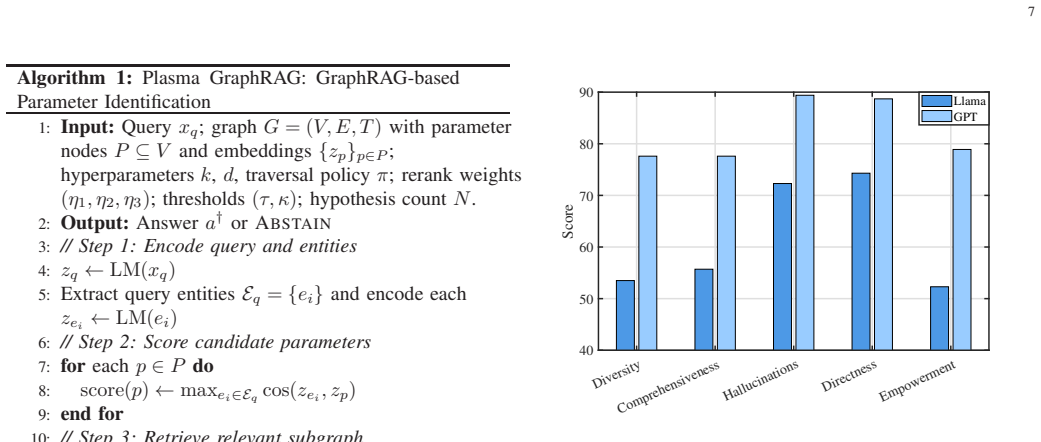
By constructing a domain-specific knowledge graph from curated plasma literature and enabling structured retrieval over graph-anchored entities and relations, Plasma GraphRAG enables LLMs to generate accurate, context-aware recommendations for parameter ranges in gyrokinetic simulations, outperforming vanilla RAG by over 10% in overall quality and reducing hallucination rates by up to 25%.
What carries the argument
The domain-specific knowledge graph that captures entities and relations from plasma physics literature to anchor retrieval-augmented generation for LLMs.
If this is right
- Parameter recommendations gain consistency and physics grounding across different users.
- Hallucination rates drop, raising trust in LLM outputs for simulation setup.
- Manual literature review time decreases, freeing researchers for higher-level analysis.
- Simulation reliability improves because initial parameter choices start closer to valid ranges.
- The same graph-retrieval pattern offers a template for other data-rich scientific domains.
Where Pith is reading between the lines
- The graph would need regular updates with new publications to stay current.
- Pairing the system with experimental validation loops could catch remaining errors.
- Similar graph-grounded methods might help parameter selection in adjacent fields such as fluid dynamics or materials modeling.
- Wider use could lower the entry barrier for researchers who lack deep prior experience with gyrokinetic codes.
Load-bearing premise
A finite set of curated papers supplies a knowledge graph that already contains the physics relations needed to guide parameter choices for new simulation setups.
What would settle it
Apply the system to a standard gyrokinetic case whose correct parameter ranges are independently established by expert consensus or experiment, then check whether the outputs match those ranges or contain fabricated relations.
Figures




read the original abstract
Accurate parameter selection is fundamental to gyrokinetic plasma simulations, yet current practices rely heavily on manual literature reviews, leading to inefficiencies and inconsistencies. We introduce Plasma GraphRAG, a novel framework that integrates Graph Retrieval-Augmented Generation (GraphRAG) with large language models (LLMs) for automated, physics-grounded parameter range identification. By constructing a domain-specific knowledge graph from curated plasma literature and enabling structured retrieval over graph-anchored entities and relations, Plasma GraphRAG enables LLMs to generate accurate, context-aware recommendations. Extensive evaluations across five metrics, comprehensiveness, diversity, grounding, hallucination, and empowerment, demonstrate that Plasma GraphRAG outperforms vanilla RAG by over $10\%$ in overall quality and reduces hallucination rates by up to $25\%$. {Beyond enhancing simulation reliability, Plasma GraphRAG offers a methodology for accelerating scientific discovery across complex, data-rich domains.
Editorial analysis
A structured set of objections, weighed in public.
Referee Report
Summary. The manuscript introduces Plasma GraphRAG, a framework integrating Graph Retrieval-Augmented Generation (GraphRAG) with large language models (LLMs) to automate physics-grounded parameter range selection for gyrokinetic plasma simulations. A domain-specific knowledge graph is constructed from curated plasma literature, enabling structured retrieval over entities and relations to inform LLM outputs. The central claim is that this yields >10% improvement in overall quality over vanilla RAG across five metrics (comprehensiveness, diversity, grounding, hallucination, empowerment) and up to 25% reduction in hallucination rates, while providing a general methodology for accelerating discovery in complex scientific domains.
Significance. If the performance claims prove robust under detailed scrutiny and the approach generalizes beyond the training corpus, Plasma GraphRAG could reduce reliance on manual literature reviews for gyrokinetic setup, improving consistency and efficiency in plasma simulation workflows. The graph-anchored retrieval offers a concrete way to inject domain physics into LLM assistance. However, the current manuscript provides insufficient methodological detail to evaluate whether these benefits are realized or transferable to novel parameter regimes.
major comments (2)
- [Evaluation section / Abstract] The abstract and evaluation results claim that 'Extensive evaluations across five metrics... demonstrate that Plasma GraphRAG outperforms vanilla RAG by over 10% in overall quality and reduces hallucination rates by up to 25%.' No definition is given for the five metrics, no description of the test cases or simulation setups, no details on the vanilla RAG baseline implementation, and no statistical significance testing or error bars. This absence renders the central empirical claim unevaluable from the manuscript.
- [Introduction / Abstract] The framework is motivated by the need to accelerate discovery for 'new simulation setups,' yet the knowledge graph is built from a finite curated literature set. The reported metric improvements are measured on cases drawn from the same corpus; no experiments are described for parameter regimes or instabilities absent from the literature. In such out-of-corpus cases the structured retrieval step supplies no additional physics relations, so the method reverts to vanilla LLM generation and the claimed deltas cannot be assumed to hold.
Simulated Author's Rebuttal
We thank the referee for their constructive comments, which help clarify the presentation of our evaluation and the scope of our claims. We address each major point below and have revised the manuscript to strengthen the methodological transparency and discussion of limitations.
read point-by-point responses
-
Referee: [Evaluation section / Abstract] The abstract and evaluation results claim that 'Extensive evaluations across five metrics... demonstrate that Plasma GraphRAG outperforms vanilla RAG by over 10% in overall quality and reduces hallucination rates by up to 25%.' No definition is given for the five metrics, no description of the test cases or simulation setups, no details on the vanilla RAG baseline implementation, and no statistical significance testing or error bars. This absence renders the central empirical claim unevaluable from the manuscript.
Authors: We agree that the original manuscript provided insufficient detail for independent evaluation of the quantitative claims. In the revised version we have substantially expanded Section 4 (Evaluation) to supply: (i) explicit operational definitions for each of the five metrics, (ii) a table describing the five gyrokinetic test cases (including the specific instabilities, parameter ranges, and simulation codes used), (iii) the precise configuration of the vanilla RAG baseline (identical LLM, same prompt templates, and standard vector retrieval without graph traversal), and (iv) error bars together with paired statistical significance tests across repeated runs. These additions render the reported >10 % quality improvement and up to 25 % hallucination reduction fully evaluable. revision: yes
-
Referee: [Introduction / Abstract] The framework is motivated by the need to accelerate discovery for 'new simulation setups,' yet the knowledge graph is built from a finite curated literature set. The reported metric improvements are measured on cases drawn from the same corpus; no experiments are described for parameter regimes or instabilities absent from the literature. In such out-of-corpus cases the structured retrieval step supplies no additional physics relations, so the method reverts to vanilla LLM generation and the claimed deltas cannot be assumed to hold.
Authors: The referee is correct that all quantitative results were obtained on in-corpus test cases. While the graph structure can surface indirect relations that may aid similar but unseen setups, we did not conduct explicit out-of-distribution experiments. We have therefore revised the abstract and Introduction to qualify the motivation, stating that the demonstrated gains apply to parameter selections supported by the existing literature corpus. A new limitations subsection has been added to the Discussion that explicitly notes the expected performance degradation for regimes entirely absent from the knowledge graph and the consequent reversion toward vanilla LLM behavior. These textual changes provide a more accurate scope without introducing unsubstantiated claims. revision: partial
Circularity Check
No significant circularity in the derivation or evaluation chain
full rationale
The paper introduces a GraphRAG framework that builds a knowledge graph from an external curated literature corpus and evaluates it against vanilla RAG on five standard metrics (comprehensiveness, diversity, grounding, hallucination, empowerment). No mathematical derivations, fitted parameters, or predictions appear in the abstract or described method. The central performance claims rest on empirical comparisons using the constructed graph, with no self-definitional loops, no renaming of known results, and no load-bearing self-citations that reduce the argument to unverified inputs. The approach is self-contained against external benchmarks and does not exhibit any of the enumerated circularity patterns.
Axiom & Free-Parameter Ledger
axioms (1)
- domain assumption Curated plasma literature contains the physics relations required to ground parameter recommendations
Reference graph
Works this paper leans on
-
[1]
The local limit of glo bal gyroki- netic simulations,
J. Candy, R. Waltz, and W. Dorland, “The local limit of glo bal gyroki- netic simulations,” Physics of Plasmas , vol. 11, no. 5, pp. L25–L28, 2004
2004
-
[2]
Gyrokinetic particle simulation model,
W. W. Lee, “Gyrokinetic particle simulation model,” Journal of Com- putational Physics , vol. 72, no. 1, pp. 243–269, 1987
1987
-
[3]
Gyrokinetic simulations of turbulent transport,
X. Garbet, Y . Idomura, L. Villard, et al. , “Gyrokinetic simulations of turbulent transport,” Nuclear Fusion , vol. 50, no. 4, p. 043002, 2010
2010
-
[4]
Exploring collaborative distributed diffusion-based ai-generated content (aigc) in wireless n etworks,
H. Du, R. Zhang, D. Niyato, et al. , “Exploring collaborative distributed diffusion-based ai-generated content (aigc) in wireless n etworks,” IEEE Network, vol. 38, no. 3, pp. 178–186, 2024
2024
-
[5]
Retrieval-Augmented Generation for Large Language Models: A Survey
Y . Gao, Y . Xiong, X. Gao, et al. , “Retrieval-augmented generation for large language models: A survey,” arXiv preprint arXiv:2312.10997 , vol. 2, no. 1, 2023
work page internal anchor Pith review Pith/arXiv arXiv 2023
-
[6]
Interactive ai with retrieval-augmented generation for next generation networking,
R. Zhang, H. Du, Y . Liu, et al., “Interactive ai with retrieval-augmented generation for next generation networking,” IEEE Network , vol. 38, no. 6, pp. 414–424, 2024
2024
-
[7]
Nonlinear gyrokinetic equation s for low- frequency electromagnetic waves in general plasma equilib ria,
E. Frieman and L. Chen, “Nonlinear gyrokinetic equation s for low- frequency electromagnetic waves in general plasma equilib ria,” The Physics of Fluids , vol. 25, no. 3, pp. 502–508, 1982
1982
-
[8]
Electron temperature gradient driven turbulence,
F. Jenko, W. Dorland, M. Kotschenreuther, et al., “Electron temperature gradient driven turbulence,” Physics of plasmas , vol. 7, no. 5, pp. 1904– 1910, 2000
1904
-
[9]
A high-accuracy e ulerian gyrokinetic solver for collisional plasmas,
J. Candy, E. A. Belli, and R. Bravenec, “A high-accuracy e ulerian gyrokinetic solver for collisional plasmas,” Journal of Computational Physics, vol. 324, pp. 73–93, 2016
2016
-
[10]
A multi-species collisional operator for full-f global gyrokinetics codes: Numerical a spects and verification with the gysela code,
P . Donnel, X. Garbet, Y . Sarazin, et al. , “A multi-species collisional operator for full-f global gyrokinetics codes: Numerical a spects and verification with the gysela code,” Computer Physics Communications , vol. 234, pp. 1–13, 2019
2019
-
[11]
A theory-based tr ansport model with comprehensive physics,
G. Staebler, J. Kinsey, and R. Waltz, “A theory-based tr ansport model with comprehensive physics,” Physics of Plasmas , vol. 14, no. 5, 2007
2007
-
[12]
Generative- machine-learning surrogate model of plasma turbulence,
B. Clavier, D. Zarzoso, D. del Castillo-Negrete, et al. , “Generative- machine-learning surrogate model of plasma turbulence,” Physical Re- view E , vol. 111, no. 1, p. L013202, 2025
2025
-
[13]
5d neural surrogates for nonlinear gyrokinetic simulations of plasma turbulence,
G. Galletti, F. Paischer, P . Setinek, et al. , “5d neural surrogates for nonlinear gyrokinetic simulations of plasma turbulence,” arXiv preprint arXiv:2502.07469, 2025
-
[14]
Multi-fidelity information fusion for turbulent transport modeling in magnetic fusion plasma,
S. Maeyama, M. Honda, E. Narita, et al. , “Multi-fidelity information fusion for turbulent transport modeling in magnetic fusion plasma,” Scientific Reports , vol. 14, no. 1, p. 28242, 2024
2024
-
[15]
D. Kim, T. Moon, C. Sung, et al. , “V erification of fast ion effects on turbulence through comparison of gene and cgyro with l-mode plasmas in kstar,” arXiv preprint arXiv:2408.13731 , 2024
-
[16]
Reading Wikipedia to Answer Open-Domain Questions
D. Chen, A. Fisch, J. Weston, et al. , “Reading wikipedia to answer open-domain questions,” arXiv preprint arXiv:1704.00051 , 2017
work page Pith review arXiv 2017
-
[17]
Retrieval augmented language model pre-training,
K. Guu, K. Lee, Z. Tung, et al. , “Retrieval augmented language model pre-training,” in International conference on machine learning . PMLR, 2020, pp. 3929–3938
2020
-
[18]
Retrieval-augmented generation for knowledge-intensive nlp tasks,
P . Lewis, E. Perez, A. Piktus, et al. , “Retrieval-augmented generation for knowledge-intensive nlp tasks,” Advances in neural information processing systems, vol. 33, pp. 9459–9474, 2020
2020
-
[19]
Graph retrieval-augmented g eneration for large language models: A survey,
T. T. Procko and O. Ochoa, “Graph retrieval-augmented g eneration for large language models: A survey,” in 2024 Conference on AI, Science, Engineering, and Technology (AIxSET) , 2024, pp. 166–169
2024
-
[20]
arXiv preprint arXiv:2408.08921 (2024) A CQ-Driven RAG Workflow for Digital Storytelling 19
B. Peng, Y . Zhu, Y . Liu, et al. , “Graph retrieval-augmented generation: A survey,” arXiv preprint arXiv:2408.08921 , 2024
-
[21]
Documen t graphrag: Knowledge graph enhanced retrieval augmented generation f or docu- ment question answering within the manufacturing domain,
S. Knollmeyer, O. Caymazer, and D. Grossmann, “Documen t graphrag: Knowledge graph enhanced retrieval augmented generation f or docu- ment question answering within the manufacturing domain,” Electronics, vol. 14, no. 11, p. 2102, 2025
2025
-
[22]
J. Lála, O. O’Donoghue, A. Shtedritski, et al. , “Paperqa: Retrieval- augmented generative agent for scientific research,” arXiv preprint arXiv:2312.07559, 2023
-
[23]
graphrag: A systematic evaluation and key insights
H. Han, H. Shomer, Y . Wang, et al. , “Rag vs. graphrag: A systematic evaluation and key insights,” arXiv preprint arXiv:2502.11371 , 2025
-
[24]
Survey of hallucination in natural language generation,
Z. Ji, N. Lee, R. Frieske, et al. , “Survey of hallucination in natural language generation,” ACM computing surveys , vol. 55, no. 12, pp. 1– 38, 2023
2023
-
[25]
Core turbulent transport in tokamak plasmas: bridging theory and experiment with qua likiz,
C. Bourdelle, J. Citrin, B. Baiocchi, et al. , “Core turbulent transport in tokamak plasmas: bridging theory and experiment with qua likiz,” Plasma Physics and Controlled Fusion , vol. 58, no. 1, p. 014036, 2015
2015
-
[26]
No nlinear gyrokinetic predictions of sparc burning plasma profiles en abled by surrogate modeling,
P . Rodriguez-Fernandez, N. T. Howard, and J. Candy, “No nlinear gyrokinetic predictions of sparc burning plasma profiles en abled by surrogate modeling,” Nuclear Fusion , vol. 62, no. 7, p. 076036, 2022
2022
-
[27]
S. Wu, Y . Xiong, Y . Cui, et al., “Retrieval-augmented generation for nat- ural language processing: A survey,” arXiv preprint arXiv:2407.13193 , 2024
-
[28]
Sentence-BERT: Sentence Embeddings using Siamese BERT-Networks
N. Reimers and I. Gurevych, “Sentence-bert: Sentence e mbeddings using siamese bert-networks,” arXiv preprint arXiv:1908.10084 , 2019
work page internal anchor Pith review Pith/arXiv arXiv 1908
-
[29]
Retrieval-augmented generation for ai-generated content: A survey.CoRR, abs/2402.19473, 2024
P . Zhao, H. Zhang, Q. Y u, et al. , “Retrieval-augmented generation for ai-generated content: A survey,” arXiv preprint arXiv:2402.19473, 2024
-
[30]
Evaluation of retrieval-augmented generation: A survey,
H. Y u, A. Gan, K. Zhang, et al. , “Evaluation of retrieval-augmented generation: A survey,” in CCF Conference on Big Data . Springer, 2024, pp. 102–120
2024
discussion (0)
Sign in with ORCID, Apple, or X to comment. Anyone can read and Pith papers without signing in.