Recognition: 2 theorem links
· Lean TheoremLattice chiral symmetry from bosons in 3+1d
Pith reviewed 2026-05-10 18:37 UTC · model grok-4.3
The pith
A solvable lattice Hamiltonian with bosons realizes exact chiral symmetry that matches the continuum axion theory.
A machine-rendered reading of the paper's core claim, the machinery that carries it, and where it could break.
Core claim
The central claim is that a Hamiltonian built from lattice bosons can enforce exact chiral U(1)_V × U(1)_A symmetry at finite lattice spacing. The U(1)_V symmetry shifts the scalar field while U(1)_A acts on short axion string operators, becoming a 1-form symmetry in the continuum. When U(1)_V is gauged, axial rotations shift the lattice theta angle, demonstrating the anomaly, and gauging either symmetry produces non-invertible or 2-group symmetries on the lattice consistent with continuum expectations.
What carries the argument
The solvable Hamiltonian that realizes the exact lattice chiral symmetry using bosonic operators associated with axion strings.
If this is right
- The lattice model evades Nielsen-Ninomiya no-go theorems by using bosons instead of fermions.
- Gauging the vector symmetry leads to non-invertible symmetries on the lattice.
- Gauging the axial symmetry leads to 2-group symmetries.
- The chiral anomaly is realized through the shift in the lattice theta angle under axial rotations.
- The continuum limit reproduces the compact boson theory with axion coupling.
Where Pith is reading between the lines
- This approach might enable lattice studies of chiral gauge theories that were previously obstructed by no-go theorems.
- Similar bosonic constructions could apply to other anomalous symmetries or in different spacetime dimensions.
- The use of axion-string operators suggests possible connections to topological phases with string-like defects.
Load-bearing premise
The lattice model has a well-defined continuum limit that reproduces the compact boson field theory with the axion-like coupling and the transmuted symmetries.
What would settle it
A direct calculation showing that an axial rotation on the lattice shifts the theta angle by the expected amount when the vector symmetry is gauged, or verifying the absence of the symmetry in the continuum limit if the assumption fails.
Figures




read the original abstract
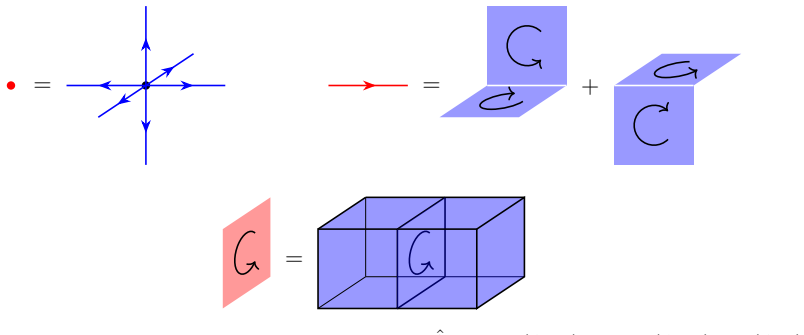
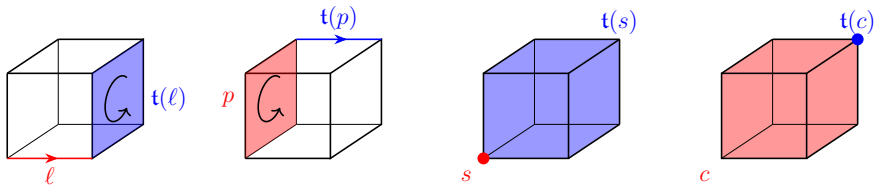
We present a solvable Hamiltonian that realizes an exact lattice chiral $U(1)_V \times U(1)_A$ symmetry. Nielsen-Ninomiya-type no-go theorems are evaded by using lattice bosons rather than fermions. The continuum limit is a compact boson field theory with an axion-like coupling. The $U(1)_V$ symmetry shifts the scalar, while $U(1)_A$ acts on local operators associated with short axion strings and is transmuted into a higher-form symmetry in the continuum limit. We demonstrate the chiral anomaly by showing that the lattice theta angle is shifted by an axial rotation when $U(1)_V$ is gauged. Gauging either $U(1)_V$ or $U(1)_A$ leads to lattice non-invertible and 2-group symmetries, respectively, matching the continuum picture.
Editorial analysis
A structured set of objections, weighed in public.
Referee Report
Summary. The manuscript constructs a solvable lattice Hamiltonian in 3+1d that realizes an exact chiral U(1)_V × U(1)_A symmetry using bosonic degrees of freedom, thereby evading Nielsen-Ninomiya no-go theorems. The continuum limit is asserted to be a compact boson theory with an axion-like coupling; U(1)_V shifts the scalar while U(1)_A acts on short axion strings and transmutes into a higher-form symmetry. The chiral anomaly is demonstrated by a shift in the lattice theta angle under axial rotations after gauging U(1)_V. Gauging either symmetry produces lattice non-invertible or 2-group symmetries that match the continuum picture.
Significance. If the central claims are established, the work supplies a bosonic lattice regularization of chiral symmetries, anomalies, and generalized symmetries in 3+1d. The solvability of the Hamiltonian and the explicit lattice realization of non-invertible/2-group structures after gauging are concrete strengths that could aid studies of axion physics and higher-form symmetries.
major comments (2)
- [Continuum limit and symmetry transmutation discussion] The identification of the continuum limit as the compact boson with axion-like coupling (and the associated symmetry transmutation) is asserted without an explicit derivation. No duality mapping, renormalization-group flow, or correlation-function calculation is supplied to show that the lattice degrees of freedom reduce precisely to the claimed theory rather than to a different phase or one with additional relevant operators. This step is load-bearing for the anomaly matching and higher-form symmetry claims.
- [Anomaly and gauging sections] The anomaly demonstration (lattice theta-angle shift under axial rotation after gauging U(1)_V) and the subsequent non-invertible/2-group structures rely on the explicit form of the Hamiltonian and the gauging procedure. Without these details being presented in a verifiable manner, it is not possible to confirm that the anomaly is captured correctly and that no extraneous lattice artifacts survive.
minor comments (1)
- [Symmetry action on operators] Define the local operators associated with short axion strings and specify how U(1)_A acts on them at the lattice level.
Simulated Author's Rebuttal
We thank the referee for their careful reading and constructive comments on our manuscript. The points raised are helpful for clarifying the presentation of the continuum limit and the anomaly calculations. We address each major comment below and indicate the revisions we will make.
read point-by-point responses
-
Referee: [Continuum limit and symmetry transmutation discussion] The identification of the continuum limit as the compact boson with axion-like coupling (and the associated symmetry transmutation) is asserted without an explicit derivation. No duality mapping, renormalization-group flow, or correlation-function calculation is supplied to show that the lattice degrees of freedom reduce precisely to the claimed theory rather than to a different phase or one with additional relevant operators. This step is load-bearing for the anomaly matching and higher-form symmetry claims.
Authors: We agree that the manuscript would benefit from a more explicit derivation of the continuum limit. The current identification rests on the exact solvability of the Hamiltonian, which allows complete diagonalization showing a single gapless mode whose dispersion and operator content match those of a compact boson, together with the precise matching of the U(1)_V and U(1)_A symmetries and the anomaly. The axion-like coupling emerges directly from the lattice definition of the short-string operators. Nevertheless, we acknowledge that an explicit correlation-function calculation or duality map is not supplied. In the revised version we will add a new subsection that computes the two-point functions of the lattice scalar and string operators in the infrared and demonstrates their agreement with the continuum compact-boson theory, including the axion term. This addition will also make the symmetry transmutation explicit. revision: yes
-
Referee: [Anomaly and gauging sections] The anomaly demonstration (lattice theta-angle shift under axial rotation after gauging U(1)_V) and the subsequent non-invertible/2-group structures rely on the explicit form of the Hamiltonian and the gauging procedure. Without these details being presented in a verifiable manner, it is not possible to confirm that the anomaly is captured correctly and that no extraneous lattice artifacts survive.
Authors: The Hamiltonian is stated explicitly in Eq. (1) and the gauging procedure, including the modified plaquette and vertex terms, is given in Section III. The anomaly is obtained by direct computation of the commutator of the axial rotation with the gauged Hamiltonian, which produces the expected shift of the lattice theta angle. We agree that additional intermediate steps would make the calculation easier to verify and would help rule out possible lattice artifacts. In the revised manuscript we will expand the anomaly section with a step-by-step derivation of the theta-angle shift, including the explicit action of the axial operator on each term of the gauged Hamiltonian and a brief discussion of why no extraneous operators are generated. revision: yes
Circularity Check
Direct lattice Hamiltonian construction with no self-referential derivations
full rationale
The paper defines an explicit solvable lattice Hamiltonian and demonstrates its exact U(1)_V × U(1)_A symmetries by direct construction on the lattice degrees of freedom. The continuum limit identification, anomaly matching via gauging, and transmutation to higher-form symmetries are argued from the lattice operators and their actions rather than from any fitted parameters, self-citations, or prior results that reduce the claim to a tautology. No step equates a derived quantity to an input by definition or renames a known result as a new prediction.
Axiom & Free-Parameter Ledger
axioms (1)
- domain assumption The lattice model admits a continuum limit matching compact boson theory with axion coupling
Lean theorems connected to this paper
-
IndisputableMonolith/Foundation/AlexanderDuality.leanalexander_duality_circle_linking echoes?
echoesECHOES: this paper passage has the same mathematical shape or conceptual pattern as the Recognition theorem, but is not a direct formal dependency.
The continuum limit is a compact boson field theory with an axion-like coupling... U(1)A acts on local operators associated with short axion strings and is transmuted into a higher-form symmetry
What do these tags mean?
- matches
- The paper's claim is directly supported by a theorem in the formal canon.
- supports
- The theorem supports part of the paper's argument, but the paper may add assumptions or extra steps.
- extends
- The paper goes beyond the formal theorem; the theorem is a base layer rather than the whole result.
- uses
- The paper appears to rely on the theorem as machinery.
- contradicts
- The paper's claim conflicts with a theorem or certificate in the canon.
- unclear
- Pith found a possible connection, but the passage is too broad, indirect, or ambiguous to say the theorem truly supports the claim.
Reference graph
Works this paper leans on
-
[1]
D. B. Kaplan,Chiral Symmetry and Lattice Fermions, inLes Houches Summer School: Session 93: Modern perspectives in lattice QCD: Quantum field theory and high performance computing, pp. 223–272, 12, 2009.arXiv:0912.2560
work page Pith review arXiv 2009
-
[2]
H. B. Nielsen and M. Ninomiya,Absence of Neutrinos on a Lattice. 1. Proof by Homotopy Theory,Nucl. Phys. B185(1981) 20. [Erratum: Nucl.Phys.B 195, 541 (1982)]
1981
-
[3]
H. B. Nielsen and M. Ninomiya,Absence of Neutrinos on a Lattice. 2. Intuitive Topological Proof,Nucl. Phys. B193(1981) 173–194
1981
-
[4]
H. B. Nielsen and M. Ninomiya,No Go Theorem for Regularizing Chiral Fermions, Phys. Lett. B105(1981) 219–223
1981
-
[5]
Friedan,A PROOF OF THE NIELSEN-NINOMIYA THEOREM,Commun
D. Friedan,A PROOF OF THE NIELSEN-NINOMIYA THEOREM,Commun. Math. Phys.85(1982) 481–490
1982
-
[6]
L. Fidkowski and C. Xu,A No-Go Result for Implementing Chiral Symmetries by Locality-Preserving Unitaries in a Three-Dimensional Hamiltonian Lattice Model of Fermions,Phys. Rev. Lett.131(2023), no. 19 196601, [arXiv:2306.10105]
-
[7]
A. Kapustin and N. Sopenko,Anomalous Symmetries of Quantum Spin Chains and a Generalization of the Lieb–Schultz–Mattis Theorem,Commun. Math. Phys.406 (2025), no. 10 238, [arXiv:2401.02533]
-
[8]
Liu,Anomalies in quantum spin systems and Nielsen-Ninomiya type Theorems, 2602.13948
R. Liu,Anomalies in quantum spin systems and Nielsen-Ninomiya type Theorems, arXiv:2602.13948. 54
-
[9]
D. J. Gross and I. R. Klebanov,ONE-DIMENSIONAL STRING THEORY ON A CIRCLE,Nucl. Phys. B344(1990) 475–498
1990
-
[10]
T. Sulejmanpasic and C. Gattringer,Abelian gauge theories on the lattice:θ-Terms and compact gauge theory with(out) monopoles,Nucl. Phys. B943(2019) 114616, [arXiv:1901.02637]
-
[11]
P. Gorantla, H. T. Lam, N. Seiberg, and S.-H. Shao,A modified Villain formulation of fractons and other exotic theories,J. Math. Phys.62(2021), no. 10 102301, [arXiv:2103.01257]
-
[12]
M. DeMarco, E. Lake, and X.-G. Wen,A Lattice Chiral Boson Theory in1 + 1d, arXiv:2305.03024
-
[13]
E. Berkowitz, A. Cherman, and T. Jacobson,Exact lattice chiral symmetry in 2D gauge theory,Phys. Rev. D110(2024), no. 1 014510, [arXiv:2310.17539]
-
[14]
Lieb-Schultz-Mattis, Luttinger, and ’t Hooft - anomaly matching in lattice systems,
M. Cheng and N. Seiberg,Lieb-Schultz-Mattis, Luttinger, and ’t Hooft - anomaly matching in lattice systems,SciPost Phys.15(2023), no. 2 051, [arXiv:2211.12543]
-
[15]
L. Fazza and T. Sulejmanpasic,Lattice quantum Villain Hamiltonians: compact scalars, U(1) gauge theories, fracton models and quantum Ising model dualities, JHEP05(2023) 017, [arXiv:2211.13047]
-
[16]
R. Thorngren, J. Preskill, and L. Fidkowski,Chiral Lattice Gauge Theories from Symmetry Disentanglers,arXiv:2601.04304
-
[17]
Seifnashri,Exactly Solvable 1+1d Chiral Lattice Gauge Theories, arXiv:2601.14359 [hep-th]
S. Seifnashri,Exactly Solvable 1+1d Chiral Lattice Gauge Theories, arXiv:2601.14359
-
[18]
D. Gaiotto, A. Kapustin, N. Seiberg, and B. Willett,Generalized Global Symmetries, JHEP02(2015) 172, [arXiv:1412.5148]
work page internal anchor Pith review arXiv 2015
-
[19]
J. McGreevy,Generalized Symmetries in Condensed Matter,Ann. Rev. Condensed Matter Phys.14(2023) 57–82, [arXiv:2204.03045]
-
[20]
C. Cordova, T. T. Dumitrescu, K. Intriligator, and S.-H. Shao,Snowmass White Paper: Generalized Symmetries in Quantum Field Theory and Beyond, inSnowmass 2021, 5, 2022.arXiv:2205.09545
-
[21]
ICTP lectures on (non-)invertible generalized symmetries,
S. Schafer-Nameki,ICTP lectures on (non-)invertible generalized symmetries,Phys. Rept.1063(2024) 1–55, [arXiv:2305.18296]
- [22]
-
[23]
Lectures on generalized symmetries,
L. Bhardwaj, L. E. Bottini, L. Fraser-Taliente, L. Gladden, D. S. W. Gould, A. Platschorre, and H. Tillim,Lectures on generalized symmetries,Phys. Rept.1051 (2024) 1–87, [arXiv:2307.07547]. 55
- [24]
-
[25]
Simons Lectures on Categorical Sym- metries,
D. Costa et al.,Simons Lectures on Categorical Symmetries, 11, 2024. arXiv:2411.09082
-
[26]
Shao,Noninvertible symmetries: What’s done cannot be undone,Physics Today 78(2025), no
S.-H. Shao,Noninvertible symmetries: What’s done cannot be undone,Physics Today 78(2025), no. 7 30–35
2025
-
[27]
Introduction to Generalized Symmetries,
J. Kaidi,Introduction to Generalized Symmetries,arXiv:2603.08798
- [28]
-
[29]
Noninvertible Chiral Symmetry and Exponential Hierarchies,
C. Cordova and K. Ohmori,Noninvertible Chiral Symmetry and Exponential Hierarchies,Phys. Rev. X13(2023), no. 1 011034, [arXiv:2205.06243]
-
[30]
L. Fidkowski, C. Xu, and C. Zhang,Non-invertible bosonic chiral symmetry on the lattice,arXiv:2510.17969
-
[31]
S. L. Adler,Axial vector vertex in spinor electrodynamics,Phys. Rev.177(1969) 2426–2438
1969
-
[32]
J. S. Bell and R. Jackiw,A PCAC puzzle:π 0 →γγin theσmodel,Nuovo Cim. A 60(1969) 47–61
1969
-
[33]
A. Y. Kitaev,Fault tolerant quantum computation by anyons,Annals Phys.303 (2003) 2–30, [quant-ph/9707021]
work page Pith review arXiv 2003
-
[34]
N. Seiberg and S. Seifnashri,Symmetry transmutation and anomaly matching,JHEP 09(2025) 014, [arXiv:2505.08618]
-
[35]
C. C´ ordova and K. Ohmori,Anomaly Obstructions to Symmetry Preserving Gapped Phases,arXiv:1910.04962
- [36]
- [37]
-
[38]
A. Antinucci, F. Benini, and G. Rizi,Holographic Duals of Symmetry Broken Phases, Fortsch. Phys.72(2024), no. 12 2400172, [arXiv:2408.01418]
- [39]
- [40]
-
[41]
Y. Tachikawa,On gauging finite subgroups,SciPost Phys.8(2020), no. 1 015, [arXiv:1712.09542]
-
[42]
Exploring 2-Group Global Symmetries
C. C´ ordova, T. T. Dumitrescu, and K. Intriligator,Exploring 2-Group Global Symmetries,JHEP02(2019) 184, [arXiv:1802.04790]
work page Pith review arXiv 2019
- [43]
- [44]
- [45]
-
[46]
Jacobson,Gauging C on the lattice,JHEP05(2025) 138 [2406.12075]
T. Jacobson,Gauging C on the lattice,JHEP05(2025) 138, [arXiv:2406.12075]
- [47]
-
[48]
Witten,Duality and Axion Wormholes,2601.01587
E. Witten,Duality and Axion Wormholes,arXiv:2601.01587
-
[49]
Quantized Axial Charge of Staggered Fermions and the Chiral Anomaly,
A. Chatterjee, S. D. Pace, and S.-H. Shao,Quantized Axial Charge of Staggered Fermions and the Chiral Anomaly,Phys. Rev. Lett.134(2025), no. 2 021601, [arXiv:2409.12220]
-
[50]
Exact Chiral Symmetries of 3+1D Hamiltonian Lattice Fermions
L. Gioia and R. Thorngren,Exact Chiral Symmetries of 3+1D Hamiltonian Lattice Fermions,Phys. Rev. Lett.136(2026), no. 6 061601, [arXiv:2503.07708]
work page internal anchor Pith review Pith/arXiv arXiv 2026
-
[51]
Xu,”Symmetry-from-Anomaly” in Condensed Matter related Constructions, arXiv:2506.09127
C. Xu,”Symmetry-from-Anomaly” in Condensed Matter related Constructions, arXiv:2506.09127
- [52]
-
[53]
M. DeMarco and X.-G. Wen,A Commuting Projector Model with a Non-zero Quantized Hall conductance,arXiv:2102.13057
- [54]
-
[55]
Y. Ogata,2D Fermionic SPT with CRT symmetry,Journal of Mathematical Physics 64(Sept., 2023) 091901, [arXiv:2212.09038]
-
[56]
R. Kobayashi, Y. Zhang, Y.-Q. Wang, and M. Barkeshli,(2+1)-dimensional topological phases with RT symmetry: Many-body invariant, classification, and 57 higher-order edge modes,Phys. Rev. B112(2025), no. 23 235111, [arXiv:2403.18887]
- [57]
-
[58]
Sopenko,Reflection positivity and a refined index for 2d invertible phases, arXiv:2509.01711
N. Sopenko,Reflection positivity and a refined index for 2d invertible phases, arXiv:2509.01711
-
[59]
N. Seiberg, S.-H. Shao, and W. Zhang,LSM and CPT,JHEP11(2025) 116, [arXiv:2508.17115]
-
[60]
Tori, Klein Bottles, and Modulo 8 Parity/Time-reversal Anomalies of 2+1d Staggered Fermions
N. Seiberg and W. Zhang,Tori, Klein Bottles, and Modulo 8 Parity/Time-reversal Anomalies of 2+1d Staggered Fermions,arXiv:2601.01191
work page internal anchor Pith review Pith/arXiv arXiv
-
[61]
N. Seiberg and S.-H. Shao,Exotic Symmetries, Duality, and Fractons in 2+1-Dimensional Quantum Field Theory,SciPost Phys.10(2021), no. 2 027, [arXiv:2003.10466]
-
[62]
N. Seiberg and S.-H. Shao,ExoticU(1)Symmetries, Duality, and Fractons in 3+1-Dimensional Quantum Field Theory,SciPost Phys.9(2020), no. 4 046, [arXiv:2004.00015]
-
[63]
N. Seiberg and S.-H. Shao,ExoticZ N symmetries, duality, and fractons in 3+1-dimensional quantum field theory,SciPost Phys.10(2021), no. 1 003, [arXiv:2004.06115]
-
[64]
P. Gorantla, H. T. Lam, N. Seiberg, and S.-H. Shao,More Exotic Field Theories in 3+1 Dimensions,SciPost Phys.9(2020) 073, [arXiv:2007.04904]
-
[65]
P. Gorantla, H. T. Lam, N. Seiberg, and S.-H. Shao,Low-energy limit of some exotic lattice theories and UV/IR mixing,Phys. Rev. B104(2021), no. 23 235116, [arXiv:2108.00020]
-
[66]
C. Closset, T. T. Dumitrescu, G. Festuccia, Z. Komargodski, and N. Seiberg,Contact Terms, Unitarity, and F-Maximization in Three-Dimensional Superconformal Theories,JHEP10(2012) 053, [arXiv:1205.4142]
-
[67]
C. Closset, T. T. Dumitrescu, G. Festuccia, Z. Komargodski, and N. Seiberg, Comments on Chern-Simons Contact Terms in Three Dimensions,JHEP09(2012) 091, [arXiv:1206.5218]
-
[68]
M. Barkeshli, P. Bonderson, M. Cheng, and Z. Wang,Symmetry Fractionalization, Defects, and Gauging of Topological Phases,Phys. Rev. B100(2019), no. 11 115147, [arXiv:1410.4540]
-
[69]
Frishman, A
Y. Frishman, A. Schwimmer, T. Banks, and S. Yankielowicz,The Axial Anomaly and the Bound State Spectrum in Confining Theories,Nucl. Phys. B177(1981) 157–171. 58
1981
-
[70]
S. R. Coleman and B. Grossman,’t Hooft’s Consistency Condition as a Consequence of Analyticity and Unitarity,Nucl. Phys. B203(1982) 205–220
1982
-
[71]
T. Jacobson and T. Sulejmanpasic,Modified Villain formulation of Abelian Chern-Simons theory,Phys. Rev. D107(2023), no. 12 125017, [arXiv:2303.06160]
-
[72]
Chen,Abelian Topological Order on Lattice Enriched with Electromagnetic Background, Commun
J.-Y. Chen,Abelian Topological Order on Lattice Enriched with Electromagnetic Background,Commun. Math. Phys.381(2021), no. 1 293–377, [arXiv:1902.06756]
-
[73]
M. DeMarco and X.-G. Wen,CompactU k(1)Chern-Simons Theory as a Local Bosonic Lattice Model with Exact Discrete 1-Symmetries,Phys. Rev. Lett.126 (2021), no. 2 021603, [arXiv:1906.08270]
-
[74]
Z. Han and J.-Y. Chen,Solvable lattice Hamiltonians with fractional Hall conductivity,Phys. Rev. B105(2022), no. 15 155130, [arXiv:2107.02817]
-
[75]
Z. Han and J.-Y. Chen,Fractional Hall conductivity and spin-c structure in solvable lattice Hamiltonians,JHEP02(2023) 130, [arXiv:2208.13785]
-
[76]
T. Jacobson and T. Sulejmanpasic,Canonical quantization of lattice Chern-Simons theory,JHEP11(2024) 087, [arXiv:2401.09597]
-
[77]
Z.-A. Xu and J.-Y. Chen,Lattice Chern-Simons-Maxwell theory and its chirality, JHEP08(2025) 062, [arXiv:2410.11034]
-
[78]
Ikeda,A Lattice U(1) Chern-Simons Theory via Lattice Deligne-Beilinson Cohomology,arXiv:2601.15939
Y. Ikeda,A Lattice U(1) Chern-Simons Theory via Lattice Deligne-Beilinson Cohomology,arXiv:2601.15939
-
[79]
Z.-A. Xu and J.-Y. Chen,Framing Anomaly in Lattice Chern-Simons-Maxwell Theory,arXiv:2601.04318
-
[80]
Witten,OnS-duality in Abelian gauge theory,Selecta Math.1(1995) 383 [hep-th/9505186]
E. Witten,OnS-duality in Abelian gauge theory,Selecta Math.1(1995) 383, [hep-th/9505186]
discussion (0)
Sign in with ORCID, Apple, or X to comment. Anyone can read and Pith papers without signing in.