Recognition: 2 theorem links
· Lean TheoremToo Big, Too Small, Too O₂: The Pandoro Effect from Oxygen Gradients in Tomographic Volumetric Additive Manufacturing
Pith reviewed 2026-05-10 18:32 UTC · model grok-4.3
The pith
Vertical oxygen gradients from resin heating and cooling cause truncated-cone distortions in tomographic volumetric additive manufacturing.
A machine-rendered reading of the paper's core claim, the machinery that carries it, and where it could break.
Core claim
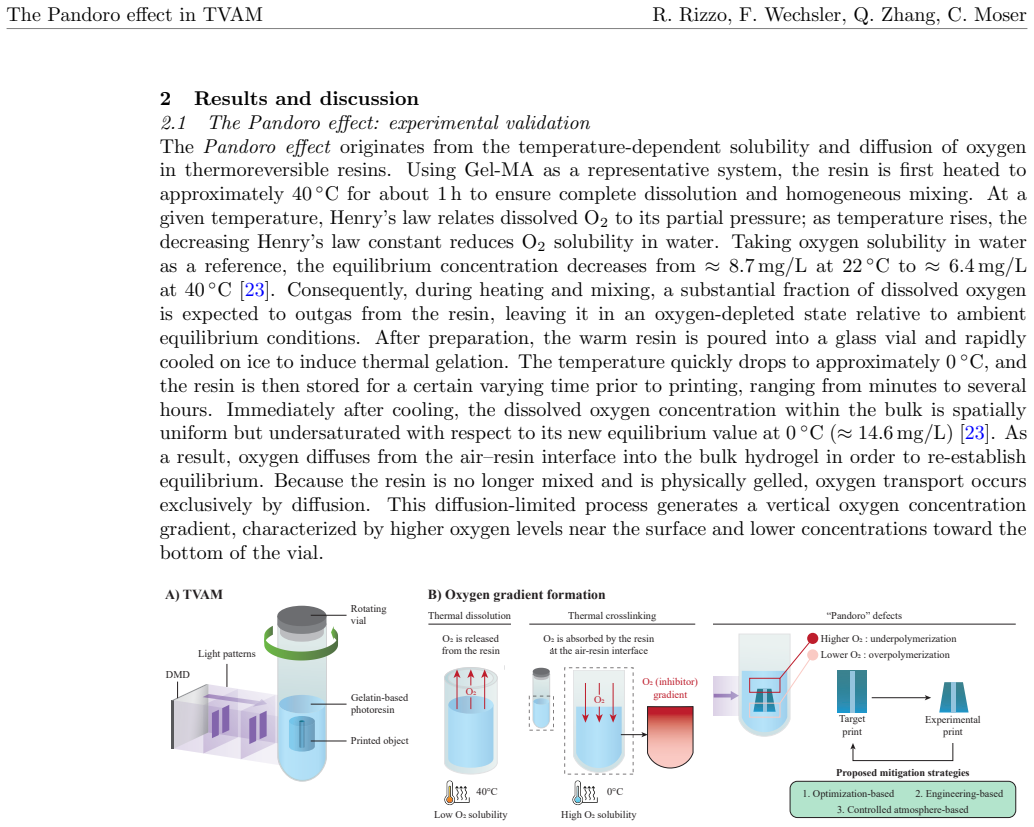
The Pandoro effect, a truncated-cone distortion, originates from a vertical oxygen gradient driven by the thermal hysteresis of resin preparation: heating depletes dissolved oxygen, while subsequent cooling induces diffusion-limited re-oxygenation from the air-resin interface. This produces premature polymerization at the vial bottom and inhibition at the top. The authors introduce a coupled ray-optical and photochemical optimization model that simulates the spatiotemporal reaction-diffusion dynamics of oxygen depletion, allowing predictive compensation for local inhibition gradients, and they validate process interventions that eliminate the air-resin interface and control headspace.
What carries the argument
The coupled ray-optical and photochemical optimization model that explicitly simulates spatiotemporal reaction-diffusion dynamics of oxygen depletion to compensate for spatially heterogeneous inhibitor concentrations.
Load-bearing premise
The observed truncated-cone distortion is caused primarily by the vertical oxygen gradient rather than by unaccounted variations in light dose, temperature during printing, or resin viscosity changes.
What would settle it
Directly measure dissolved oxygen concentration versus height in the prepared resin vial after cooling; if no vertical gradient exists yet the truncated-cone distortion still appears in prints, or if the gradient exists but the distortion pattern does not match the model's oxygen-inhibition prediction, the causal claim is falsified.
Figures


read the original abstract
Tomographic Volumetric Additive Manufacturing (TVAM) enables rapid, layerless biofabrication; however, its application to thermoreversible hydrogels is often compromised by complex chemical kinetics. In this study, we identify and characterize a recurrent printing artifact - termed the Pandoro effect - manifesting as a truncated-cone distortion caused by premature polymerization at the vial bottom and inhibition at the top. We demonstrate that this phenomenon originates from a vertical oxygen gradient driven by the thermal hysteresis of resin preparation: heating depletes dissolved oxygen, while subsequent cooling induces diffusion-limited re-oxygenation from the air-resin interface. To mitigate this, we present a multi-tiered strategy. First, we introduce a coupled ray-optical and photochemical optimization model that rigorously accounts for spatially heterogeneous inhibitor concentrations. Unlike conventional threshold-based approaches, this differentiable framework explicitly simulates the spatiotemporal reaction-diffusion dynamics of oxygen depletion, allowing the inverse solver to predictively compensate for local inhibition gradients. Complementing this algorithmic correction, we validate two process-based interventions: the elimination of the air-resin interface and the control of headspace atmosphere. We demonstrate that these strategies effectively suppress the Pandoro effect, and are compatible with cell-laden resins. This work establishes guidelines for reproducible volumetric bioprinting and expands our open-source Dr.TVAM platform with advanced polymerization modeling capabilities.
Editorial analysis
A structured set of objections, weighed in public.
Referee Report
Summary. The manuscript identifies a recurrent printing artifact in tomographic volumetric additive manufacturing (TVAM) of thermoreversible hydrogels, termed the Pandoro effect, which manifests as truncated-cone distortion due to premature polymerization at the vial bottom and inhibition at the top. It attributes this to a vertical oxygen gradient arising from thermal hysteresis during resin preparation (heating depletes dissolved O2; cooling induces diffusion-limited re-oxygenation from the air-resin interface). The authors present a coupled ray-optical and photochemical optimization model that simulates spatiotemporal reaction-diffusion dynamics of oxygen to predictively compensate for heterogeneous inhibition, and they validate two process interventions (elimination of the air-resin interface and headspace atmosphere control) that suppress the effect while remaining compatible with cell-laden resins. The work also extends the open-source Dr.TVAM platform with advanced polymerization modeling.
Significance. If the central attribution and interventions hold, the work would be significant for enabling reproducible volumetric bioprinting of thermoreversible hydrogels, a key challenge in biofabrication. The differentiable modeling framework that explicitly handles spatially varying inhibitor concentrations advances beyond conventional threshold-based methods, and the open-source extension of Dr.TVAM provides a concrete community resource for handling complex oxygen dynamics in TVAM.
major comments (3)
- [Results and Discussion] The central claim that the truncated-cone distortion originates specifically from the vertical oxygen gradient (driven by thermal hysteresis) is not supported by direct evidence such as spatially resolved dissolved-oxygen profiles before/after the thermal cycle or control prints that isolate O2 uniformity while matching light dose, temperature history, and viscosity. Without these, alternative explanations (vertical light attenuation or temperature-dependent flow) cannot be ruled out.
- [Model Description] The optimization model is described as predictive and differentiable for compensating inhibition gradients, yet the manuscript provides no information on whether model parameters (e.g., diffusion coefficients or reaction rates) were fitted to the observed distortion data; this raises the risk that validation is circular rather than independent.
- [Experimental Validation] The validation of the two process interventions lacks quantitative before-after metrics, error bars, statistical tests, or sample sizes demonstrating suppression of the Pandoro effect; the abstract states effectiveness but supplies no data to assess the magnitude or reproducibility of the improvement.
minor comments (1)
- [Abstract] The abstract introduces the term 'Pandoro effect' without a brief etymology or reference to its visual resemblance, which would aid readers unfamiliar with the shape.
Simulated Author's Rebuttal
We thank the referee for their thorough and constructive review of our manuscript. We have addressed each major comment in detail below, providing clarifications, additional discussion, and revisions where supported by our data and analysis. We believe these changes strengthen the attribution of the Pandoro effect and the validation of our interventions and model.
read point-by-point responses
-
Referee: [Results and Discussion] The central claim that the truncated-cone distortion originates specifically from the vertical oxygen gradient (driven by thermal hysteresis) is not supported by direct evidence such as spatially resolved dissolved-oxygen profiles before/after the thermal cycle or control prints that isolate O2 uniformity while matching light dose, temperature history, and viscosity. Without these, alternative explanations (vertical light attenuation or temperature-dependent flow) cannot be ruled out.
Authors: We acknowledge that direct, spatially resolved dissolved-oxygen profiles would constitute stronger evidence. Such measurements proved technically challenging in our viscous, thermoreversible hydrogel system during the thermal cycle and were not performed. However, we provide multiple lines of indirect but convergent evidence: the strict temporal correlation between the thermal hysteresis protocol and the appearance of the distortion; the ray-optical model, which already incorporates measured vertical light attenuation yet still requires the oxygen gradient term to reproduce the observed truncated-cone geometry; and the fact that the two interventions (air-resin interface removal and headspace atmosphere control) eliminate the distortion while light dose, temperature history, and viscosity remain unchanged. We have expanded the Results and Discussion sections to explicitly rule out vertical light attenuation (already accounted for in the model) and temperature-dependent flow (inconsistent with the observed top-to-bottom polymerization asymmetry and the success of oxygen-specific interventions). A new paragraph discusses the practical limitations of in-situ O2 profiling in this resin. revision: partial
-
Referee: [Model Description] The optimization model is described as predictive and differentiable for compensating inhibition gradients, yet the manuscript provides no information on whether model parameters (e.g., diffusion coefficients or reaction rates) were fitted to the observed distortion data; this raises the risk that validation is circular rather than independent.
Authors: All kinetic and transport parameters (oxygen diffusion coefficient, reaction rate constants, etc.) were taken from peer-reviewed literature values for comparable photopolymerizable hydrogel systems and were not adjusted or fitted to the Pandoro-effect distortion data. The model was used in a forward predictive mode to compute the spatially varying light-dose compensation required by the oxygen gradient; the experimental validation of the interventions was performed independently of any parameter optimization. We have added a new subsection (Model Parameters and Validation Strategy) that lists the exact literature sources, states that no fitting to distortion observations occurred, and confirms the independence of the experimental tests. revision: yes
-
Referee: [Experimental Validation] The validation of the two process interventions lacks quantitative before-after metrics, error bars, statistical tests, or sample sizes demonstrating suppression of the Pandoro effect; the abstract states effectiveness but supplies no data to assess the magnitude or reproducibility of the improvement.
Authors: We agree that quantitative metrics are essential. In the revised manuscript we have added: (i) before-and-after measurements of the truncated-cone distortion angle (mean ± s.d., n = 6 independent prints per condition), (ii) error bars on all relevant figures, and (iii) statistical comparison (two-tailed Student’s t-test, p < 0.001) confirming significant suppression for both interventions. These data appear in the Results section, a new supplementary figure, and the abstract has been updated to reference the quantitative improvement. All experiments used cell-laden resins to demonstrate compatibility. revision: yes
Circularity Check
No significant circularity in derivation of Pandoro effect origin
full rationale
The paper's central claim attributes the truncated-cone distortion to a vertical oxygen gradient from thermal hysteresis (heating depletes O2; cooling allows diffusion-limited re-oxygenation from the air interface). This is supported by a coupled ray-optical/photochemical model that explicitly simulates spatiotemporal reaction-diffusion dynamics of oxygen depletion and by direct experimental interventions (eliminating the air-resin interface and controlling headspace atmosphere) that suppress the effect. The model is presented as a differentiable forward simulator enabling inverse compensation rather than a fit to the observed distortions themselves. No equations reduce the claimed cause to the target data by construction, no parameters are described as fitted to the Pandoro geometry and then called predictive, and no load-bearing self-citations or uniqueness theorems are invoked. The derivation chain remains self-contained via physical modeling and independent process controls.
Axiom & Free-Parameter Ledger
axioms (1)
- domain assumption Dissolved oxygen acts as a polymerization inhibitor in the resin
Lean theorems connected to this paper
-
IndisputableMonolith/Cost/FunctionalEquation.leanwashburn_uniqueness_aczel unclear?
unclearRelation between the paper passage and the cited Recognition theorem.
We solve Fick’s second law … ∂c/∂t = D ∂²c/∂h² … coupled ray-optical and photochemical optimization framework … c[O2] and c[P*] … loss with ReLU thresholds
-
IndisputableMonolith/Foundation/RealityFromDistinction.leanreality_from_one_distinction unclear?
unclearRelation between the paper passage and the cited Recognition theorem.
vertical oxygen gradient driven by thermal hysteresis … Henry’s law … diffusion-limited re-oxygenation
What do these tags mean?
- matches
- The paper's claim is directly supported by a theorem in the formal canon.
- supports
- The theorem supports part of the paper's argument, but the paper may add assumptions or extra steps.
- extends
- The paper goes beyond the formal theorem; the theorem is a base layer rather than the whole result.
- uses
- The paper appears to rely on the theorem as machinery.
- contradicts
- The paper's claim conflicts with a theorem or certificate in the canon.
- unclear
- Pith found a possible connection, but the passage is too broad, indirect, or ambiguous to say the theorem truly supports the claim.
Reference graph
Works this paper leans on
-
[1]
Guiding Lights: Tissue Bioprinting Using Photoactivated Materials
Mihyun Lee, Riccardo Rizzo, Frantiˇ sek Surman, and Marcy Zenobi-Wong. “Guiding Lights: Tissue Bioprinting Using Photoactivated Materials”. In:Chemical Reviews120.19 (2020). PMID: 32662642, pp. 10950–11027.doi:10.1021/acs.chemrev.0c00077
-
[2]
Light-based vat-polymerization bioprinting
Riccardo Levato, Oksana Dudaryeva, Carlos Ezio Garciamendez-Mijares, Bruce E. Kirkpatrick, Riccardo Rizzo, Jacob Schimelman, Kristi S. Anseth, Shaochen Chen, Marcy Zenobi-Wong, and Yu Shrike Zhang. “Light-based vat-polymerization bioprinting”. In:Nature Reviews Methods Primers3.1 (June 2023), p. 47.doi:10.1038/s43586-023-00231-0
-
[3]
Volumetric additive manufacturing via tomographic recon- struction
Brett E. Kelly, Indrasen Bhattacharya, Hossein Heidari, Maxim Shusteff, Christopher M. Spadaccini, and Hayden K. Taylor. “Volumetric additive manufacturing via tomographic recon- struction”. In:Science363.6431 (Mar. 2019), pp. 1075–1079.doi:10.1126/science.aau7114
-
[4]
Volumetric Bioprinting of Complex Living-Tissue Constructs within Seconds
Paulina Nu˜ nez Bernal, Paul Delrot, Damien Loterie, Yang Li, Jos Malda, Christophe Moser, and Riccardo Levato. “Volumetric Bioprinting of Complex Living-Tissue Constructs within Seconds”. en. In:Advanced Materials31.42 (2019), p. 1904209.doi:10.1002/adma.201904209
-
[5]
High-resolution tomographic volumetric additive manufacturing
Damien Loterie, Paul Delrot, and Christophe Moser. “High-resolution tomographic volumetric additive manufacturing”. en. In:Nature Communications11.11 (Feb. 2020), p. 852.doi:10. 1038/s41467-020-14630-4
2020
-
[6]
A review of materials used in tomographic volumetric additive manufacturing
Jorge Madrid-Wolff, Joseph Toombs, Riccardo Rizzo, Paulina Nu˜ nez Bernal, Dominique Porcin- cula, Rebecca Walton, Bin Wang, Frederik Kotz-Helmer, Yi Yang, David Kaplan, Yu Shrike Zhang, Marcy Zenobi-Wong, Robert R. McLeod, Bastian Rapp, Johanna Schwartz, Maxim Shusteff, Hayden Talyor, Riccardo Levato, and Christophe Moser. “A review of materials used in ...
-
[7]
Optimized Photoclick (Bio)Resins for Fast Volumetric Bioprinting
Riccardo Rizzo, Dominic Ruetsche, Hao Liu, and Marcy Zenobi-Wong. “Optimized Photoclick (Bio)Resins for Fast Volumetric Bioprinting”. In:Advanced Materials33.49 (2021), p. 2102900. doi:https://doi.org/10.1002/adma.202102900
-
[8]
Object-space optimization of tomographic reconstructions for additive manufacturing
Charles M. Rackson, Kyle M. Champley, Joseph T. Toombs, Erika J. Fong, Vishal Bansal, Hayden K. Taylor, Maxim Shusteff, and Robert R. McLeod. “Object-space optimization of tomographic reconstructions for additive manufacturing”. en. In:Additive Manufacturing48 (Dec. 2021), p. 102367.doi:10.1016/j.addma.2021.102367
-
[9]
High fidelity volumetric additive manufacturing
Indrasen Bhattacharya, Joseph Toombs, and Hayden Taylor. “High fidelity volumetric additive manufacturing”. In:Additive Manufacturing47 (2021), p. 102299.doi:https://doi.org/10. 1016/j.addma.2021.102299
-
[10]
Chi Chung Li, Joseph Toombs, Hayden K. Taylor, and Thomas J. Wallin. “Tomographic projec- tion optimization for volumetric additive manufacturing with general band constraint Lp-norm minimization”. In:Additive Manufacturing94 (Aug. 2024), p. 104447.doi:10.1016/j.addma. 2024.104447
-
[11]
Inverse Rendering for Tomographic Volumetric Additive Manufacturing
Baptiste Nicolet, Felix Wechsler, Jorge Madrid-Wolff, Christophe Moser, and Wenzel Jakob. “Inverse Rendering for Tomographic Volumetric Additive Manufacturing”. In:ACM Trans. Graph.43.6 (Nov. 2024), 228:1–228:17.doi:10.1145/3687924. 11 The Pandoro effect in TVAM R. Rizzo, F. Wechsler, Q. Zhang, C. Moser
-
[12]
Versatile volumetric additive manufacturing with 3D ray tracing
Daniel Webber, Yujie Zhang, Michel Picard, Jonathan Boisvert, Chantal Paquet, and Antony Orth. “Versatile volumetric additive manufacturing with 3D ray tracing”. EN. In:Optics Ex- press31.4 (Feb. 2023), pp. 5531–5546.doi:10.1364/OE.481318
-
[13]
Wave optical model for tomographic volumetric additive manufacturing
Felix Wechsler, Carlo Gigli, Jorge Madrid-Wolff, and Christophe Moser. “Wave optical model for tomographic volumetric additive manufacturing”. EN. In:Optics Express32.8 (Apr. 2024), pp. 14705–14712.doi:10.1364/OE.521322
-
[14]
Intensity-coupled multi-beam phase retrieval for holographic volumetric additive manufacturing
Chi Chung Li, Joseph Toombs, Vivek Subramanian, and Hayden K. Taylor. “Intensity-coupled multi-beam phase retrieval for holographic volumetric additive manufacturing”. In:Opt. Ex- press32.26 (Dec. 2024), pp. 47620–47637.doi:10.1364/OE.544010
-
[15]
Large language models encode clinical knowledge
Xukang Wang, Yuanzhu Ma, Yihan Niu, Bo Xiong, Anke Zhang, Guoxun Zhang, Yifan Chen, Wei Wei, Lu Fang, Jiamin Wu, and Qionghai Dai. “Sub-second volumetric 3D printing by synthesis of holographic light fields”. en. In:Nature(Feb. 2026), pp. 1–9.doi:10.1038/s41586- 026-10114-5
-
[16]
Overprinting with Tomographic Volumetric Additive Manufacturing
Felix Wechsler, Viola Sgarminato, Riccardo Rizzo, Baptiste Nicolet, Wenzel Jakob, and Christophe Moser. “Overprinting with Tomographic Volumetric Additive Manufacturing”. In: arXiv:2507.13842 (July 2025). arXiv:2507.13842 [physics].doi:10.48550/arXiv.2507.13842
-
[17]
Oxygen Saturation as a Strategy to Mitigate User-Induced Variation in Tomographic Volumetric Additive Manufacturing: 36th Annual International Solid Freeform Fabrication Symposium
Carl Sander Kruse, Nicole Pellizzon, Roozbeh Salajeghe, Jon Spangenberg, Frieder Lucklum, and Aminul Islam. “Oxygen Saturation as a Strategy to Mitigate User-Induced Variation in Tomographic Volumetric Additive Manufacturing: 36th Annual International Solid Freeform Fabrication Symposium”. In:Solid Freeform Fabrication 2025: Proceedings of the 36th Annual...
2025
-
[18]
Impact of oxygen inhibition on (meth)acrylate photopolymerization in tomographic volumetric printing
Yujie Zhang, Hendrick de Haan, Katherine Houlahan, Kathleen L. Sampson, Daniel Webber, Antony Orth, Thomas Lacelle, Liliana Gaburici, Rene Lam, Bhavana Deore, and Chantal Paquet. “Impact of oxygen inhibition on (meth)acrylate photopolymerization in tomographic volumetric printing”. In:Additive Manufacturing109 (July 2025), p. 104844.doi:10.1016/ j.addma.2...
-
[19]
Yujie Zhang, Katherine Houlahan, Daniel Webber, Nicolas Milliken, Kathleen L. Sampson, Hendrick W. de Haan, Hao Li, Robynne Vlaming, Liliana Gaburici, Antony Orth, and Chantal Paquet. “Advancing Tomographic Volumetric Printing Via Oxygen Inhibition Control: Im- proved Accuracy and Large-Volume Capability”. In:Advanced Materials37.47 (2025), e08729. doi:ht...
-
[20]
Quinten Thijssen, Antonio Ja´ en Ortega, Roni´ erik Pioli Vieira, and Sandra Van Vlierberghe. “Radical inhibition in tomographic volumetric 3D printing for thiol-ene photoresists: From photorheology to printability”. In:Reactive and Functional Polymers205 (2024), p. 106096. doi:https://doi.org/10.1016/j.reactfunctpolym.2024.106096
-
[21]
Deconvolution vol- umetric additive manufacturing
Antony Orth, Daniel Webber, Yujie Zhang, Kathleen L. Sampson, Hendrick W. de Haan, Thomas Lacelle, Rene Lam, Daphene Solis, Shyamaleeswari Dayanandan, Taylor Waddell, Tasha Lewis, Hayden K. Taylor, Jonathan Boisvert, and Chantal Paquet. “Deconvolution vol- umetric additive manufacturing”. en. In:Nature Communications14.11 (July 2023), p. 4412. doi:10.1038...
-
[22]
Felix Wechsler, Riccardo Rizzo, and Christophe Moser. “Single-View Holographic Volumetric 3D Printing with Coupled Differentiable Wave-Optical and Photochemical Optimization”. In: arXiv:2601.16330 (Jan. 2026). arXiv:2601.16330 [physics].doi:10.48550/arXiv.2601.16330
-
[23]
Bruce B. Benson and Daniel Krause Jr. “The concentration and isotopic fractionation of oxygen dissolved in freshwater and seawater in equilibrium with the atmosphere”. In:Limnology and Oceanography29.3 (1984), pp. 620–632.doi:https://doi.org/10.4319/lo.1984.29.3. 0620
-
[24]
From Free-Radical to Radical-Free: A Paradigm Shift in Light-Mediated Biofabrication
Riccardo Rizzo, Nika Petelinˇ sek, Angela Bonato, and Marcy Zenobi-Wong. “From Free-Radical to Radical-Free: A Paradigm Shift in Light-Mediated Biofabrication”. In:Advanced Science 10.8 (2023), p. 2205302.doi:https://doi.org/10.1002/advs.202205302
-
[25]
Takashi Kaneko, Ronnie V. Garcia, Allison L. Chau, Angela A. Pitenis, Sijia Huang, Bryan D. Moran, Sophia J. Bailey, Craig J. Hawker, and Javier Read de Alaniz. “Radical-Free Digital Light Processing 3D Printing of Hydrogels Using a Photo-Caged Cyclopentadiene Diels–Alder Strategy”. In:Advanced Functional Materials36.7 (2026), e14415.doi:https://doi.org/ ...
-
[26]
Photoinitiator-free light-mediated crosslinking of dynamic polymer and pristine protein networks
Riccardo Rizzo, Dylan M. Barber, Jackson K. Wilt, Alexander J. Ainscough, and Jennifer A. Lewis. “Photoinitiator-free light-mediated crosslinking of dynamic polymer and pristine protein networks”. In:Biomater. Sci.13.1 (2025), pp. 210–222.doi:10.1039/D4BM00849A
-
[27]
Light- induced primary amines and o-nitrobenzyl alcohols cyclization as a versatile photoclick reaction for modular conjugation
An-Di Guo, Dan Wei, Hui-Jun Nie, Hao Hu, Chengyuan Peng, Shao-Tong Li, Ke-Nian Yan, Bin-Shan Zhou, Lei Feng, Chao Fang, Minjia Tan, Ruimin Huang, and Xiao-Hua Chen. “Light- induced primary amines and o-nitrobenzyl alcohols cyclization as a versatile photoclick reaction for modular conjugation”. In:Nature Communications11.1 (Oct. 2020), p. 5472.doi:10.1038...
2020
-
[28]
Temperature Dependence of Oxygen Diffusion in H2O and D2O
Ping Han and David M. Bartels. “Temperature Dependence of Oxygen Diffusion in H2O and D2O”. In:The Journal of Physical Chemistry100.13 (Jan. 1996), pp. 5597–5602.doi:10 . 1021/jp952903y
1996
-
[29]
Virtual Volumetric Additive Manufacturing (VirtualVAM)
Todd H Weisgraber, Martin P de Beer, Sijia Huang, John J Karnes, Caitlyn C Cook, and Maxim Shusteff. “Virtual Volumetric Additive Manufacturing (VirtualVAM)”. In:Advanced Materials Technologies8.23 (2023), p. 2301054.doi:10.1002/admt.202301054
-
[30]
Tom Scherzer and Helmut Langguth. “Temperature Dependence of the Oxygen Solubility in Acrylates and its Effect on the Induction Period in UV Photopolymerization”. In:Macromolec- ular Chemistry and Physics206.2 (2005), pp. 240–245.doi:https://doi.org/10.1002/macp. 200400300
-
[31]
Tomographic Print- ing in a Chip: A Versatile Platform for Biomimetic 3D Organ-on-Chip
Riccardo Rizzo, Viola Sgarminato, Felix Wechsler, and Christophe Moser. “Tomographic Print- ing in a Chip: A Versatile Platform for Biomimetic 3D Organ-on-Chip”. In:bioRxiv(2026). https://www.biorxiv.org/content/early/2026/03/02/2026.02.26.708161.full.pdf.doi:10.64898/ 2026.02.26.708161
2026
-
[32]
On the limited memory BFGS method for large scale opti- mization
Dong C. Liu and Jorge Nocedal. “On the limited memory BFGS method for large scale opti- mization”. en. In:Mathematical Programming45.1 (Aug. 1989), pp. 503–528.doi:10.1007/ BF01589116. 13 The Pandoro effect in TVAM R. Rizzo, F. Wechsler, Q. Zhang, C. Moser Supplementary Information A Oxygen diffusion-related defects Our uncorrected prints display channels...
1989
discussion (0)
Sign in with ORCID, Apple, or X to comment. Anyone can read and Pith papers without signing in.