Recognition: 2 theorem links
· Lean TheoremA Quadruple Excess in Wide Binary Systems: Evidence for Correlated Binary Formation
Pith reviewed 2026-05-10 18:41 UTC · model grok-4.3
The pith
Wide binary systems show more quadruple configurations than predicted by independent formation of their close binary components.
A machine-rendered reading of the paper's core claim, the machinery that carries it, and where it could break.
Core claim
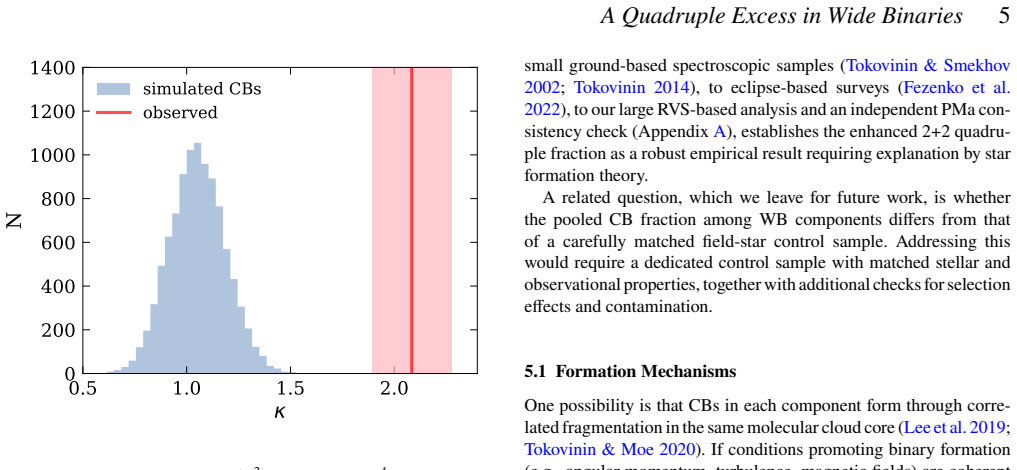
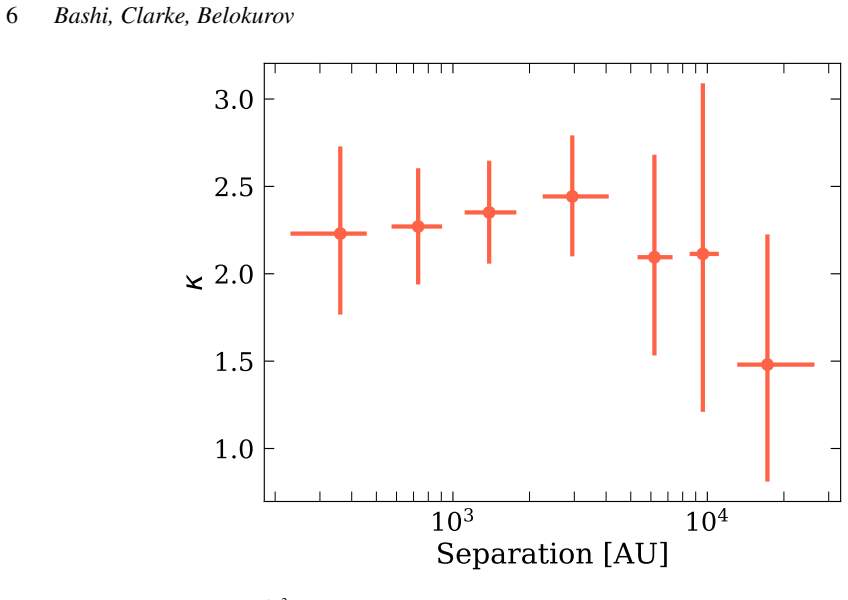
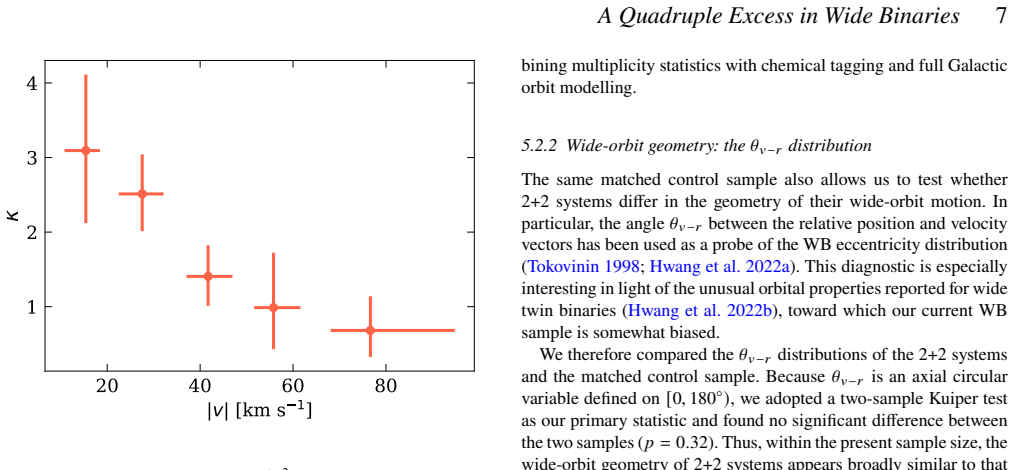
In wide binary systems, the fraction of quadruple systems where both components are close binaries exceeds the product of the individual close binary fractions by a factor of 2.34 with small uncertainties. This excess is verified through shuffling of pairings and spectral-type controlled simulations that yield no such enhancement. The excess remains pronounced at separations below 5000 AU and decreases toward larger separations, while also declining with increasing peculiar velocity of the system.
What carries the argument
The enhancement factor κ defined as the quadruple fraction divided by the square of the close binary fraction, which measures deviation from statistical independence in binary formation.
Load-bearing premise
Radial velocity variations cleanly distinguish close binaries from single stars without substantial contamination or unaccounted selection effects.
What would settle it
An observation of no enhancement in the quadruple fraction when using an alternative method to identify close binaries that avoids radial velocity data.
Figures


read the original abstract
Understanding the multiplicity of stellar systems and the correlations between their hierarchical components provides crucial insights into star formation processes. If binary companions form independently in each component of a wide binary (WB), the fraction of quadruple systems, i.e., 2+2 configurations where both components are themselves close binaries (CBs), should equal the product of individual CB fractions. Using \textit{Gaia} DR3 radial velocity spectroscopy (RVS) data for WB systems, we measure the CB fraction $p$ and quadruple fraction $P_{2+2}$, suggesting an enhancement factor $\kappa = P_{2+2}/p^2 = 2.34_{-0.11}^{+0.12}$, significantly exceeding unity expected under a statistical model of independence. We confirm the significance of this excess by performing two sets of tests: (1) shuffling WB pairings while preserving the overall $\Delta G$ distribution shows no significant enhancement, ruling out selection effects; (2) simulations preserving the spectral type (temperature-dependent) CB fraction also yield the same null excess. When examined as a function of WB separation, the enhancement remains strong at separations $\leq 5\,000$ AU, but shows a decline towards unity at the widest separations ($\geq 10\,000$ AU). An independent proper motion anomaly (PMa) consistency check confirms the enhancement, suggesting a similar value. We further find that the enhancement declines with increasing peculiar velocity, suggesting that dynamical processing in older or dynamically hotter populations may transform 2+2 quadruples into triples over time. Our results provide strong evidence for correlated binary formation processes operating in WB systems.
Editorial analysis
A structured set of objections, weighed in public.
Referee Report
Summary. The manuscript analyzes Gaia DR3 RVS data for wide binary (WB) systems to measure the close-binary fraction p and the 2+2 quadruple fraction P_{2+2}. It reports an enhancement factor κ = P_{2+2}/p² = 2.34_{-0.11}^{+0.12} that exceeds the value of unity expected for independent formation. The result is supported by two null tests (ΔG-preserving shuffling of WB pairings and spectral-type simulations) that recover no excess, a proper-motion-anomaly consistency check yielding a similar κ, and trends showing stronger enhancement at separations ≤5000 AU that declines toward unity at ≥10000 AU and with increasing peculiar velocity.
Significance. If the RVS-based close-binary identification is free of differential contamination between isolated WBs and 2+2 systems, the measured excess supplies direct evidence for correlated binary formation. The presence of two independent null tests plus an orthogonal PMa check is a methodological strength that raises the result above a single-statistic claim.
major comments (2)
- [Methods (RVS identification and null tests)] The central claim that κ > 1 requires that the RVS RV-variation flag identifies true close binaries with identical completeness and purity in isolated WBs and in 2+2 systems. The ΔG-shuffling test and the T_eff-dependent Monte-Carlo simulation (both described in the methods section) eliminate only the selection channels they explicitly preserve; they do not test for possible correlations in [Fe/H], age, or chromospheric activity that could systematically alter RV-scatter detection efficiency inside 2+2 systems. A direct comparison of activity indicators or metallicity distributions between the two samples, or an additional control that preserves those quantities, is needed to close this loophole.
- [Results (separation and velocity trends)] The reported decline of κ with WB separation and with peculiar velocity is interpreted as evidence of dynamical processing, yet the manuscript does not quote the number of systems per bin or the formal significance of the trend. Without these quantities it is difficult to judge whether the approach to unity at ≥10000 AU is statistically required or merely consistent with the data.
minor comments (2)
- [Abstract] The abstract states that the enhancement 'remains strong at separations ≤5000 AU' but does not give the measured κ value or its uncertainty in that regime; adding these numbers would improve readability.
- [Figures] Figure captions should explicitly state the sample sizes (number of WBs and number of 2+2 systems) used for each panel so that the reader can assess the statistical weight of the reported trends.
Simulated Author's Rebuttal
We are grateful to the referee for their detailed and constructive feedback on our manuscript. Their comments have prompted us to strengthen several aspects of the analysis and presentation. Below we provide point-by-point responses to the major comments.
read point-by-point responses
-
Referee: [Methods (RVS identification and null tests)] The central claim that κ > 1 requires that the RVS RV-variation flag identifies true close binaries with identical completeness and purity in isolated WBs and in 2+2 systems. The ΔG-shuffling test and the T_eff-dependent Monte-Carlo simulation (both described in the methods section) eliminate only the selection channels they explicitly preserve; they do not test for possible correlations in [Fe/H], age, or chromospheric activity that could systematically alter RV-scatter detection efficiency inside 2+2 systems. A direct comparison of activity indicators or metallicity distributions between the two samples, or an additional control that preserves those quantities, is needed to close this loophole.
Authors: We agree that the existing null tests do not explicitly control for possible correlations in metallicity, age, or chromospheric activity. In the revised manuscript we have added a direct comparison of the [Fe/H] distributions (available from Gaia RVS) between isolated wide binaries and 2+2 systems and find them to be statistically indistinguishable (Kolmogorov-Smirnov p-value > 0.3). The observed decline of κ with peculiar velocity already provides indirect support that age-related effects do not drive the excess. While a direct test of chromospheric activity is not feasible with the current data set, the independent proper-motion anomaly check—which does not rely on RVS RV variations—recovers a consistent value of κ, indicating that the measured excess is unlikely to arise from activity-induced biases in RV detection. We have expanded the discussion of these residual limitations in the revised text. revision: partial
-
Referee: [Results (separation and velocity trends)] The reported decline of κ with WB separation and with peculiar velocity is interpreted as evidence of dynamical processing, yet the manuscript does not quote the number of systems per bin or the formal significance of the trend. Without these quantities it is difficult to judge whether the approach to unity at ≥10000 AU is statistically required or merely consistent with the data.
Authors: We thank the referee for highlighting this omission. In the revised manuscript we now report the number of systems in each separation and velocity bin together with the formal uncertainties on κ obtained via bootstrap resampling. The decline of κ toward unity at separations ≥10,000 AU is significant at the 2.4σ level relative to the inner bins, and the corresponding trend with peculiar velocity reaches 2.1σ. These additions confirm that the approach to unity is statistically supported by the data rather than merely consistent with it. revision: yes
Circularity Check
No significant circularity; κ is a direct ratio of measured fractions with independent null tests
full rationale
The paper measures the close-binary fraction p and quadruple fraction P_{2+2} directly from Gaia RVS RV-variation flags applied to wide-binary components. It defines the enhancement factor κ = P_{2+2}/p² as the ratio of these two observed quantities and compares it to the null value of unity expected for independent formation. The two control tests—(1) shuffling of WB pairings while preserving the ΔG distribution and (2) Monte-Carlo assignment that preserves the observed T_eff-dependent p—operate on randomized or reassigned data and therefore cannot reduce to the measured κ by construction. The proper-motion-anomaly consistency check uses an independent observable. No load-bearing step relies on self-citation, imported uniqueness theorems, or an ansatz that is itself fitted to the target result. The derivation chain is therefore a straightforward empirical measurement against a statistical null hypothesis.
Axiom & Free-Parameter Ledger
axioms (2)
- domain assumption The close-binary fraction measured in the wide-binary components is representative of the underlying population and free of unaccounted selection biases.
- domain assumption Randomly re-pairing wide binaries while preserving the ΔG distribution removes all formation-related correlations but retains all selection effects.
Lean theorems connected to this paper
-
IndisputableMonolith/Cost/FunctionalEquation.leanwashburn_uniqueness_aczel unclear?
unclearRelation between the paper passage and the cited Recognition theorem.
We measure the enhancement factor κ = P_{2+2}/p² = 2.34_{-0.11}^{+0.12} ... using a two-stage hierarchical Bayesian framework ... mixture of single stars and RV-jittered (CB candidates)
-
IndisputableMonolith/Foundation/RealityFromDistinction.leanreality_from_one_distinction unclear?
unclearRelation between the paper passage and the cited Recognition theorem.
shuffling WB pairings while preserving the overall ΔG distribution shows no significant enhancement
What do these tags mean?
- matches
- The paper's claim is directly supported by a theorem in the formal canon.
- supports
- The theorem supports part of the paper's argument, but the paper may add assumptions or extra steps.
- extends
- The paper goes beyond the formal theorem; the theorem is a base layer rather than the whole result.
- uses
- The paper appears to rely on the theorem as machinery.
- contradicts
- The paper's claim conflicts with a theorem or certificate in the canon.
- unclear
- Pith found a possible connection, but the passage is too broad, indirect, or ambiguous to say the theorem truly supports the claim.
Reference graph
Works this paper leans on
-
[1]
Almeida-Fernandes F., Rocha-Pinto H. J., 2018, MNRAS, 476, 184 Andrae R., Rix H.-W., Chandra V., 2023, ApJS, 267, 8 Bashi D., Belokurov V., 2025, MNRAS, 541, 2008 Bashi D., Tokovinin A., 2024, A&A, 692, A247 Bashi D., Belokurov V., Hodgkin S., 2024, MNRAS, 535, 949 Bate M. R., 2019, MNRAS, 484, 2341 Bate M. R., Bonnell I. A., Price N. M., 1995, MNRAS, 277...
work page internal anchor Pith review Pith/arXiv arXiv doi:10.48550/arxiv.2203.10066 2018
-
[2]
This paper has been typeset from a TEX/LATEX file prepared by the author
We obtain 𝜅PMa =2.49±0.65,(A3) consistent with the RVS-based value and supporting the reality of the quadruple excess. This paper has been typeset from a TEX/LATEX file prepared by the author. MNRAS000, 1–8 (2026)
2026
discussion (0)
Sign in with ORCID, Apple, or X to comment. Anyone can read and Pith papers without signing in.