Recognition: no theorem link
STDec: Spatio-Temporal Stability Guided Decoding for dLLMs
Pith reviewed 2026-05-10 18:26 UTC · model grok-4.3
The pith
STDec improves dLLM speed by using observed spatio-temporal stability to create adaptive per-token thresholds.
A machine-rendered reading of the paper's core claim, the machinery that carries it, and where it could break.
Core claim
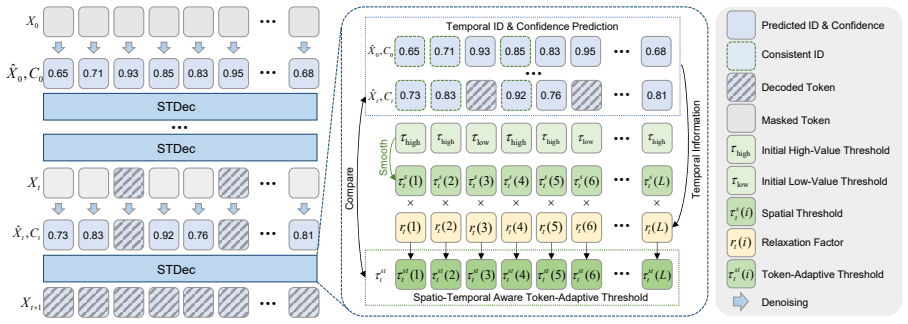
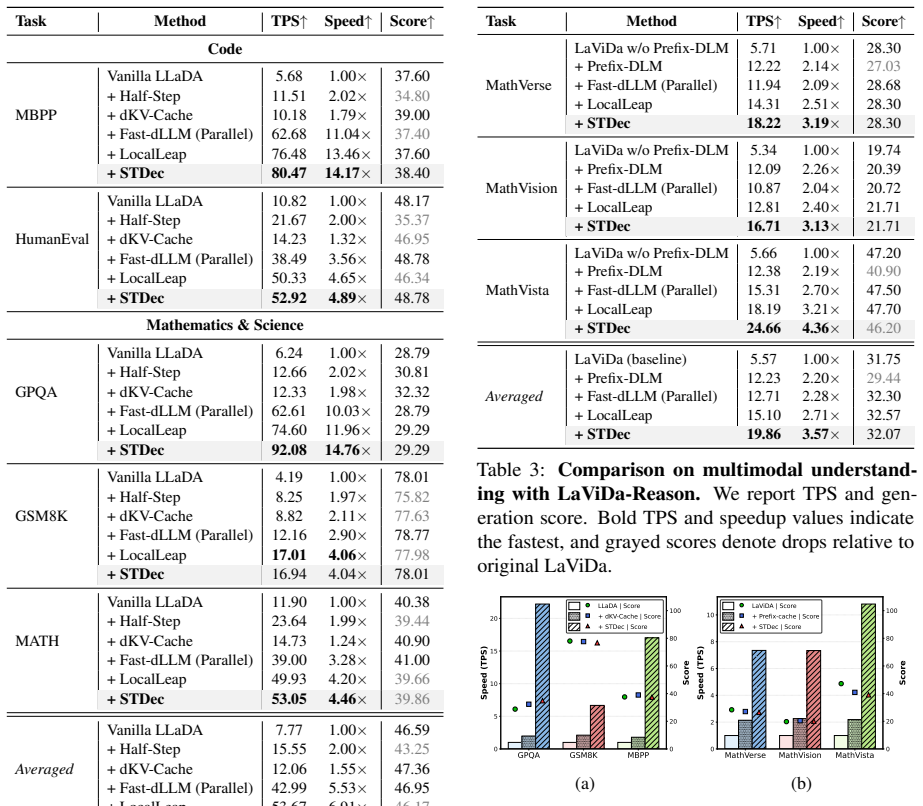
Diffusion large language models display strong spatio-temporal stability, with newly decoded tokens lying near their spatial neighbors and predicted token IDs remaining consistent across denoising steps. STDec uses this property for spatial-aware decoding, which aggregates states from nearby tokens to produce token-adaptive thresholds, and temporal-aware decoding, which relaxes thresholds for tokens whose predictions hold steady over steps. The resulting training-free method raises throughput on textual and multimodal benchmarks while preserving task performance, with a reported maximum of 14.17 times speedup on MBPP using LLaDA.
What carries the argument
Spatio-temporal stability of token predictions, which drives spatial aggregation of neighboring decoded states for adaptive thresholds and temporal consistency checks for threshold relaxation.
If this is right
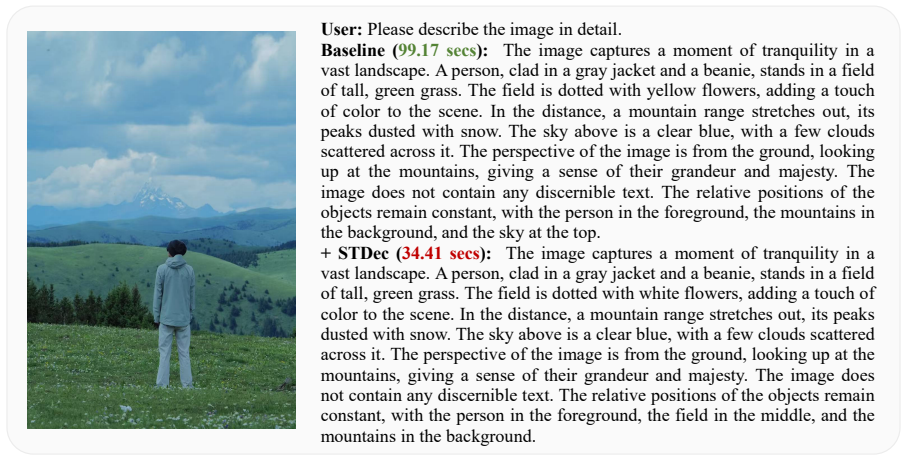
- Throughput rises substantially on textual reasoning and multimodal understanding benchmarks while task scores stay comparable.
- Up to 14.17 times speedup is achieved on MBPP with the LLaDA model.
- The method works without training and remains compatible with existing cache-based acceleration techniques.
- Output quality holds on tasks such as code generation and understanding benchmarks.
Where Pith is reading between the lines
- Similar stability patterns may exist in other iterative non-autoregressive generation approaches, allowing related adaptive decoding in those settings.
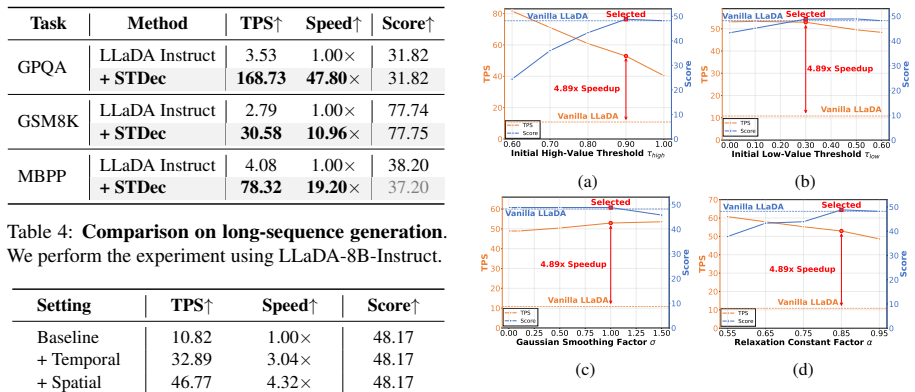
- The latency advantage could narrow the practical gap between diffusion LLMs and standard autoregressive models for longer outputs.
- Explicit measurement of how stability changes with sequence length or input distribution would help bound the method's reliability.
Load-bearing premise
The observed spatio-temporal stability in dLLM token predictions is general and safe enough to relax or adapt thresholds without introducing new errors on complex or unseen inputs.
What would settle it
A controlled run on a held-out dLLM model or dataset where STDec produces lower final task scores than the global-threshold baseline at matched or higher generation speed.
Figures



read the original abstract
Diffusion Large Language Models (dLLMs) have achieved rapid progress, viewed as a promising alternative to the autoregressive paradigm. However, most dLLM decoders still adopt a global confidence threshold, and do not explicitly model local context from neighboring decoded states or temporal consistency of predicted token IDs across steps. To address this issue, we propose a simple spatio-temporal stability guided decoding approach, named STDec. We observe strong spatio-temporal stability in dLLM decoding: newly decoded tokens tend to lie near decoded neighbors, and their predicted IDs often remain consistent across several denoising steps. Inspired by this stability, our STDec includes spatial-aware decoding and temporal-aware decoding. The spatial-aware decoding dynamically generates the token-adaptive threshold by aggregating the decoded states of nearby tokens. The temporal-aware decoding relaxes the decoding thresholds for tokens whose predicted token IDs remain consistent over denoising steps. Our STDec is training-free and remains compatible with cache-based acceleration methods. Across textual reasoning and multimodal understanding benchmarks, STDec substantially improves throughput while maintaining comparable task performance score. Notably, on MBPP with LLaDA, STDec achieves up to 14.17x speedup with a comparable score. Homepage: https://yzchen02.github.io/STDec.
Editorial analysis
A structured set of objections, weighed in public.
Referee Report
Summary. The paper proposes STDec, a training-free decoding method for diffusion LLMs (dLLMs) that exploits observed spatio-temporal stability—nearby decoded tokens and consistent token ID predictions across denoising steps—to dynamically adapt per-token confidence thresholds via spatial aggregation and temporal relaxation. It claims this yields substantial throughput gains on textual reasoning and multimodal benchmarks while preserving task scores, notably up to 14.17x speedup on MBPP with LLaDA, and remains compatible with cache-based accelerations.
Significance. If the stability property proves robust and general, STDec could provide a simple, plug-in acceleration for dLLMs that improves practical inference efficiency without retraining or architectural changes. The training-free nature and benchmark results position it as potentially impactful for deploying diffusion-based models in resource-constrained settings.
major comments (3)
- [Abstract, §3] Abstract and §3 (method): The central performance claim of 'comparable task performance' with large speedups (e.g., 14.17x on MBPP) lacks any reported error bars, multiple-run statistics, or ablation isolating the spatial vs. temporal components, making it impossible to assess whether gains are reliable or if localized degradations are masked by averages.
- [§3.2] §3.2 (temporal-aware decoding): The relaxation of thresholds based on cross-step ID consistency is presented as safe due to observed stability, but no error-bound analysis, failure-case enumeration, or evaluation on out-of-distribution inputs is provided; this is load-bearing because undetected token errors could silently degrade outputs on complex reasoning tasks.
- [§4] §4 (experiments): No details on implementation (exact threshold formulas, hyperparameter sensitivity, or pseudocode), baseline configurations, or hardware/setup are given, undermining reproducibility of the reported speedups and compatibility claims with cache methods.
minor comments (2)
- [§3] Notation for 'spatio-temporal stability' and threshold aggregation could be formalized with a short equation or algorithm box for clarity.
- [Abstract] The abstract mentions 'strong spatio-temporal stability' without quantifying it (e.g., percentage of consistent tokens or average distance); adding a brief statistic or figure would strengthen the motivation.
Simulated Author's Rebuttal
We thank the referee for their thorough review and valuable suggestions. We believe the comments will help improve the manuscript significantly. Below, we provide point-by-point responses to the major comments.
read point-by-point responses
-
Referee: [Abstract, §3] Abstract and §3 (method): The central performance claim of 'comparable task performance' with large speedups (e.g., 14.17x on MBPP) lacks any reported error bars, multiple-run statistics, or ablation isolating the spatial vs. temporal components, making it impossible to assess whether gains are reliable or if localized degradations are masked by averages.
Authors: We agree with this assessment. To address it, we will conduct additional experiments with multiple random seeds to report mean and standard deviation (error bars) for the performance metrics and speedups. Additionally, we will include a dedicated ablation study in the revised manuscript that separately evaluates the spatial-aware decoding and temporal-aware decoding components, as well as their combination, to isolate their individual contributions and ensure no localized degradations are overlooked. revision: yes
-
Referee: [§3.2] §3.2 (temporal-aware decoding): The relaxation of thresholds based on cross-step ID consistency is presented as safe due to observed stability, but no error-bound analysis, failure-case enumeration, or evaluation on out-of-distribution inputs is provided; this is load-bearing because undetected token errors could silently degrade outputs on complex reasoning tasks.
Authors: We acknowledge the potential risks highlighted. In the revision, we will enumerate specific failure cases where the temporal consistency leads to incorrect token decoding, and we will evaluate STDec on out-of-distribution inputs, including noisy or adversarial prompts from the benchmarks. Regarding error-bound analysis, our work is primarily empirical; we will explicitly discuss this as a limitation and suggest it as future work, but we cannot provide formal bounds without substantial additional theoretical development. revision: partial
-
Referee: [§4] §4 (experiments): No details on implementation (exact threshold formulas, hyperparameter sensitivity, or pseudocode), baseline configurations, or hardware/setup are given, undermining reproducibility of the reported speedups and compatibility claims with cache methods.
Authors: We apologize for these omissions in the original submission. The revised manuscript will include: (1) the precise mathematical formulations for the spatial aggregation and temporal relaxation thresholds, (2) pseudocode for the full STDec algorithm, (3) hyperparameter sensitivity analysis (e.g., varying the spatial window size and temporal consistency steps), (4) detailed descriptions of all baselines and their configurations, and (5) hardware and software setup details (GPU type, CUDA version, etc.). We will also make the code publicly available upon acceptance to support reproducibility and the compatibility claims with cache-based methods. revision: yes
- Formal theoretical error-bound analysis for the temporal-aware decoding, as this would require new theoretical contributions beyond the empirical scope of the current work.
Circularity Check
No circularity: heuristic method directly from empirical observation
full rationale
The paper claims no first-principles derivation or mathematical prediction chain. It reports an empirical observation of spatio-temporal stability in dLLM decoding, then defines STDec (spatial aggregation for adaptive thresholds + temporal consistency relaxation) as a training-free heuristic inspired by that observation. No equations reduce the method to its own fitted inputs, no self-citations are load-bearing for uniqueness or ansatz, and benchmark results are presented as external validation rather than derived quantities. The approach is self-contained as a practical decoding technique without any of the enumerated circular patterns.
Axiom & Free-Parameter Ledger
axioms (1)
- domain assumption Newly decoded tokens in dLLMs tend to lie near already-decoded neighbors and their predicted IDs remain consistent across several denoising steps.
Reference graph
Works this paper leans on
-
[1]
Learning to parallel: Accelerating diffusion large language models via learnable parallel decod- ing.Preprint, arXiv:2509.25188. Shuochen Chang, Xiaofeng Zhang, Qingyang Liu, and Li Niu. 2026. D 3ToM: Decider-guided dynamic to- ken merging for accelerating diffusion mllms.Pro- ceedings of the AAAI Conference on Artificial Intelli- gence. Mark Chen. 2021. ...
-
[2]
Training Verifiers to Solve Math Word Problems
Training verifiers to solve math word prob- lems.arXiv preprint arXiv:2110.14168. OpenCompass Contributors. 2023. Opencompass: A universal evaluation platform for foundation models. https://github.com/open-compass/ opencompass. Abhimanyu Dubey, Abhinav Jauhri, Abhinav Pandey, Abhishek Kadian, Ahmad Al-Dahle, Aiesha Letman, Akhil Mathur, Alan Schelten, Amy...
work page internal anchor Pith review Pith/arXiv arXiv 2023
-
[3]
S., Seo, J.-s., Zhang, Z., and Gupta, U
Flashdlm: Accelerating diffusion language model inference via efficient kv caching and guided diffusion.arXiv preprint arXiv:2505.21467v2. Jianuo Huang, Yaojie Zhang, Yicun Yang, Benhao Huang, Biqing Qi, Dongrui Liu, and Linfeng Zhang. 2025a. Mask tokens as prophet: Fine-grained cache eviction for efficient dllm inference.Preprint, arXiv:2510.09309. Pengc...
-
[4]
Deepseek-v3 technical report.arXiv preprint arXiv:2412.19437. Sulin Liu, Juno Nam, Andrew Campbell, Hannes Stark, Yilun Xu, Tommi Jaakkola, and Rafael Gomez- Bombarelli. 2025a. Think while you generate: Dis- crete diffusion with planned denoising. InInterna- tional Conference on Learning Representations. Xuyang Liu, Zichen Wen, Shaobo Wang, Junjie Chen, Z...
work page internal anchor Pith review Pith/arXiv arXiv 2024
-
[5]
Diffusion LLMs Can Do Faster- Than-AR Inference via Discrete Diffusion Forcing, August 2025c
Measuring multimodal mathematical reason- ing with math-vision dataset.Advances in Neural Information Processing Systems, 37:95095–95169. Xu Wang, Chenkai Xu, Yijie Jin, Jiachun Jin, Hao Zhang, and Zhijie Deng. 2025b. Diffusion llms can do faster-than-ar inference via discrete diffusion forc- ing.arXiv preprint arXiv:2508.09192. Qingyan Wei, Yaojie Zhang,...
-
[6]
Dream 7B: Diffusion Large Language Models
Dream 7b: Diffusion large language models. arXiv preprint arXiv:2508.15487. Runpeng Yu, Xinyin Ma, and Xinchao Wang. 2025. Dimple: Discrete diffusion multimodal large lan- guage model with parallel decoding.arXiv preprint arXiv:2505.16990. Renrui Zhang, Dongzhi Jiang, Yichi Zhang, Haokun Lin, Ziyu Guo, Pengshuo Qiu, Aojun Zhou, Pan Lu, Kai-Wei Chang, Yu Q...
work page internal anchor Pith review arXiv 2025
discussion (0)
Sign in with ORCID, Apple, or X to comment. Anyone can read and Pith papers without signing in.