Knowledge Markers: An AI-Agnostic Concept for the Design of Programming Courses
Pith reviewed 2026-05-10 18:13 UTC · model grok-4.3
The pith
Knowledge markers label each learning unit in programming courses as application, structure or procedure to make intent explicit when AI can generate code.
A machine-rendered reading of the paper's core claim, the machinery that carries it, and where it could break.
Core claim
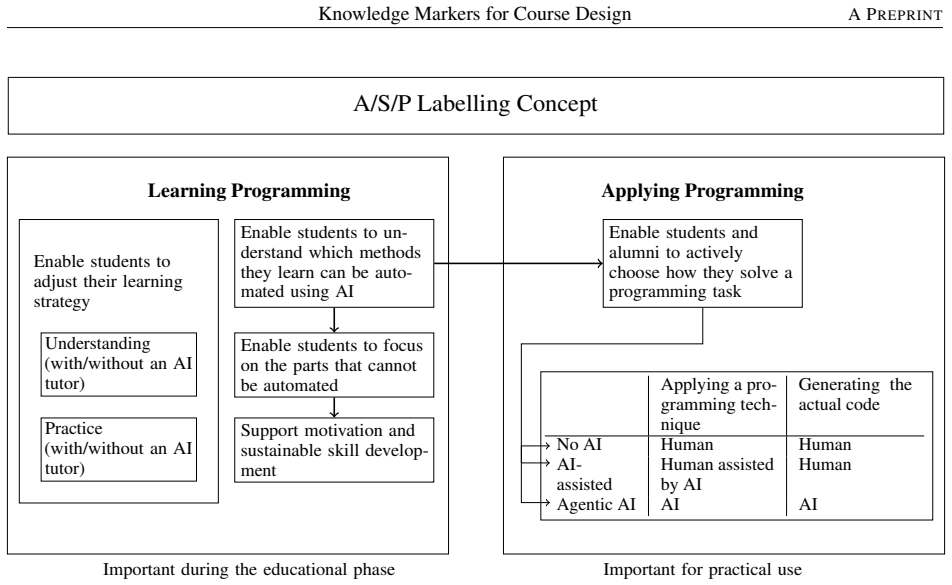
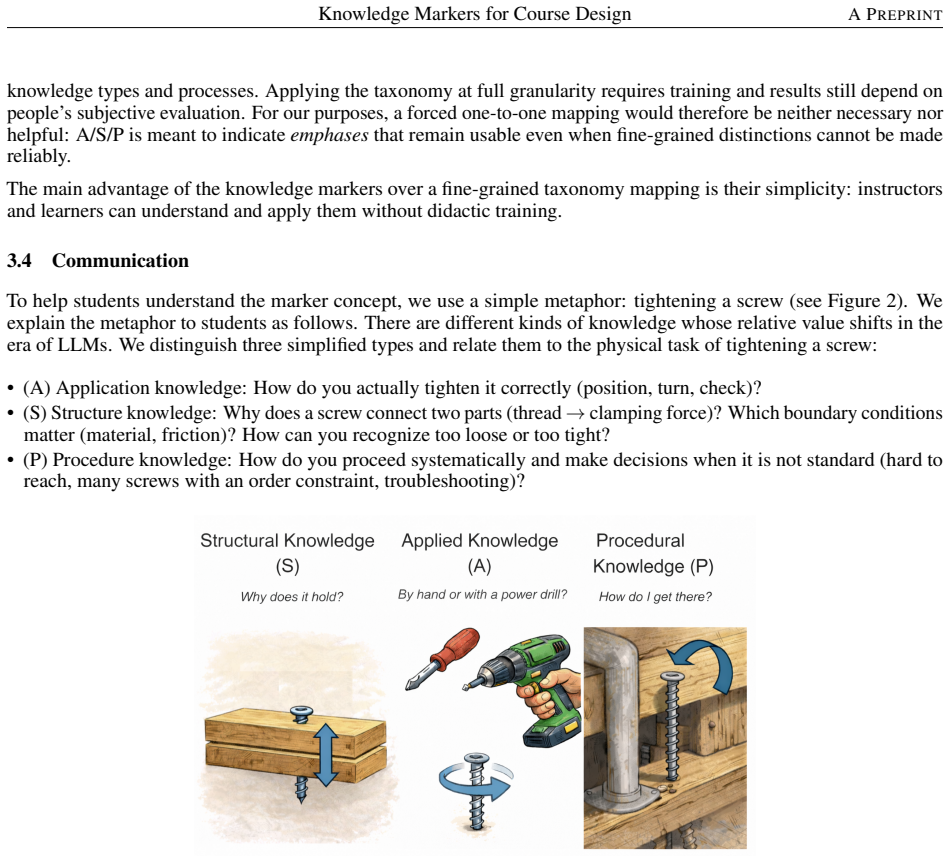
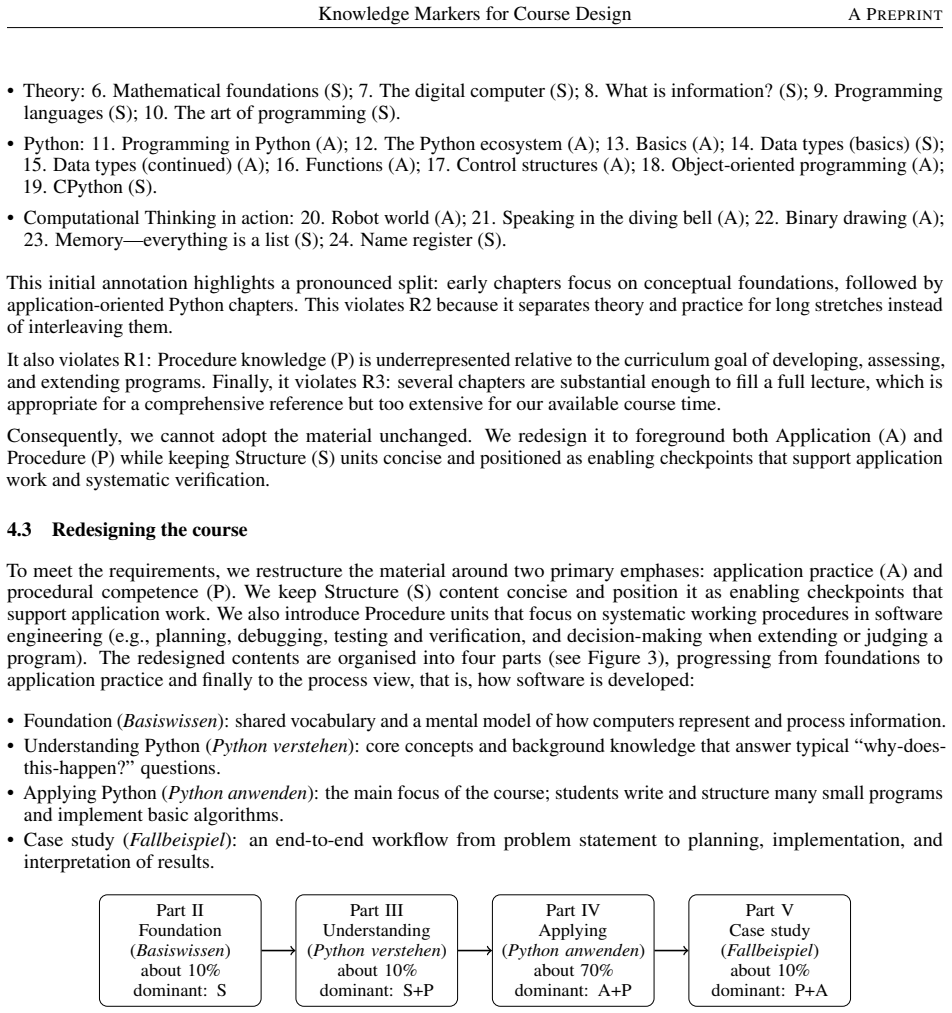
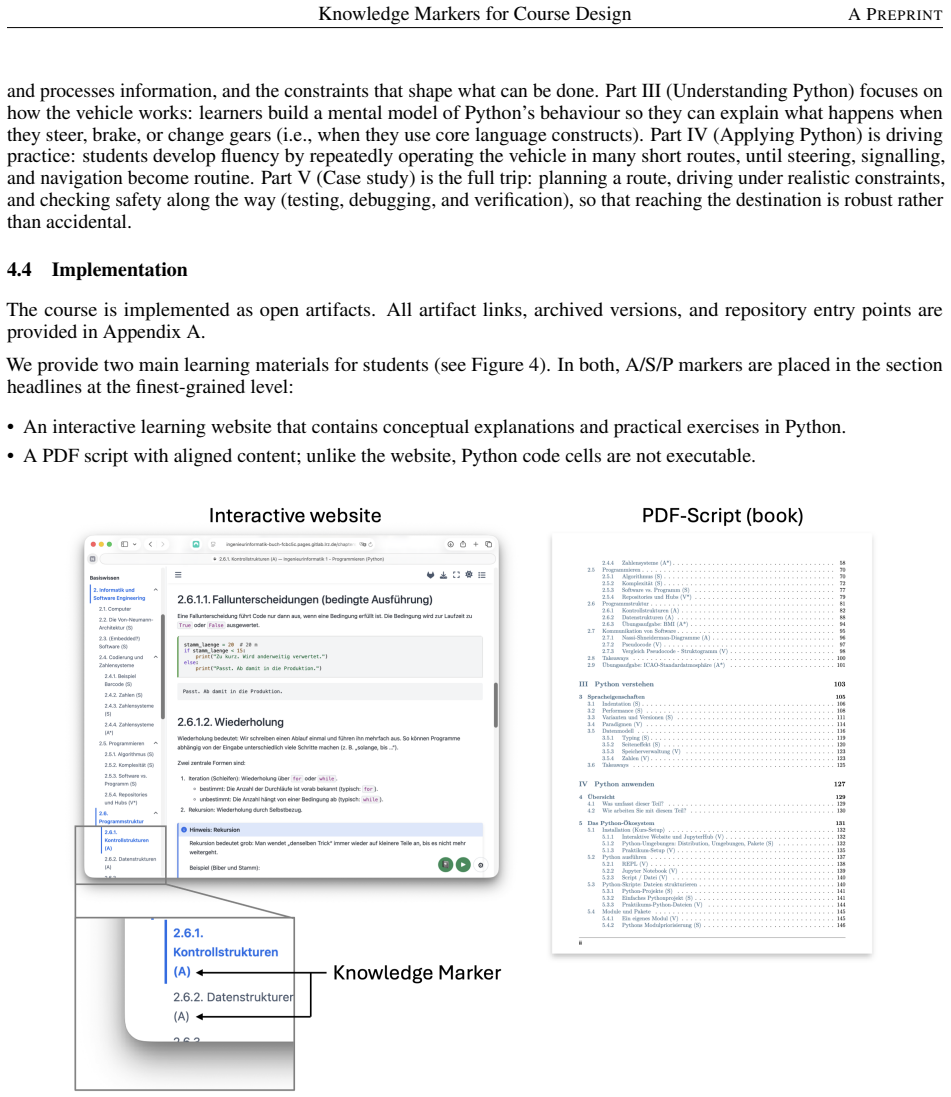
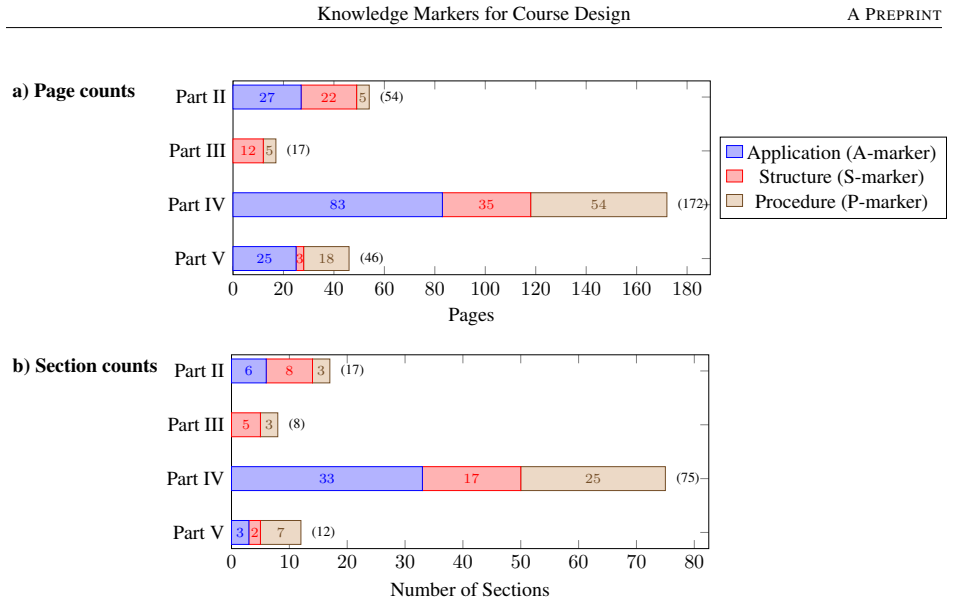
The paper presents knowledge markers as a course-level operationalisation that labels learning units by primary emphasis as A for application knowledge consisting of implementation, S for structure knowledge consisting of concepts and mental models, or P for procedure knowledge consisting of systematic methods, decision making and verification. The markers are embedded at fine granularity inside open teaching artifacts such as an interactive website, a PDF script and notebooks, and are paired with communication elements plus optional AI-usage guidance. The approach is demonstrated by analysing the table of contents of an introductory programming course, deriving marker distributions, and re-
What carries the argument
Knowledge markers: a three-category labeling system (A for Application knowledge, S for Structure knowledge, P for Procedure knowledge) applied to learning units and embedded in course artifacts to communicate primary learning emphasis.
If this is right
- Instructors can derive marker distributions directly from a course table of contents to evaluate and adjust the balance of application, structure and procedure emphasis.
- The labels can be placed at fine scale inside interactive websites, PDF scripts and notebooks together with explanatory text and AI-usage notes.
- Optional guidance on when and how to use AI tools can be attached to each marker type to align tool use with the intended knowledge focus.
- Time-constrained non-computer-science programmes gain a reusable method to keep conceptual foundations alongside sufficient practice.
Where Pith is reading between the lines
- The same labeling idea could be adapted for other subjects where AI tools now let students generate outputs without showing understanding.
- If many courses adopt the markers, shared templates or distribution guidelines might emerge that help new instructors design balanced sequences.
- Empirical work could later measure whether students from marker-labeled courses show stronger ability to explain ideas or transfer knowledge to new problems.
Load-bearing premise
That applying the three-way A/S/P labels to units and pairing them with communication elements will make learning intent clear enough to shape concrete teaching structures and student behavior.
What would settle it
A side-by-side comparison of the same programming course taught once with knowledge markers embedded in all materials and once without, checking whether students in the marked version produce better explanations of concepts or different study patterns when asked to solve problems without code-generation tools.
Figures
read the original abstract
Generative AI enables students to produce plausible code quickly. Producing working code is therefore no longer a reliable indicator of understanding. This is particularly problematic in non-computer-science programmes, where time constraints make it hard to balance conceptual foundations with sufficient application practice. Empirical studies of AI tutors, educational chatbots, and code-assistance systems report useful but often case-specific findings, while learning theory remains too abstract to directly guide course design. As a result, instructors lack a simple, reusable way to make learning intent explicit and translate it into concrete teaching structures and student learning behaviour. This paper contributes knowledge markers as a lightweight, AI-agnostic, course-level operationalisation for course design. The markers label learning units by their primary emphasis: (A) Application knowledge (implementation), (S) Structure knowledge (concepts and mental models), or (P) Procedure knowledge (systematic methods, decision making, and verification). We show how the labels can be embedded at fine granularity in open teaching artifacts (interactive website, PDF script, and notebooks), paired with communication elements and optional AI-usage guidance. We demonstrate the approach by analysing, redesigning, and descriptively evaluating an introductory programming course using marker distributions derived from the table of contents. The paper is design- and artifact-oriented and does not claim measured learning gains; empirical evaluation is future work.
Editorial analysis
A structured set of objections, weighed in public.
Referee Report
Summary. The paper claims to introduce knowledge markers (A/S/P) as a lightweight, AI-agnostic operationalisation for programming course design. These markers label learning units by primary emphasis on application (implementation), structure (concepts/mental models), or procedure (methods, decision making, verification). The labels are embedded in artifacts like websites, PDFs, and notebooks, paired with communication and AI guidance. It demonstrates by analysing and redesigning one introductory course via TOC marker distributions. The work is design-oriented, with no claims of measured learning gains; empirical evaluation is left for future work.
Significance. This design contribution is significant for providing a practical tool to make learning intent explicit in AI-influenced education. It bridges the gap between abstract learning theory and case-specific AI tool studies by offering a reusable classification that can directly inform course structures. Credit is due for the explicit artifact examples, the avoidance of overclaiming effectiveness, and the focus on non-CS programmes with time constraints. If adopted, it could help instructors balance conceptual and application elements without additional empirical burden in the short term.
minor comments (2)
- [Embedding section] The explanation of how markers are embedded at fine granularity in open teaching artifacts would be strengthened by including specific examples or screenshots from the interactive website or notebooks.
- [Course redesign] The descriptive analysis of marker distributions from the table of contents is useful, but adding the actual percentages or a summary table would improve clarity and allow readers to better assess the redesign impact.
Simulated Author's Rebuttal
We thank the referee for the positive assessment of our design contribution, the recognition of its practical value in bridging learning theory and AI-influenced course design, and the recommendation for minor revision. We appreciate the credit given for explicit artifact examples, avoidance of overclaiming, and focus on non-CS programmes.
Circularity Check
No significant circularity
full rationale
The paper introduces knowledge markers (A/S/P) as a new, lightweight labeling scheme for programming course design. It defines the three categories explicitly, illustrates their embedding in artifacts such as websites and notebooks, and applies them descriptively to the table of contents of one course for redesign purposes. No equations, fitted parameters, predictions, or derivations are present that could reduce to the inputs by construction. The work is explicitly design-oriented and defers empirical validation to future research, with no load-bearing self-citations or uniqueness claims imported from prior author work. The central contribution remains a definitional and illustrative proposal rather than a deductive chain.
Axiom & Free-Parameter Ledger
axioms (1)
- domain assumption Explicit labeling of learning units by primary knowledge type improves instructors' ability to balance conceptual and practical elements in course design.
invented entities (1)
-
Knowledge markers (A/S/P labels)
no independent evidence
Reference graph
Works this paper leans on
-
[1]
A generative AI-based per- sonalized guidance tool for enhancing the feedback to MOOC learners
doi:10.1109/EDUCON60312.2024.10578838. URL https://doi.org/10.1109/EDUCON60312.2024. 10578838. Preprint: arXiv:2403.09744. Mohammad Amin Kuhail, Nazik Alturki, Salwa Alramlawi, and Kholood Alhejori. Interacting with educational chatbots: A systematic review.Education and Information Technologies, 28(1):973–1018, 2023. doi:10.1007/s10639- 022-11177-3. URLh...
-
[2]
Trust in Automation: Designing for Appropriate Reliance,
URLhttps://journals.sagepub.com/doi/10.1518/hfes.46.1.50_30392. Benedikt Zönnchen. Computational thinking, 2026. URL https://bzoennchen.github.io/ct-book/intro. html. Online resource; accessed 2026-04-06. Helen Crompton and Diane Burke. Artificial intelligence in higher education: the state of the field.International Journal of Educational Technology in H...
discussion (0)
Sign in with ORCID, Apple, or X to comment. Anyone can read and Pith papers without signing in.