Recognition: 2 theorem links
· Lean TheoremJustifiable Priority Violations
Pith reviewed 2026-05-10 18:17 UTC · model grok-4.3
The pith
Priority violations in student-school matching can be justified without consent by checking direct benefits or unimprovability under Pareto improvements over deferred acceptance.
A machine-rendered reading of the paper's core claim, the machinery that carries it, and where it could break.
Core claim
A priority violation is justifiable whenever the affected student either directly benefits from the improvement or is unimprovable under any assignment that Pareto-dominates the Deferred Acceptance outcome. This endogenous criterion permits improvements unattainable by consent-based mechanisms under any consent structure. A just-below-cutoffs mechanism always finds a strongly justifiable matching when Deferred Acceptance is inefficient, and an iterative polynomial-time algorithm expands such improvements until reaching a Deferred Acceptance improvement that cannot be Pareto-improved by any justifiable matching without strictly expanding the beneficiary set.
What carries the argument
The endogenous justifiability criterion, which declares a priority violation justifiable if the affected student directly benefits or cannot be improved upon in any Pareto-dominating assignment over the Deferred Acceptance outcome.
If this is right
- The just-below-cutoffs mechanism always identifies a strongly justifiable matching whenever Deferred Acceptance produces an inefficient outcome.
- The iterative algorithm converges to a maximal justifiable improvement over Deferred Acceptance that cannot be further improved without expanding the set of beneficiaries.
- Both the consent-based and endogenous justifiability frameworks are provably unable to reach every Pareto-efficient outcome.
- Simulations quantify how often these theoretical limitations bind in practical market sizes.
Where Pith is reading between the lines
- The criterion could simplify real-world implementation by removing the need to collect consent in advance.
- Similar endogenous tests might apply to other priority-based matching settings such as housing or organ allocation.
- Empirical tests could check whether the justifiability rule matches community fairness intuitions in actual school districts.
Load-bearing premise
That the full set of assignments Pareto-dominating the Deferred Acceptance outcome can be characterized and searched using only the reported preferences and priorities.
What would settle it
A concrete preference profile in which a proposed priority violation improves outcomes for some students, yet the criterion rejects it because an undiscovered Pareto-dominating assignment exists that would make the affected student better off.
Figures


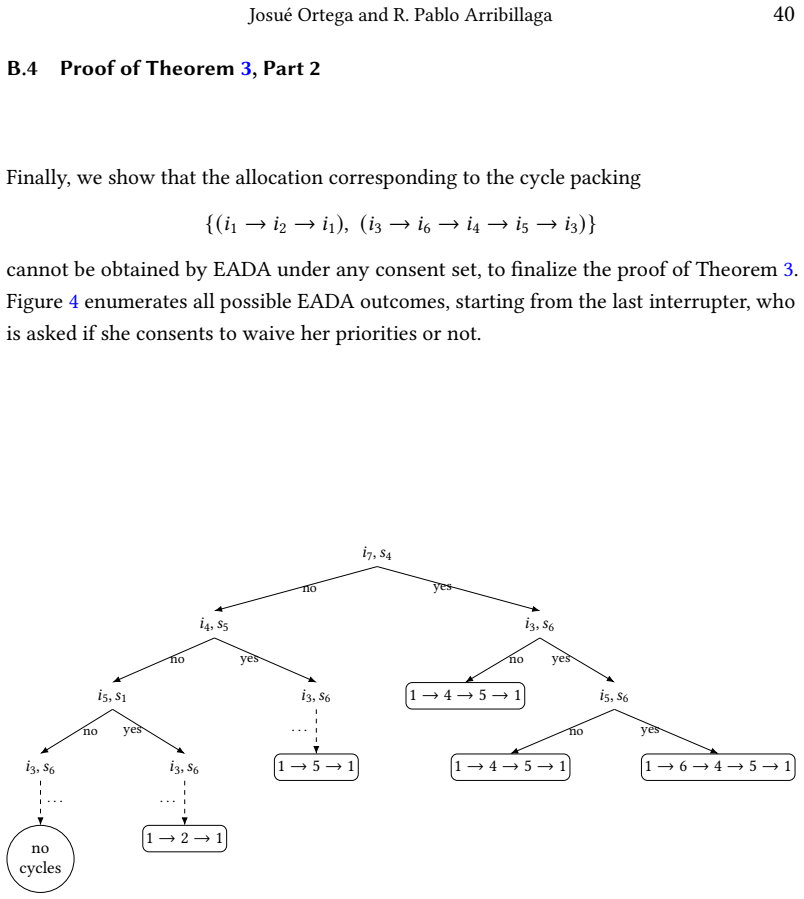

read the original abstract
Addressing the large inefficiencies generated by the Deferred Acceptance (DA) mechanism requires priority violations, but which ones are justifiable? The leading approach is to ask individuals if they consent to waive their priority ex-ante. We develop an alternative question-free solution, in which a priority violation is justifiable whenever the affected student either (i) directly benefits from the improvement, or (ii) is unimprovable under any assignment that Pareto-dominates DA. This endogenous justifiability criterion permits improvements unattainable by the leading consent-based mechanism under any consent structure. We provide a ``just below cutoffs'' mechanism that always finds a strongly justifiable matching whenever DA's outcome is inefficient, and build on it to construct a polynomial-time algorithm that expands justifiable improvements iteratively, converging to a DA improvement that cannot be Pareto-improved by any justifiable matching without strictly expanding the beneficiary set. Finally, we prove theoretically that both the ex-ante consent and the endogenous justifiability frameworks have important limitations in reaching Pareto-efficient outcomes, and use simulations to quantify how binding these constraints are in practice.
Editorial analysis
A structured set of objections, weighed in public.
Referee Report
Summary. The paper develops an endogenous justifiability criterion for priority violations in the Deferred Acceptance (DA) mechanism: a violation is justifiable if the affected student either (i) directly benefits or (ii) is unimprovable under any Pareto-dominating assignment over DA. It shows this criterion permits improvements unattainable under any consent structure in the leading ex-ante consent framework, provides a 'just below cutoffs' mechanism that finds a strongly justifiable matching whenever DA is inefficient, and constructs a polynomial-time iterative algorithm that expands such improvements until reaching a DA improvement that cannot be Pareto-improved by any justifiable matching without expanding the beneficiary set. The paper also proves theoretical limitations of both the consent and endogenous frameworks in reaching Pareto-efficient outcomes and uses simulations to quantify how binding these constraints are in practice.
Significance. If the central claims hold, the work supplies a question-free, endogenous alternative to consent-based mechanisms for addressing DA inefficiencies while preserving a clear justifiability standard. The provision of an explicit 'just below cutoffs' construction, a polynomial-time iterative procedure, and impossibility results for full Pareto efficiency constitute clear theoretical contributions. The simulations add practical insight into the quantitative relevance of the identified limitations. Credit is given for deriving the framework from first principles using DA outcomes and Pareto dominance without fitted parameters or circular definitions.
major comments (2)
- [Abstract] Abstract and the description of the iterative algorithm: the claim that the polynomial-time procedure produces a matching that 'cannot be Pareto-improved by any justifiable matching' rests on the global condition (ii) in the justifiability definition. The manuscript does not exhibit an explicit reduction or bounding argument showing that the local iterative expansions suffice to verify unimprovability against the entire set of Pareto-dominating assignments over DA; if the check is only local, the output may contain violations that fail the global test.
- [theoretical results on mechanisms] The section establishing the 'just below cutoffs' mechanism and its extension to the iterative algorithm: while the mechanism is asserted to always find a strongly justifiable matching when DA is inefficient, the argument does not clarify how the unimprovability check in (ii) is performed in polynomial time when the Pareto frontier over DA may contain exponentially many assignments under standard preference domains.
minor comments (2)
- [Abstract] The abstract introduces 'strongly justifiable matching' without an immediate cross-reference to its formal definition in the main text; adding a parenthetical pointer would improve readability.
- [simulations] The simulation section should specify the exact preference-generation process and parameter values used to quantify the bindingness of the constraints, to facilitate replication.
Simulated Author's Rebuttal
We thank the referee for the careful reading and constructive comments. We address each major comment below and will revise the manuscript to add the requested clarifications and explicit arguments.
read point-by-point responses
-
Referee: [Abstract] Abstract and the description of the iterative algorithm: the claim that the polynomial-time procedure produces a matching that 'cannot be Pareto-improved by any justifiable matching' rests on the global condition (ii) in the justifiability definition. The manuscript does not exhibit an explicit reduction or bounding argument showing that the local iterative expansions suffice to verify unimprovability against the entire set of Pareto-dominating assignments over DA; if the check is only local, the output may contain violations that fail the global test.
Authors: We appreciate this observation on the abstract claim. The iterative algorithm expands using local justifiable improvements and terminates when no further such improvement exists without expanding the beneficiary set. This termination is intended to ensure global unimprovability under (ii). To address the concern directly, we will add a formal lemma in the revised manuscript proving by contradiction that any Pareto-dominating assignment violating the global condition would imply an earlier local expansion opportunity, leveraging the structure of DA outcomes and the definition of justifiability. This makes the reduction explicit. revision: yes
-
Referee: [theoretical results on mechanisms] The section establishing the 'just below cutoffs' mechanism and its extension to the iterative algorithm: while the mechanism is asserted to always find a strongly justifiable matching when DA is inefficient, the argument does not clarify how the unimprovability check in (ii) is performed in polynomial time when the Pareto frontier over DA may contain exponentially many assignments under standard preference domains.
Authors: The just below cutoffs mechanism verifies strong justifiability directly from the constructed cutoffs and DA priorities, without enumerating the Pareto frontier: students satisfying (i) benefit directly, and those under (ii) are shown unimprovable because any potential Pareto improvement would contradict the cutoff selection or DA stability properties. The iterative algorithm extends this by applying the mechanism repeatedly; each iteration runs in polynomial time via standard assignment algorithms, and the number of iterations is bounded by the number of students. We will revise the section to spell out this complexity analysis and confirm that no exponential enumeration occurs. revision: yes
Circularity Check
No significant circularity; definitions and algorithms are independent of inputs by construction.
full rationale
The paper defines the endogenous justifiability criterion directly from the DA outcome and the set of Pareto-dominating assignments, without any self-referential equations, fitted parameters renamed as predictions, or load-bearing self-citations. The 'just below cutoffs' mechanism and iterative expansion algorithm are constructed to satisfy the stated properties using standard matching-theoretic operations; no step reduces the claimed result to its own inputs or prior author work by definition. The derivation chain remains self-contained against external benchmarks such as Gale-Shapley DA and Pareto dominance.
Axiom & Free-Parameter Ledger
axioms (2)
- domain assumption Students have strict preferences over schools and schools have strict priorities over students.
- ad hoc to paper The set of assignments that Pareto-dominate the DA outcome can be identified or searched.
invented entities (1)
-
Endogenous justifiability criterion
no independent evidence
Lean theorems connected to this paper
-
IndisputableMonolith/Foundation/AbsoluteFloorClosure.leanreality_from_one_distinction uncleara priority violation is justifiable whenever the affected student either (i) directly benefits from the improvement, or (ii) is unimprovable under any assignment that Pareto-dominates DA
-
IndisputableMonolith/Cost/FunctionalEquation.leanwashburn_uniqueness_aczel unclearJust Below Cutoffs mechanism that always finds a strongly justifiable matching
Reference graph
Works this paper leans on
-
[1]
American Economic Review93, 3 (2003), 729–747
School choice: A mechanism design approach. American Economic Review93, 3 (2003), 729–747. 4, 32 Mustafa Oğuz Afacan, Umut Dur, A Arda Gitmez, and Özgür Yılmaz
2003
-
[2]
5 Samson Alva and Vikram Manjunath
Improving the deferred acceptance with minimal compromise.Games and Economic Behavior(2025). 5 Samson Alva and Vikram Manjunath. 2019.Stable-dominating rules. Technical Report. Working paper, University of Ottawa. 5 Keisuke Bando
2025
-
[3]
4 Claudia Cerrone, Yoan Hermstrüwer, and Onur Kesten
On the existence of a strictly strong Nash equilibrium under the student- optimal deferred acceptance algorithm.Games and Economic Behavior87 (2014), 269–287. 4 Claudia Cerrone, Yoan Hermstrüwer, and Onur Kesten
2014
-
[4]
1, 29 Yiqiu Chen and Markus Möller
School choice with consent: An experiment.The Economic Journal(01 2024). 1, 29 Yiqiu Chen and Markus Möller
2024
-
[5]
Theoretical Economics(2023)
Regret-free truth-telling in school choice with consent. Theoretical Economics(2023). 4 Thomas H. Cormen, Charles E. Leiserson, Ronald L. Rivest, and Clifford Stein. 2009.Introduction to Algorithms(3 ed.). MIT Press. 17, 22 Benoit Decerf, Guillaume Haeringer, and Martin Van der Linden
2023
-
[6]
arXiv preprint arXiv:2401.03598(2024)
Incontestable Assignments. arXiv preprint arXiv:2401.03598(2024). 5 Battal Doğan and Lars Ehlers
-
[7]
5 Battal Doğan and M Bumin Yenmez
Minimally unstable Pareto improvements over deferred acceptance.Theoretical Economics16, 4 (2021), 1249–1279. 5 Battal Doğan and M Bumin Yenmez
2021
-
[8]
5 Umut Dur, A Arda Gitmez, and Özgür Yılmaz
Consistent Pareto improvement over the student-optimal stable mechanism.Economic Theory Bulletin8 (2020), 125–137. 5 Umut Dur, A Arda Gitmez, and Özgür Yılmaz
2020
-
[9]
4, 7 Lars Ehlers and Thayer Morrill
School choice under partial fairness.Theoretical Economics14, 4 (2019), 1309–1346. 4, 7 Lars Ehlers and Thayer Morrill
2019
-
[10]
4, 25 Aytek Erdil and Haluk Ergin
(Il) legal assignments in school choice.The Review of Economic Studies87, 4 (2020), 1837–1875. 4, 25 Aytek Erdil and Haluk Ergin
2020
-
[11]
5 Mikhail Freer, Thilo Klein, and Josué Ortega
What’s the matter with tie-breaking? Improving efficiency in school choice.American Economic Review98, 3 (2008), 669–89. 5 Mikhail Freer, Thilo Klein, and Josué Ortega
2008
-
[12]
Experimental School Choice with Parents.arXiv preprint arXiv:2603.24615(2026). 30 Onur Kesten
-
[13]
4, 24 Onur Kesten and Morimitsu Kurino
School choice with consent.The Quarterly Journal of Economics125, 3 (2010), 1297–1348. 4, 24 Onur Kesten and Morimitsu Kurino
2010
-
[14]
5 Minoru Kitahara and Yasunori Okumura
Strategy-proof improvements upon deferred acceptance: A maximal domain for possibility.Games and Economic Behavior117 (2019), 120–143. 5 Minoru Kitahara and Yasunori Okumura
2019
-
[15]
5 Josué Ortega and R
Improving efficiency in school choice under partial priorities.International Journal of Game Theory50, 4 (2021), 971–987. 5 Josué Ortega and R. Pablo Arribillaga34 Taylor Knipe and Josué Ortega
2021
-
[16]
24 Hyukjun Kwon and Ran I Shorrer
The Trade-off Between Minimal Instability and Larger Improvements over Deferred Acceptance.arXiv preprint arXiv:2504.12871(2026). 24 Hyukjun Kwon and Ran I Shorrer
-
[17]
5 Josué Ortega and Thilo Klein
Justified-envy-minimal efficient mechanisms for priority- based matching.A vailable at SSRN 3495266(2020). 5 Josué Ortega and Thilo Klein
2020
-
[18]
5 Josué Ortega, Gabriel Ziegler, R Pablo Arribillaga, and Geng Zhao
The cost of strategy-proofness in school choice.Games and Economic Behavior141 (2023), 515–528. 5 Josué Ortega, Gabriel Ziegler, R Pablo Arribillaga, and Geng Zhao
2023
-
[19]
5, 7 Josué Ortega, Gabriel Ziegler, R Pablo Arribillaga, and Geng Zhao
Identifying and Quantifying (Un) Improvable Students.arXiv preprint arXiv:2407.19831(2024). 5, 7 Josué Ortega, Gabriel Ziegler, R Pablo Arribillaga, and Geng Zhao
-
[20]
5 Philip J Reny
What Pareto-Efficiency Adjustments Cannot Fix.Journal of Political Economy: Microeconomics(2026). 5 Philip J Reny
2026
-
[21]
4, 25 Ryo Shirakawa
Efficient matching in the school choice problem.American Economic Review 112, 6 (2022), 2025–43. 4, 25 Ryo Shirakawa
2022
-
[22]
4 Qianfeng Tang and Jingsheng Yu
Simple Manipulations in School Choice Mechanisms.American Economic Journal: Microeconomics(2025). 4 Qianfeng Tang and Jingsheng Yu
2025
-
[23]
4, 7, 26 Qianfeng Tang and Yongchao Zhang
A new perspective on Kesten’s school choice with consent idea.Journal of Economic Theory154 (2014), 543–561. 4, 7, 26 Qianfeng Tang and Yongchao Zhang
2014
-
[24]
Economic Theory71 (2021), 533–552
Weak stability and Pareto efficiency in school choice. Economic Theory71 (2021), 533–552. 4 Peter Troyan, David Delacrétaz, and Andrew Kloosterman
2021
-
[25]
Games and Economic Behavior120 (2020), 370–390
Essentially stable matchings. Games and Economic Behavior120 (2020), 370–390. 4, 25, 46 Peter Troyan and Thayer Morrill
2020
-
[26]
4, 32 Josué Ortega and R
Obvious manipulations.Journal of Economic Theory185 (2020), 104970. 4, 32 Josué Ortega and R. Pablo Arribillaga35 A DA and EADA Descriptions This appendix describes the Deferred Acceptance (DA) algorithm and the Efficiency- Adjusted Deferred Acceptance (EADA) algorithm. A.1 Deferred Acceptance (DA) Algorithm The student-proposing Deferred Acceptance algor...
2020
-
[27]
Pablo Arribillaga42 In this reduced digraph, JBC selects the ∅-labelled 2-cycle between 𝑖3 and 𝑖4, recommend- ing that𝑖 3 and𝑖 4 exchange schools
Josué Ortega and R. Pablo Arribillaga42 In this reduced digraph, JBC selects the ∅-labelled 2-cycle between 𝑖3 and 𝑖4, recommend- ing that𝑖 3 and𝑖 4 exchange schools. This yields the intermediate matching 𝜇′ =(𝑖 1 →𝑠 3, 𝑖 2 →𝑠 1, 𝑖 3 →𝑠 2, 𝑖 4 →𝑠 5, 𝑖 5 →𝑠 4). At this point, Sequential JBC continues by selecting a maximum packing of admissible cycles in t...
2020
discussion (0)
Sign in with ORCID, Apple, or X to comment. Anyone can read and Pith papers without signing in.