Recognition: 2 theorem links
· Lean TheoremNon-Monotonicity of Transverse Momentum Correlations in Au + Au Collisions at RHIC
Pith reviewed 2026-05-10 17:48 UTC · model grok-4.3
The pith
Transverse momentum correlations in central Au+Au collisions exhibit a non-monotonic dependence on collision energy with approximately 5 sigma significance.
A machine-rendered reading of the paper's core claim, the machinery that carries it, and where it could break.
Core claim
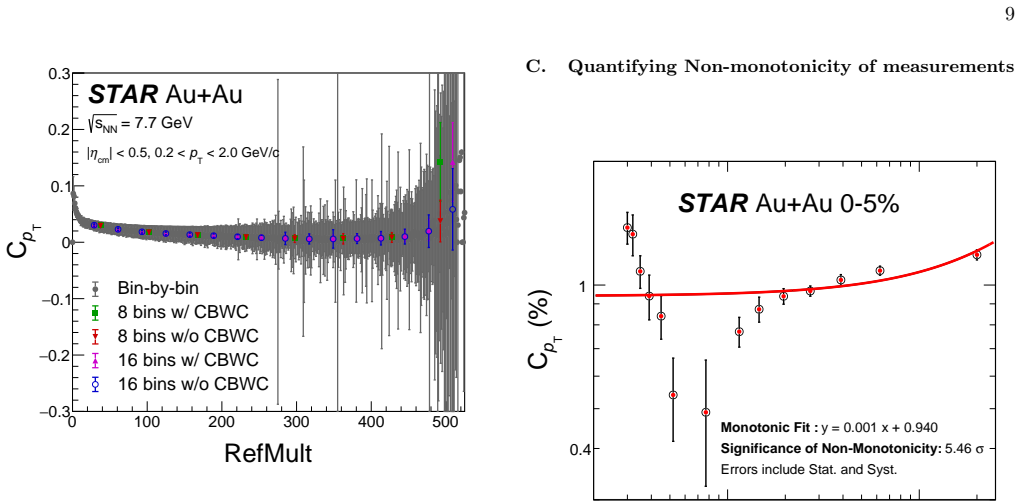
The paper states that the scaled pT correlator deviates from the expected 1 over square root of N_part scaling in central collisions and displays a statistically significant non-monotonic dependence on collision energy with a significance of approximately 5 sigma, while transport-model calculations reach only 2 sigma and mid-central data reach 1.4 sigma.
What carries the argument
The scaled transverse momentum correlator, whose dependence on the number of participating nucleons is compared against the 1 over square root of N_part scaling predicted by an independent-source scenario.
If this is right
- The results supply new constraints on the equation of state of strongly interacting matter at high baryon density.
- The non-monotonic behavior may be sensitive to the presence of a QCD critical point.
- Transport-model calculations do not reproduce the observed non-monotonic dependence at comparable significance.
- The measurements constitute the first such data set from the fixed-target configuration in the Beam Energy Scan Phase II program.
Where Pith is reading between the lines
- The energy location of the observed non-monotonicity could be compared against theoretical predictions for the critical point location in the QCD phase diagram.
- Higher-statistics data in subsequent runs could test whether the signal persists or sharpens at specific energies.
- Analogous correlation studies in asymmetric collision systems might reveal whether the non-monotonic feature is tied to the initial baryon density profile.
Load-bearing premise
The reported 5 sigma significance fully accounts for all systematic uncertainties, background contributions, and the specific choices of centrality and rapidity selections without post-hoc adjustments that could inflate the apparent non-monotonicity.
What would settle it
A re-analysis that includes additional or larger systematic uncertainties or alternative centrality definitions and finds the significance of the non-monotonic energy dependence falling below 3 sigma would falsify the central claim.
Figures


read the original abstract
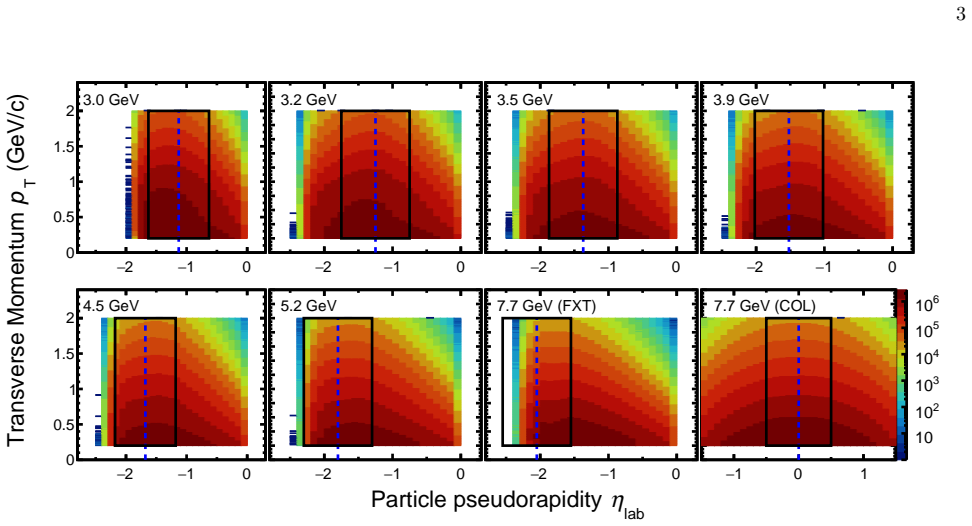
Event-by-event transverse momentum correlations are sensitive to the equation of state of strongly interacting matter and are expected to exhibit anomalous fluctuations in the vicinity of the QCD critical point. We report the first measurements of two-particle transverse momentum ($p_T$) correlations for mid-rapidity charged particles in fixed-target Au+Au collisions at nucleon-nucleon center-of-mass energies $\sqrt{s_{NN}} = 3.0--7.7$ GeV, measured by the STAR experiment during the Beam Energy Scan (BES) Phase II program. The dependence of the scaled correlator on the number of participating nucleons ($N_{part}$) is studied to test expectations from an independent-source scenario, where the correlations are expected to scale as $1/\sqrt{N_{part}}$. We observe a clear breakdown of the expected scaling behavior in central collisions and identify a statistically significant non-monotonic dependence of the $p_T$ correlations on collision energy, with a significance of approximately $5\sigma$. In contrast, transport-model calculations and data from mid-central collisions yield significances of only $2\sigma$ and $1.4\sigma$, respectively, insufficient to support a claim of non-monotonicity. These observations provide new constraints on the equation of state at high baryon density and may be sensitive to the presence of a QCD critical point.
Editorial analysis
A structured set of objections, weighed in public.
Referee Report
Summary. The manuscript reports the first measurements of two-particle transverse momentum (p_T) correlations for mid-rapidity charged particles in fixed-target Au+Au collisions at √s_NN = 3.0–7.7 GeV using the STAR experiment. It examines the dependence of the scaled correlator on the number of participating nucleons (N_part) to test the independent-source expectation of 1/√N_part scaling, observes a breakdown of this scaling in central collisions, and identifies a non-monotonic dependence of the p_T correlations on collision energy with approximately 5σ significance. Transport models and mid-central data yield only 2σ and 1.4σ, respectively. The observations are presented as new constraints on the QCD equation of state at high baryon density, potentially sensitive to a critical point.
Significance. If the reported 5σ non-monotonicity is robust after full propagation of energy-dependent systematics, the result would provide important new experimental constraints on the behavior of strongly interacting matter at high baryon density. The explicit contrast with transport-model calculations (only 2σ) and mid-central data (1.4σ) strengthens the data-driven character of the claim and highlights the need for improved theoretical modeling of p_T correlations near the QCD critical-point region.
major comments (2)
- [§4] §4 (energy dependence results): the 5σ significance quoted for non-monotonicity in central collisions does not explicitly demonstrate that the full covariance matrix incorporates all energy-dependent systematic uncertainties (acceptance, efficiency, and N_part determination) that are correlated across the √s_NN = 3.0–7.7 GeV points. Residual biases from beam-energy changes in fixed-target running could artificially enhance the apparent non-monotonicity.
- [§3.2] §3.2 and Fig. 4 (scaling with N_part): the quantitative deviation from 1/√N_part scaling in the most central bins is shown, but the paper does not provide a direct statistical comparison of this deviation against the model predictions at the same centralities, leaving unclear whether the data-model tension itself reaches the claimed significance level.
minor comments (3)
- [§2] The explicit definition of the scaled p_T correlator (including any normalization factors) should be restated in the results section for reader convenience rather than referenced only to prior work.
- [Fig. 5] Figure 5 (energy dependence plot): the visual separation between central and mid-central points is clear, but adding a ratio panel relative to the lowest-energy point would improve assessment of the non-monotonic trend.
- [§3.3] A brief statement on the treatment of track reconstruction efficiency variations with beam energy should be added to the systematic uncertainty section.
Simulated Author's Rebuttal
We thank the referee for the careful reading of our manuscript and the constructive comments. We address each of the major comments below and will incorporate revisions to improve the clarity and robustness of the presented results.
read point-by-point responses
-
Referee: [§4] §4 (energy dependence results): the 5σ significance quoted for non-monotonicity in central collisions does not explicitly demonstrate that the full covariance matrix incorporates all energy-dependent systematic uncertainties (acceptance, efficiency, and N_part determination) that are correlated across the √s_NN = 3.0–7.7 GeV points. Residual biases from beam-energy changes in fixed-target running could artificially enhance the apparent non-monotonicity.
Authors: We appreciate the referee's emphasis on the proper treatment of correlated systematics in the significance calculation. The covariance matrix used for the 5σ assessment does incorporate the energy-dependent systematic uncertainties, including acceptance, efficiency, and N_part determination, with appropriate correlations across the beam energies. These were evaluated using a combination of data-driven methods and simulation studies that account for variations in fixed-target running conditions. To make this explicit and address potential concerns about residual biases, we will add a detailed description in Section 4 and a supplementary appendix outlining the covariance matrix construction and the propagation of these uncertainties. Additional robustness checks, including varying the correlated components within their uncertainties, confirm that the non-monotonicity significance remains above 4σ in conservative scenarios. revision: yes
-
Referee: [§3.2] §3.2 and Fig. 4 (scaling with N_part): the quantitative deviation from 1/√N_part scaling in the most central bins is shown, but the paper does not provide a direct statistical comparison of this deviation against the model predictions at the same centralities, leaving unclear whether the data-model tension itself reaches the claimed significance level.
Authors: We agree that providing a direct statistical comparison of the scaling deviation would enhance the manuscript. The quoted 2σ for transport models pertains to the lack of significant non-monotonic energy dependence in the model results for central collisions, whereas the data shows 5σ. For the scaling with N_part, the manuscript demonstrates the breakdown in central bins through the deviation from the expected 1/√N_part line. In the revision, we will include a quantitative assessment of the data-model difference in the deviation from scaling at the most central N_part bins, using appropriate statistical metrics such as the significance of the pull or a χ² test between data and model predictions. This will clarify the level of tension. revision: yes
Circularity Check
Pure experimental measurement; no derivation chain or self-referential steps
full rationale
This is a data-driven experimental paper reporting direct measurements of two-particle pT correlations from STAR fixed-target Au+Au data at several √s_NN. The central claim (breakdown of 1/√N_part scaling and ~5σ non-monotonic energy dependence in central collisions) is extracted from binned data points, efficiency-corrected yields, and a significance calculation that compares observed energy dependence against a flat or monotonic null hypothesis. No equations are derived from first principles, no parameters are fitted to produce the reported non-monotonicity, and no self-citations are invoked to justify uniqueness or ansatzes. The result is compared to external transport models and mid-central data as independent checks. All load-bearing steps (centrality selection, acceptance corrections, covariance for significance) are standard experimental procedures applied to raw data rather than reductions to prior outputs of the same paper.
Axiom & Free-Parameter Ledger
axioms (1)
- domain assumption Standard heavy-ion analysis assumptions for mid-rapidity selection, charged-particle identification, and N_part estimation from Glauber modeling.
Lean theorems connected to this paper
-
IndisputableMonolith/Foundation/RealityFromDistinction.leanreality_from_one_distinction unclearWe observe a clear breakdown of the expected scaling behavior in central collisions and identify a statistically significant non-monotonic dependence of the pT correlations on collision energy, with a significance of approximately 5σ.
-
IndisputableMonolith/Cost/FunctionalEquation.leanwashburn_uniqueness_aczel unclearthe correlations are expected to scale as 1/√Npart
Reference graph
Works this paper leans on
- [1]
-
[2]
Bzdak, S
A. Bzdak, S. Esumi, V. Koch, J. Liao, M. Stephanov, and N. Xu, Physics Reports853, 1–87 (2020)
2020
-
[3]
J. Chenet al., Nucl. Sci. Tech.35, 214 (2024), arXiv:2407.02935 [nucl-ex]
-
[4]
Adamet al.(STAR Collaboration), Phys
J. Adamet al.(STAR Collaboration), Phys. Rev. C103, 034908 (2021), arXiv:2007.14005 [nucl-ex]
-
[5]
W.-j. Fu, J. M. Pawlowski, and F. Rennecke, Phys. Rev. D101, 054032 (2020)
2020
-
[6]
P. J. Gunkel and C. S. Fischer, Phys. Rev. D104, 054022 (2021)
2021
-
[7]
M. Hippert, J. Grefa, T. Manning, J. Noronha, J. Noronha-Hostler, I. Vazquez, C. Ratti, R. Rouge- mont, and M. Trujillo, Physical Review D110(2024), 10.1103/PhysRevD.110.094006
-
[8]
G. m. c. Ba¸ sar, Phys. Rev. C110, 015203 (2024)
2024
-
[9]
Searching for the qcd critical endpoint using multi-point pad´ e approx- imations,
D. A. Clarke, P. Dimopoulos, F. D. Renzo, J. Goswami, C. Schmidt, S. Singh, and K. Zambello, “Searching for the qcd critical endpoint using multi-point pad´ e approx- imations,” (2024), arXiv:2405.10196 [hep-lat]
-
[10]
Locating the qcd critical point from first principles through contours of constant entropy density,
H. Shah, M. Hippert, J. Noronha, C. Ratti, and V. Vovchenko, “Locating the qcd critical point from first principles through contours of constant entropy density,” (2024), arXiv:2410.16206 [hep-ph]
-
[11]
A. Sorensen and P. Sorensen, “Locating the critical point for the hadron to quark-gluon plasma phase transition from finite-size scaling of proton cumulants in heavy-ion collisions,” (2024), arXiv:2405.10278 [nucl-th]
-
[12]
S. A. Bass, P. Danielewicz, and S. Pratt, Phys. Rev. Lett.85, 2689 (2000)
2000
-
[13]
S. A. Voloshin, V. Koch, and H. G. Ritter, Phys. Rev. C60, 024901 (1999)
1999
-
[14]
Heiselberg, Physics Reports351, 161–194 (2001)
H. Heiselberg, Physics Reports351, 161–194 (2001)
2001
- [15]
-
[16]
Stephanov, K
M. Stephanov, K. Rajagopal, and E. Shuryak, Phys. Rev. D60, 114028 (1999)
1999
-
[17]
M. S. Pradeep, J. Subatomic Part. Cosmol.4, 100189 (2025)
2025
- [18]
-
[19]
Adamczyket al.(STAR Collaboration), Phys
L. Adamczyket al.(STAR Collaboration), Phys. Rev. Lett.112, 032302 (2014), arXiv:1309.5681 [nucl-ex]
-
[20]
Adamet al.(STAR Collaboration), Phys
J. Adamet al.(STAR Collaboration), Phys. Rev. Lett. 126, 092301 (2021), [Erratum: Phys.Rev.Lett. 134, 139902 (2025)], arXiv:2001.02852 [nucl-ex]
-
[21]
B. E. Aboonaet al.(STAR Collaboration), Phys. Rev. Lett.135, 142301 (2025)
2025
-
[22]
Gavin, Phys
S. Gavin, Phys. Rev. Lett.92, 162301 (2004)
2004
-
[23]
Gavin and G
S. Gavin and G. Moschelli, Phys. Rev. C85, 014905 (2012)
2012
-
[24]
Stephanov, Phys
M. Stephanov, Phys. Rev. D65, 096008 (2002)
2002
-
[25]
Adamet al.(STAR Collaboration), Phys
J. Adamet al.(STAR Collaboration), Phys. Rev. C99, 044918 (2019), arXiv:1901.00837 [nucl-ex]
- [26]
- [27]
- [28]
- [29]
-
[30]
G. Aadet al.(ATLAS), Phys. Rev. Lett.133, 252301 (2024), arXiv:2407.06413 [nucl-ex]
-
[31]
Stodolsky, Phys
L. Stodolsky, Phys. Rev. Lett.75, 1044 (1995)
1995
-
[32]
Shuryak, Physics Letters B423, 9–14 (1998)
E. Shuryak, Physics Letters B423, 9–14 (1998)
1998
- [33]
-
[34]
High-order fluctuations of temperature in hot QCD matter
J. Chen, W.-j. Fu, S. Yin, and C. Zhang, (2025), arXiv:2504.06886 [hep-ph]
work page internal anchor Pith review Pith/arXiv arXiv 2025
-
[35]
S. Jeon and V. Koch, “Event-by-event fluctuations,” (2003), arXiv:hep-ph/0304012 [hep-ph]
work page internal anchor Pith review arXiv 2003
-
[36]
S. Basu, S. Chatterjee, R. Chatterjee, T. K. Nayak, and B. K. Nandi, Physical Review C94(2016), 10.1103/phys- revc.94.044901
-
[37]
F. G. Gardim, A. V. Giannini, and J.-Y. Ollitrault, Physics Letters B856, 138937 (2024)
2024
-
[38]
Mu, J.-A
Y.-S. Mu, J.-A. Sun, L. Yan, and X.-G. Huang, Phys. Rev. Lett.135, 162301 (2025)
2025
-
[39]
Sorensen et al., Dense nuclear matter equation of state from heavy-ion collisions, Prog
A. Sorensenet al., Prog. Part. Nucl. Phys.134, 104080 (2024), arXiv:2301.13253 [nucl-th]
-
[40]
New constraints on equation of state of hot qcd matter,
L.-M. Liu, J. Chen, X.-G. Huang, J. Jia, C. Shen, and 7 C. Zhang, “New constraints on equation of state of hot qcd matter,” (2025), arXiv:2511.11094 [nucl-th]
-
[41]
K. H. Ackermannet al.(STAR Collaboration), Nucl. In- strum. Meth. A499, 624 (2003)
2003
- [42]
-
[43]
M. L. Miller, K. Reygers, S. J. Sanders, and P. Stein- berg, Annual Review of Nuclear and Particle Science57, 205–243 (2007)
2007
-
[44]
W. J. Llope (STAR Collaboration), Nucl. Instrum. Meth. A661, S110 (2012)
2012
- [45]
-
[46]
V. Fine, Y. V. Fisyak, V. Perevozchikov, and T. Wenaus, in11th International Conference on Computing in High- Energy and Nuclear Physics(2000) pp. 196–200
2000
-
[47]
Systematic errors: facts and fictions,
R. Barlow, “Systematic errors: facts and fictions,” (2002), arXiv:hep-ex/0207026 [hep-ex]
work page internal anchor Pith review arXiv 2002
-
[48]
Kovalenko and V
V. Kovalenko and V. Vechernin, Journal of Physics: Con- ference Series798, 012053 (2017)
2017
-
[49]
Acharyaet al.(ALICE Collaboration), Physics Letters B850, 138541 (2024)
S. Acharyaet al.(ALICE Collaboration), Physics Letters B850, 138541 (2024)
2024
-
[50]
Bhatta, C
S. Bhatta, C. Zhang, and J. Jia, Phys. Rev. C105, 024904 (2022)
2022
-
[51]
J. Jia, S. Huang, and C. Zhang, Phys. Rev. C105, 014906 (2022)
2022
-
[52]
B. Schenke, C. Shen, and D. Teaney, Physical Review C 102(2020), 10.1103/PhysRevC.102.034905
-
[53]
G. Aadet al.(ATLAS Collaboration), (2025), arXiv:2503.24125 [nucl-ex]
-
[54]
S. Acharyaet al.(ALICE Collaboration), (2025), arXiv:2504.04796 [nucl-ex]
-
[55]
D. Adamovaet al.(CERES), Nucl. Phys. A811, 179 (2008), arXiv:0803.2407 [nucl-ex]
-
[56]
Sweger, D
Z. Sweger, D. Cebra, and X. Dong, Phys. Rev. C111, 034902 (2025)
2025
-
[57]
M. J. Tannenbaum, Phys. Lett. B498, 29 (2001)
2001
-
[58]
T. A. Trainor, Phys. Rev. C92, 024915 (2015)
2015
-
[59]
Zhang, J
L. Zhang, J. Chen, and C. Zhang, Phys. Rev. C111, 024911 (2025)
2025
-
[60]
Gavin, G
S. Gavin, G. Moschelli, and C. Zin, Phys. Rev. C95, 064901 (2017)
2017
- [61]
-
[62]
Lattice qcd constraints on the critical point from an improved precision equation of state,
S. Borsanyi, Z. Fodor, J. N. Guenther, P. Parotto, A. Pasztor, C. Ratti, V. Vovchenko, and C. H. Wong, “Lattice qcd constraints on the critical point from an improved precision equation of state,” (2025), arXiv:2502.10267 [hep-lat]
-
[63]
X. Luo, J. Xu, B. Mohanty, and N. Xu, Journal of Physics G: Nuclear and Particle Physics40, 105104 (2013). 8 I. SUPPLEMENTAL MATERIAL A. Effect of Frame of Reference on Measurement In this Letter, we have reported measurements for Au+Au collisions at √sN N = 7.7 GeV in both col- lider and fixed-target modes. This section presents cross- checks performed t...
2013
discussion (0)
Sign in with ORCID, Apple, or X to comment. Anyone can read and Pith papers without signing in.