Recognition: no theorem link
Diffusion-Based Point-Cloud Generation of Heavy-Ion Events
Pith reviewed 2026-05-10 18:31 UTC · model grok-4.3
The pith
A diffusion model generates realistic high-multiplicity heavy-ion collision events.
A machine-rendered reading of the paper's core claim, the machinery that carries it, and where it could break.
Core claim
A score-driven diffusion process combined with a Point-Edge Transformer architecture, after two-stage training on oxygen-oxygen then lead-lead collisions, produces final-state particle point clouds whose event-level and particle-level distributions, reconstructed flow, and jet observables agree with reference samples at the level needed for practical use.
What carries the argument
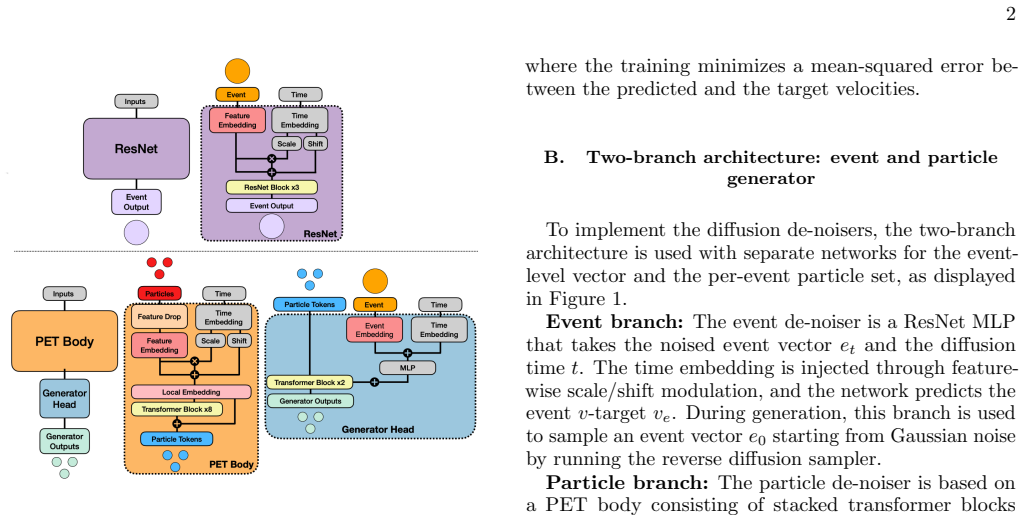
Score-driven diffusion process with Point-Edge Transformer architecture inside the two-stage training pipeline that first learns from lower-multiplicity events before fine-tuning on high-multiplicity ones.
If this is right
- Event and particle observables agree in one and two dimensions with reference samples.
- Flow harmonics reconstructed from generated particles match those from simulated data.
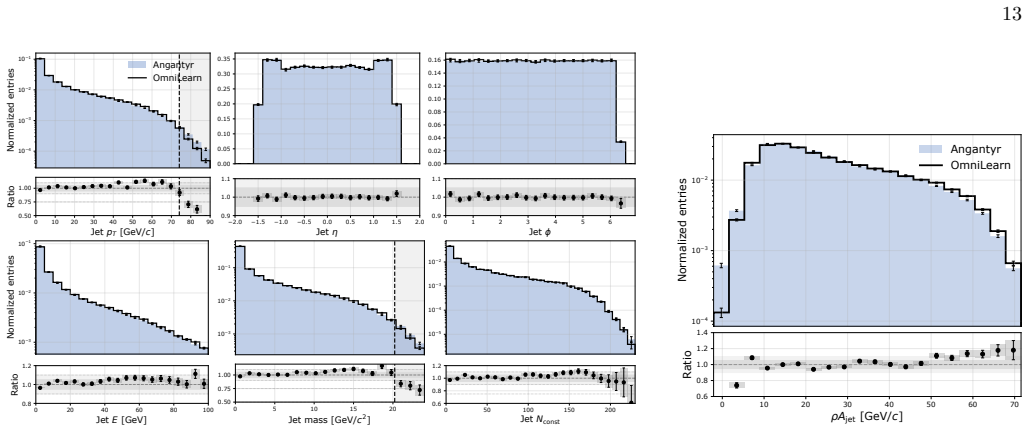
- End-to-end jet finding and substructure measurements with standard tools remain consistent.
- A downstream classifier cannot reliably separate generated events from reference ones.
- Local-scale, high-statistics generation of heavy-ion events becomes computationally feasible.
Where Pith is reading between the lines
- The same training strategy could be applied to other collision systems or energies without retraining from scratch.
- Generated events could be fed directly into detector simulation chains to study acceptance and efficiency effects at scale.
- The point-cloud output format allows straightforward combination with other machine-learning tools for anomaly detection or rare-process searches.
Load-bearing premise
The two-stage training transfers the required physics from simpler collisions to high-multiplicity ones without introducing biases missed by the closure tests.
What would settle it
Significant mismatch in the two-dimensional correlations between flow coefficients and jet substructure variables, or failure of a trained classifier to be fooled at the reported rate when distinguishing generated from reference events.
Figures




read the original abstract
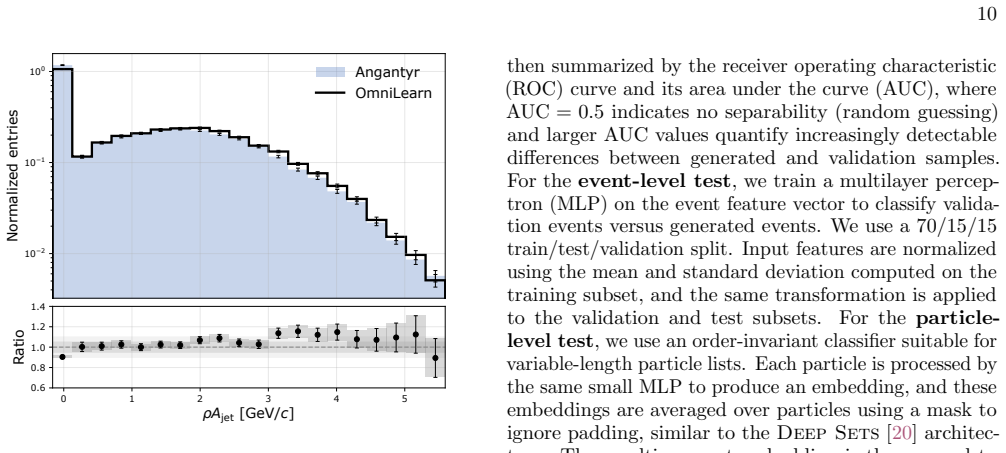
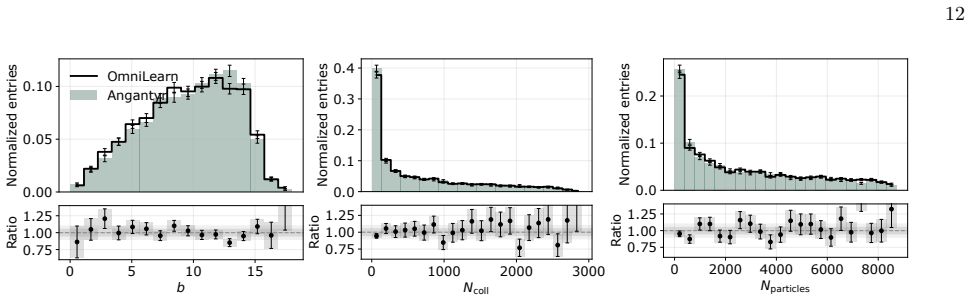
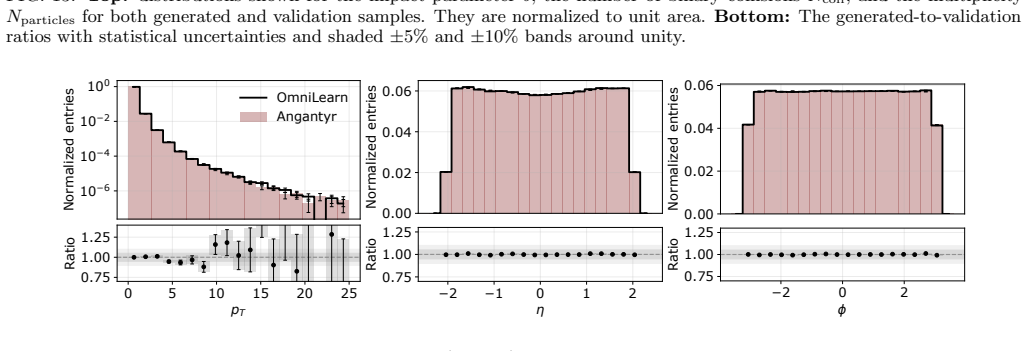
Heavy-ion collisions produce final states with thousands to tens of thousands of particles, making their simulation among the most computationally intensive tasks in high-energy nuclear physics. We present a fast, high-fidelity generative model for heavy-ion events based on a score-driven diffusion process and the Point-Edge Transformer architecture within the OmniLearn framework. A two-stage training strategy is performed: Stage-1 training on lower-multiplicity O-O collisions allowing the model to learn a stable event and particles representation, followed by fine-tuning on challenging high-multiplicity Pb-Pb collisions. We benchmark the generator with a broad set of closure checks, including agreement of event- and particle-level observables in one and two dimensions, flow consistency reconstructed from the generated particles, end-to-end jet finding with FastJet including key jet and substructure observables, and a classifier-based application to quantify the sample fidelity. The results are promising, showing that a compact generative model can produce realistic, high-multiplicity heavy-ion events, at a level that makes local-scale generation for heavy-ion collisions at high energies a practical goal.
Editorial analysis
A structured set of objections, weighed in public.
Referee Report
Summary. The manuscript presents a diffusion-based generative model for high-multiplicity heavy-ion collision events, employing a score-driven diffusion process and Point-Edge Transformer architecture. A two-stage training strategy is used: pre-training on lower-multiplicity O-O collisions to learn stable representations, followed by fine-tuning on high-multiplicity Pb-Pb collisions. Validation relies on closure tests covering 1D/2D event- and particle-level observables, flow consistency, FastJet jet finding and substructure, and a classifier-based fidelity metric, with the central claim that this compact model produces realistic events and makes local-scale generation practical.
Significance. If the results hold under more rigorous validation, the approach could provide a computationally efficient alternative to traditional Monte Carlo generators for heavy-ion physics, where event simulation with thousands of particles is highly resource-intensive. The use of independent physics observables (flow, jets) for evaluation, rather than direct optimization in the loss, supports potential physical fidelity and could enable broader studies at high energies.
major comments (2)
- [Abstract] Abstract and training strategy description: the two-stage procedure (O-O pre-training followed by Pb-Pb fine-tuning) is load-bearing for the claim of stable high-multiplicity generation, yet no ablation study (e.g., single-stage Pb-Pb training) or independent validation on held-out physics quantities is described. Closure tests confirm distribution matching but do not isolate whether pre-training transfers relevant physics without domain-shift artifacts or mode collapse.
- [Abstract] Abstract (closure tests paragraph): the benchmarks are described only qualitatively as 'promising' with no quantitative metrics, error bars, data-split details, or discussion of potential post-hoc selections. This weakens assessment of whether the model achieves the fidelity needed for the central claim of practical local-scale generation.
minor comments (1)
- [Abstract] The abstract uses 'promising' without defining quantitative success criteria or thresholds for the closure tests.
Simulated Author's Rebuttal
We thank the referee for the constructive and detailed comments. We address each major comment point by point below, indicating where revisions will be made to strengthen the manuscript.
read point-by-point responses
-
Referee: [Abstract] Abstract and training strategy description: the two-stage procedure (O-O pre-training followed by Pb-Pb fine-tuning) is load-bearing for the claim of stable high-multiplicity generation, yet no ablation study (e.g., single-stage Pb-Pb training) or independent validation on held-out physics quantities is described. Closure tests confirm distribution matching but do not isolate whether pre-training transfers relevant physics without domain-shift artifacts or mode collapse.
Authors: We agree that the two-stage training strategy is central to achieving stable high-multiplicity generation and that an explicit ablation would provide stronger isolation of its benefits. The current closure tests demonstrate that the full pipeline reproduces a broad range of independent physics observables (flow, jets, particle distributions) not directly optimized in the loss. To address the concern directly, we will add an ablation study in the revised manuscript comparing the two-stage model to a single-stage Pb-Pb-only model. This will include quantitative comparisons on key observables, stability metrics, and discussion of any domain-shift effects or mode-collapse indicators. We will also clarify how the multi-observable closure tests already serve as validation on held-out physics quantities. revision: yes
-
Referee: [Abstract] Abstract (closure tests paragraph): the benchmarks are described only qualitatively as 'promising' with no quantitative metrics, error bars, data-split details, or discussion of potential post-hoc selections. This weakens assessment of whether the model achieves the fidelity needed for the central claim of practical local-scale generation.
Authors: We acknowledge that the abstract summarizes the results qualitatively. The full manuscript contains quantitative details on all benchmarks, including agreement metrics for 1D/2D distributions, flow coefficients with uncertainties, FastJet jet and substructure observables, and classifier-based fidelity scores, along with descriptions of data splits and validation procedures. To improve the abstract, we will revise it to include key quantitative highlights (e.g., typical agreement levels within uncertainties) and a brief note on the validation methodology, including data partitioning to address potential post-hoc selection concerns. This will better substantiate the fidelity claim. revision: yes
Circularity Check
No circularity: generative model validated on independent observables
full rationale
The paper trains a diffusion model on simulated O-O and Pb-Pb events using a standard score-matching loss within the Point-Edge Transformer architecture. Validation proceeds via closure tests on event-level, particle-level, flow, and jet observables that are not part of the training objective. No derivation reduces a claimed result to a fitted parameter or self-citation by construction; the two-stage procedure is presented as an empirical training choice whose necessity is not asserted via uniqueness theorems or prior self-citations. The central claim remains an empirical demonstration of fidelity rather than a mathematical reduction to inputs.
Axiom & Free-Parameter Ledger
free parameters (2)
- diffusion process hyperparameters
- Point-Edge Transformer architecture parameters
axioms (2)
- domain assumption Score-driven diffusion can faithfully model the joint distribution of particle kinematics in heavy-ion events
- ad hoc to paper Two-stage training on O-O then Pb-Pb transfers relevant physics without domain shift artifacts
Reference graph
Works this paper leans on
-
[1]
Training is performed with the OmniLearn TensorFlow/Keras imple- mentation [11]
across 5 GPU nodes (20 GPUs total). Training is performed with the OmniLearn TensorFlow/Keras imple- mentation [11]. We use a per-rank (local) batch size of 64 and train for 75 epochs. Optimization uses the Lion optimizer [12] with parameters β1 = 0.95 and β2 = 0.99. The learning rate follows a cosine-decay schedule start- ing from 3 × 10⁻⁵ with a warmup ...
2000
-
[2]
Zurbano Fernandezet al.,High-Luminosity Large Hadron Collider (HL-LHC): Technical design report, Tech
I. Zurbano Fernandezet al.,High-Luminosity Large Hadron Collider (HL-LHC): Technical design report, Tech. Rep. (2020)
2020
-
[3]
V. Mikuni and B. Nachman, Physical Review D111, 10.1103/physrevd.111.054015 (2025)
-
[4]
Y. Song, J. Sohl-Dickstein, D. P. Kingma, A. Kumar, S. Ermon, and B. Poole, Score-based generative mod- eling through stochastic differential equations (2021), arXiv:2011.13456 [cs.LG]
work page internal anchor Pith review Pith/arXiv arXiv 2021
- [5]
-
[6]
Progressive Distillation for Fast Sampling of Diffusion Models
T. Salimans and J. Ho, Progressive distillation for fast sampling of diffusion models (2022), arXiv:2202.00512 [cs.LG]
work page internal anchor Pith review arXiv 2022
-
[7]
C. Bierlich, G. Gustafson, L. L¨ onnblad, and H. Shah, Journal of High Energy Physics2018, 10.1007/jhep10(2018)134 (2018)
-
[8]
A comprehensive guide to the physics and usage of PYTHIA 8.3
C. Bierlich, S. Chakraborty, N. Desai, L. Gellersen, I. He- lenius, P. Ilten, L. L¨ onnblad, S. Mrenna, S. Prestel, C. T. Preuss, T. Sj¨ ostrand, P. Skands, M. Utheim, and R. Ver- heyen, A comprehensive guide to the physics and usage of pythia 8.3 (2022), arXiv:2203.11601 [hep-ph]
work page internal anchor Pith review arXiv 2022
-
[9]
M. L. Miller, K. Reygers, S. J. Sanders, and P. Stein- berg, Annual Review of Nuclear and Particle Science57, 205–243 (2007)
2007
-
[10]
Perlmutter Architecture, https://docs.nersc.gov/ systems/perlmutter/architecture/
-
[11]
Horovod: fast and easy distributed deep learning in TensorFlow
A. Sergeev and M. D. Balso, Horovod: fast and easy distributed deep learning in tensorflow (2018), arXiv:1802.05799 [cs.LG]
work page Pith review arXiv 2018
-
[12]
M. Abadi, P. Barham, J. Chen, Z. Chen, A. Davis, J. Dean, M. Devin, S. Ghemawat, G. Irving, M. Isard, M. Kud- lur, J. Levenberg, R. Monga, S. Moore, D. G. Murray, B. Steiner, P. Tucker, V. Vasudevan, P. Warden, M. Wicke, Y. Yu, and X. Zheng, Tensorflow: A system for large-scale machine learning (2016), arXiv:1605.08695 [cs.DC]
- [13]
-
[14]
A. M. Poskanzer and S. A. Voloshin, Physical Review C 58, 1671–1678 (1998)
1998
-
[15]
Cacciari, G
M. Cacciari, G. P. Salam, and G. Soyez, Journal of High Energy Physics2008, 063–063 (2008)
2008
-
[16]
M. Cacciari, G. P. Salam, and G. Soyez, The European Physical Journal C72, 10.1140/epjc/s10052-012-1896-2 (2012)
-
[17]
A. J. Larkoski, D. Neill, and J. Thaler, Journal of High Energy Physics2014, 10.1007/jhep04(2014)017 (2014)
-
[18]
Dokshitzer, G
Y. Dokshitzer, G. Leder, S. Moretti, and B. Webber, Journal of High Energy Physics1997, 001–001 (1997)
1997
-
[19]
A. J. Larkoski, S. Marzani, G. Soyez, and J. Thaler, Journal of High Energy Physics2014, 10.1007/jhep05(2014)146 (2014)
-
[20]
A. J. Larkoski, J. Thaler, and W. J. Waalewijn, Journal of High Energy Physics2014, 10.1007/jhep11(2014)129 (2014)
-
[21]
M. Zaheer, S. Kottur, S. Ravanbakhsh, B. Poczos, R. Salakhutdinov, and A. Smola, Deep sets (2018), arXiv:1703.06114 [cs.LG]
work page Pith review arXiv 2018
-
[22]
Z.-W. Lin, C. M. Ko, B.-A. Li, B. Zhang, and S. Pal, Phys- ical Review C72, 10.1103/physrevc.72.064901 (2005)
-
[23]
com/matplo/OmniLearn
OmniLearn for heavy-ion collisions, https://github. com/matplo/OmniLearn
discussion (0)
Sign in with ORCID, Apple, or X to comment. Anyone can read and Pith papers without signing in.