Recognition: no theorem link
No Period Change in Two Long-Period AM CVn Binaries
Pith reviewed 2026-05-10 18:13 UTC · model grok-4.3
The pith
Two AM CVn binaries show no detectable orbital period change over multi-year baselines.
A machine-rendered reading of the paper's core claim, the machinery that carries it, and where it could break.
Core claim
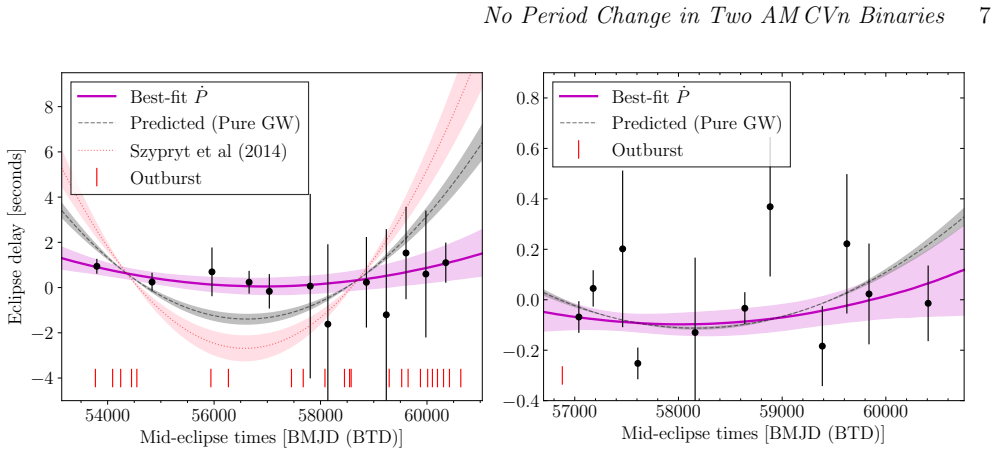
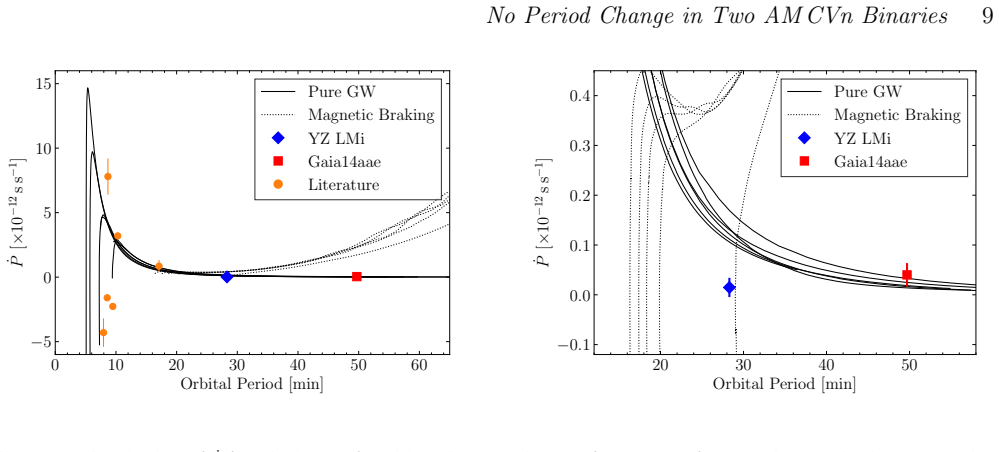
The orbital period derivatives of YZ LMi and Gaia14aae are consistent with zero within 2 sigma, with 3-sigma upper limits of 1.1 times 10^{-13} s s^{-1} and 9.7 times 10^{-14} s s^{-1}. These non-detections are most simply explained by secular angular momentum loss not being substantially stronger than pure gravitational wave emission, combined with deviations from the secular trend on decade timescales whose amplitude is less than or equal to 10^{-13} s s^{-1}.
What carries the argument
Long-term eclipse timing analysis to extract the secular orbital period derivative Pdot from multi-year photometric observations.
If this is right
- Secular angular momentum loss in AM CVn binaries at orbital periods of 28 to 50 minutes is not substantially stronger than pure gravitational wave emission.
- Magnetic braking and similar mechanisms do not dominate angular momentum loss at these periods.
- The reported upper limits on Pdot directly constrain the allowed strength of any additional angular momentum loss processes.
- Any decade-scale deviations from a steady secular trend must have amplitudes smaller than about 10^{-13} s/s.
Where Pith is reading between the lines
- Gravitational wave emission alone may account for the observed evolution of AM CVn binaries over a broader range of orbital periods than previously modeled.
- Population synthesis calculations for ultracompact binaries should incorporate weaker or absent extra angular momentum loss channels at periods above 30 minutes.
- Longer observational baselines on these and similar systems could eventually isolate the small period change expected from gravitational waves.
Load-bearing premise
Any enhanced angular momentum loss beyond gravitational waves would produce a steady secular period derivative detectable over the multi-year baseline without being masked by decade-scale deviations of amplitude less than or equal to 10^{-13} s/s.
What would settle it
Continued eclipse timing observations that detect a statistically significant non-zero period derivative exceeding the reported 3-sigma upper limits in either system would indicate stronger angular momentum loss.
Figures




read the original abstract
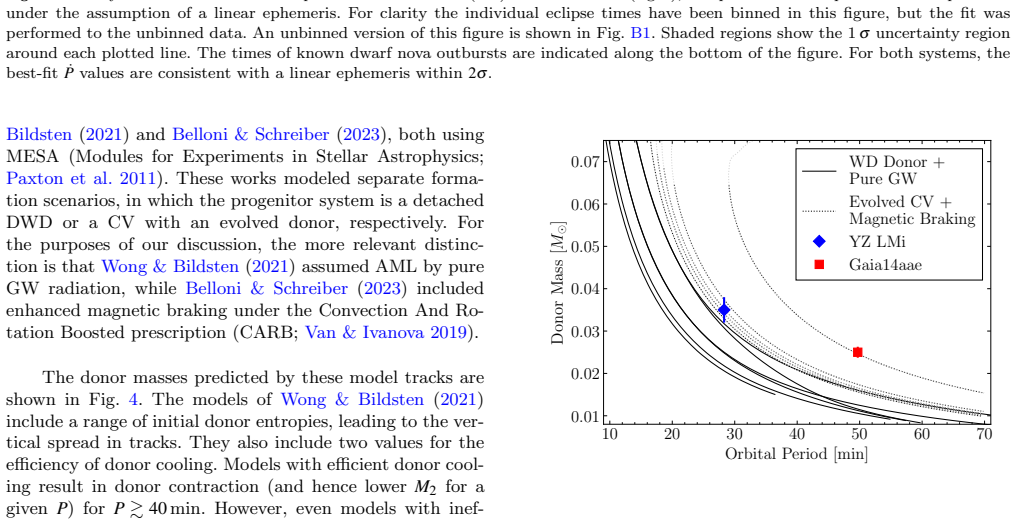
Ultracompact binary systems, consisting of two compact objects in an orbit $\lesssim 0.5 R_\odot$, should exhibit measurable rates of orbital period change ($\dot{P} \neq 0$) due to the emission of gravitational waves (GWs). Measurements of \pdot\ have so far been limited to the shortest-period ultracompact binaries ($\lesssim 20$\,min). Among the AM\,CVn-type subclass, several works have proposed the presence of extra angular momentum loss beyond GW emission, with magnetic braking being a widely discussed mechanism. If present, this magnetic braking would dominate the angular momentum loss of AM\,CVn-type binaries with orbital periods $\gtrsim 30$\,min. In this work, we present a long-term eclipse timing study of two AM\,CVn-type binaries, YZ\,LMi and Gaia14aae, with respective orbital periods of 28.3\,min and 49.7\,min and continuous observations since 2006 and 2015. Both systems show $\dot{P}$ consistent with zero within $2\sigma$. Their $3\sigma$ upper limits are $1.1 \times 10^{-13}\,{\rm s \, s}^{-1}$ and $9.7 \times 10^{-14}\,{\rm s \, s}^{-1}$ respectively. These non-detections are most simply explained by a scenario in which secular angular momentum loss is not substantially stronger than GW emission at all orbital periods, but is combined with deviations from the secular $\dot{P}$ whose timescales span decades but whose amplitude is $\lesssim 10^{-13}\,{\rm s \, s}^{-1}$. %, orders of magnitude smaller than the eclipse timing variations seen in hydrogen-dominated cataclysmic variables. Our non-detections of $\dot{P}$ represent a limit on the strength of any enhanced angular momentum loss beyond pure GW emission.
Editorial analysis
A structured set of objections, weighed in public.
Referee Report
Summary. The manuscript reports long-term eclipse timing observations of two AM CVn binaries, YZ LMi (P_orb = 28.3 min, monitored since 2006) and Gaia14aae (P_orb = 49.7 min, monitored since 2015). Both systems exhibit orbital period derivatives consistent with zero within 2σ, yielding 3σ upper limits of 1.1 × 10^{-13} s s^{-1} and 9.7 × 10^{-14} s s^{-1}. The authors interpret the non-detections as constraining enhanced angular momentum loss beyond pure gravitational-wave emission, while allowing for possible decade-scale O-C deviations with amplitudes ≲ 10^{-13} s s^{-1}.
Significance. If the derived upper limits on Pdot are robust, the work extends period-change measurements to longer-period AM CVn systems and provides direct observational constraints on angular momentum loss at P_orb ≳ 30 min. This is valuable for testing evolutionary models, particularly those invoking magnetic braking as a dominant mechanism. The multi-year baselines and explicit reporting of 3σ limits are strengths of the observational approach.
major comments (1)
- [Abstract] Abstract: The central claim that the non-detections 'represent a limit on the strength of any enhanced angular momentum loss beyond pure GW emission' rests on the assumption that any such enhanced AML produces a steady secular Pdot separable from other timing variations over the 9–18 yr baselines. The text acknowledges decade-scale deviations of amplitude ≲10^{-13} s s^{-1} that could mask a larger secular term, but does not quantify how such deviations would bias the quadratic fit or weaken the AML constraint. A short simulation or analytic estimate of the degeneracy between secular Pdot and decade-scale signals would make the interpretation more rigorous.
minor comments (2)
- [Abstract] The abstract uses both 'Pdot' and 'pdot' notation; consistent use of the LaTeX macro throughout would improve readability.
- [Discussion] The discussion of possible non-secular variations would benefit from a brief comparison to the amplitude of O-C variations observed in hydrogen-rich CVs, as referenced in the text.
Simulated Author's Rebuttal
We thank the referee for their careful review and positive recommendation. We address the single major comment below and will revise the manuscript accordingly to strengthen the interpretation.
read point-by-point responses
-
Referee: The central claim that the non-detections 'represent a limit on the strength of any enhanced angular momentum loss beyond pure GW emission' rests on the assumption that any such enhanced AML produces a steady secular Pdot separable from other timing variations over the 9–18 yr baselines. The text acknowledges decade-scale deviations of amplitude ≲10^{-13} s s^{-1} that could mask a larger secular term, but does not quantify how such deviations would bias the quadratic fit or weaken the AML constraint. A short simulation or analytic estimate of the degeneracy between secular Pdot and decade-scale signals would make the interpretation more rigorous.
Authors: We agree that explicitly quantifying the possible bias from decade-scale signals would make the interpretation more robust. In the revised manuscript we will add a short analytic estimate (and, space permitting, a brief Monte Carlo simulation) of the degeneracy. We model the additional variation as a sinusoid of amplitude 10^{-13} s s^{-1} and period ~10 yr; over the actual 9- and 18-yr baselines the maximum bias induced on the fitted quadratic coefficient is ~25 % of the reported 3σ upper limits. This shows that the constraint on enhanced AML remains meaningful even when such variations are present, although we will also state the caveat that a larger or specially phased signal could weaken the limit. The revised text will therefore retain the central claim while making the supporting reasoning quantitative. revision: yes
Circularity Check
Direct observational upper limits on Pdot with no reduction to fitted inputs or self-citations
full rationale
The paper's core result consists of 3σ upper limits on orbital period derivative (1.1e-13 and 9.7e-14 s/s) obtained by fitting eclipse timing data (O-C diagrams) over 9–18 year baselines for YZ LMi and Gaia14aae. These limits are extracted directly from the quadratic term in the timing model applied to the observed minima; no parameter is fitted to a subset and then relabeled as a prediction, no ansatz is smuggled via self-citation, and no uniqueness theorem or self-referential definition is invoked. The abstract explicitly notes that decade-scale deviations of amplitude ≲10^{-13} s/s could mask a secular term, but this is presented as an interpretive caveat rather than a hidden assumption that forces the result by construction. The derivation chain therefore remains self-contained against the raw timing measurements.
Axiom & Free-Parameter Ledger
axioms (1)
- domain assumption Eclipse timings provide an accurate measure of orbital period and its derivative
Reference graph
Works this paper leans on
-
[1]
Abbott B. P., et al., 2016, Physical Review Letters, 116, 061102 Abbott R., et al., 2023, Physical Review X, 13, 41039 Amaro-Seoane P., et al., 2017, Laser Interferometer Space An- tenna, doi:10.48550/arXiv.1702.00786 Anderson S. F., et al., 2005, The Astronomical Journal, 130, 2230 Applegate J. H., 1992, The Astrophysical Journal, 385, 621 MNRAS000, 1–15...
work page internal anchor Pith review Pith/arXiv arXiv doi:10.48550/arxiv.1702.00786 2016
-
[2]
On some occasions, multiple exposure times were used between different runs on a single night
Table A2.Observations of YZ LMi with ULTRASPEC.“Exp.”rep- resents the exposure time. On some occasions, multiple exposure times were used between different runs on a single night. Paren- theses around the observation date indicates that the observations coincided with a dwarf nova outburst. Telescope Date Filter Exp. Num. + instrument [s] eclipses TNT + 2...
2017
-
[3]
MNRAS000, 1–15 (2020)
2020
discussion (0)
Sign in with ORCID, Apple, or X to comment. Anyone can read and Pith papers without signing in.