Recognition: 2 theorem links
· Lean TheoremDesigNet: Learning to Draw Vector Graphics as Designers Do
Pith reviewed 2026-05-10 18:28 UTC · model grok-4.3
The pith
DesigNet generates SVG vector graphics with higher continuity and alignment accuracy by incorporating designer-style self-refinement modules.
A machine-rendered reading of the paper's core claim, the machinery that carries it, and where it could break.
Core claim
DesigNet is a hierarchical Transformer-VAE that operates directly on SVG sequences with a continuous command parameterization. Its main contributions are two differentiable modules: a continuity self-refinement module that predicts C0, G1, and C1 continuity for each curve point and enforces it by modifying Bezier control points, and an alignment self-refinement module with snapping capabilities for horizontal or vertical lines. DesigNet produces editable outlines and achieves competitive results against state-of-the-art methods, with notably higher accuracy in continuity and alignment.
What carries the argument
Two differentiable self-refinement modules inside the hierarchical Transformer-VAE: one that predicts and enforces continuity types at curve points by adjusting Bezier controls, and one that snaps lines to axes.
Load-bearing premise
The self-refinement modules can be trained to enforce continuity and alignment without degrading overall path quality or introducing artifacts that still need human fixes.
What would settle it
A test set evaluation in which DesigNet outputs show equal or lower scores on continuity and alignment metrics than baseline SVG generators that lack the refinement modules.
Figures


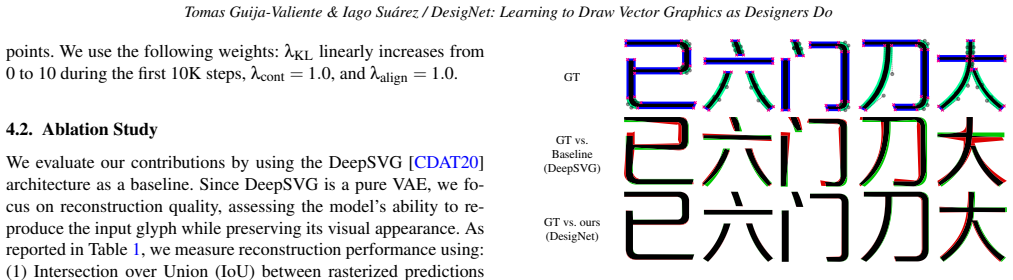
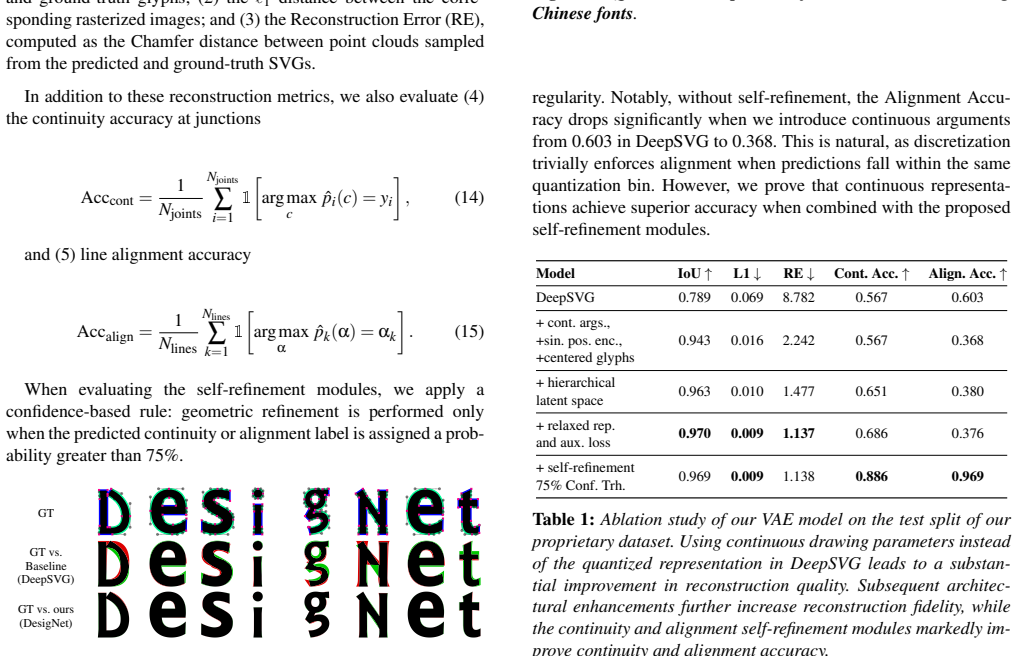


read the original abstract
AI-driven content generation has made remarkable progress in recent years. However, neural networks and human designers operate in fundamentally different ways, making collaboration between them challenging. We address this gap for Scalable Vector Graphics (SVG) by equipping neural networks with tools commonly used by designers, such as axis alignment and explicit continuity control at command junctions. We introduce DesigNet, a hierarchical Transformer-VAE that operates directly on SVG sequences with a continuous command parameterization. Our main contributions are two differentiable modules: a continuity self-refinement module that predicts $C^0$, $G^1$, and $C^1$ continuity for each curve point and enforces it by modifying B\'ezier control points, and an alignment self-refinement module with snapping capabilities for horizontal or vertical lines. DesigNet produces editable outlines and achieves competitive results against state-of-the-art methods, with notably higher accuracy in continuity and alignment. These properties ensure the outputs are easier to refine and integrate into professional design workflows. Source Code: https://github.com/TomasGuija/DesigNet.
Editorial analysis
A structured set of objections, weighed in public.
Referee Report
Summary. The paper introduces DesigNet, a hierarchical Transformer-VAE that generates SVG sequences using continuous command parameterization. It contributes two differentiable self-refinement modules: a continuity module that predicts C^0/G^1/C^1 labels at junctions and enforces them via Bezier control-point edits, and an alignment module that snaps paths to horizontal or vertical axes. The central claim is that the resulting editable outlines achieve competitive performance against SOTA methods while delivering notably higher continuity and alignment accuracy, making outputs more suitable for professional design workflows.
Significance. If the claims hold, the work is significant for closing the gap between neural SVG generation and human design practice by embedding standard designer operations (axis snapping, explicit continuity) as differentiable components inside the model. The end-to-end trainability of the refinement modules and the public source code are concrete strengths that support reproducibility and potential adoption.
major comments (2)
- [§3.2] §3.2 (continuity self-refinement module): the module predicts C^0/G^1/C^1 labels and then modifies control points; however, no ablation is reported that disables the module while keeping the Transformer-VAE and training objective fixed. Without this isolation, it is impossible to verify that the post-hoc edits do not systematically raise the primary reconstruction loss or introduce artifacts that the VAE cannot compensate for.
- [§4] §4 (experimental results): the headline claim of competitive overall quality plus superior continuity/alignment accuracy rests on the joint effect of the refinement modules, yet the paper provides no quantitative ablation that measures reconstruction metrics with and without the modules. This omission directly undermines confidence in the claim that the modules improve usability without degrading path quality.
minor comments (1)
- The abstract asserts 'notably higher accuracy' in continuity and alignment; the results section should include a dedicated table row or column that directly compares these metrics against all listed baselines, with error bars if multiple runs were performed.
Simulated Author's Rebuttal
We thank the referee for the constructive and detailed feedback. We address each major comment below and will incorporate additional ablation experiments in the revised manuscript to strengthen the validation of the self-refinement modules.
read point-by-point responses
-
Referee: [§3.2] §3.2 (continuity self-refinement module): the module predicts C^0/G^1/C^1 labels and then modifies control points; however, no ablation is reported that disables the module while keeping the Transformer-VAE and training objective fixed. Without this isolation, it is impossible to verify that the post-hoc edits do not systematically raise the primary reconstruction loss or introduce artifacts that the VAE cannot compensate for.
Authors: We appreciate the request for isolation. The continuity module is fully differentiable and integrated into the end-to-end training pipeline, with the reconstruction loss computed on the refined output; this ensures that the Transformer-VAE learns representations compatible with the edits and that any potential artifacts are directly penalized during optimization. While the original submission focused on the joint system rather than isolated ablations, we agree that the requested experiment would improve clarity. We will add a quantitative ablation disabling only the continuity module (keeping the VAE and objective fixed) and report its effect on reconstruction metrics in the revision. revision: yes
-
Referee: [§4] §4 (experimental results): the headline claim of competitive overall quality plus superior continuity/alignment accuracy rests on the joint effect of the refinement modules, yet the paper provides no quantitative ablation that measures reconstruction metrics with and without the modules. This omission directly undermines confidence in the claim that the modules improve usability without degrading path quality.
Authors: We acknowledge that the current results present the full model without separate ablations for the modules' impact on primary reconstruction metrics. Our experiments show competitive performance on standard quality measures alongside superior continuity and alignment, consistent with the modules being trained jointly. To directly address the concern, we will include in the revised version a set of ablations (model without alignment module, without continuity module, and without both) reporting reconstruction loss, path quality metrics, and continuity/alignment accuracy. This will quantify whether the modules enhance usability without degrading overall path quality. revision: yes
Circularity Check
No significant circularity; empirical training on external data with independent modules
full rationale
The paper defines a hierarchical Transformer-VAE architecture and two differentiable self-refinement modules (continuity prediction + Bezier adjustment; alignment snapping) that operate on SVG command sequences. These modules are specified independently of the final evaluation metrics and are trained end-to-end on external SVG datasets. No equation or claim reduces a prediction to a fitted input by construction, no self-citation chain supports a load-bearing uniqueness result, and no ansatz is smuggled via prior author work. The headline performance claims rest on standard supervised training and benchmark comparison rather than definitional equivalence.
Axiom & Free-Parameter Ledger
axioms (2)
- domain assumption SVG paths can be represented as continuous sequences of commands that a hierarchical Transformer-VAE can model effectively.
- domain assumption Enforcing C0/G1/C1 continuity and axis alignment via post-processing of Bezier points improves usability without harming other quality metrics.
Lean theorems connected to this paper
-
IndisputableMonolith/Foundation/Cost/FunctionalEquation.leanwashburn_uniqueness_aczel unclear?
unclearRelation between the paper passage and the cited Recognition theorem.
We introduce differentiable continuity and alignment self-refinement modules that expose geometric design decisions to the network via deterministic geometric operators... straight-through estimators
-
IndisputableMonolith/Foundation/RealityFromDistinction.leanreality_from_one_distinction unclear?
unclearRelation between the paper passage and the cited Recognition theorem.
hierarchical Transformer-VAE... partitioned latent space... continuous command parameterization
What do these tags mean?
- matches
- The paper's claim is directly supported by a theorem in the formal canon.
- supports
- The theorem supports part of the paper's argument, but the paper may add assumptions or extra steps.
- extends
- The paper goes beyond the formal theorem; the theorem is a base layer rather than the whole result.
- uses
- The paper appears to rely on the theorem as machinery.
- contradicts
- The paper's claim conflicts with a theorem or certificate in the canon.
- unclear
- Pith found a possible connection, but the passage is too broad, indirect, or ambiguous to say the theorem truly supports the claim.
Reference graph
Works this paper leans on
-
[1]
Estimating or Propagating Gradients Through Stochastic Neurons for Conditional Computation
[Ahr12] AHRENST.: A closer look at font rendering.Smashing Magazine (2012). 1 [BLC13] BENGIOY., LÉONARDN., COURVILLEA.: Estimating or propagating gradients through stochastic neurons for conditional com- putation.arXiv preprint arXiv:1308.3432(2013). 4, 5 [CDAT20] CARLIERA., DANELLJANM., ALAHIA., TIMOFTER.: DeepSVG: A hierarchical generative network for v...
work page internal anchor Pith review arXiv 2012
-
[2]
InECCV(2024), Springer, pp
8 [CSGB24] CHANDRANP., SERIFIA., GROSSM., BÄCHERM.: Spline- Based Transformers. InECCV(2024), Springer, pp. 1–17. 3 [CWD∗18] CRESWELLA., WHITET., DUMOULINV., ARULKU- MARANK., SENGUPTAB., BHARATHA. A.: Generative adversarial networks: An overview.IEEE signal processing magazine 35, 1 (2018), 53–65. 2 [CWEL23] CAOD., WANGZ., ECHEVARRIAJ., LIUY.: Svgformer: ...
2024
-
[3]
From top to bottom: ground truth (GT), DeepVecFont- v2, and our method after refinement
Tomas Guija-Valiente & Iago Suárez / DesigNet: Learning to Draw Vector Graphics as Designers Do Encoding glyphs Decoding glyphs GT DeepVecFont-v2 [WWY∗23] Ours Figure 8:Reconstruction quality across encoding (left) and decoding (right) glyph sets. From top to bottom: ground truth (GT), DeepVecFont- v2, and our method after refinement. [GPAM∗14] GOODFELLOW...
2014
-
[4]
InNeurIPS(2020), vol
2 [HJA20] HOJ., JAINA., ABBEELP.: Denoising diffusion probabilistic models. InNeurIPS(2020), vol. 33, pp. 6840–6851. 2 [HP20] HANOVERPETTITR.: Peter Bil’ak.Communication Design: Design Pioneers, 20 (2020). 1 [JXA23] JAINA., XIEA., ABBEELP.: Vectorfusion: Text-to-svg by abstracting pixel-based diffusion models. InCVPR(2023), pp. 1911–
2020
-
[5]
P., WELLINGM.: Auto-encoding variational {Bayes}
3 [KW14] KINGMAD. P., WELLINGM.: Auto-encoding variational {Bayes}. InICLR(2014). 2, 6 [KW∗19] KINGMAD. P., WELLINGM.,ET AL.: An introduction to variational autoencoders.Foundations and Trends® in Machine Learn- ing 12, 4 (2019), 307–392. 2 [KYR11] KRISHNAPURAMB., YUS., RAOR. B.:Cost-sensitive ma- chine learning. CRC Press,
2014
-
[6]
InICLR(2019)
6 [LH19] LOSHCHILOVI., HUTTERF.: Decoupled weight decay regular- ization. InICLR(2019). 6 [LHES19] LOPESR. G., HAD., ECKD., SHLENSJ.: A learned repre- sentation for scalable vector graphics. InICCV(2019), pp. 7930–7939. 1, 2 [LLGRK20] LIT.-M., LUKÁ ˇCM., GHARBIM., RAGAN-KELLEYJ.: Differentiable Vector Graphics Rasterization for Editing and Learning. ACM T...
2019
-
[7]
J.: Im2vec: Synthesizing vector graphics without vector supervision
1 [RGLM21] REDDYP., GHARBIM., LUKACM., MITRAN. J.: Im2vec: Synthesizing vector graphics without vector supervision. InCVPR (2021), pp. 7342–7351. 2 [RPA∗25] RODRIGUEZJ. A., PURIA., AGARWALS., LARADJII. H., RODRIGUEZP., RAJESWARS., VAZQUEZD., PALC., PEDERSOLIM.: Starvector: Generating scalable vector graphics code from images and text. InCVPR(2025), pp. 16...
2021
-
[8]
P., KUMAR A., ERMONS., POOLEB.: Score-Based Generative Modeling through Stochastic Differential Equations
2 [SSDK∗21] SONGY., SOHL-DICKSTEINJ., KINGMAD. P., KUMAR A., ERMONS., POOLEB.: Score-Based Generative Modeling through Stochastic Differential Equations. InICLR(2021). 2 [TLA∗24] THAMIZHARASANV., LIUD., AGARWALS., FISHERM., GHARBIM., WANGO., JACOBSONA., KALOGERAKISE.: Vecfusion: Vector font generation with diffusion. InCVPR(2024), pp. 7943–7952. 2 [TLF∗24...
2021
-
[9]
2 [WWY∗23] WANGY., WANGY., YUL., ZHUY., LIANZ.: Deepvecfont-v2: Exploiting transformers to synthesize vector fonts with higher quality
2 [WL21] WANGY., LIANZ.: Deepvecfont: synthesizing high-quality vector fonts via dual-modality learning.ACM TOG 40, 6 (2021), 1–15. 2 [WWY∗23] WANGY., WANGY., YUL., ZHUY., LIANZ.: Deepvecfont-v2: Exploiting transformers to synthesize vector fonts with higher quality. InCVPR(2023), pp. 18320–18328. 1, 2, 3, 6, 8, 9, 10 [XYW∗25] XINGX., YUQ., WANGC., ZHOUH....
2021
discussion (0)
Sign in with ORCID, Apple, or X to comment. Anyone can read and Pith papers without signing in.