pith. machine review for the scientific record. sign in

arxiv: 2604.06504 · v1 · submitted 2026-04-07 · 🌌 astro-ph.GA

Recognition: 2 theorem links

· Lean Theorem

A Close Quasar Pair in a Massive Galaxy Merger at z=5.7

Authors on Pith no claims yet

Pith reviewed 2026-05-10 18:25 UTC · model grok-4.3

classification 🌌 astro-ph.GA
keywords quasar pairsgalaxy mergershigh-redshift quasarsALMA observationssupermassive black holesactive galactic nucleigravitational wavestidal features
0
0 comments X

The pith

Confirmation of a quasar pair at z=5.7 sets a lower limit on the high-redshift pair fraction above 1.2 percent.

A machine-rendered reading of the paper's core claim, the machinery that carries it, and where it could break.

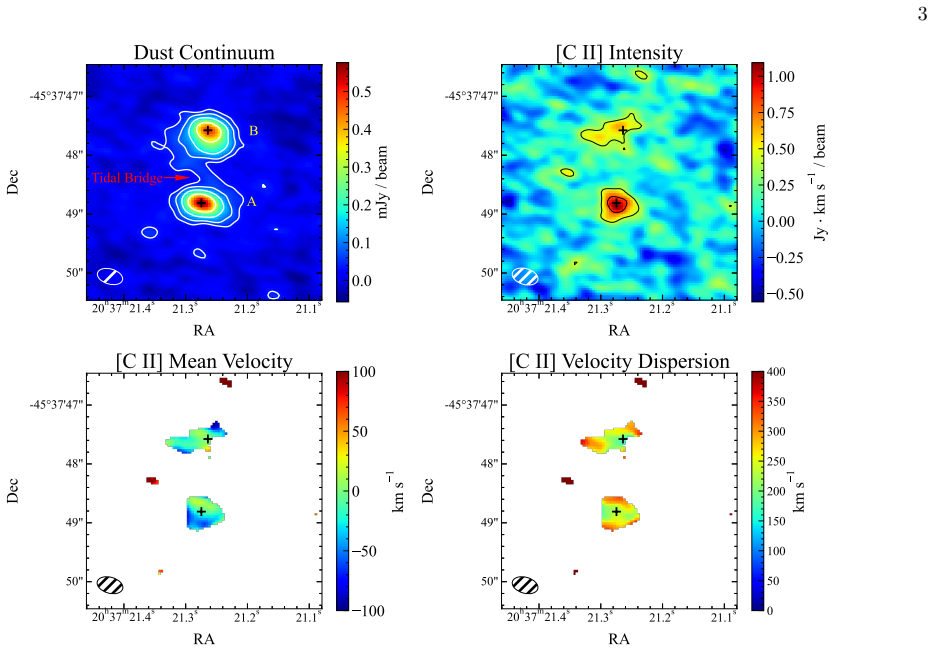
The paper reports the discovery and confirmation of a close quasar pair at redshift 5.7 within a massive galaxy merger. Using high-resolution ALMA observations, the authors detect tidal features in the far-infrared continuum and CII line emission from the host galaxies, which rules out the possibility that this is a single quasar lensed into two images. The confirmation raises the lower limit on the fraction of quasar pairs at redshifts between 5.5 and 6 to over 1.2 percent, a value notably higher than the fraction found at redshifts below 4. This elevated rate points to more vigorous merger activity fueling black hole growth in the early universe.

Core claim

The authors confirm J2037-4537 as a close quasar pair at z=5.7, with ALMA observations revealing tidal disturbed features in the far-infrared continuum and CII line emission that establish two distinct massive star-forming host galaxies rather than a doubly-imaged lensed quasar. This places a lower limit on the quasar pair fraction F_pair >1.2% at 5.5<z<6, which is much higher than the fraction at z≲4. The system is expected to form a gravitationally-bound supermassive black hole binary within ≲2 Gyr and likely contributes to the high gravitational-wave background reported by pulsar timing array experiments.

What carries the argument

High-resolution ALMA imaging of the far-infrared continuum and CII line emission that reveals tidal disturbed features in the quasar host galaxies.

If this is right

  • The quasar pair fraction at 5.5<z<6 exceeds 1.2 percent and is much higher than at z≲4.
  • The two supermassive black holes will form a gravitationally-bound binary within ≲2 Gyr.
  • The elevated pair fraction at z>5.5 contributes to the high gravitational-wave background from pulsar timing array experiments.
  • Close quasar pairs arise as products of galaxy mergers in which both black holes are actively accreting.

Where Pith is reading between the lines

These are editorial extensions of the paper, not claims the author makes directly.

  • Galaxy mergers were likely more efficient at simultaneously activating both supermassive black holes in the early universe than at later times.
  • Additional high-redshift pair detections could refine models of black hole growth through mergers.
  • The link to gravitational waves suggests these systems influence the stochastic background detectable by future observatories.

Load-bearing premise

The tidal disturbed features observed in the far-infrared continuum and CII line emission definitively indicate a galaxy merger rather than projection effects or other phenomena that could mimic them in a lensed system.

What would settle it

Higher-resolution or multi-wavelength observations showing no tidal features or demonstrating that the two quasars are images of a single object with identical properties and no separate hosts would falsify the pair interpretation.

Figures
Figures reproduced from arXiv: 2604.06504 by Anna-Christina Eilers, Feige Wang, Jinyi Yang, Minghao Yue, Robert A. Simcoe, Xiaohui Fan.

Figure 1
Figure 1. Figure 1: The ALMA observation of J2037–4537. The images are cleaned with natural weighting. The cleaned beam has sizes of 0. ′′44 × 0. ′′26, demonstrated by the hatched ellipses. The black crosses mark the optical positions of the quasars as measured by previous HST imaging M. Yue et al. (2021). Upper Left: The FIR continuum. The white lines mark 2σ, 4σ, 8σ, and 16σ contours. We denote the southern object as Quasar… view at source ↗
Figure 2
Figure 2. Figure 2: The extracted [C ii] spectra of the two quasars (step plots) and the best-fit Gaussian profile for the lines (solid lines). The two quasars have [C ii] redshifts of z[C ii] = 5.69 and do not show a significant line-of-sight veloc￾ity difference. We note that the [C ii] lines fall on the edge of the spectral windows, and the continuum with frequency lower than 283.50 GHz is not covered [PITH_FULL_IMAGE:fig… view at source ↗
Figure 3
Figure 3. Figure 3: The best-fit lensing model for the continuum and [C ii] line emission. From left to right: the observed dirty image, the modeled dirty image, and the source plane emission. The red lines mark the caustics of the best-fit lensing models. The best-fit lensing configuration for the continuum emission and the [C ii] line differ significantly, essentially ruling out the strong lensing hypothesis for J2037–4537.… view at source ↗
Figure 4
Figure 4. Figure 4: The redshift evolution of quasar pair fraction (Fpair), defined as the number of quasar pairs with separation d < 30 kpc divided by the total number of quasars. At z ≲ 3.5, the quasar pair fraction is Fpair ∼ (0.5 − 2) × 10−3 with little redshift evolution. In comparison, J2037–4537 itself indicates Fpair > 1.2% at 5.5 < z < 6. pair fraction at z ≳ 5.5 indicates that the merger-driven quasar triggering mec… view at source ↗
Figure 5
Figure 5. Figure 5: The [C ii] spectra of example pixels and their best-fit Gaussian emission line model (Section 2.2). For each pixel, we use a Gaussian profile to fit the [C ii] line flux, velocity, and velocity dispersion ( [PITH_FULL_IMAGE:figures/full_fig_p009_5.png] view at source ↗
read the original abstract

Close quasar pairs are rare products of galaxy mergers in which both supermassive black holes (SMBHs) are actively accreting, offering strong constraints on merger-driven active galactic nuclei (AGN) evolution. Identifying close quasar pairs at $z\gtrsim4$ is challenging due to the declining quasar number density in the early Universe. Here we report the confirmation of a close quasar pair at $z=5.7$, J2037--4537, utilizing high-resolution Atacama Large Millimeter/submillimeter Array (ALMA) observations. The quasar host galaxies exhibit tidal disturbed features in both the far-infrared continuum emission and the {\cii} line emission, ruling out the doubly-imaged lensed quasar scenario. The two quasar hosts are massive $(M_\text{dyn}\gtrsim10^{10}M_\odot)$ and star-forming (SFR $\gtrsim500 M_\odot~ \mathrm{yr^{-1}}$). The confirmation of J2037--4537 puts a lower limit on the quasar pair fraction at $5.5<z<6$, $F_\text{pair}>1.2\%$, which is much higher than the quasar pair fraction at $z\lesssim4$. J2037--4537 is expected to form a gravitationally-bound SMBH binary within $\lesssim2$ Gyr. The elevated quasar pair fraction at $z>5.5$, as indicated by J2037--4537, likely contributes to the high gravitational-wave background reported by recent Pulsar Timing Array experiments.

Editorial analysis

A structured set of objections, weighed in public.

Desk editor's note, referee report, simulated authors' rebuttal, and a circularity audit. Tearing a paper down is the easy half of reading it; the pith above is the substance, this is the friction.

Referee Report

1 major / 2 minor

Summary. The paper reports the confirmation of a close quasar pair, J2037--4537, at z=5.7 using high-resolution ALMA observations. The quasar host galaxies show tidal disturbed features in both the far-infrared continuum and [CII] line emission, which the authors interpret as ruling out a doubly-imaged lensed quasar. The hosts are massive (M_dyn ≳ 10^{10} M_⊙) and star-forming (SFR ≳ 500 M_⊙ yr^{-1}). This single detection is used to set a lower limit on the quasar pair fraction at 5.5 < z < 6 of F_pair > 1.2%, higher than at z ≲ 4, with implications for SMBH binary formation within ≲ 2 Gyr and contribution to the PTA gravitational-wave background.

Significance. If the physical-merger interpretation is robust, the result would be significant for constraining merger-driven AGN activity and SMBH growth at the highest redshifts. It supplies a rare z > 5.5 anchor point for the quasar pair fraction and offers a plausible link to the stochastic GW background reported by pulsar timing arrays. The ALMA morphological data provide a practical template for distinguishing close pairs from lenses in future high-z surveys.

major comments (1)
  1. [ALMA results and lensing-exclusion discussion] The central claim that tidal features in the FIR continuum and [CII] emission definitively exclude the doubly-imaged lensed-quasar scenario rests on qualitative morphology alone. No quantitative lens modeling (e.g., comparison of observed image separation, flux ratio, and extended emission against a singular isothermal ellipsoid or NFW lens at plausible z_lens) is presented, leaving open the possibility that differential magnification or line-of-sight projection could produce apparent tidal tails and velocity gradients. This step is load-bearing for the reported F_pair > 1.2% limit.
minor comments (2)
  1. [Abstract] The abstract states the ALMA data show tidal features but supplies no quantitative information on beam size, rms noise, or the precise criteria used to identify and confirm the disturbed morphology.
  2. [Host-galaxy properties paragraph] The dynamical-mass and SFR values are quoted without reference to the exact [CII] linewidth, spatial extent, or conversion assumptions employed in their derivation.

Simulated Author's Rebuttal

1 responses · 0 unresolved

We thank the referee for their constructive and detailed review. The major comment identifies a valid point regarding the robustness of our lensing exclusion, which we address directly below with a targeted revision.

read point-by-point responses
  1. Referee: The central claim that tidal features in the FIR continuum and [CII] emission definitively exclude the doubly-imaged lensed-quasar scenario rests on qualitative morphology alone. No quantitative lens modeling (e.g., comparison of observed image separation, flux ratio, and extended emission against a singular isothermal ellipsoid or NFW lens at plausible z_lens) is presented, leaving open the possibility that differential magnification or line-of-sight projection could produce apparent tidal tails and velocity gradients. This step is load-bearing for the reported F_pair > 1.2% limit.

    Authors: We agree that the exclusion of lensing would be strengthened by quantitative modeling. Our current argument rests on the extended, asymmetric tidal structures and kinematic gradients seen in both the continuum and [CII] maps, which are difficult to reproduce via lensing of a single source. To address the concern, we have added a dedicated paragraph in the revised Section 3.2 that compares the observed ~1-arcsec separation, flux ratio, and extended emission morphology against the expectations for strong lensing by a foreground galaxy at plausible z_lens. We note that the velocity field shows coherent gradients inconsistent with the multiple images of a single rotating disk under differential magnification. While we have not performed full SIE or NFW lens modeling (which would require additional assumptions about the lens mass distribution and is beyond the scope of this discovery paper), the morphological mismatch already makes lensing highly improbable. This revision clarifies the reasoning without altering the reported lower limit on the pair fraction. revision: partial

Circularity Check

0 steps flagged

No circularity: purely observational confirmation with no derivations or self-referential fits

full rationale

The paper reports an ALMA-based discovery and confirmation of a quasar pair at z=5.7. The key step is morphological identification of tidal features in FIR continuum and [CII] emission to exclude a lensed single-quasar interpretation, followed by a direct statistical lower bound on pair fraction (F_pair > 1.2%) from the detection itself. No equations, parameter fitting, predictions derived from fits, or load-bearing self-citations appear in the provided text. The result is an empirical finding whose validity rests on data interpretation rather than any reduction to its own inputs by construction. This matches the default expectation for observational papers.

Axiom & Free-Parameter Ledger

0 free parameters · 2 axioms · 0 invented entities

The claim rests on standard astrophysical conversions for dynamical mass and star-formation rate plus the assumption that tidal morphology excludes lensing; no new free parameters or invented entities are introduced.

axioms (2)
  • domain assumption Standard dynamical mass estimation from line width and spatial size
    Invoked to obtain M_dyn ≳ 10^10 M_⊙
  • domain assumption Standard far-infrared to SFR conversion calibration
    Invoked to obtain SFR ≳ 500 M_⊙ yr^{-1}

pith-pipeline@v0.9.0 · 5618 in / 1420 out tokens · 161054 ms · 2026-05-10T18:25:54.659704+00:00 · methodology

discussion (0)

Sign in with ORCID, Apple, or X to comment. Anyone can read and Pith papers without signing in.

Lean theorems connected to this paper

Citations machine-checked in the Pith Canon. Every link opens the source theorem in the public Lean library.

What do these tags mean?
matches
The paper's claim is directly supported by a theorem in the formal canon.
supports
The theorem supports part of the paper's argument, but the paper may add assumptions or extra steps.
extends
The paper goes beyond the formal theorem; the theorem is a base layer rather than the whole result.
uses
The paper appears to rely on the theorem as machinery.
contradicts
The paper's claim conflicts with a theorem or certificate in the canon.
unclear
Pith found a possible connection, but the passage is too broad, indirect, or ambiguous to say the theorem truly supports the claim.

Reference graph

Works this paper leans on

41 extracted references · 40 canonical work pages · 2 internal anchors

  1. [1]

    M., et al

    Agazie, G., Anumarlapudi, A., Archibald, A. M., et al. 2023, ApJL, 952, L37, doi: 10.3847/2041-8213/ace18b

  2. [2]

    and Arimoto, N

    Aihara, H., Arimoto, N., Armstrong, R., et al. 2018, PASJ, 70, S4, doi: 10.1093/pasj/psx066 Astropy Collaboration, Robitaille, T. P., Tollerud, E. J., et al. 2013, A&A, 558, A33, doi: 10.1051/0004-6361/201322068 Astropy Collaboration, Price-Whelan, A. M., Sip˝ ocz, B. M., et al. 2018, AJ, 156, 123, doi: 10.3847/1538-3881/aabc4f Astropy Collaboration, Pric...

  3. [3]

    J., et al

    Beelen, A., Cox, P., Benford, D. J., et al. 2006, ApJ, 642, 694, doi: 10.1086/500636

  4. [4]

    R., Dotti, M., Volonteri, M., et al

    Capelo, P. R., Dotti, M., Volonteri, M., et al. 2017, MNRAS, 469, 4437, doi: 10.1093/mnras/stx1067

  5. [5]

    R., Volonteri, M., Dotti, M., et al

    Capelo, P. R., Volonteri, M., Dotti, M., et al. 2015, MNRAS, 447, 2123, doi: 10.1093/mnras/stu2500 CASA Team, Bean, B., Bhatnagar, S., et al. 2022, PASP, 134, 114501, doi: 10.1088/1538-3873/ac9642

  6. [6]

    1943, ApJ, 97, 255, doi: 10.1086/144517

    Chandrasekhar, S. 1943, ApJ, 97, 255, doi: 10.1086/144517

  7. [7]

    2025, ApJL, 991, L19, doi: 10.3847/2041-8213/adefe2 6 https://almascience.nrao.edu/aq/

    Chen, N., Di Matteo, T., Zhou, Y., et al. 2025, ApJL, 991, L19, doi: 10.3847/2041-8213/adefe2 6 https://almascience.nrao.edu/aq/

  8. [8]

    Chen, S., Sesana, A., & Conselice, C. J. 2019, MNRAS, 488, 401, doi: 10.1093/mnras/stz1722

  9. [9]

    C., Liu, X., et al

    Chen, Y.-C., Gross, A. C., Liu, X., et al. 2025, ApJ, 988, 126, doi: 10.3847/1538-4357/ade23b

  10. [10]

    2022, ApJ, 925, 162, doi: 10.3847/1538-4357/ac401b Cid Fernandes, R., Stasi´ nska, G., Mateus, A., & Vale Asari, N

    Chen, Y.-C., Hwang, H.-C., Shen, Y., et al. 2022, ApJ, 925, 162, doi: 10.3847/1538-4357/ac401b

  11. [11]

    2023, Nature, 616, 45, doi: 10.1038/s41586-023-05766-6

    Chen, Y.-C., Liu, X., Foord, A., et al. 2023, Nature, 616, 45, doi: 10.1038/s41586-023-05766-6

  12. [12]

    2026, A&A, 706, A285, doi: 10.1051/0004-6361/202556812 De Rosa, A., Vignali, C., Bogdanovi´ c, T., et al

    Costa, M., Decarli, R., Pozzi, F., et al. 2026, A&A, 706, A285, doi: 10.1051/0004-6361/202556812 De Rosa, A., Vignali, C., Bogdanovi´ c, T., et al. 2019, New Astronomy Review, 86, 101525, doi: 10.1016/j.newar.2020.101525

  13. [13]

    P., et al

    Decarli, R., Walter, F., Venemans, B. P., et al. 2018, ApJ, 854, 97, doi: 10.3847/1538-4357/aaa5aa DES Collaboration, Abbott, T. M. C., Adamow, M., et al. 2021, arXiv e-prints, arXiv:2101.05765. https://arxiv.org/abs/2101.05765 Di Matteo, T., Springel, V., & Hernquist, L. 2005, Nature, 433, 604, doi: 10.1038/nature03335 EPTA Collaboration, InPTA Collabora...

  14. [14]

    B., Stern, H

    Gelman, A., Carlin, J. B., Stern, H. S., et al. 2013, Bayesian Data Analysis, 3rd edn., Chapman & Hall/CRC Texts in Statistical Science Series (Boca Raton, Florida: CRC). https://stat.columbia.edu/ ∼gelman/book/

  15. [15]

    A Cosmological Framework for the Co-Evolution of Quasars, Supermassive Black Holes, and Elliptical Galaxies: I. Galaxy Mergers & Quasar Activity

    Hopkins, P. F., Hernquist, L., Cox, T. J., & Kereˇ s, D. 2008, ApJS, 175, 356, doi: 10.1086/524362

  16. [16]

    2022, MNRAS, 509, 3488, doi:10.1093/mnras/stab3239 28 LILA Black Hole Binary Detection Landscape&Science CasesNguyenet al.2026

    Izquierdo-Villalba, D., Sesana, A., Bonoli, S., & Colpi, M. 2022, MNRAS, 509, 3488, doi: 10.1093/mnras/stab3239

  17. [17]

    2019, PASJ, 71, 111, doi: 10.1093/pasj/psz096

    Izumi, T., Onoue, M., Matsuoka, Y., et al. 2019, PASJ, 71, 111, doi: 10.1093/pasj/psz096

  18. [18]

    2024, ApJ, 972, 116, doi: 10.3847/1538-4357/ad57c6

    Izumi, T., Matsuoka, Y., Onoue, M., et al. 2024, ApJ, 972, 116, doi: 10.3847/1538-4357/ad57c6

  19. [19]

    2008, ApJ, 675, 1095, doi: 10.1086/526412

    Li, C. 2008, ApJ, 675, 1095, doi: 10.1086/526412

  20. [20]

    and Evans, Neal J

    Kennicutt, R. C., & Evans, N. J. 2012, ARA&A, 50, 531, doi: 10.1146/annurev-astro-081811-125610

  21. [21]

    Kulkarni, G., Worseck, G., & Hennawi, J. F. 2019, MNRAS, 488, 1035, doi: 10.1093/mnras/stz1493

  22. [22]

    W., McMahon, R., et al

    Lemon, C., Auger, M. W., McMahon, R., et al. 2020, MNRAS, 494, 3491, doi: 10.1093/mnras/staa652

  23. [23]

    2022, arXiv e-prints, arXiv:2206.07714

    Lemon, C., Anguita, T., Auger, M., et al. 2022, arXiv e-prints, arXiv:2206.07714. https://arxiv.org/abs/2206.07714

  24. [24]

    J., Duan, Q., et al

    Li, Q., Conselice, C. J., Duan, Q., et al. 2025, arXiv e-prints, arXiv:2508.09749, doi: 10.48550/arXiv.2508.09749

  25. [25]

    W., Higley, A

    Lyke, B. W., Higley, A. N., McLane, J. N., et al. 2020, ApJS, 250, 8, doi: 10.3847/1538-4365/aba623

  26. [26]

    A., Kashikawa, N., et al

    Matsuoka, Y., Strauss, M. A., Kashikawa, N., et al. 2018, ApJ, 869, 150, doi: 10.3847/1538-4357/aaee7a

  27. [27]

    2024, ApJL, 965, L4, doi: 10.3847/2041-8213/ad35c7

    Matsuoka, Y., Izumi, T., Onoue, M., et al. 2024, ApJL, 965, L4, doi: 10.3847/2041-8213/ad35c7

  28. [28]

    2025, A&A, 694, A171, doi: 10.1051/0004-6361/202451290

    Mazzucchelli, C., Decarli, R., Belladitta, S., et al. 2025, A&A, 694, A171, doi: 10.1051/0004-6361/202451290

  29. [29]

    W., & Dye, S

    Nightingale, J. W., & Dye, S. 2015, MNRAS, 452, 2940, doi: 10.1093/mnras/stv1455

  30. [30]

    W., Dye, S., & Massey, R

    Nightingale, J. W., Dye, S., & Massey, R. J. 2018, MNRAS, 478, 4738, doi: 10.1093/mnras/sty1264

  31. [31]

    W., Hayes, R

    Nightingale, J. W., Hayes, R. G., Kelly, A., et al. 2021, J. Open Source Softw., 6, 2825, doi: 10.21105/joss.02825 Puerto-S´ anchez, C., Habouzit, M., Volonteri, M., et al. 2025, MNRAS, 536, 3016, doi: 10.1093/mnras/stae2763

  32. [32]

    F., Faucher-Gigu` ere, C.-A., et al

    Shen, X., Hopkins, P. F., Faucher-Gigu` ere, C.-A., et al. 2020, MNRAS, 495, 3252, doi: 10.1093/mnras/staa1381

  33. [33]

    2021, Nature Astronomy, 5, 569, doi: 10.1038/s41550-021-01323-1

    Shen, Y., Chen, Y.-C., Hwang, H.-C., et al. 2021, Nature Astronomy, 5, 569, doi: 10.1038/s41550-021-01323-1

  34. [34]

    2023, ApJ, 943, 38, doi: 10.3847/1538-4357/aca662

    Shen, Y., Hwang, H.-C., Oguri, M., et al. 2023, ApJ, 943, 38, doi: 10.3847/1538-4357/aca662

  35. [35]

    D., Tang, S., Lee, K.-G., et al

    Silverman, J. D., Tang, S., Lee, K.-G., et al. 2020, ApJ, 899, 154, doi: 10.3847/1538-4357/aba4a3

  36. [36]

    M., Perea, J

    Solanes, J. M., Perea, J. D., & Valent´ ı-Rojas, G. 2018, A&A, 614, A66, doi: 10.1051/0004-6361/201832855

  37. [37]

    , keywords =

    Tang, S., Silverman, J. D., Ding, X., et al. 2021, arXiv e-prints, arXiv:2105.10163. https://arxiv.org/abs/2105.10163 Vanden Berk, D. E., Richards, G. T., Bauer, A., et al. 2001, AJ, 122, 549, doi: 10.1086/321167

  38. [38]

    P., Walter, F., Neeleman, M., et al

    Venemans, B. P., Walter, F., Neeleman, M., et al. 2020, ApJ, 904, 130, doi: 10.3847/1538-4357/abc563

  39. [39]

    2024, ApJ, 968, 9, doi: 10.3847/1538-4357/ad3fb4

    Wang, F., Yang, J., Fan, X., et al. 2024, ApJ, 968, 9, doi: 10.3847/1538-4357/ad3fb4

  40. [40]

    2021, ApJL, 921, L27, doi: 10.3847/2041-8213/ac31a9

    Yue, M., Fan, X., Yang, J., & Wang, F. 2021, ApJL, 921, L27, doi: 10.3847/2041-8213/ac31a9

  41. [41]

    2023, AJ, 165, 191, doi: 10.3847/1538-3881/acc2be

    Yue, M., Fan, X., Yang, J., & Wang, F. 2023, AJ, 165, 191, doi: 10.3847/1538-3881/acc2be