Recognition: no theorem link
A characterization of the sphere in terms of the stereographic projection
Pith reviewed 2026-05-10 18:33 UTC · model grok-4.3
The pith
A convex body in three-space is a sphere precisely when the cones from one boundary point to its plane sections are axially symmetric and the symmetry rotations send each section to a homothetic copy of its stereographic image.
A machine-rendered reading of the paper's core claim, the machinery that carries it, and where it could break.
Core claim
Let K be a convex body in E^3 with boundary points N ≠ S, where the supporting plane Π_S at S is unique. Define the stereographic projection Ψ from bd K ∖ {N} to Π_S by intersecting the line through N and x with Π_S. Then K is a sphere if and only if, for every section K_Γ of K, the cone with vertex N and base K_Γ is invariant under rotation by angle π (axial symmetry), and this rotation maps K_Γ to a set that is homothetic to Ψ(K_Γ) with center of homothety at N.
What carries the argument
The axial symmetry of cones from N to sections of K combined with the condition that the π-rotation maps sections to homothetic images of their stereographic projections from N.
If this is right
- The sphere fulfills both properties because its stereographic projection preserves circles and the relevant rotations align with the geometry.
- Every section of such a K must itself be a circle, following from the stereographic property of circles.
- This gives a purely geometric test for the sphere using only symmetry and homothety in projections, without explicit curvature computations.
- The result extends the classical circle-to-circle mapping property to a full characterization of the sphere.
Where Pith is reading between the lines
- One could test whether similar projection-based symmetries characterize spheres in higher dimensions or on other manifolds.
- This approach might connect to other known characterizations of the sphere, such as those involving constant brightness or floating bodies.
- If the conditions hold, it implies that the body has no flat parts or irregularities that would break the homothety mapping.
Load-bearing premise
The supporting plane at S must be unique; otherwise the stereographic projection is not a single-valued map onto a fixed plane and the definitions break down.
What would settle it
A convex body other than a sphere, such as a non-spherical ellipsoid, that still has all its N-cones axially symmetric under π-rotations and satisfies the homothety mapping of sections to projections would falsify the claim.
Figures

read the original abstract
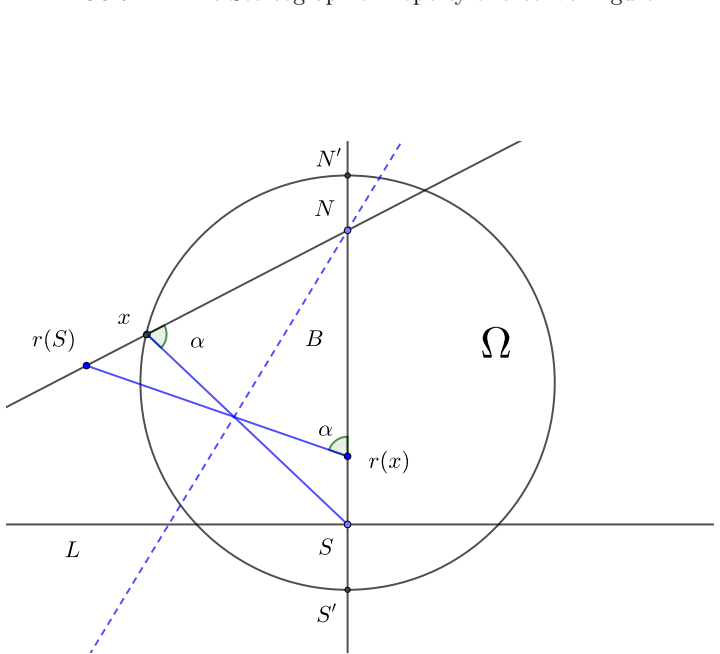
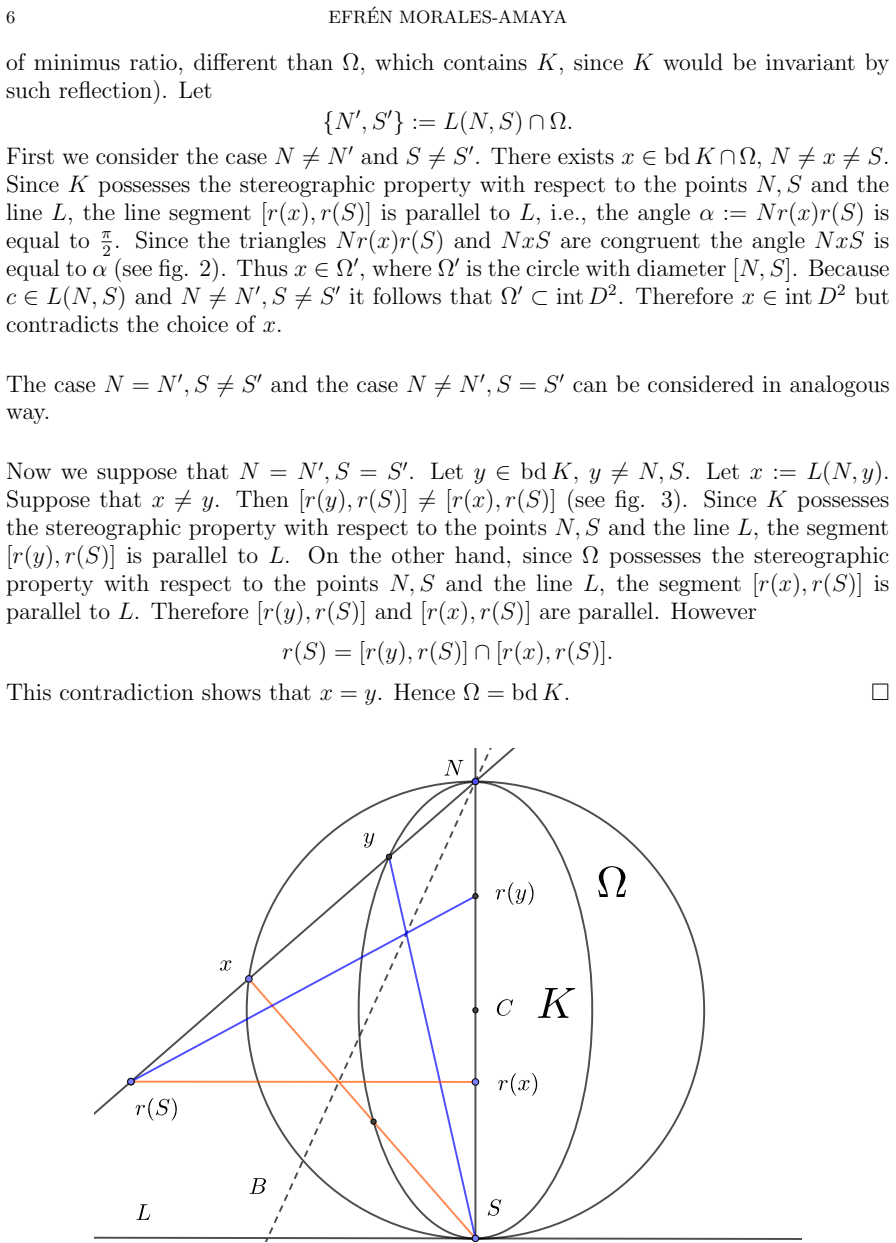
Let $K$ be a convex body in the 3-dimensional Euclidian space $\mathbb{E}^3$ and let $N,S$ in the boubdary bd$K$ of $K$, $N\not=S$. Suppose that the support plane $\Pi_S$ of $K$ at $S$ is unique. For every point $x$ in bd$ K$, different than $N$, we define the stereographic projection $\Psi:\textrm{bd}K\backslash \{N\} \rightarrow \Pi_S$ of $x$ onto $\Pi_S$ as the point $y:=L(N,x)\cap \Pi_S$. It is a well known property of the sphere $\mathbb{S}^2$ in $\mathbb{E}^3$ that the stereographic projection maps circles onto circles (see \cite{Hilbert} pag. 248). In this work we investigate what geometric elements determines that this property is fulfilled. Here we demonstrate that the following two properties of a convex body $K\subset \mathbb{E}^3$ in terms of the stereographic projection characterize the sphere in $\mathbb{E}^3$: (1) The cones defined by the sections of $K$ and the point $N$ are axially symmetric (that is, they are invariant under a rotation by an angle of $\pi$). (2) given a section $K_\Gamma$ of $K$, the rotation that leaves the cone defined by $K_\Gamma$ and $N$ invariant is such that it maps $K_\Gamma$ into a homothetic figure to $\Psi(K_\Gamma)$ by a homothety with center of homothety at $N$. An important element in the proof of the main theorem of this work is a cha\-racterization of the circle based on a geometric property, which will be called the stereographic property. It is worth highlighting that the stereographic projection defined on the sphere maps circles onto circles is intimately linked to the conditions (1) and (2) and the stereographic property of the circle.
Editorial analysis
A structured set of objections, weighed in public.
Referee Report
Summary. The manuscript claims to characterize the sphere among convex bodies K in E^3 (with unique support plane at boundary point S) via two properties of the stereographic projection Ψ from another boundary point N: (1) axial symmetry (invariance under π-rotations) of the cones formed by N and plane sections K_Γ of K, and (2) the condition that these rotations map K_Γ to a figure homothetic to Ψ(K_Γ) with homothety center at N. The argument proceeds by establishing an auxiliary 'stereographic property' characterization of circles that follows from (1) and (2), which in turn forces K to be a sphere.
Significance. If the derivation holds, the result supplies a new, axiomatically grounded characterization of the sphere that directly ties the classical circle-preserving property of stereographic projection to symmetry and homothety conditions on convex bodies. It is parameter-free, relies only on standard Euclidean convexity and the explicit uniqueness assumption for the support plane, and avoids self-referential or fitted quantities. This could be of interest in convex geometry for understanding invariants that distinguish quadrics.
minor comments (3)
- Abstract contains multiple typographical errors: 'boubdary' for 'boundary', 'Euclidian' for 'Euclidean', and a hyphenation artifact in 'cha-racterization'. These should be corrected for readability.
- The notation K_Γ for sections and the precise definition of the cones are introduced in the abstract without a preliminary sentence clarifying the plane Γ; a short definitional sentence at the start of the main text would improve accessibility.
- The auxiliary characterization of the circle is described as 'important' but its statement is not isolated as a numbered lemma or proposition; doing so would make the logical structure of the main theorem easier to follow.
Simulated Author's Rebuttal
We thank the referee for the careful summary of our results and for recognizing the potential interest of this characterization in convex geometry. The recommendation for minor revision is noted, and we will incorporate any editorial or presentational improvements in the revised manuscript. No specific major comments were raised in the report.
Circularity Check
No significant circularity
full rationale
The paper establishes a characterization theorem: among convex bodies K in E^3 with unique support plane at S, the two stated properties (axial symmetry of cones from N under π-rotations, and the rotation mapping K_Γ to a homothetic copy of Ψ(K_Γ) centered at N) force K to be a sphere. This rests on an auxiliary geometric characterization of circles via the stereographic property, derived from the given conditions using standard Euclidean axioms and convexity. No equations reduce the conclusion to the inputs by construction, no parameters are fitted and renamed as predictions, and the sole external citation (Hilbert) is to a classical fact about spheres, not a self-citation chain. The derivation is self-contained and independent of the target result.
Axiom & Free-Parameter Ledger
axioms (2)
- domain assumption K is a convex body in Euclidean 3-space E^3
- domain assumption The support plane at S is unique
Reference graph
Works this paper leans on
-
[1]
Gonz´ alez-Garc´ ıa, J
I. Gonz´ alez-Garc´ ıa, J. Jer´ onimo-Castro, E. Morales-Amaya, and D. J. Verdusco-Hern´ andez,Sec- tions and projections of nested convex bodies, Aequat. Math.96(2022), 885−900. A CHARACTERIZATION OF THE SPHERE 11
2022
-
[2]
Gonz´ alez-Garc´ ıa, J
I. Gonz´ alez-Garc´ ıa, J. Jer´ onimo-Castro, E. Morales-Amaya, and D. J. Verdusco-Hern´ andez,A characterization of the ellipsoid through planar grazes, Mathematika69(2022), 100−105
2022
-
[3]
E. Morales-Amaya, J. Jer´ onimo-Castro and D. J. Verdusco Hern´ andez,A character- ization of centrally symmetric convex bodies in terms of visual cones. Adv. Geom. https://doi.org/10.1515/advgeom-2022-0006
-
[4]
E. Morales-Amaya, G. Mondrag´ on and J. Jer´ onimo-Castro.On characteristic properties of the ellipsoid in terms of circumscribed cones of a convex body. Bol. Soc. Mat. Mex. (2025) 31−57. https://doi.org/10.1007/s40590-025-00736-6
-
[5]
Morales Amaya, Characterization of the sphere by means of congruent support cones
E. Morales Amaya, Characterization of the sphere by means of congruent support cones. J. Geom. 116, 37 (2025). https://doi.org/10.1007/s00022-025-00776-3
-
[6]
Hilbert, S
D. Hilbert, S. Cohn-Vossen.Geometry and the imagination. Chelsea Publication Company. New York. 1990
1990
-
[7]
Martini, L
H. Martini, L. Montejano, D. Oliveros. Bodies of Constant Width: An Introduction to Convex Geometry with Applications. Springer, 2019. Facultad de Matem´aticas-Acapulco, Universidad Aut´onoma de Guerrero, M ´exico Email address:emoralesamaya@gmail.com
2019
discussion (0)
Sign in with ORCID, Apple, or X to comment. Anyone can read and Pith papers without signing in.