Recognition: 2 theorem links
· Lean TheoremAccelerating 4D Hyperspectral Imaging through Physics-Informed Neural Representation and Adaptive Sampling
Pith reviewed 2026-05-10 18:41 UTC · model grok-4.3
The pith
A multilayer perceptron reconstructs full 4D spectra from just 1/32 of the usual measurements in 2DIR experiments.
A machine-rendered reading of the paper's core claim, the machinery that carries it, and where it could break.
Core claim
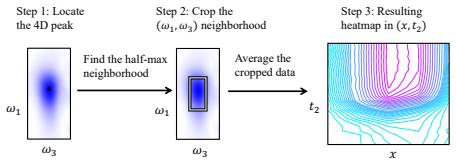
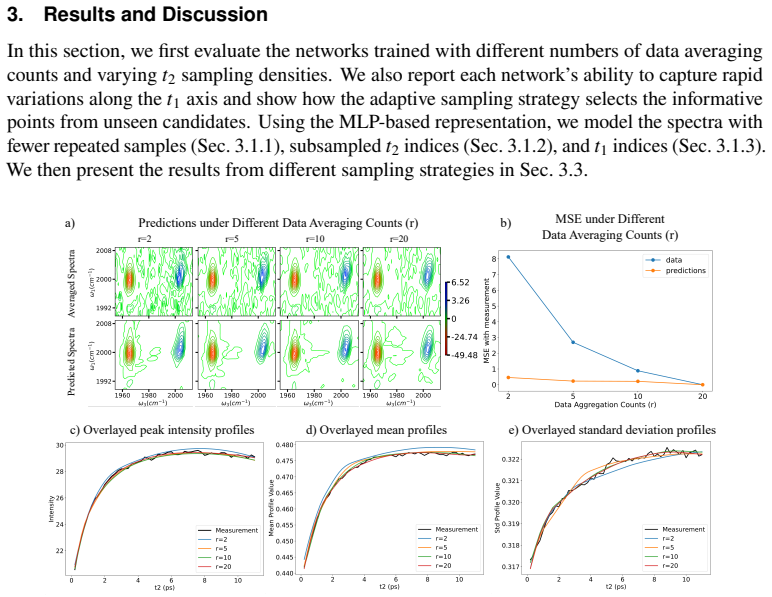
A physics-informed multilayer perceptron models the relationship between sub-sampled 4D coordinates and their spectral intensities, allowing dense 4D spectra to be recovered from limited observations. When combined with loss-aware adaptive sampling, the method achieves high-fidelity reconstruction of both oscillatory and non-oscillatory dynamics using only 1/32 of the full sampling budget, reducing experiment time by up to 32-fold in 2DIR hyperspectral measurements.
What carries the argument
Multilayer perceptron that takes 4D coordinates as input and outputs spectral intensity, trained on sparse experimental points and paired with iterative loss-aware adaptive sampling.
If this is right
- High-fidelity recovery of both oscillatory and non-oscillatory spectral dynamics from limited samples.
- Up to 32-fold reduction in total acquisition time for 4D hyperspectral imaging.
- A scalable approach that applies to any hypercube data collection task in multidimensional spectroscopy.
- Enables faster chemical imaging of transient biological and material systems.
Where Pith is reading between the lines
- The same coordinate-to-intensity model could be tested on other high-dimensional modalities where acquisition time is the main bottleneck, such as volumetric fluorescence imaging.
- Adding explicit physical constraints (for example, known dispersion relations) to the MLP input might permit even lower sampling fractions.
- Running the adaptive sampler in a closed loop with the instrument could allow experiments to stop early once a target fidelity is reached.
Load-bearing premise
The multilayer perceptron accurately represents the mapping from coordinates to intensities without introducing systematic bias or erasing important oscillatory features.
What would settle it
A side-by-side comparison on the same sample showing that the 1/32-sample reconstruction deviates significantly from the fully sampled reference in peak positions, amplitudes, or oscillatory behavior.
Figures





read the original abstract
High-dimensional hyperspectral imaging (HSI) enables the visualization of ultrafast molecular dynamics and complex, heterogeneous spectra. However, applying this capability to resolve spatially varying vibrational couplings in two-dimensional infrared (2DIR) spectroscopy, a type of coherent multidimensional spectroscopy (CMDS), necessitates prohibitively long data acquisition, driven by dense Nyquist sampling requirements and the need for extensive signal accumulation. To address this challenge, we introduce a physics-informed neural representation approach that efficiently reconstructs dense spatially-resolved 2DIR hyperspectral images from sparse experimental measurements. In particular, we used a multilayer perceptron (MLP) to model the relationship between the sub-sampled 4D coordinates and their corresponding spectral intensities, and recover densely sampled 4D spectra from limited observations. The reconstruction results demonstrate that our method, using a fraction of the samples, faithfully recovers both oscillatory and non-oscillatory spectral dynamics in experimental measurement. Moreover, we develop a loss-aware adaptive sampling method to progressively introduce potentially informative samples for iterative data collection while conducting experiments. Experimental results show that the proposed approach achieves high-fidelity spectral recovery using only $1/32$ of the sampling budget, as opposed to exhaustive sampling, effectively reducing total experiment time by up to 32-fold. This framework offers a scalable solution for accelerating any experiments with hypercube data, including multidimensional spectroscopy and hyperspectral imaging, paving the way for rapid chemical imaging of transient biological and material systems.
Editorial analysis
A structured set of objections, weighed in public.
Referee Report
Summary. The paper proposes a physics-informed neural representation using a multilayer perceptron (MLP) to model the mapping from sparsely sampled 4D coordinates (spatial, temporal, spectral) to spectral intensities in 2DIR hyperspectral imaging. Combined with a loss-aware adaptive sampling strategy for iterative data acquisition, the approach claims to reconstruct dense 4D spectra with high fidelity using only 1/32 of the full Nyquist sampling budget, yielding up to a 32-fold reduction in experimental acquisition time while preserving both oscillatory vibrational couplings and non-oscillatory dynamics.
Significance. If the reconstruction fidelity holds under rigorous validation, the method would offer a practical route to accelerate data collection in coherent multidimensional spectroscopy and other hypercube-based experiments, potentially enabling higher-throughput studies of transient molecular systems. The adaptive sampling component adds value by focusing acquisition on informative points, though its impact depends on the underlying representation quality.
major comments (2)
- [Abstract] Abstract: The central claim of 'high-fidelity spectral recovery' and 'faithfully recovers both oscillatory and non-oscillatory spectral dynamics' using 1/32 sampling is asserted without any quantitative metrics (RMSE, spectral correlation, error bars), baseline comparisons (e.g., to bilinear interpolation, compressed sensing, or standard NN reconstruction), or validation details on experimental 2DIR data; this absence directly limits assessment of the 32-fold speedup assertion.
- [Methods (neural representation)] MLP architecture description: The model is presented as a standard multilayer perceptron mapping 4D coordinates to intensities with no reference to positional encodings, Fourier feature mappings, or periodic activations. Given the well-known spectral bias of MLPs toward low-frequency components, this omission creates a concrete risk that high-frequency oscillatory features in vibrational 2DIR spectra will be attenuated or distorted, which is load-bearing for the fidelity claim.
minor comments (1)
- [Abstract] The abstract and introduction would benefit from a brief statement of the precise loss function used for the MLP and how the adaptive sampler selects points (e.g., uncertainty or gradient-based criteria).
Simulated Author's Rebuttal
We thank the referee for the constructive and detailed feedback on our manuscript. We address each major comment point by point below, indicating the revisions made to strengthen the presentation of our results.
read point-by-point responses
-
Referee: [Abstract] Abstract: The central claim of 'high-fidelity spectral recovery' and 'faithfully recovers both oscillatory and non-oscillatory spectral dynamics' using 1/32 sampling is asserted without any quantitative metrics (RMSE, spectral correlation, error bars), baseline comparisons (e.g., to bilinear interpolation, compressed sensing, or standard NN reconstruction), or validation details on experimental 2DIR data; this absence directly limits assessment of the 32-fold speedup assertion.
Authors: We agree that the abstract would benefit from explicit quantitative support for the central claims. In the revised version, we have updated the abstract to include specific metrics (RMSE and spectral correlation coefficients with error bars) drawn from the experimental 2DIR reconstructions reported in the Results section. We have also added a concise reference to baseline comparisons against bilinear interpolation (with full details and additional comparisons to standard NN reconstruction provided in Section 4 and the supplementary material). These changes directly address the assessment of the 32-fold speedup while preserving the abstract's brevity. revision: yes
-
Referee: [Methods (neural representation)] MLP architecture description: The model is presented as a standard multilayer perceptron mapping 4D coordinates to intensities with no reference to positional encodings, Fourier feature mappings, or periodic activations. Given the well-known spectral bias of MLPs toward low-frequency components, this omission creates a concrete risk that high-frequency oscillatory features in vibrational 2DIR spectra will be attenuated or distorted, which is load-bearing for the fidelity claim.
Authors: We acknowledge the referee's valid concern about MLP spectral bias. Our physics-informed formulation incorporates a loss term that enforces consistency with the known structure of 2DIR spectra (including both oscillatory couplings and non-oscillatory dynamics), which empirically enables recovery of high-frequency features as demonstrated by the preserved vibrational cross-peaks in the experimental results. To strengthen the manuscript, we have added a dedicated paragraph in the Methods section discussing the spectral bias issue, the role of the physics-informed loss in mitigating it for this domain, and an ablation analysis confirming that high-frequency oscillatory content is retained at the reported sampling density. While we did not employ explicit Fourier feature mappings in the current implementation, the added discussion clarifies why the chosen architecture suffices for the fidelity achieved. revision: partial
Circularity Check
No significant circularity in neural representation or adaptive sampling
full rationale
The paper trains an MLP directly on measured sub-sampled 4D experimental data to reconstruct the dense hyperspectral volume and uses model loss to guide adaptive sampling of new measurements. This is a standard data-driven interpolation procedure with no self-definitional reduction, no fitted parameter renamed as an independent prediction, and no load-bearing self-citation chain or imported uniqueness theorem. The central claim rests on empirical fidelity to held-out experimental measurements rather than any algebraic identity or ansatz smuggled through prior work by the same authors.
Axiom & Free-Parameter Ledger
Lean theorems connected to this paper
-
IndisputableMonolith/Cost/FunctionalEquation.leanwashburn_uniqueness_aczel unclear?
unclearRelation between the paper passage and the cited Recognition theorem.
we used a multilayer perceptron (MLP) to model the relationship between the sub-sampled 4D coordinates and their corresponding spectral intensities... four hidden layers, each comprising 64 neurons with Rectified Linear Unit (ReLU) activations... LMSE,slow ... Lmoment ... Lmono ... Lsmooth
What do these tags mean?
- matches
- The paper's claim is directly supported by a theorem in the formal canon.
- supports
- The theorem supports part of the paper's argument, but the paper may add assumptions or extra steps.
- extends
- The paper goes beyond the formal theorem; the theorem is a base layer rather than the whole result.
- uses
- The paper appears to rely on the theorem as machinery.
- contradicts
- The paper's claim conflicts with a theorem or certificate in the canon.
- unclear
- Pith found a possible connection, but the passage is too broad, indirect, or ambiguous to say the theorem truly supports the claim.
Reference graph
Works this paper leans on
-
[1]
Imaging spectrometry for earth remote sensing,
A. F. Goetz, G. Vane, J. E. Solomon, and B. N. Rock, “Imaging spectrometry for earth remote sensing,” Science228, 1147–1153 (1985)
1985
-
[2]
Hyperspectral imaging: techniques for spectral detection and classification,
C.-I. Chang, “Hyperspectral imaging: techniques for spectral detection and classification,” Kluwer Acad. Publ. (2003)
2003
-
[3]
Hyperspectral 2d ir imaging: Principles and applications to biological and materials systems,
M. T. Zanni, “Hyperspectral 2d ir imaging: Principles and applications to biological and materials systems,” in2020 45th International Conference on Infrared, Millimeter, and Terahertz Waves (IRMMW-THz),(IEEE, 2020), pp. 1–2
2020
-
[4]
Emerging trends in chemical applications of lasers,
American Chemical Society, “Emerging trends in chemical applications of lasers,” (ACS Publications,2021)
2021
-
[5]
Ultrafast 2d ir microscopy,
C. R. Baiz, D. Schach, and A. Tokmakoff, “Ultrafast 2d ir microscopy,” Opt. Express22, 18724–18735 (2014)
2014
-
[6]
Spatially resolved two-dimensional infrared spectroscopy via wide-field microscopy,
J. S. Ostrander, A. L. Serrano, A. Ghosh, and M. T. Zanni, “Spatially resolved two-dimensional infrared spectroscopy via wide-field microscopy,” ACS Photonics3, 1315–1323 (2016)
2016
-
[7]
Review of snapshot spectral imaging technologies,
N. Hagen and M. W. Kudenov, “Review of snapshot spectral imaging technologies,” Opt. Eng.52, 090901–090901 (2013)
2013
-
[8]
Single-shotcompressivespectralimagingwithadual-disperserarchitecture,
M.E.Gehm,R.John,D.J.Brady,et al.,“Single-shotcompressivespectralimagingwithadual-disperserarchitecture,” Opt. express15, 14013–14027 (2007)
2007
-
[9]
Compact implementation of fourier transform two-dimensional ir spectroscopy without phase ambiguity,
J. Helbing and P. Hamm, “Compact implementation of fourier transform two-dimensional ir spectroscopy without phase ambiguity,” J. Opt. Soc. Am. B28, 171–178 (2010)
2010
-
[10]
Accelerating two-dimensional infrared spectroscopy while preserving lineshapes using giraf,
I. Bhattacharya, J. J. Humston, C. M. Cheatum, and M. Jacob, “Accelerating two-dimensional infrared spectroscopy while preserving lineshapes using giraf,” Opt. letters42, 4573–4576 (2017)
2017
-
[11]
Compressedsensingformultidimensionalspectroscopyexperiments,
J.N.Sanders,S.K.Saikin,S.Mostame,et al.,“Compressedsensingformultidimensionalspectroscopyexperiments,” The journal physical chemistry letters3, 2697–2702 (2012)
2012
-
[12]
Accelerated 2d-ir using compressed sensing,
J. A. Dunbar, D. G. Osborne, J. M. Anna, and K. J. Kubarych, “Accelerated 2d-ir using compressed sensing,” The J. Phys. Chem. Lett.4, 2489–2492 (2013)
2013
-
[13]
Compressively sampled two-dimensional infrared spectroscopy that preserves line shape information,
J. J. Humston, I. Bhattacharya, M. Jacob, and C. M. Cheatum, “Compressively sampled two-dimensional infrared spectroscopy that preserves line shape information,” The J. Phys. Chem. A121, 3088–3093 (2017)
2017
-
[14]
Cutting through the noise: Extracting dynamics from ultrafast spectra using dynamic mode decomposition,
C. Xu and C. R. Baiz, “Cutting through the noise: Extracting dynamics from ultrafast spectra using dynamic mode decomposition,” The J. Phys. Chem. A127, 9853–9862 (2023)
2023
-
[15]
Generative adversarial neural networks for denoising coherent multidimensional spectra,
Z. A. Al-Mualem and C. R. Baiz, “Generative adversarial neural networks for denoising coherent multidimensional spectra,” The J. Phys. Chem. A126, 3816–3825 (2022)
2022
-
[16]
Learning implicit fields for generative shape modeling,
Z. Chen and H. Zhang, “Learning implicit fields for generative shape modeling,” inProceedings of the IEEE/CVF conference on computer vision and pattern recognition,(2019), pp. 5939–5948
2019
-
[17]
Deepsdf: Learning continuous signed distance functions for shape representation,
J. J. Park, P. Florence, J. Straub,et al., “Deepsdf: Learning continuous signed distance functions for shape representation,” inProceedings of the IEEE/CVF conference on computer vision and pattern recognition,(2019), pp. 165–174
2019
-
[18]
Physics-informed neural networks: A deep learning framework for solving forward and inverse problems involving nonlinear partial differential equations,
M. Raissi, P. Perdikaris, and G. E. Karniadakis, “Physics-informed neural networks: A deep learning framework for solving forward and inverse problems involving nonlinear partial differential equations,” J. Comput. physics378, 686–707 (2019)
2019
-
[19]
Z. Hao, S. Liu, Y. Zhang,et al., “Physics-informed machine learning: A survey on problems, methods and applications,” arXiv preprint arXiv:2211.08064 (2022)
-
[20]
A differentiable wave optics model for end-to-end computational imaging system optimization,
C.-J. Ho, Y. Belhe, S. Rotenberg,et al., “A differentiable wave optics model for end-to-end computational imaging system optimization,” inProceedings of the IEEE/CVF International Conference on Computer Vision,(2025), pp. 28042–28051
2025
-
[21]
Acorn: Adaptive coordinate networks for neural representation,
J. N. Martel, D. B. Lindell, C. Z. Lin,et al., “Acorn: Adaptive coordinate networks for neural representation,” ACM Trans. Graph. (SIGGRAPH) (2021)
2021
-
[22]
Structure of the amide i band of peptides measured by femtosecond nonlinear-infrared spectroscopy,
P. Hamm, M. Lim, and R. M. Hochstrasser, “Structure of the amide i band of peptides measured by femtosecond nonlinear-infrared spectroscopy,” The J. Phys. Chem. B102, 6123–6138 (1998)
1998
-
[23]
Principles of nonlinear optical spectroscopy,
S. Mukamel, “Principles of nonlinear optical spectroscopy,” ( Oxf. Univ. Press. (1995)
1995
-
[24]
Enabling multiple intercavity polariton coherences by adding quantum confinement to cavity molecular polaritons,
Z. Yang, H. H. Bhakta, and W. Xiong, “Enabling multiple intercavity polariton coherences by adding quantum confinement to cavity molecular polaritons,” Proc. National Acad. Sci.120, e2206062120 (2023)
2023
-
[25]
Ultrafast coherence delocalization in real space simulated by polaritons
Xiang, B., Yang, Z., You, Y. & Xiong, W. “Ultrafast coherence delocalization in real space simulated by polaritons.” Advanced Optical Materials.10, 2102237 (2022)
2022
-
[26]
Two-dimensional infrared spectroscopy of vibrational polaritons
Xiang, B., Ribeiro, R., Dunkelberger, A., Wang, J., Li, Y., Simpkins, B., Owrutsky, J., Yuen-Zhou, J. & Xiong, W. “Two-dimensional infrared spectroscopy of vibrational polaritons.”Proceedings Of The National Academy Of Sciences.115, 4845-4850 (2018)
2018
-
[27]
Manipulating optical nonlinearities of molecular polaritons by delocalization
Xiang, B., Ribeiro, R., Li, Y., Dunkelberger, A., Simpkins, B., Yuen-Zhou, J. & Xiong, W. “Manipulating optical nonlinearities of molecular polaritons by delocalization.”Science Advances.5, eaax5196 (2019)
2019
-
[28]
Application of 2d ir bioimaging: Hyperspectral images of formalin-fixedpancreatictissuesandobservationofslowproteindegradation,
S. S. Dicke, A. M. Alperstein, K. L. Schueler,et al., “Application of 2d ir bioimaging: Hyperspectral images of formalin-fixedpancreatictissuesandobservationofslowproteindegradation,”TheJ.Phys.Chem.B125,9517–9525 (2021)
2021
-
[29]
Spatially-resolved fluorescence-detected two-dimensional electronic spectroscopy probes varying excitonic structure in photosynthetic bacteria,
V. Tiwari, Y. A. Matutes, A. T. Gardiner,et al., “Spatially-resolved fluorescence-detected two-dimensional electronic spectroscopy probes varying excitonic structure in photosynthetic bacteria,” Nat. Commun.9, 4219 (2018)
2018
-
[30]
Transient absorption microscopy: Technological innovations and applications in materials science and life science,
Y. Zhu and J.-X. Cheng, “Transient absorption microscopy: Technological innovations and applications in materials science and life science,” The J. Chem. Phys.152(2020)
2020
-
[31]
Progress and prospects in optical ultrafast microscopy in the visible spectral region: Transient absorption and two-dimensional microscopy,
N. Gross, C. T. Kuhs, B. Ostovar,et al., “Progress and prospects in optical ultrafast microscopy in the visible spectral region: Transient absorption and two-dimensional microscopy,” The J. Phys. Chem. C127, 14557–14586 (2023)
2023
-
[32]
& Sun, J
He, K., Zhang, X., Ren, S. & Sun, J. Deep residual learning for image recognition.Proceedings Of The IEEE Conference On Computer Vision And Pattern Recognition. pp. 770-778 (2016)
2016
-
[33]
Deep Learning using Rectified Linear Units (ReLU)
A. F. Agarap, “Deep learning using rectified linear units (relu),” arXiv preprint arXiv:1803.08375 (2018)
work page internal anchor Pith review Pith/arXiv arXiv 2018
-
[34]
On the spectral bias of neural networks,
N. Rahaman, A. Baratin, D. Arpit,et al., “On the spectral bias of neural networks,” inInternational conference on machine learning,(PMLR, 2019), pp. 5301–5310
2019
-
[35]
Subdiffusive exciton transport in quantum dot solids
Akselrod, G., Prins, F., Poulikakos, L., Lee, E., Weidman, M., Mork, A., Willard, A., Bulovic, V. & Tisdale, W. “Subdiffusive exciton transport in quantum dot solids.”Nano Letters.14, 3556-3562 (2014)
2014
-
[36]
Resolving ultrafast exciton migration in organic solids at the nanoscale
Penwell, S., Ginsberg, L., Noriega, R. & Ginsberg, N. “Resolving ultrafast exciton migration in organic solids at the nanoscale.”Nature Materials.16, 1136-1141 (2017)
2017
-
[37]
Tuning the coherent propagation of organic exciton-polaritons through dark state delocalization
Pandya, R., Ashoka, A., Georgiou, K., Sung, J., Jayaprakash, R., Renken, S., Gai, L., Shen, Z., Rao, A. & Musser, A. “Tuning the coherent propagation of organic exciton-polaritons through dark state delocalization.”Advanced Science. 9, 2105569 (2022)
2022
-
[38]
From enhanced diffusion to ultrafast ballistic motion of hybrid light–matter excitations
Balasubrahmaniyam, M., Simkhovich, A., Golombek, A., Sandik, G., Ankonina, G. & Schwartz, T. “From enhanced diffusion to ultrafast ballistic motion of hybrid light–matter excitations.”Nature Materials.22, 338-344 (2023)
2023
-
[39]
Cavity-enhanced energy transport in molecular systems
Sandik, G., Feist, J., García-Vidal, F. & Schwartz, T. “Cavity-enhanced energy transport in molecular systems. ” Nature Materials.24, 344-355 (2025)
2025
-
[40]
Ultrafast imaging of polariton propagation and interactions
Xu, D., Mandal, A., Baxter, J., Cheng, S., Lee, I., Su, H., Liu, S., Reichman, D. & Delor, M. “Ultrafast imaging of polariton propagation and interactions.”Nature Communications.14, 3881 (2023)
2023
-
[41]
Solutions of ill-posed problems,
R. A. Willoughby, “Solutions of ill-posed problems,” Siam Rev.21, 266 (1979)
1979
-
[42]
R. C. Aster, B. Borchers, and C. H. Thurber,Parameter estimation and inverse problems(Elsevier, 2018)
2018
-
[43]
Pytorch: An imperative style, high-performance deep learning library
Paszke, A., Gross, S., Massa, F., Lerer, A., Bradbury, J., Chanan, G., Killeen, T., Lin, Z., Gimelshein, N., Antiga, L. & Others “Pytorch: An imperative style, high-performance deep learning library.”Advances In Neural Information Processing Systems.32(2019)
2019
-
[44]
Adam: A Method for Stochastic Optimization
D. P. Kingma and J. Ba, “Adam: A method for stochastic optimization,” arXiv preprint arXiv:1412.6980 (2014)
work page internal anchor Pith review Pith/arXiv arXiv 2014
-
[45]
Fourier features let networks learn high frequency functions in low dimensional domains,
M. Tancik, P. Srinivasan, B. Mildenhall,et al., “Fourier features let networks learn high frequency functions in low dimensional domains,” Adv. neural information processing systems33, 7537–7547 (2020)
2020
-
[46]
Phase distortion-free paramagnetic nmr spectra,
E. Ravera, “Phase distortion-free paramagnetic nmr spectra,” J. Magn. Reson. Open8, 100022 (2021)
2021
-
[47]
A structured dictionary perspective on implicit neural representations,
G. Yüce, G. Ortiz-Jiménez, B. Besbinar, and P. Frossard, “A structured dictionary perspective on implicit neural representations,” inProceedings of the IEEE/CVF Conference on Computer Vision and Pattern Recognition,(2022), pp. 19228–19238
2022
-
[48]
Understanding and mitigating extrapolation failures in physics-informed neural networks,
L. Fesser, L. D’Amico-Wong, and R. Qiu, “Understanding and mitigating extrapolation failures in physics-informed neural networks,” arXiv preprint arXiv:2306.09478 (2023)
-
[49]
On the gibbs phenomenon and its resolution,
D. Gottlieb and C.-W. Shu, “On the gibbs phenomenon and its resolution,” SIAM review39, 644–668 (1997)
1997
-
[50]
Optimized reconstructions of compressively sampled two-dimensional infrared spectra,
J. J. Humston, I. Bhattacharya, M. Jacob, and C. M. Cheatum, “Optimized reconstructions of compressively sampled two-dimensional infrared spectra,” The J. chemical physics150(2019)
2019
-
[51]
Plenoctrees for real-time rendering of neural radiance fields,
A. Yu, R. Li, M. Tancik,et al., “Plenoctrees for real-time rendering of neural radiance fields,” inProceedings of the IEEE/CVF international conference on computer vision,(2021), pp. 5752–5761
2021
-
[52]
Learning continuous image representation with local implicit image function,
Y. Chen, S. Liu, and X. Wang, “Learning continuous image representation with local implicit image function,” in Proceedings of the IEEE/CVF conference on computer vision and pattern recognition,(2021), pp. 8628–8638
2021
-
[53]
Nermo: Learningimplicitneuralrepresentationsfor3dhumanmotionprediction,
D.Wei,H.Sun,X.Sun,andS.Hu,“Nermo: Learningimplicitneuralrepresentationsfor3dhumanmotionprediction,” inEuropean Conference on Computer Vision,(Springer, 2024), pp. 409–427
2024
discussion (0)
Sign in with ORCID, Apple, or X to comment. Anyone can read and Pith papers without signing in.