Recognition: unknown
Single Scattering Properties for an Ensemble of Randomly Oriented Convex Polyhedra in Geometrical Optics Regime
Pith reviewed 2026-05-10 17:35 UTC · model grok-4.3
The pith
Ensembles of irregular convex polyhedra produce smooth, featureless scattering matrices while regular hexagonal prisms retain geometric signatures.
A machine-rendered reading of the paper's core claim, the machinery that carries it, and where it could break.
Core claim
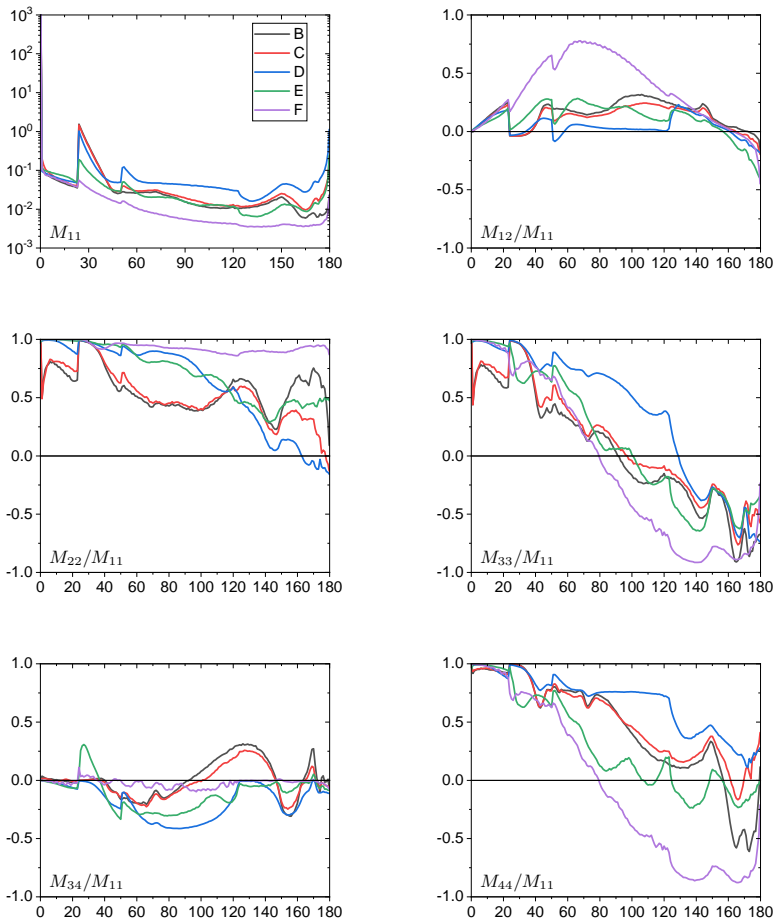
Statistical numerical simulations using a unified framework for convex polyhedra scattering matrices show that ensembles of randomly oriented irregular particles yield smooth and featureless non-zero matrix elements, while ensembles of regular hexagonal particles with varying aspect ratios retain common geometric scattering features.
What carries the argument
A unified computational framework for scattering matrices of convex polyhedra that allows statistical averaging over random orientations and controlled shape variations.
If this is right
- Irregular particle ensembles lose distinctive polarization and angular scattering signatures through orientation averaging.
- Regular hexagonal prisms preserve identifiable geometric features in their ensemble-averaged matrices regardless of modest aspect-ratio changes.
- Shape regularity versus irregularity produces qualitatively different matrix behaviors under identical random-orientation conditions.
- The results enable shape-based discrimination between particle types using measured scattering matrices without resolving individual particles.
Where Pith is reading between the lines
- The contrast in matrix smoothness could support remote-sensing methods that infer average particle irregularity from polarization data in atmospheric or aerosol contexts.
- Because the framework handles arbitrary convex shapes, it could test whether other regular polyhedra families also retain features or whether irregularity is the dominant smoothing factor.
Load-bearing premise
The geometrical optics approximation applies and diffraction plus absorption effects can be neglected at the single fixed wavelength used.
What would settle it
Direct measurement of scattering matrix elements from a laboratory ensemble of known irregular convex polyhedra at the same wavelength, showing retained non-smooth features comparable to regular prisms, would contradict the reported smoothness.
Figures




read the original abstract
To study how geometrical shape affect the light scattering properties for an ensemble of randomly orientated particles, the single scattering matrices including complete polarization information are calculated statistically for a group of crystals with random geometrical shape and a group of hexagonal prisms with various aspect ratios in geometrical optics approximation method. To compare, the single scattering matrices for individual random irregular crystal and individual hexagonal prism are also presented. It should be noted that all statistical simulation experiments in this study are restricted to the following conditions: diffraction and absorption effects are neglected, calculations are performed at a single fixed wavelength, particles are assumed to be randomly oriented, and the simulations are limited to the regime where the geometric optics approximation is applicable. Using a unified computational framework for scattering matrices of convex polyhedra, we carried out a series of statistical numerical simulations. The flexibility of this framework in modifying particle geometry enables a systematic investigation of shape-dependent scattering characteristics. The results demonstrate that regular and irregular particles exhibit noticeably different scattering matrix signatures, and ensembles of irregular particles yield smooth and featureless non-zero matrix elements. In contrast, ensembles of regular hexagonal particles with varying aspect ratios retain common geometric scattering features.
Editorial analysis
A structured set of objections, weighed in public.
Referee Report
Summary. The manuscript computes single scattering matrices (including polarization) for ensembles of randomly oriented convex polyhedra using a unified geometrical-optics ray-tracing framework. It contrasts statistical results for irregular random crystals against those for regular hexagonal prisms of varying aspect ratios, reporting that irregular ensembles produce smooth, featureless non-zero matrix elements while hexagonal ensembles retain common geometric features. Individual-particle matrices are shown for comparison. All calculations are performed under explicitly stated restrictions: geometrical-optics regime only, diffraction and absorption neglected, fixed wavelength, random orientations.
Significance. If the numerical results are reproducible and the implementation is accurate, the work supplies a clear, systematic demonstration that shape irregularity smooths scattering-matrix signatures under ensemble averaging. The unified convex-polyhedron framework is a methodological asset that permits controlled variation of geometry and could support future studies in atmospheric optics or remote sensing. The contrast between the two ensembles is the central, falsifiable claim.
major comments (2)
- [Results] Results section (and associated figures): the claims that irregular ensembles yield 'smooth and featureless' elements while hexagonal ensembles 'retain common geometric scattering features' are presented qualitatively. No quantitative metrics (e.g., RMS deviation across realizations, standard error on matrix elements, or a statistical test for feature retention) are supplied, making it impossible to judge the robustness or magnitude of the reported contrast. This directly affects the strength of the main conclusion.
- [Methods] Methods section: although the geometrical-optics framework is described as unified and flexible, no implementation details are given for ray-polyhedron intersection, polarization tracking, or the numerical construction of the 4x4 scattering matrix from individual rays. Without these or a validation against a known analytic case (e.g., a sphere or cube in the GO limit), the accuracy of the reported matrices cannot be assessed.
minor comments (2)
- [Abstract] Abstract, first sentence: 'how geometrical shape affect' should read 'how geometrical shape affects'.
- [Abstract and Introduction] The repeated statement of the four simulation restrictions (no diffraction/absorption, fixed wavelength, random orientation, GO regime) could be consolidated into a single, clearly labeled paragraph or table rather than appearing in both abstract and main text.
Simulated Author's Rebuttal
We thank the referee for the constructive comments, which help clarify the presentation of our results and strengthen the methodological description. We address each major comment below and indicate the planned revisions.
read point-by-point responses
-
Referee: [Results] Results section (and associated figures): the claims that irregular ensembles yield 'smooth and featureless' elements while hexagonal ensembles 'retain common geometric scattering features' are presented qualitatively. No quantitative metrics (e.g., RMS deviation across realizations, standard error on matrix elements, or a statistical test for feature retention) are supplied, making it impossible to judge the robustness or magnitude of the reported contrast. This directly affects the strength of the main conclusion.
Authors: We agree that the contrast between the ensembles is presented qualitatively in the current manuscript. To address this, we will add quantitative metrics in the revised Results section and figures, including RMS deviations of the scattering matrix elements across multiple independent realizations of the irregular polyhedra, standard errors on the ensemble-averaged elements, and a simple variance-based measure of feature retention in angular regions for the hexagonal prisms. These additions will allow a more rigorous assessment of the smoothness and the persistence of geometric features. revision: yes
-
Referee: [Methods] Methods section: although the geometrical-optics framework is described as unified and flexible, no implementation details are given for ray-polyhedron intersection, polarization tracking, or the numerical construction of the 4x4 scattering matrix from individual rays. Without these or a validation against a known analytic case (e.g., a sphere or cube in the GO limit), the accuracy of the reported matrices cannot be assessed.
Authors: We acknowledge that the manuscript provides only a high-level overview of the unified convex-polyhedron framework. In the revision we will expand the Methods section with explicit details on the ray-polyhedron intersection routine, the tracking of polarization state along each ray, and the accumulation procedure used to assemble the 4x4 scattering matrix from the ray ensemble. We will also include a validation subsection comparing our implementation against an analytic geometrical-optics result for a cube (or sphere where the limit applies) to demonstrate numerical accuracy and reproducibility. revision: yes
Circularity Check
No significant circularity; forward simulations only
full rationale
The paper reports statistical results from direct numerical ray-tracing simulations of scattering matrices under the geometrical optics approximation for convex polyhedra. No parameters are fitted to the output data, no predictions are generated from fitted inputs, and no load-bearing steps reduce to self-citations or self-definitions. The reported differences between regular hexagonal and irregular ensembles follow directly from ensemble averaging over the enumerated shape and orientation distributions within the explicitly restricted GO regime (no diffraction, fixed wavelength). The derivation chain is therefore self-contained forward computation with no reduction to its own inputs.
Axiom & Free-Parameter Ledger
axioms (3)
- domain assumption Geometrical optics approximation applies to the particles and conditions studied
- domain assumption Particles are randomly oriented
- domain assumption Diffraction and absorption effects can be neglected
Reference graph
Works this paper leans on
-
[1]
Cambridge University Press, 2016
Kuo-Nan Liou and Ping Yang.Light scattering by ice crystals: fundamentals and applications. Cambridge University Press, 2016
2016
-
[2]
Light scattering by nonspher- ical particles: theory, measurements, and applications.Measurement Science and Technology, 11(12):1827–1827, 2000
Michael I Mishchenko, Joop W Hovenier, and Larry D Travis. Light scattering by nonspher- ical particles: theory, measurements, and applications.Measurement Science and Technology, 11(12):1827–1827, 2000
2000
-
[3]
Hemmer, L
F. Hemmer, L. C.-Labonnote, F. Parol, G. Brogniez, B. Damiri, and T. Podvin. An algorithm to retrieve ice water content profiles in cirrus clouds from the synergy of ground-based lidar and thermal infrared radiometer measurements.Atmospheric Measurement Techniques, 12(3):1545– 1568, 2019
2019
-
[4]
Zhang, P
Z. Zhang, P. Yang, G. Kattawar, J. Riedi, L. C. Labonnote, B. A. Baum, S. Platnick, and H.-L. Huang. Influence of ice particle model on satellite ice cloud retrieval: lessons learned from MODIS and POLDER cloud product comparison.Atmospheric Chemistry and Physics, 9(18):7115–7129, 2009
2009
-
[5]
D. L. Mitchell, A. Garnier, and S. Woods. Advances in CALIPSO (IIR) cirrus cloud property retrievals – Part 1: Methods and testing.Atmospheric Chemistry and Physics, 25(20):14071– 14098, 2025
2025
-
[6]
A review of ice cloud optical property models for passive satellite remote sensing.Atmosphere, 9(12):499, 2018
Ping Yang, Souichiro Hioki, Masanori Saito, Chia-Pang Kuo, Bryan A Baum, and Kuo-Nan Liou. A review of ice cloud optical property models for passive satellite remote sensing.Atmosphere, 9(12):499, 2018
2018
-
[7]
In situ measurements of cirrus clouds on a global scale.Atmosphere, 12(1):41, 2020
Gary Lloyd, Martin Gallagher, Thomas Choularton, Martina Kr¨ amer, Petzold Andreas, and Darrel Baumgardner. In situ measurements of cirrus clouds on a global scale.Atmosphere, 12(1):41, 2020
2020
-
[8]
In situ observations of the microphysical properties of wave, cirrus, and anvil clouds
R Paul Lawson, Brad Baker, Bryan Pilson, and Qixu Mo. In situ observations of the microphysical properties of wave, cirrus, and anvil clouds. part ii: Cirrus clouds.Journal of the Atmospheric Sciences, 63(12):3186–3203, 2006
2006
-
[9]
Cloud chamber experiments on the origin of ice crystal complexity in cirrus clouds.Atmospheric Chem- istry and Physics, 16(8):5091–5110, 2016
Martin Schnaiter, Emma J¨ arvinen, Paul Vochezer, Ahmed Abdelmonem, Robert Wagner, Olivier Jourdan, Guillaume Mioche, Valery N Shcherbakov, Carl G Schmitt, Ugo Tricoli, et al. Cloud chamber experiments on the origin of ice crystal complexity in cirrus clouds.Atmospheric Chem- istry and Physics, 16(8):5091–5110, 2016
2016
-
[10]
Kara D Lamb, Jerry Y Harrington, Benjamin W Clouser, Elisabeth J Moyer, Laszlo Sarkozy, Volker Ebert, Ottmar M¨ ohler, and Harald Saathoff. Re-evaluating cloud chamber constraints on depositional ice growth in cirrus clouds–part 1: Model description and sensitivity tests.Atmo- spheric Chemistry and Physics, 23(11):6043–6064, 2023
2023
-
[11]
Mu˜ noz and J.W
O. Mu˜ noz and J.W. Hovenier. Laboratory measurements of single light scattering by ensembles of randomly oriented small irregular particles in air. a review.Journal of Quantitative Spec- troscopy and Radiative Transfer, 112(11):1646–1657, 2011. Electromagnetic and Light Scattering by Nonspherical Particles XII
2011
-
[12]
Discrete-dipole approximation for scattering calculations
Bruce T Draine and Piotr J Flatau. Discrete-dipole approximation for scattering calculations. Journal of the Optical Society of America A, 11(4):1491–1499, 1994. 11
1994
-
[13]
T-matrix computations of light scattering by nonspherical particles: A review.Journal of Quantitative Spectroscopy and Radiative Transfer, 55(5):535–575, 1996
Michael I Mishchenko, Larry D Travis, and Daniel W Mackowski. T-matrix computations of light scattering by nonspherical particles: A review.Journal of Quantitative Spectroscopy and Radiative Transfer, 55(5):535–575, 1996
1996
-
[14]
The discrete dipole approximation: an overview and recent developments.Journal of Quantitative Spectroscopy and Radiative Transfer, 106(1-3):558– 589, 2007
Maxim A Yurkin and Alfons G Hoekstra. The discrete dipole approximation: an overview and recent developments.Journal of Quantitative Spectroscopy and Radiative Transfer, 106(1-3):558– 589, 2007
2007
-
[15]
Borovoi, Alexey V
Anatoli G. Borovoi, Alexey V. Burnashov, and Ulrich.G. Oppel. Scattering matrices for hor- izontally oriented ice crystals.Journal of Quantitative Spectroscopy and Radiative Transfer, 109(15):2648–2655, 2008
2008
-
[16]
Dependence of ice crystal optical properties on particle aspect ra- tio.Journal of Quantitative Spectroscopy and Radiative Transfer, 110(14):1604–1614, 2009
Ping Yang and Qiang Fu. Dependence of ice crystal optical properties on particle aspect ra- tio.Journal of Quantitative Spectroscopy and Radiative Transfer, 110(14):1604–1614, 2009. XI Conference on Electromagnetic and Light Scattering by Non-Spherical Particles: 2008
2009
-
[17]
The effective equivalence of geometric irregular- ity and surface roughness in determining particle single-scattering properties.Optics express, 22(19):23620–23627, 2014
Chao Liu, R Lee Panetta, and Ping Yang. The effective equivalence of geometric irregular- ity and surface roughness in determining particle single-scattering properties.Optics express, 22(19):23620–23627, 2014
2014
-
[18]
Grynko and Yu
Ye. Grynko and Yu. Shkuratov. Scattering matrix calculated in geometric optics approximation for semitransparent particles faceted with various shapes.Journal of Quantitative Spectroscopy and Radiative Transfer, 78(3):319–340, 2003
2003
-
[19]
Anthony J. Baran. A review of the light scattering properties of cirrus.Journal of Quantitative Spectroscopy and Radiative Transfer, 110(14):1239–1260, 2009. XI Conference on Electromagnetic and Light Scattering by Non-Spherical Particles: 2008
2009
-
[20]
Min, J.W
M. Min, J.W. Hovenier, C. Dominik, A. de Koter, and M.A. Yurkin. Absorption and scattering properties of arbitrarily shaped particles in the rayleigh domain: A rapid computational method and a theoretical foundation for the statistical approach.Journal of Quantitative Spectroscopy and Radiative Transfer, 97(2):161–180, 2006
2006
-
[21]
Baum, Andrew J
Bryan A. Baum, Andrew J. Heymsfield, Ping Yang, and Sarah T. Bedka. Bulk scattering prop- erties for the remote sensing of ice clouds. Part I: Microphysical data and models.Journal of Applied Meteorology, 44(12):1885 – 1895, 2005
2005
-
[22]
Aircraft measurements of the solar and infrared radiative properties of cirrus and their dependence on ice crystal shape.Journal of Geophysical Research, 104:31685–31695, 12 1999
Pete Francis, John Foot, and Anthony Baran. Aircraft measurements of the solar and infrared radiative properties of cirrus and their dependence on ice crystal shape.Journal of Geophysical Research, 104:31685–31695, 12 1999
1999
-
[23]
Light scattering by a random convex polyhedron in the geometric optics approximation.Appl
Quan Mu and Ye Zhang. Light scattering by a random convex polyhedron in the geometric optics approximation.Appl. Opt., 65(8):2754–2762, Mar 2026
2026
-
[24]
Springer Science & Business Media, 2012
Franco P Preparata and Michael I Shamos.Computational geometry: an introduction. Springer Science & Business Media, 2012
2012
-
[25]
Springer, 2008
Mark De Berg, Otfried Cheong, Marc Van Kreveld, and Mark Overmars.Computational geometry: algorithms and applications. Springer, 2008
2008
-
[26]
Computer-aided construction of three-dimensional convex bodies of arbitrary shapes.Computational technologies, 27(2):54–61, 2022
Q Mu, BA Kargin, and EG Kablukova. Computer-aided construction of three-dimensional convex bodies of arbitrary shapes.Computational technologies, 27(2):54–61, 2022
2022
-
[27]
American Geophysical Union, 2006
Walter Tape and Jarmo Moilanen.Atmospheric Halos and the Search for Angle x. American Geophysical Union, 2006
2006
-
[28]
American Geophysical Union, 2013
Walter Tape.Atmospheric halos, volume 64. American Geophysical Union, 2013
2013
-
[29]
Numerical stochastic simulation of optical radiation scattering by ice crystals of irregular random shapes.Computational Technologies, 27(2):4–18, 2022
BA Kargin, EG Kablukova, and Q Mu. Numerical stochastic simulation of optical radiation scattering by ice crystals of irregular random shapes.Computational Technologies, 27(2):4–18, 2022. 12
2022
-
[30]
Ice crystal shapes in cirrus clouds derived from POLDER/ADEOS-1.Journal of Geophysical Research: Atmospheres, 106(D8):7955–7966, 2001
H´ el` ene Chepfer, Philippe Goloub, J´ erˆ ome Ri´ edi, JF De Haan, JW Hovenier, and PH Flamant. Ice crystal shapes in cirrus clouds derived from POLDER/ADEOS-1.Journal of Geophysical Research: Atmospheres, 106(D8):7955–7966, 2001. 13
2001
discussion (0)
Sign in with ORCID, Apple, or X to comment. Anyone can read and Pith papers without signing in.